
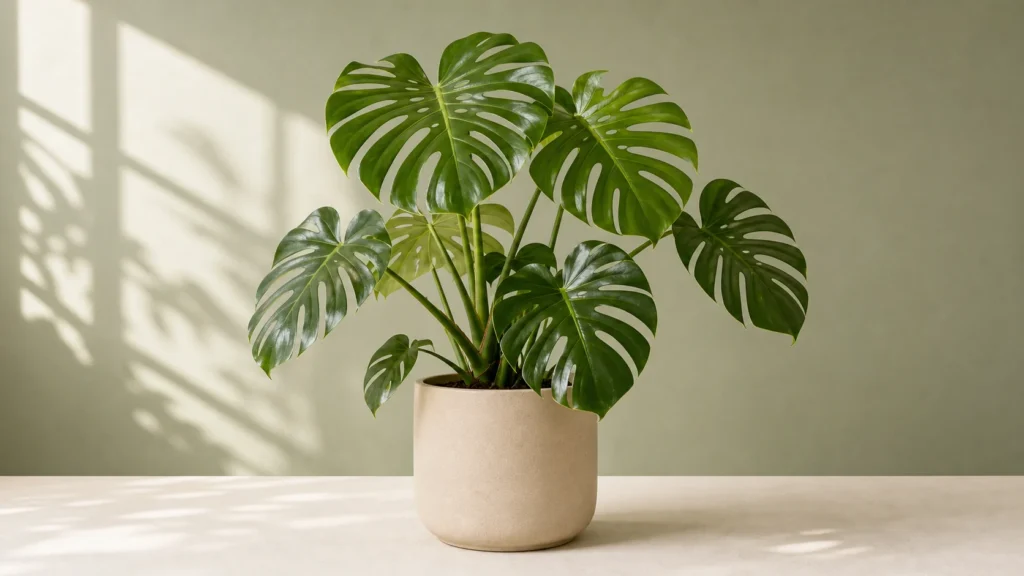
Monstera Deliciosa
Monstera deliciosa
A climbing tropical aroid whose large, naturally split leaves make it one of the most recognizable statement houseplants.
Watering frequency
Every 7-10 days
Ideal temperature
65-85°F / 18-29°C
Humidity
50-70%
Care difficulty
Medium
Air purifying
Yes
Growth rate
Fast
Plant size
4-8 ft / 1.2-2.4 m
Soil type
Chunky aroid mix
Fertilizer need
Monthly, spring-summer.
Care summary
- Light: Give bright indirect light with gentle acclimated sun.
- Water: Let the upper mix dry, then soak and drain thoroughly.
- Soil: Use an airy mix and a pot with open drainage.
- Support: Train the climbing stem on a sturdy pole or plank.
- Safety: Keep away from pets and children who may chew it.
Common problems
- Yellow leaves: Check wet soil, drainage, light, and root condition.
- Small unsplit leaves: Review maturity, light, support, and root health.
- Brown edges: Check drought, salts, heat, and damaged roots.
- Leaning growth: Add support and improve directional light.
- Pests: Inspect leaf undersides, petioles, and new growth.
Plant care guide
About Monstera Deliciosa
Monstera Deliciosa (Monstera deliciosa) is the large-leaved tropical climber commonly called Swiss Cheese Plant or Split-leaf Philodendron. The second nickname is misleading: it belongs to the arum family, Araceae, but it is not a philodendron. According to NC State Extension's species profile, its native range extends from Mexico into Central America, where it climbs through tropical forest using aerial roots.
The holes and deep splits in a mature leaf are called fenestrations. Young plants begin with smaller, heart-shaped, usually unbroken leaves. As a healthy plant ages and climbs in useful light, later leaves can become larger and more divided. This developmental change is one reason an established Monstera looks so different from a juvenile nursery pot.
The species can produce an edible fruit outdoors in suitable climates, which explains the name deliciosa. That fact should never be treated as permission to sample an indoor plant: immature fruit and the rest of the plant contain irritating calcium oxalate crystals, and indoor specimens rarely develop fully ripe fruit.
Why You'll Like It
Few houseplants create as much visual structure with one plant. A single mature leaf can fill an empty wall area, while the climbing habit lets you guide the plant vertically instead of allowing it to sprawl across a room. New growth also records the quality of recent care: stronger light, healthy roots, and effective support usually produce more substantial leaves.
Monstera is adaptable, but it is not small or maintenance-free. It suits an owner who can give it floor space, wipe broad leaves, rotate or train new growth, and eventually provide a sturdy support. For a smaller perforated climber, compare Swiss Cheese Vine. For simpler trailing growth, Golden Pothos or Heartleaf Philodendron may fit a shelf better.
What Kind of Plant Is It?
Monstera is a hemiepiphytic climbing aroid. In practical indoor terms, it has a main stem with nodes—the points where leaves, roots, and buds can emerge. Thick aerial roots seek moisture and support. They are normal organs, not pests or evidence that the plant is pot-bound.
Leaves attach by long petioles. These leaf stalks turn each blade toward light, but they are not the part that should be tied to a pole. Secure the main stem loosely and allow petioles to move. The plant has a front, where leaves tend to face, and a back, where aerial roots emerge. Positioning the back against a pole makes training tidier.
Multiple cuttings are often planted together for a fuller retail pot. Over time, that can create a dense, heavy specimen with several growth directions. You may keep the group, separate stems during a careful repot, or prune selected vines. None is automatically better; choose according to the space and silhouette you want.
Popular Monstera Varieties and Related Plants
Retail labels can blur species and cultivars, so identity matters before you pay a collector price.
- Monstera deliciosa: The standard green species and the most forgiving choice for strong growth.
- Monstera deliciosa 'Thai Constellation': A cultivated form with stable cream-speckled sectoring. Pale tissue has less chlorophyll, so it needs excellent light without scorching and often grows more slowly. The Thai Constellation Monstera has the full profile.
- Monstera deliciosa 'Albo Variegata': A trade label widely used for white-sector plants, often propagated from selected material. Each cutting can carry a different balance of green and white. The Albo Variegata Monstera explains the chimeral pattern behind the instability.
- Monstera deliciosa 'Aurea': A yellow-patterned cultivated form whose color becomes clearer as leaves harden.
- Monstera adansonii: A different species, commonly called Swiss Cheese Vine, with smaller leaves and enclosed holes rather than the same mature silhouette.
- Rhaphidophora tetrasperma: Often sold as Mini Monstera, but it belongs to a different genus. Its compact split leaves make it useful where true M. deliciosa is too large.
Patterned plants are not separate care systems, but their reduced green area makes weak light especially costly. Never assume a generic word such as “variegated” identifies a cultivar; preserve the verified cultivar or trade name.
Where It Works Best
Choose a bright room with several feet of vertical and lateral space. An east window, a bright north window, or a position set back from a strong south or west window often works. A sheer curtain can soften intense afternoon sun. The exact distance from glass depends on season, latitude, glazing, outdoor shade, and the plant's previous exposure.
Medium light can keep a Monstera alive, but growth may slow and new leaves may remain smaller. A dark corner is not made suitable by humidity or fertilizer. If stems stretch toward one window, move the plant gradually closer to better light or add a suitable grow light.
Keep foliage away from cold glass, exterior-door drafts, and heating vents. Because a mature pot becomes top-heavy, place it where people and pets will not repeatedly bump it. Protect floors from drainage water rather than letting the plant sit in a filled cachepot.
How to Care for Monstera Deliciosa
Light
Bright indirect light is the dependable target. Gentle morning sun can be useful after gradual acclimation. Abrupt exposure to intense midday or afternoon sun may bleach or scorch leaves, especially tender new growth. Rotate a free-standing plant a quarter turn periodically only if you want a more even canopy; a trained specimen may look best kept facing one direction.
Do not judge light by a room's general brightness to human eyes. Watch the plant: widening gaps between nodes, very small new leaves, and persistent leaning suggest inadequate light. A lack of splits by itself is not proof of a problem because age, genetics, support, and overall vigor also matter.
Water
Use the listed seven-to-ten-day frequency only as an inspection reminder. Push a finger or wooden skewer into the upper mix and water when roughly the top quarter to third has dried. Pot size, root density, temperature, light, soil texture, and season can change the interval substantially.
When watering, soak the entire root ball until water exits the drainage holes, then empty the saucer or outer pot. Small repeated sips can leave dry pockets and encourage shallow roots. Constant saturation removes oxygen from the root zone and creates conditions for decay.
If a badly dried mix repels water, soak slowly in several passes, then let it drain. Do not compensate for one drought by keeping the pot permanently wet afterward.
Soil and Container
Use a loose mix that holds some moisture while draining freely. A practical blend may combine quality potting mix or coco-based medium with coarse orchid bark and pumice or perlite. Ingredients matter less than the finished structure: water should spread through the pot, excess should escape, and the mix should not collapse into dense mud.
A drainage hole is essential. Choose a pot only modestly wider than the root mass. An oversized container holds a larger volume of wet mix around relatively few roots. Heavy ceramic can improve stability for a tall plant, provided you can still lift or safely water it.
Humidity and Temperature
Monstera adapts to ordinary household humidity but tends to grow more smoothly around 50–70 percent. Humidity cannot repair chronic overwatering, weak light, or cold stress. A humidifier is more effective than occasional misting, which changes humidity only briefly and can leave foliage wet.
Keep temperatures broadly between 65 and 85°F (18–29°C). Avoid sustained chill, sudden temperature swings, and direct HVAC airflow. Growth naturally slows during darker winter months even in a warm home.
Fertilizer
Feed a healthy, actively growing plant with a balanced houseplant fertilizer at a diluted label rate about monthly in spring and summer. Reduce or pause when growth slows. Water plain soil first if it is very dry, and occasionally flush the mix to limit soluble-salt buildup. Fertilizer will not replace adequate light or cure rotten roots.
Support, Pruning, and Cleaning
Install a pole, plank, or sturdy trellis early enough to avoid wrestling a heavy stem later. Place aerial roots toward the support and use soft, adjustable ties around the stem between nodes. Check ties as the stem thickens. A small decorative coir pole may not support a mature specimen; anchor the support deep in the pot or use a stable external system.
Prune a long stem just above a node on the mother plant. New growth may activate from a bud below the cut. Use clean blades and wear gloves because sap can irritate skin. Remove damaged leaves at their petiole base, but do not strip healthy leaves merely to expose the trunk.
Wipe dust from both leaf surfaces with a damp cloth while checking for pests. Avoid commercial leaf-shine products that leave residue. Dust removal improves appearance and makes mites, scale, or mealybugs easier to notice.
How to Propagate Monstera Deliciosa
A viable stem cutting must include at least one node. A leaf and petiole without stem tissue may remain green for a time but cannot form a complete new vine. An aerial root is helpful but not mandatory.
- Identify a healthy node and cut below it with a clean blade.
- Let excess sap stop, then place the node in water, damp sphagnum, perlite, or an airy propagation mix.
- Keep it warm in bright indirect light with the node moist but not stagnant.
- If using water, refresh it when cloudy and keep leaves above the surface.
- Pot the cutting when it has a developing root system with branching roots, not merely one fragile nub.
Water propagation is easy to observe; direct-to-mix propagation avoids a later change from water roots to potting mix. Large top cuttings can dehydrate because their leaves lose more moisture than undeveloped roots can replace. High humidity and a smaller leaf load can help, but sealed wet conditions invite rot.
When to Repot
Repot when roots densely circle the pot, water rushes through a badly compacted root ball, the plant dries unusually fast, or the support and pot no longer remain stable. Roots visible at a drainage hole alone are not an emergency. Spring or early active growth gives the plant the best chance to recover.
Move up one practical pot size, loosen only roots that can be freed without tearing the mass apart, and replace collapsed mix. Keep the stem at its former depth; burying petioles and excessive stem can encourage decay. After repotting, return the plant to stable light and avoid heavy fertilizer until growth resumes.
Toxicity and Pet Safety
Monstera is not pet-safe. ASPCA's Swiss Cheese Plant record lists it as toxic to cats and dogs because insoluble calcium oxalate crystals can cause intense oral irritation, drooling, vomiting, and difficulty swallowing.
Keep leaves, pruned pieces, and dangling aerial roots away from pets and children who chew plants. A high shelf is not a complete control once growth trails downward. If exposure occurs, contact a veterinarian, animal poison-control service, human poison-control service, or medical professional as appropriate. Breathing or swallowing difficulty requires urgent professional help.
Common Problems and Practical Fixes
Yellow leaves
One old lower leaf can age naturally. Multiple yellow leaves require investigation. Check moisture deep in the pot, drainage, root smell and firmness, recent cold, and light. If soil remains saturated for many days, stop calendar watering and inspect roots rather than adding fertilizer.
Brown or black patches
Crisp tan areas may follow drought, sun scorch, hot glass, or salt stress. Soft dark patches can accompany cold injury or root problems. The location and texture matter. Stabilize conditions and protect healthy new growth; damaged tissue will not turn green again.
Small leaves or no fenestrations
Improve useful light gradually, train the stem upward, and verify that roots are healthy. Do not cut young leaves in an attempt to create splits. Fenestrations are produced as the leaf develops and cannot be induced after it opens.
Drooping
Check soil before watering. Both a dry root ball and oxygen-starved roots can leave foliage limp. Newly unfurled leaves may also hang differently until their tissues harden. Diagnose the root zone instead of treating droop as an automatic request for water.
Pests
Spider mites create fine stippling and sometimes webbing; mealybugs gather as cottony clusters; scale appears as attached bumps; thrips can scar new leaves. Isolate the plant, confirm the pest, wash foliage where practical, and use a product labeled for that pest and indoor setting. Repeat according to the label because one treatment rarely reaches every life stage.
Frequently Asked Questions
Why is my Monstera growing sideways?
It is a climber searching for light and support. Position the back of the stem against a sturdy support, tie the stem rather than the petioles, and improve directional light.
Should aerial roots go into the soil?
They can be guided toward a pole or into the pot if convenient, but do not force brittle roots. Long awkward roots may be trimmed with a clean tool, although preserving them can help anchorage.
Can Monstera live in low light?
It may persist in medium-to-lower light, but darkness usually produces slower, weaker, smaller growth. Bright indirect light is a better long-term goal.
How often will it make a new leaf?
There is no reliable universal schedule. Season, light, root health, plant maturity, and recent stress all change the pace. Judge progress over several months rather than promising a monthly leaf count.
Does Monstera purify indoor air?
The database retains an air-purifying category, but a few pots should not be treated as room-scale air cleaners. Ventilation and purpose-built filtration are the meaningful controls; grow Monstera for its foliage and care experience.
Final Thought
Monstera Deliciosa rewards three habits: provide useful bright light, let an airy root zone partly dry before a thorough watering, and support the climbing stem. Give it enough space and inspect rather than react to single symptoms. With healthy roots and patient training, the juvenile heart-shaped plant can develop into the dramatic fenestrated specimen people recognize.