
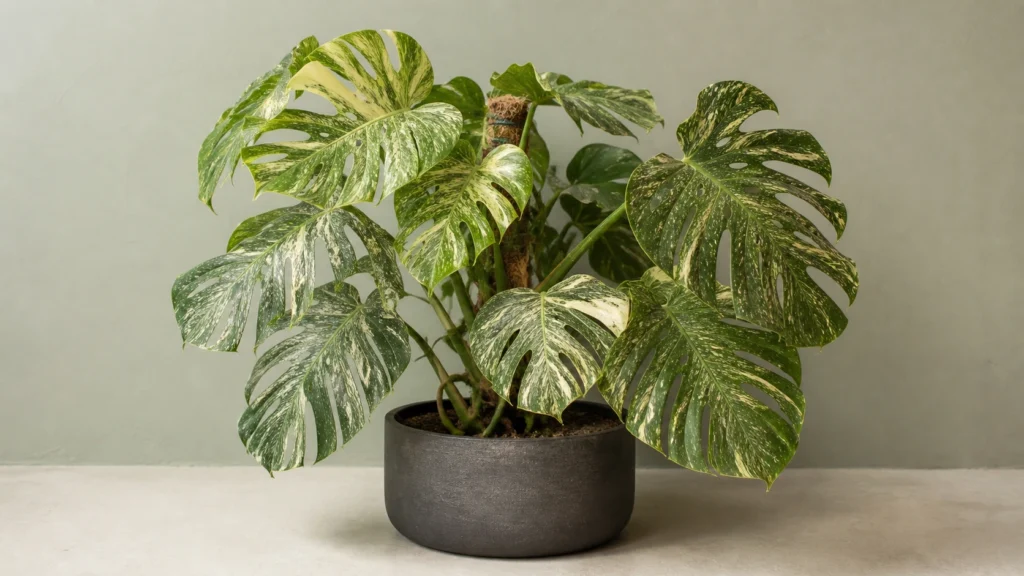
Monstera Thai Constellation
Monstera deliciosa 'Thai Constellation'
A cultivated Monstera deliciosa selection with cream and butter-colored speckles that is widely propagated through tissue culture and generally more stable than an albo.
Watering frequency
Every 7-10 days
Ideal temperature
65-80°F / 18-27°C
Humidity
60-80%
Care difficulty
Medium
Air purifying
No/Not Known
Growth rate
Moderate
Plant size
2-3 ft indoors / 0.6-0.9 m, larger with support
Soil type
Chunky, well-draining aroid mix
Fertilizer need
Monthly, spring-summer.
Care summary
- Light: Give bright, indirect light; the cream tissue burns in direct sun.
- Water: Water when the top inch or two of mix dries; never leave the roots saturated.
- Humidity: Average to high household humidity helps new leaves unfurl cleanly.
- Support: Provide a moss pole to reach larger, more fenestrated leaves.
- Safety: Monstera is toxic to cats and dogs if ingested.
Common problems
- Brown edges on cream tissue: Check humidity and water quality.
- Burned pale patches: Review direct sun exposure.
- Greener new growth: Check light, overall plant health, and whether the stem still shows variegation.
- Yellow leaves: Inspect saturated mix and drainage.
- Pests: Check leaf undersides for thrips and mites.
Plant care guide
About
The Thai Constellation Monstera is a cultivated selection of Monstera deliciosa whose leaves carry cream and butter-yellow speckles, flecks, and marbled patches. The color reads softer than the sharp white sectors associated with many albo plants and is scattered across the leaf like stars, which is where the trade name comes from. Its early origin is not documented well enough to support one definitive laboratory story, although tissue culture later became central to commercial propagation. Young leaves emerge heart-shaped and unbroken; splits and holes, called fenestrations, develop as the climbing plant matures under suitable conditions.
Why You'll Like It
The single strongest reason collectors reach for the Thai Constellation is relative reliability. Compared with the strongly sectorial pattern of many albo plants, its cream speckling is generally more consistent through new growth and commercial propagation. That does not mean every leaf has the same balance of green and cream or that reversion is impossible. Plants that retain substantial green tissue between the cream markings are often easier to maintain than heavily white-sectorial Monsteras.
It is also simply one of the most photographed houseplants of the 2020s. The pattern looks different from every angle, every leaf is unique, and the slow growth means the plant stays at a manageable size for years. It is a statement plant that does not demand the space of a full-size Monstera.
What Kind of Plant Is It
The Thai Constellation is a cultivar of Monstera deliciosa, a climbing aroid in the arum family (Araceae) documented by the North Carolina State Extension. The species is a liana native to the tropical forests of southern Mexico and Central America. The cultivar keeps that climbing habit and leaf shape. University of Florida researchers studying its micropropagation describe 'Thai Constellation' as relatively genetically stable, but tissue culture is a propagation method rather than proof of how the original mutation first arose.
The exact cellular origin and arrangement of the variegation are not established clearly enough in accessible primary documentation to assign separate "somatic" and "chimeral" layers. What growers can observe is simpler: the speckled pattern is usually more consistent than the large white sectors of an albo, while individual leaves can still vary. Occasional greener growth should be assessed from the stem and subsequent leaves rather than diagnosed from one leaf.
History
The species behind the cultivar has a long paper trail. Monstera deliciosa was first described in 1849 by the Danish botanist Frederik Liebmann, according to Kew's Plants of the World Online, based on material from Mexico, and it entered European cultivation around the same time. For a century and a half it was simply the Swiss cheese plant of Victorian conservatories. The Thai Constellation Monstera is a modern addition to that story.
Exactly when and where the original selection appeared remains uncertain. A frequently repeated trade account places its commercial development in Thailand, while other grower accounts suggest an existing variegated plant may have been selected first and introduced to tissue culture later. Neither a precise discovery date nor a complete breeder record is readily available in authoritative public documentation. The reliable modern evidence concerns propagation rather than origin: horticultural researchers have successfully micropropagated the cultivar and describe it as relatively stable.
The 2020s turned the Thai Constellation Monstera from a collector plant into a much more widely distributed nursery crop. Prices rose sharply during the pandemic houseplant boom and later fell as more growers supplied tissue-cultured plants. Exact peak prices and country-by-country introduction dates vary by market and should not be treated as a single documented global timeline.
One distinction is worth making: tissue culture is not the same as genetic engineering. Micropropagation multiplies selected plant tissue under sterile conditions. It can explain how large numbers of Thai Constellations reached the market, but it does not by itself establish whether the first variegated plant arose in a laboratory, a nursery crop, or another cultivated setting.
Related Varieties
The Thai Constellation belongs to a crowded family of variegated Monsteras, and each one behaves differently. The Albo Variegata Monstera is the closest rival and the most useful comparison: pure white sectors instead of cream speckle, a chimeral pattern that can revert, and a thinner, more dramatic leaf that demands more careful handling. Aurea forms carry yellow-gold patches rather than cream, and mint forms show pale green and white marbling.
Within the Thai Constellation line itself, growers now list several select forms. Platinum is an extreme expression where leaves come out almost entirely cream, and White Snow is a finer, more evenly distributed pattern. None of these are botanically distinct; they are selections of the same cultivar with heavier or lighter expression, and they cost more mainly because of scarcity.
The parent species is worth knowing too. The Monstera Deliciosa itself, with plain green leaves, is one of the most popular houseplants in the world, and the Swiss Cheese Vine (Monstera adansonii) is the smaller-leaved climbing cousin often sold alongside it. The Mini Monstera (Rhaphidophora tetrasperma) completes the lookalike family: a plant that resembles a small Monstera but belongs to a different genus entirely.
Where It Works
The Thai Constellation is a single-plant centerpiece. It works best in a bright living room, a well-lit office, or a conservatory, where it can be seen from several angles. Because the cream tissue has less chlorophyll, the plant needs more light than a plain Monstera, not less: a spot a few feet from a large east or west window, or near a south window behind a sheer curtain, keeps the variegation bright. In a dark corner the plant survives but slowly fades toward green.
Give it room to climb. On a moss pole or totem the leaves grow larger, develop deeper fenestration, and show off the pattern better than a plant allowed to sprawl. The plant stays compact enough for a plant stand or side table for several years, which makes it far easier to place than a full-size Monstera.
How to Care for a Thai Constellation Monstera
Light. Bright, indirect light is the priority. The cream areas can scorch after abrupt exposure to intense afternoon sun, while insufficient light slows growth and limits leaf size. Light supports the green tissue but does not guarantee a particular amount of cream on the next leaf.
Water. Water when the top inch or two of the mix has dried. Pot size, root mass, temperature, light, and season change the interval, so use the 7-to-10-day frontmatter range only as a starting point. Drain the pot fully and do not assume all variegated plants use water at one predictable rate.
Humidity. Average household humidity can work, while moderately higher humidity may help new leaves unfurl cleanly. Brown edges can also come from inconsistent watering, damaged roots, fertilizer salts, or irrigation water, so do not diagnose humidity from one symptom alone.
Temperature. Keep it in the comfortable indoor range of 65 to 80°F (18 to 27°C), and protect it from cold drafts and from heat registers. It tolerates brief drops above 60°F (15°C) but grows best with steady warmth.
Soil. Use a chunky, well-draining aroid mix with bark, perlite, and a little coir or potting compost. The mix must hold moisture without staying soggy, because root rot is the most common fatal mistake.
Fertilizer. Feed monthly in spring and summer with a complete, balanced fertilizer at half strength. Restricting nitrogen does not reliably control the genetic pattern and can weaken the plant.
How to Propagate
The Thai Constellation propagates from stem cuttings, and this is where its stable variegation pays off. Take a cutting that includes at least one node and, ideally, an aerial root, with one or two leaves. The new plant will carry the same speckled pattern, which is exactly why the cultivar can be mass-produced: every cutting is true to type.
Root the cutting in water or directly in moist aroid mix. In water, change it weekly and pot up once roots reach a couple of inches. In mix, keep it evenly moist and in bright, indirect light. New growth usually appears within a month or two. Because the plant is slow, do not expect the same speed you would get from a plain Monstera cutting; patience is part of the deal.
When to Repot
Repot every one to two years, in spring or early summer, moving up only one pot size. The plant prefers to be slightly snug, and an oversized pot holds too much water for its slow metabolism. Use fresh chunky aroid mix, and if the roots circle the pot tightly, loosen them gently before planting. After repotting, keep the soil evenly moist and skip fertilizer for about a month.
Toxicity
Like all Monsteras, the Thai Constellation contains insoluble calcium oxalate crystals, and the ASPCA lists Monstera deliciosa among plants toxic to cats and dogs. Chewing the leaves releases these needle-like crystals, which cause immediate oral irritation, drooling, pawing at the mouth, and sometimes vomiting. The symptoms are unpleasant but rarely life-threatening. Cats are the main practical risk, since they are drawn to the broad, textured leaves. Keep the plant out of reach of determined chewers, and contact a veterinarian if your pet has eaten a significant amount.
Common Problems
Brown edges on the cream tissue. Check inconsistent watering, damaged roots, very dry air, fertilizer salts, and irrigation water before choosing a correction.
Scorched pale patches. The cream tissue burns in direct sun. Move the plant to bright, filtered light.
New leaves coming out greener. One greener leaf is not proof of reversion. Confirm adequate light, then watch the stem and next growth point. If a shoot becomes consistently all green, consider pruning to a node that still shows the desired pattern.
Yellowing leaves. Almost always overwatering or poor drainage. Check the pot and let the mix dry further between waterings.
Thrips. The silver-streak damage is harder to spot on cream tissue, so inspect leaf undersides regularly, especially on new growth.
Spider mites. Dry indoor air favors them. Fine webbing between the leaf and stem, plus stippling on the green tissue, is the giveaway; raise humidity and treat promptly.
FAQ
Will a Thai Constellation Monstera revert to green? It is generally more stable than an albo, but no individual leaf pattern is guaranteed. Assess the stem and subsequent growth before pruning.
What is the difference between Thai Constellation and Albo? Thai Constellation has stable cream speckling that rarely reverts; the Albo has pure white sectors that are chimeral and unstable. Thai is easier to keep attractive, while the Albo offers a sharper, more dramatic look.
Why is it expensive? The plant grows slowly and, until recently, could only be multiplied through cuttings and tissue culture. Production has scaled up since 2022, and prices have fallen well below the pandemic peak.
Why are my new leaves small and without holes? Juvenile growth is normally unsplit, and low light keeps leaves small. Give the plant brighter light and a climbing support; mature, fenestrated leaves come with age and vertical growth.
Can it grow outside? In warm, humid, frost-free climates it can grow outdoors in shade, but it is best kept as a houseplant almost everywhere.
Final Thought
The Thai Constellation earned its place as a 2020s houseplant icon through its recognizable cream pattern and increasing availability. It is generally more consistent than an albo, but it is still a living cultivar whose leaves vary. Give it strong indirect light, an airy root zone, and climbing support, and judge the plant by sustained growth rather than one imperfect leaf.