
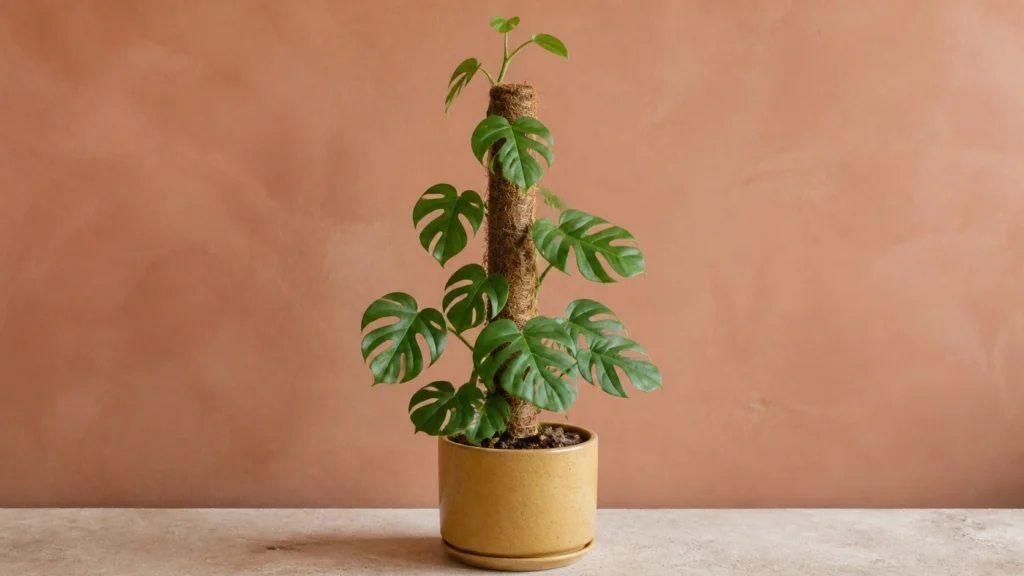
Mini Monstera
Rhaphidophora tetrasperma
A fast, easy climber with Monstera-style split leaves at a fraction of the size, known as the Mini Monstera even though it is not a Monstera at all, but a Rhaphidophora.
Watering frequency
Every 5-7 days
Ideal temperature
65-80°F / 18-27°C
Humidity
40-70%
Care difficulty
Easy
Air purifying
No/Not Known
Growth rate
Fast
Plant size
6-8 ft indoors / 1.8-2.4 m with support
Soil type
Moist, well-draining aroid mix
Fertilizer need
Monthly, spring-summer.
Care summary
- Light: Give bright, indirect light; a little morning sun is fine.
- Water: Water when the top inch of mix dries.
- Humidity: Average to high; the plant tolerates normal rooms but prefers more.
- Support: Provide a moss pole or totem for climbing growth.
- Safety: Toxic to cats and dogs if ingested, like other aroids.
Common problems
- Yellow leaves: Check saturated mix, drainage, and light.
- Brown, crispy edges: Review humidity and dry air.
- Drooping or curling leaves: Check for underwatering.
- Leggy growth with small leaves: Increase light.
- Pests: Inspect undersides for spider mites and scale.
Plant care guide
About
The Mini Monstera is a compact climbing aroid whose split leaves look like a shrunken version of the classic Swiss cheese plant, which is exactly how it got its common name. Botanically it is not a Monstera at all. It is Rhaphidophora tetrasperma, a distinct species in a different genus, though a close cousin within the same tribe of the arum family. The name is misleading, the plant is not, and the confusion is so common that half the fun of owning one is explaining the taxonomy to guests.
Why You'll Like It
The Mini Monstera delivers the look of a Monstera without the space, the cost, or the moodiness. Leaves reach only a few inches across, the plant stays manageable on a desk or shelf, and it grows quickly enough that new split leaves appear on a regular basis. Where a full-size Monstera takes years and a corner of the room to impress, the Mini Monstera starts splitting its leaves almost immediately, so even a young plant has that iconic cut-leaf silhouette.
It is also one of the easiest tropical climbers you can own. It forgives missed waterings, tolerates normal room humidity, and propagates from a single node. For beginners who want the Monstera look, and for collectors who already have a full-size plant and want the mini version, it is the rare houseplant that satisfies both audiences.
What Kind of Plant Is It
The Mini Monstera is Rhaphidophora tetrasperma, a species in the genus Rhaphidophora, which contains around 100 species distributed across Southeast Asia, India, and Africa. The genus belongs to the tribe Monstereae in the arum family (Araceae), the same tribe as Monstera itself. That shared tribe is the closest thing to a botanical excuse for the common name: the two genera are related, but they are not the same plant, and they evolved on opposite sides of the world.
Monstera species are New World plants, native to Mexico, Central America, and the tropical Americas. Rhaphidophora is an Old World genus, and R. tetrasperma is native to the Malay Peninsula and southern Thailand. The resemblance is convergent: both are climbing aroids that evolved split and perforated leaves to cope with wind and light in tropical forest canopies, and the similarity ends there. The species name tetrasperma means "four-seeded," a reference to the seeds in its fruit, and the genus name refers to the needle-like oxalate crystals, called raphides, that the plant carries in its tissues.
History
Rhaphidophora tetrasperma was first described in 1893 by the British botanist Joseph Dalton Hooker in Flora of British India, according to Kew's Plants of the World Online, one of the great botanical works of the Victorian era. Hooker was the director of the Royal Botanic Gardens at Kew and the closest thing the nineteenth century had to a global botanical authority, and his multi-volume flora catalogued the plants of the entire Indian subcontinent. This small Malaysian climber earned only a brief entry in that vast work, but the name he gave it is the one still in use today. For decades afterward the species lived quietly in herbaria and botanical gardens, and its entry into cultivation was equally unglamorous: it appears in mid-century aroid literature as a cultivated plant under names that now read like a game of telephone. The American aroid specialist Monroe Birdsey's The Cultivated Aroids, published in 1951, lists it among the "dwarf cerimans," and for years the trade sold it under a string of wrong labels: Amydrium tetrasperma, Philodendron "Ginny," Philodendron imbe "Ginny," Epipremnum "Ginny." None of those names is correct, but they stuck for decades.
The taxonomy was finally settled by Peter Boyce, the leading specialist on the genus. In a 2007 statement on the Aroid-l forum, Boyce confirmed that the so-called dwarf or miniature forms of Monstera deliciosa in European cultivation, including the "Dwarf Ceriman" of Birdsey's book, were all Rhaphidophora tetrasperma from peninsular Malaysia and southern Thailand. The "mini Monstera" was never a small Monstera; it was a misidentified Rhaphidophora all along.
The plant's modern fame has a much more recent chapter. During the pandemic plant boom, variegated specimens sold for unusually high prices at New Zealand auctions and drew international media attention. Those sales helped make the species recognizable far beyond specialist aroid collections. Variegated plants can differ in stability and provenance, however, and there is no reliable basis for claiming that every variegated Mini Monstera was chemically induced or will lose its pattern within a fixed period. Buyers should judge the actual stem, growth point, and seller documentation rather than assuming all variegated plants have the same origin.
Related Varieties
The plant most often compared to the Mini Monstera is the Monstera Deliciosa itself, the full-size Swiss cheese plant it resembles. The Mini Monstera is the beginner-friendly option: cheaper, smaller, faster, and far more tolerant of ordinary rooms. The Swiss Cheese Vine (Monstera adansonii) is another close visual cousin, with narrow, holed leaves and the same vining habit, and it is the Mini Monstera's main rival for the "small-leaved climber" spot on a shelf.
Within the wider aroid world, the Mini Monstera's true relatives include Epipremnum pinnatum, which produces similar split foliage at larger size, and Rhaphidophora species like R. korthalsii that are still rare in cultivation. If the variegated Monstera look tempts you, the Thai Constellation Monstera is the stable variegated form worth considering instead. If you want a trailing companion, the Heartleaf Philodendron (Philodendron hederaceum) is the classic low-effort vine that pairs naturally with it in hanging baskets and mixed displays.
Where It Works
The Mini Monstera is one of the most versatile climbers for indoor spaces. It shines on a desk, bookshelf, or plant stand where its split leaves are visible up close, and it also works as a hanging plant with the vines trailing over the pot. Given a moss pole or totem, it will climb enthusiastically and produce larger leaves; left alone, it trails and stays more compact.
It tolerates normal room conditions better than most tropical aroids, which makes it a strong choice for a home office or bedroom as well as the living room. Keep it out of direct afternoon sun, which scorches the leaves, and away from cold drafts. A bright spot near an east or west window is ideal, and it will grow almost anywhere with adequate indirect light.
How to Care for a Mini Monstera
Light. Bright, indirect light is best, with a little gentle morning sun tolerated. In too little light the plant grows leggy, with longer stems and smaller, less split leaves. If the leaves are staying plain and hole-free, light is usually the first thing to increase.
Water. Water when the top inch of mix has dried, usually every 5 to 7 days in the growing season. The plant prefers even moisture but recovers well from a missed watering; the bigger risk is a permanently soggy pot, which leads to root rot.
Humidity. Average indoor humidity is acceptable, and the plant will thank you for more. Brown, crispy leaf edges in dry winter air signal a need for a humidifier or a pebble tray. It is far less demanding than a Calathea in this regard.
Temperature. Keep it in the comfortable range of 65 to 80°F (18 to 27°C). It tolerates short dips above 55°F (13°C) but does not like cold drafts, so keep it away from doors and air-conditioner vents.
Soil. Use a well-draining aroid mix with bark and perlite. The plant is forgiving of soil type as long as the mix does not stay waterlogged.
Fertilizer. Feed monthly at half strength from spring through summer. Little to none is needed in winter, when growth slows.
How to Propagate
Propagation is so easy that one plant can become a shelf of plants within a season. Take a stem cutting with at least one node and, preferably, an aerial root already forming. The aerial roots that develop along the stem are a sign the plant is ready to propagate, and they root readily.
Root the cutting in water or in moist mix. In water, change it weekly and pot up once roots reach a couple of inches, usually within three to four weeks. In mix, keep it evenly moist and in bright, indirect light. Because the plant grows fast, the new cutting establishes quickly, and you can repeat the process as the parent climbs. This is the trait that made the species affordable: once a few nurseries had mother plants, everyone could have one.
When to Repot
Repot every one to two years in spring, moving up one pot size. The plant grows quickly and can fill a pot with roots faster than you expect, which is why annual checks are worthwhile. Use fresh aroid mix, and if the plant is sprawling, this is a good moment to take cuttings or add a taller support. After repotting, water well and keep it in bright, indirect light while it settles.
Toxicity
Like its Monstera cousins, the Mini Monstera contains insoluble calcium oxalate crystals, and the North Carolina State Extension notes the plant's toxicity if ingested, along with the possibility of skin irritation from handling. The ASPCA's database does not list Rhaphidophora species specifically, so the assessment rests on the family record rather than a species-specific test: as an aroid, the plant carries the same needle-like crystals that make the rest of the family irritating to chew. Expect oral irritation, drooling, and vomiting in pets that take a bite, and keep the plant out of reach of cats, which are often drawn to the dangling vines. Wearing gloves when pruning is a reasonable precaution for people with sensitive skin.
Common Problems
Yellow leaves. Usually overwatering or poor drainage. Check the pot, let the mix dry further between waterings, and make sure water drains freely.
Brown, crispy leaf edges. Dry air or underwatering. Raise humidity and check that the plant is not drying out completely between waterings.
Drooping or curling leaves. The classic underwatering signal. The plant recovers quickly after a good watering, so it is one of the most forgiving signs to see.
Leggy growth with small, unsplit leaves. Not enough light. Move the plant to a brighter spot and the new growth will tighten up and start splitting again.
Spider mites. The most common pest on this plant, favored by dry indoor air. Look for fine webbing on the undersides of leaves and raise humidity as part of the treatment.
FAQ
Is the Mini Monstera actually a Monstera? No. It is Rhaphidophora tetrasperma, a different genus in the same aroid tribe. The name comes from its resemblance to a small Monstera deliciosa.
How big does it get? With a moss pole and good light it can climb to 6 to 8 feet indoors. The leaves stay small, which is the point, but the vine itself keeps growing.
When do the split leaves appear? Much earlier than on a real Monstera. Even young plants throw split and holed leaves, which is part of why the plant is so satisfying to grow.
Is the variegated version worth buying? It depends on the plant, price, and provenance. Variegated specimens may be less predictable and slower than the green form, so inspect the stem and growing point and avoid sellers promising guaranteed future patterns. The green form is the more straightforward choice for most homes.
Why is it called tetrasperma? The species name means "four-seeded," describing the seeds in its fruit. The plant rarely flowers indoors, so the name is a botanical detail you are unlikely to see in person.
Does it flower indoors? Rarely. Like most aroids, it needs maturity and strong light to bloom, and the small white flower that the species produces is far less interesting than the foliage anyway. Do not buy one for the flowers.
Final Thought
The Mini Monstera is the houseplant equivalent of a well-designed copy: it captures everything people love about the Monstera look, strips out the space requirements and the temperament, and adds a genuinely interesting backstory. The fact that it is not a Monstera at all, but a Malaysian cousin that fooled botanists and nurseries for a century, only makes it more charming. If you want the Swiss cheese silhouette without the commitment, this is the plant.