
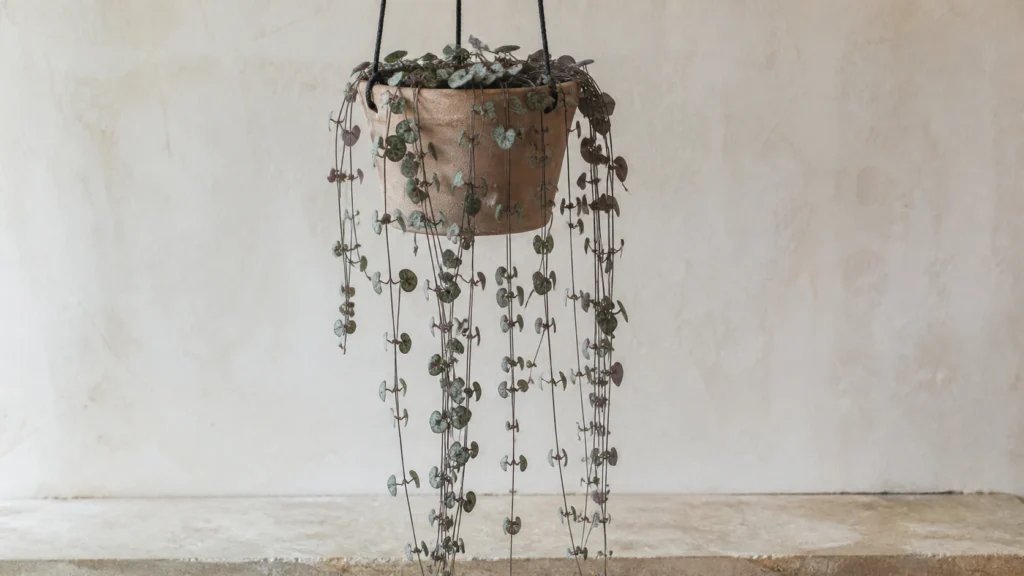
String of Hearts
Ceropegia woodii
A delicate southern African vine whose wiry stems carry heart-shaped, silver-marbled leaves and bead-like tubers, made to trail from a hanging pot.
Watering frequency
Every 10-14 days
Ideal temperature
65-80°F / 18-27°C
Humidity
40-60%
Care difficulty
Easy
Air purifying
No/Not Known
Growth rate
Fast
Plant size
3-6 ft trailing / 0.9-1.8 m
Soil type
Well-draining succulent or cactus mix
Fertilizer need
Monthly, spring-summer.
Care summary
- Light: Give bright, indirect light; morning sun is fine.
- Water: Water only when the soil is mostly dry.
- Humidity: Average room humidity is plenty.
- Support: Let it trail from a hanging pot or shelf.
- Safety: Pet toxicity lacks an explicit species-, genus-, or family-level authoritative record; keep it out of reach.
Common problems
- Long gaps between leaves: Increase light.
- Soft, translucent stems: Root rot from overwatering.
- Wrinkled, shriveled leaves: Underwatering.
- Pale, washed-out leaves: Low light or too much harsh sun.
- Leaf drop: Cold draft or soggy soil.
Plant care guide
About
The String of Hearts is a slender, trailing succulent vine from southern Africa whose wiry stems are strung with small, heart-shaped leaves, dark green on top and etched with silver, purple underneath. Along the stems between the leaves, the plant produces little bead-like structures called aerial tubers, which is why it is also known as the rosary vine. Those beads are not decoration: they are storage organs and a built-in propagation system, capable of rooting wherever they touch soil. In its native range the vine can stretch twelve feet, but indoors it is happiest spilling over the edge of a hanging pot, where it forms a curtain of tiny hearts.
The plant is tougher than it looks. It stores water in its leaves, stems, and underground tubers, which makes it genuinely drought-tolerant and remarkably forgiving for beginners. It asks for strong light, fast-draining soil, and restraint with the watering can, and it rewards that restraint with fast, dense growth.
Why You'll Like It
The String of Hearts offers the rare combination of delicate beauty and easy care. The silver marbling makes every leaf look hand-painted, and the purple undersides flash color as the vines move. It grows quickly enough to be satisfying, with new growth appearing in waves through spring and summer, and it is effortless to propagate, which means one plant can become a shelf of plants in a season.
It is often included on pet-safe houseplant lists, but that reputation is based largely on long trade experience and the absence of commonly reported poisoning rather than an explicit species- or genus-level veterinary record. Pet owners can still enjoy it as a trailing display plant, but this database does not promise Pet Safe until an authoritative record clearly covers Ceropegia woodii, its genus, or its family.
What Kind of Plant Is It
The String of Hearts is Ceropegia woodii, a member of the dogbane family (Apocynaceae) documented by the North Carolina State Extension. The genus name Ceropegia comes from the Greek for "wax" and "fountain," a reference to the plant's small, tubular flowers, which look like waxy little fountains or lanterns. The species epithet woodii honors John Medley Wood, a botanist and plant collector who spent decades documenting the flora of Natal in South Africa.
Botanically it is a succulent: its leaves are fleshy, its stems are wiry rather than woody, and it carries its water reserves in thickened underground tubers. It is one of several southern African succulents popular indoors, alongside the stone-mimicking living stones and the classic jade plant. The flowers are worth knowing about even though they are easy to miss. They are small, purplish, and shaped like slender tubes, and they are part of an extraordinary pollination strategy: the flower temporarily traps small flies inside its tube, holds them long enough to pick up or deposit pollen, then releases them. The plant is sometimes called the bushman's pipe in its native region, after the shape of those flowers.
History
The species was collected and named in the late nineteenth century, and its paper trail is unusually well documented. The plant was first brought to scientific attention in 1881, when John Medley Wood found it growing on a mountainside in what is now KwaZulu-Natal in South Africa. The formal description followed in 1894, published by the German botanist Rudolf Schlechter, according to Kew's Plants of the World Online, who named the species in honor of its discoverer. Kew records six synonyms for the species, including the name under which it is still sold in some parts of the trade, Ceropegia linearis subsp. woodii, a 1957 reclassification that most modern references have since abandoned in favor of full species status.
The plant entered cultivation almost immediately, and by 1900 it had earned a place in the most prestigious botanical publication of the Victorian era. That year Curtis's Botanical Magazine published a plate of the plant, illustrated by Matilda Smith, the magazine's first official female artist, with a botanical description by the British botanist N. E. Brown. The plate made the plant known to gardeners across Europe, and its combination of delicate foliage and easy propagation quickly made it a conservatory favorite.
In the decades since, the String of Hearts has moved from Victorian curiosity to mainstream houseplant, helped by hanging-basket culture and, more recently, social media. Its heart-shaped leaves and widespread reputation as a pet-friendly vine have added to that appeal, although the controlled safety status remains unconfirmed under this database's evidence rule.
Related Varieties
The species has produced a small family of cultivated forms, and several are worth knowing if you are shopping.
- 'Silver Glory' has broader, apple-shaped leaves with a strong silver flush and a dark green midrib.
- f. variegata carries cream and pink variegation on the leaf edges.
- 'Heartless' (also sold as String of Spades) has pointed, spade-shaped leaves, bright green with a pink underside.
- 'Orange River' has leaves flushed with orange tones, named for the South African river valley where it was found.
- 'String of Arrows' has narrow, arrow-shaped leaves in lime green and silver.
If you are new to the plant, the plain species is the easiest place to start; the variegated forms are slightly slower and need a bit more light to keep their color. Whichever you choose, the care is identical.
Where It Works
The String of Hearts is a bright-light plant that looks best where its vines have room to fall. Hang it in a window with bright, indirect light, or set it on a high shelf, where the trailing stems become a living curtain. It tolerates a couple of hours of gentle morning sun, which actually deepens the leaf color, but it should be kept out of harsh afternoon sun, which bleaches the silver and scorches the leaves. A bathroom or bedroom with a bright window suits it well, and it is entirely happy in ordinary household humidity.
Because it is succulent, it survives brief neglect better than almost any other trailing vine. If you travel often, forget to water, or want a plant that will forgive you, this is one of the most reliable choices in the houseplant world. It also makes an excellent choice for a south-facing windowsill, where many delicate plants would burn but this one simply thrives.
How to Care for String of Hearts
Light. Bright, indirect light is the key to a dense String of Hearts. The plant is compact and heavily leaved when light is strong, and it stretches into long, bare, widely spaced stems when light is weak. If your vines are growing sparse, the answer is almost always more light, not more fertilizer.
Water. This is a succulent, so the golden rule is to let the soil dry. Water thoroughly only when the mix is mostly or completely dry, which in practice means every ten days to two weeks in summer and every two to three weeks in winter. The underground tubers store water, so the plant recovers quickly from a missed watering but rots quickly from a persistent one. When in doubt, wait.
Soil. Use a fast-draining mix. A cactus or succulent blend, or a general houseplant mix lightened with perlite and coarse sand, works well. The plant hates sitting in dense, wet soil, and drainage is more important than nutrition.
Temperature and humidity. Average room temperatures of 65 to 80°F (18 to 27°C) suit it perfectly. It is not frost-hardy and should be kept above 50°F (10°C). Winter brings a natural rest period: growth slows, and the plant wants less water and no fertilizer.
Fertilizer. Feed monthly in spring and summer with a balanced liquid fertilizer at quarter to half strength. The plant is not a heavy feeder, and overfeeding produces soft, weak growth. Stop entirely in winter.
Pruning. Trim back any long, leafless stems to encourage branching. The cuttings root easily, so pruning is also propagation.
How to Propagate
The String of Hearts is one of the easiest plants in existence to propagate, and it offers three separate methods, which is rare.
The first is stem cuttings. Cut a stem with several leaves, remove the lower leaves, and place the cutting in water or directly into moist succulent mix. Roots form in a few weeks, and the cutting grows into a new plant.
The second is the aerial tubers. The little beads along the stems can be pressed into the surface of damp soil, or a whole stem with tubers can be laid across the pot and pinned down at the nodes. Roots grow from the tubers, and each becomes a new plant. This is exactly how the plant colonizes ground in the wild, so it needs almost no help from you.
The third is division: when you repot, the underground tubers can be separated and planted individually. Whatever method you choose, keep the new pots in bright, indirect light and water sparingly until roots are established.
When to Repot
The String of Hearts prefers to be root-bound and is slow to fill a pot, so repot only when the underground tubers are visibly crowding the container, generally every two to three years, in spring. Use a pot only one size larger, with fresh well-draining mix, and water sparingly for the first week or two while the roots recover. The plant's roots are delicate, so disturb them as little as possible.
Toxicity
The String of Hearts is widely described in horticultural sources as non-toxic, but the available evidence does not meet this database's current threshold for the controlled Pet safe value. The ASPCA database does not list Ceropegia, and an extension profile that carries no toxicity warning is not the same as an explicit non-toxic classification. The wider Apocynaceae family contains plants with very different chemical profiles, so the safety of unrelated family members cannot be generalized to this species. For now the structured status remains Not pet safe, meaning unconfirmed rather than known to be poisonous.
The long, wiry vines may also attract cats, and swallowing a substantial length of any fibrous vine could create a physical problem independent of plant chemistry. Keep it out of reach, and contact a veterinarian or animal poison-control service if a pet eats it and develops symptoms.
One more warning is worth attaching to any discussion of this species: identification matters. The String of Hearts is frequently confused with the string of pearls, and the two could not be more different in safety. String of pearls (Curio rowleyanus) is genuinely toxic to cats and dogs and causes vomiting and lethargy when eaten. The heart-shaped, flat leaves of the String of Hearts versus the round, bead-like leaves of string of pearls are the easiest way to tell them apart at a glance.
Common Problems
Long, bare stems with few leaves. The classic complaint, and almost always a light problem. Move the plant to brighter light; the gaps between leaves will shrink on new growth.
Soft, translucent stems or yellowing leaves. Root rot from overwatering. Remove the plant from the pot, trim any black, mushy roots, let the root system dry, and repot into fresh dry succulent mix. Reduce watering for good.
Wrinkled, shriveled leaves. Underwatering. The plant tolerates this well and plumps back within a day or two of a thorough watering.
Pale, washed-out leaves. Either too little light or too much harsh sun. Brighten the position, or soften the exposure.
Leaves dropping. Cold drafts, overwatering, or temperatures below 50°F (10°C). Check the roots for rot and move the plant away from cold windows and doors.
Mealybugs and scale. Both pests like succulent vines. Wipe them off with a cotton swab dipped in rubbing alcohol and follow up with diluted neem oil. Isolate the plant until the infestation clears.
FAQ
How long can String of Hearts vines grow? In good conditions the vines trail three to six feet indoors and occasionally longer. Growth is fastest in spring and summer.
Is String of Hearts safe for cats and dogs? Many horticultural lists describe it as non-toxic, but the ASPCA database does not list the genus and this project has not found an authoritative species-, genus-, or suitable family-level safety record. The structured status therefore remains Not pet safe as an unconfirmed category. Keep the vines out of reach and seek veterinary advice if ingestion causes symptoms.
Why is my String of Hearts not growing? Almost always light. The plant needs bright, indirect light to grow densely. A cooler, drier winter rest also prepares it for a flush of spring growth.
How often should I water String of Hearts? Only when the soil is mostly dry, roughly every ten days to two weeks in summer and every two to three weeks in winter. This is a succulent; underwatering is recoverable, overwatering is not.
Can String of Hearts grow outdoors? In USDA zones 10 to 12 it grows outdoors year-round. Elsewhere, grow it as a patio plant in summer and bring it inside before temperatures fall below 50°F (10°C).
Final Thought
The String of Hearts is proof that a plant can be delicate in appearance and bulletproof in practice. Its silver-marbled hearts and cascading habit give it the look of something that would demand a greenhouse, while its succulent biology makes it one of the most forgiving houseplants you can own. Give it bright light, water it like a cactus, and let it trail, and it will fill a shelf or a corner with one of the most charming vines in the trade, all without putting your pets at risk. Just keep it away from the string of pearls on the way out.