
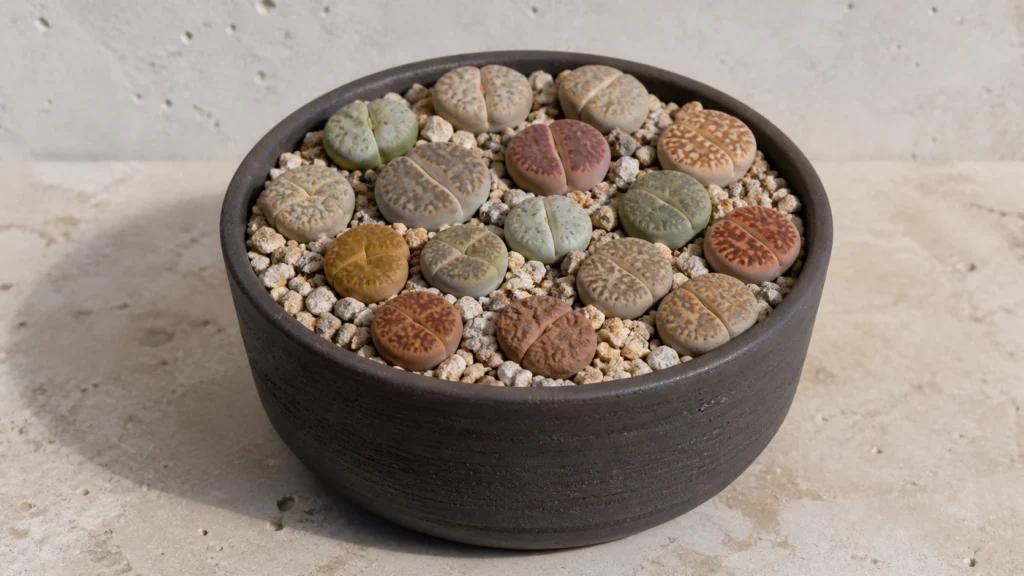
Lithops
Lithops spp.
Tiny southern African succulents with pebble-like paired leaves, translucent surface windows, and unexpectedly large daisy-like flowers.
Watering frequency
Seasonal; water only during active growth after the mix dries fully
Ideal temperature
65-85°F / 18-29°C
Humidity
Low
Care difficulty
Medium
Air purifying
No/Not Known
Growth rate
Slow
Plant size
0.5-1.5 in / 1-4 cm tall, excluding flowers
Soil type
Very gritty, mineral-based mix
Fertilizer need
Once in spring, if needed.
Care summary
- Light: Give several hours of strong light, introducing direct sun gradually.
- Water: Follow the plant's growth and leaf-replacement cycle rather than a fixed calendar.
- Soil: Use a nearly all-mineral, fast-draining mix.
- Pot: Use a deep pot for the taproot; top-dress with gravel.
- Safety: Pet safe based on an ASPCA non-toxic record for a species in the same genus.
Common problems
- Soft, squishy plant: Overwatering, often fatal.
- Tall, stretched growth: Not enough light.
- Shriveling, sunken leaves: Underwatering or normal dormancy.
- No flower: Needs more light or a proper rest.
- Fungus between leaves: Watering during the rest period.
Plant care guide
About
Lithops, commonly called living stones or pebble plants, are a genus of tiny succulents from southern Africa whose paired leaves closely resemble the stones around them. Each plant has thick, fused leaves with a flattened, intricately patterned top and usually sits partly buried in mineral soil. In the right season, a surprisingly large flower—often yellow or white—emerges from the fissure between the leaves.
Lithops are not beginner succulents, but they are not difficult either; they simply operate on a different schedule than most plants. They are adapted to receive water only a few times a year, in brief windows dictated by the seasons, and they have evolved an extraordinary internal cycle in which the plant absorbs its own old leaves each year rather than growing taller. Understanding that cycle is the entire secret to keeping them alive.
Why You'll Like It
Lithops are among the most collectible plants in the succulent world, and for good reason. No two look alike: the genus contains dozens of species and countless cultivated forms, each with a different top pattern, from speckled gray to windowed green to rust-red fissured stone. Collectors build trays of them the way others collect minerals, and the display, a dish of what looks like colored pebbles that quietly produce daisy flowers, is genuinely unlike anything else you can grow indoors.
They are low-maintenance in one narrow sense: they need little routine intervention. They can spend long periods dry, need no pruning, require little or no fertilizer, and may remain in the same mineral mix for years. The challenge is observation and restraint—learning when the plant is actively using water and when a drying leaf pair is part of its normal cycle.
What Kind of Plant Is It
Lithops are leaf succulents in the ice plant family (Aizoaceae). Kew Plants of the World Online records the genus from Botswana, Namibia, and several regions of South Africa and currently accepts 38 species. The name comes from Greek roots meaning stone-like, an apt description of the camouflage that helps the exposed leaf tops blend into rocky ground.
Each plant is a single pair of leaves, fused at the base into a body the size of a thumbnail or smaller. The flattened top carries a translucent "window" or windowed pattern that lets light reach the photosynthetic tissue inside, while the rest of the body stays buried in the soil, protected from sun and heat. Below the surface, a long taproot anchors the plant and stores water. The bodies sit just proud of the gravel, and the pattern on top, spots, lines, fissures, and translucent areas, varies wildly between species and forms.
The genus has its own internal calendar. In late summer to autumn, most species flower. In winter, the plant rests. In spring, the remarkable part happens: the old leaf pair slowly shrivels and dries out as a new pair grows from between the leaves, absorbing moisture and nutrients from the dying pair. This process, called the split, is how Lithops replace their leaves each year, and watering during it can cause the old leaves to stay plump and rot the new pair inside.
History
European botanical accounts of Lithops are commonly traced to William John Burchell, who encountered a stone-like succulent during an 1811 expedition in southern Africa. North Carolina State Extension records Burchell's 1811 discovery, but the often-repeated story that he physically picked it up as a pebble should be treated as horticultural storytelling rather than a necessary identification fact.
Nicholas Edward Brown formally established the genus in 1922; Kew cites the original publication in the 1922 Gardeners' Chronicle. Taxonomy has continued to change since Brown's work, so this page uses Kew's current total of 38 accepted species rather than presenting an approximate historical count as fixed.
The modern era of Lithops began with a South African husband-and-wife team, Desmond and Naureen Cole, who spent decades in the field documenting every known species, population, and color form. Their 1988 book on the genus established the standard numbering system that collectors still use, in which each distinct form is assigned a number, and their field collections became the basis of a national collection in South Africa. The Cole numbers, as they are known, are why collectors trade plants today with labels like "Lithops optica 'Rubra' C339." A plant with a Cole number is a documented plant with a known history, and that system, born in the deserts of South Africa, is now the international language of living stones.
Related Varieties
The genus offers an extraordinary range of forms, and collectors usually start with a few well-known species before chasing the rarities.
- Lithops lesliei is one of the most forgiving species, with flat, mottled tops and large yellow flowers. It is the classic starter Lithops.
- Lithops optica 'Rubra' is famous for its vivid reddish-purple bodies, and it is one of the most striking plants in the genus.
- Lithops salicola has dark, fissured tops and a neat, compact habit.
- Lithops aucampiae is a robust species with large flowers and variable brown or gray patterns.
- Lithops julii is known for its pale, translucent windows and fine lines.
Within the succulent houseplant world, Lithops sit alongside other low-water favorites such as the jade plant, the burro's tail, the Mexican snowball, and the zebra haworthia, and they share the string of hearts' southern African origins and drought-first biology.
Where It Works
Lithops need strong light to remain compact, but a plant raised under cover can scorch if moved abruptly into intense afternoon sun. Indoors, use the brightest suitable windowsill available and introduce direct sun gradually. North Carolina State Extension suggests roughly four to five hours of morning sun with some afternoon protection as a practical starting point. In a dim room, growth stretches and flowering becomes less likely.
They also need air movement and dryness. They hate sitting in still, humid air, and they are far happier in a dry, sunny room than in a steamy bathroom. A dish of Lithops on a sunny windowsill, top-dressed with gravel so that only the patterned tops show, is the classic way to grow them, and it is both the correct horticulture and the best possible display.
How to Care for Lithops
Light. Full sun. A south-facing windowsill is ideal, and western exposure works. Without strong light, the plants stretch, lose their patterns, and will not flower. A grow light is a legitimate option for dark rooms.
Water. Follow the plant rather than a universal month-by-month schedule. Species come from different rainfall regions, and indoor cycles also shift with hemisphere, temperature, and light. As a general rule, water thoroughly only while the plant is actively growing and the old leaf pair has been substantially absorbed, then let the mineral mix dry completely. Withhold routine watering while a new pair is drawing moisture from the old leaves. Slight wrinkling alone is not enough reason to water; first check the season, leaf-replacement stage, roots, and firmness.
Soil. Use an almost entirely mineral mix: coarse sand, perlite, pumice, and a little grit, with at most a small fraction of organic matter. Lithops grow among rocks and stones, and a mix that holds water will kill them.
Pot and planting. Use a pot deeper than it looks necessary, because the taproot is long, and plant the bodies so that only the tops are above the surface. Top-dress with fine gravel, which keeps the bodies dry and looks natural.
Temperature. Lithops tolerate warm conditions and need to stay above about 50°F (10°C). In winter they rest best in cool, bright conditions.
Fertilizer. Almost none. A single very diluted succulent feed in spring is plenty; most collectors never fertilize at all. Overfeeding makes Lithops grow soft and split badly.
How to Propagate
Lithops are propagated almost exclusively from seed, because the plants rarely offset in cultivation and each plant is a single body. Seed is also how collectors acquire the rare species and forms.
Sow the dust-fine seeds on the surface of a gritty, sterile mix in spring or early summer. Keep the mix barely moist and warm, ideally around 70°F (21°C), and cover the pot with clear plastic to hold humidity. Germination takes one to three weeks. Seedlings look nothing like the adults for the first year: they are tiny green bodies, and they must be kept lightly moist and bright through their first season. Growth is slow, and seedlings take three to five years to reach flowering size. It is a long game, but it is the only game, and raising a tray of seedlings to their first flower is one of the most satisfying experiences in succulent growing.
When to Repot
Lithops need repotting only every few years, and only for practical reasons: the taproot has outgrown the pot, the mix has broken down, or you want to reorganize a dish. Repot in late summer, just before the autumn growth window, when the plants are at their most tolerant. Gently remove the plant, shake off the old mix, and replant at the same depth in fresh mineral mix. Do not water for at least a week after repotting, to let any damaged roots callus over, and do not repot during the winter rest or the spring split, when the plants are at their most fragile.
Toxicity
The structured status is Pet safe based on an authoritative same-genus record. The ASPCA lists Living Stones, specifically Lithops naureeniae, as non-toxic to dogs, cats, and horses. This supports the genus-level page, but it should not be misrepresented as an individual toxicology test of every one of Kew's accepted Lithops species.
Non-toxic does not mean that chewing an unfamiliar plant is desirable or guaranteed to cause no digestive upset. A curious pet may also knock over the shallow-looking display or damage a plant that took years to grow. Keep the pot in a stable location and contact a veterinarian if ingestion is followed by concerning symptoms.
Common Problems
Soft, squishy bodies. Overwatering, and it is usually fatal. Lithops that have been watered during the rest or split period burst or rot from the inside. Remove the plant from the pot, check for rot, and dry it out completely; the prognosis is poor once the tissue is mushy.
Tall, cylindrical growth. Not enough light. The plant is stretching, a sign that it is slowly starving. Move it to full sun immediately; the stretched growth will not shrink, but new growth will be correct.
Wrinkled, sunken bodies. Could be underwatering or, more often, the normal seasonal cycle: plants shrivel during the winter rest and the spring split. If the plant is resting, leave it alone; if it is in an active growth window, a deep watering will plump it up within days.
No flowers. Not enough light, or the plant is still young. Give it full sun and be patient; most species flower only after several years and only in autumn.
Fungal growth between the leaves. Watering at the wrong time. The moisture trapped between the old and new leaf pairs is what causes the rot; let the plant dry out completely.
FAQ
How often should I water Lithops? There is no safe universal interval. Water during active growth after the mineral mix dries fully, and normally withhold routine watering while a new leaf pair is absorbing the old one. Adjust for the species, hemisphere, temperature, light, and the plant's actual stage.
Why are my Lithops splitting and drying out? That is the plant working correctly. Each year the old leaf pair dries and is absorbed as a new pair grows from between the leaves. Do not water during the split, or the old leaves will stay plump and rot the new pair.
Do Lithops need direct sun? They need very bright conditions and several hours of useful sun to stay compact and flower well. Introduce direct sun gradually; morning sun with protection from the harshest afternoon exposure is a safer starting point than an abrupt move into all-day sun.
Are Lithops toxic to pets? The ASPCA lists one species, Lithops naureeniae, as non-toxic to dogs, cats, and horses. This project uses that same-genus evidence to classify the genus page as Pet safe, while acknowledging that it is not a separate test of every species.
Why are my Lithops mushy? Overwatering. Lithops store water in their leaves and taproot and are adapted to long dry seasons. Let the plant dry out completely and check for rot; mushy tissue usually means the plant is beyond saving.
Final Thought
Lithops are the most patient plants you will ever grow, and they reward that patience with one of the strangest and most beautiful displays in the plant world. They ask for full sun, almost no water, and the discipline to do nothing at exactly the moments when you want to help, and in return they spend their lives perfecting a disguise, looking like stones until, for a few weeks each autumn, they burst into daisy-like flowers that make it impossible to mistake them for anything but living things. For collectors they are an endless rabbit hole of species and forms; for beginners they are a masterclass in restraint. Either way, they are tiny, alien, and unforgettable.