
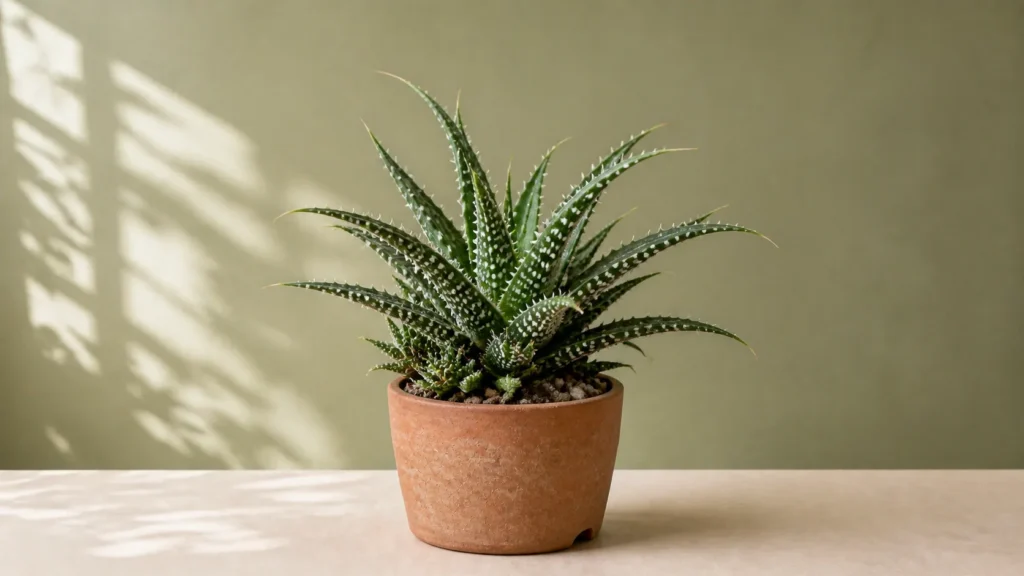
Lace Aloe
Aristaloe aristata
A compact rosette succulent with white-speckled leaves, soft bristled tips, easy offsets, and a modern botanical identity outside the Aloe genus.
Watering frequency
Every 14-21 days
Ideal temperature
50-80°F / 10-27°C
Humidity
30-50%
Care difficulty
Easy
Air purifying
No/Not Known
Growth rate
Slow
Plant size
6-10 in / 15-25 cm
Soil type
Fast-draining cactus mix with added mineral grit
Fertilizer need
Once or twice, spring-summer.
Care summary
- Light: Give bright light with several hours of gentle or acclimated direct sun.
- Water: Soak thoroughly only after the mix has dried through most of the pot.
- Soil: Use a gritty, fast-draining mix in a pot with an open drainage hole.
- Propagation: Separate established offsets once they have roots of their own.
- Safety: Treat as not pet safe; RHS warns that ingestion may cause severe discomfort.
Common problems
- Soft or translucent leaves: Check saturated soil, poor drainage, and cold wet roots.
- Stretched open rosette: Increase usable light gradually.
- Brown dry tips: Review prolonged drought, damaged roots, and salt buildup.
- Pale or scorched patches: Acclimate the plant before exposing it to strong direct sun.
- Pests: Inspect tight leaf bases and offsets for mealybugs and scale.
Plant care guide
About Lace Aloe
Lace Aloe is a compact rosette succulent with dark green, triangular leaves covered in white raised spots and edged with small, soft teeth. Each leaf ends in a fine pale bristle, giving the plant its “lace” or awn-like appearance. It is commonly sold beside Aloe Vera, but it is not a variety of Aloe vera and should not be described as medicinal Aloe.
The accepted botanical name is Aristaloe aristata. Kew Plants of the World Online accepts it as a distinct species in the genus Aristaloe and records Aloe aristata and Tulista aristata as botanical synonyms. The older name remains common on nursery labels, which is why Aloe aristata belongs in Botanical Synonyms rather than being treated as a separate plant.
This classification change matters for identity, not because the plant suddenly needs completely different household care. Lace Aloe is still an alooid succulent in the family Asphodelaceae and shares the water-storing leaves and dry-down routine people associate with aloes. However, it does not produce Aloe Vera gel and should never be presented as a substitute for Aloe Vera.
Why You’ll Like It
Lace Aloe stays compact while gradually producing offsets around the original rosette. A healthy plant becomes a clustered pot without developing the tall bare stem seen in some older succulents. The white spotting remains visible year-round, and mature plants can send up surprisingly tall stalks of tubular orange-red flowers.
It is also forgiving of ordinary dry indoor air and an occasional missed watering. The main requirement is restraint: a bright position, a drainage hole, and enough time for the root zone to dry. That makes it useful for a sunny desk or windowsill where a thin-leaved tropical plant would dry too quickly.
Unlike Zebra Haworthia, its leaves usually carry a distinct pale bristle at the tip and are arranged in a softer, more open rosette. Compare Zebra Haworthia if you want a similarly compact, striped succulent that is handled under a pet-safe taxonomy.
What Kind of Plant Is It?
Lace Aloe is a stemless or nearly stemless evergreen succulent. Its leaves grow from a central point to form a rosette, while short underground growth produces offsets at the base. Thick leaves store water, but the roots still need oxygen. Water storage is an adaptation to intermittent moisture, not permission to grow in permanently wet compost.
RHS describes Lace Aloe as a tufted evergreen perennial from South Africa and Lesotho, usually forming a rosette around 20 cm tall. It also records orange-red tubular flowers carried above the foliage. Indoors, flowering is most likely when a mature plant receives strong light, a seasonal change in temperature, and a sensible winter reduction in watering.
The genus Aristaloe currently contains only this species. South African National Biodiversity Institute material on alooid classification explains that molecular research divided the older broad concept of Aloe into several related genera, including Aristaloe. That is why the plant can remain “Lace Aloe” in ordinary language while its accepted scientific name begins with Aristaloe.
History and Botanical Identity
The species was originally described as Aloe aristata in the nineteenth century. The epithet aristata refers to the bristle or awn at the leaf tip. Its modern combination, Aristaloe aristata, was published after research showed that several familiar aloe-like plants belonged in separate evolutionary lineages.
Retail naming has not caught up uniformly. You may see Lace Aloe, Torch Plant, Awn-leaf Aloe, or simply Aloe aristata. These labels can refer to the same species, but “Aloe Vera variety” cannot. Aloe Vera is Aloe vera; Lace Aloe is Aristaloe aristata. They differ in leaf shape, spotting, rosette size, offset behavior, flower presentation, accepted genus, and documented uses.
The common name Guinea-fowl Aloe is sometimes used for spotted alooids and may overlap with other plants in retail. Use the botanical name to confirm identity rather than buying by that alias alone.
Lace Aloe and Related Succulents
- Aloe Vera: Larger, usually gray-green leaves with medicinal-market associations; a different species and genus-level identity.
- Zebra Haworthia: Firm striped leaves with white bands rather than the same spotted, bristle-tipped pattern.
- Lace Aloe ‘Magic’ and ‘Cathedral Peak’: Named selections of Aristaloe aristata recorded by RHS; confirm the cultivar label before treating one as distinct.
- Aloe hybrids: Retail hybrids may resemble Lace Aloe but can differ in teeth, spotting, color, and mature size.
These comparisons are useful because juvenile alooid succulents can look deceptively similar in small nursery pots. A reliable label and a clear view of the leaf tip are more useful than color alone.
Where Lace Aloe Works Best
Place Lace Aloe at the brightest practical indoor window. An east-facing window with direct morning sun is usually easy to manage. A south- or west-facing window can work well after gradual acclimation, especially where glass, screens, overhangs, or seasonal sun angle soften the strongest rays.
The plant fits naturally among Full Sun Houseplants, but “full sun” indoors still requires observation. A plant moved abruptly from a shaded shop shelf to hot glass may scorch even though the species can use strong light once acclimated.
A terracotta pot can help a slow-drying household because the material releases moisture through its walls, but it is not mandatory. Plastic or glazed ceramic works when the mix is coarse, the pot is not oversized, and watering is adjusted to the actual drying rate.
Lace Aloe Care
Light
Strong light keeps the rosette compact and the leaves firm. In insufficient light, the center opens, new leaves become longer and thinner, and the plant may lean toward the window. Move it closer to light gradually rather than changing from dim shade to intense afternoon sun in one day.
Several hours of direct sun can be beneficial after acclimation. Watch the newest growth: compact leaves and maintained color suggest useful light, while bleached tan patches on the sun-facing side point to scorch. Deep green color alone does not prove the plant is receiving enough light.
Watering
Water thoroughly, then let excess water drain completely. Wait until most or all of the potting mix is dry before watering again. A calendar range of roughly 14–21 days is only a starting point; winter, low light, a large pot, and moisture-retentive mix can extend the interval substantially.
Do not give small sips every few days. That can leave the center of the pot chronically damp while never wetting the full root ball evenly. A complete soak followed by a real dry-down better matches the plant’s root physiology.
Wrinkling after a long dry period may indicate thirst, but wrinkled leaves can also appear when damaged roots cannot take up water. Check the root zone before assuming that more water is the cure.
Soil and Container
Use cactus or succulent mix amended with mineral material such as pumice, coarse perlite, or horticultural grit. The goal is a structure that drains promptly and does not collapse into dense mud after repeated watering.
Choose a pot only slightly wider than the root mass. Oversized containers hold unused wet soil around a small root system. A drainage hole is essential; a decorative cachepot is safe only when the inner pot can be removed, watered, drained, and returned without standing in runoff.
Humidity
Average or dry household humidity is suitable. Lace Aloe does not need misting, a pebble tray, or a sealed terrarium. High humidity is not automatically harmful, but high humidity combined with wet soil and weak airflow slows drying and raises the risk of rot.
Temperature
Ordinary room temperatures are comfortable. Lace Aloe can handle cooler conditions than many tropical houseplants, but a potted plant with wet roots is much more vulnerable to cold. Keep it away from freezing glass, outdoor frost, and cold rain.
If it spends summer outside, acclimate it to sun and bring it back indoors before freezing weather. Check carefully for pests before returning it to the house.
Fertilizer
Feed lightly once or twice during active spring and summer growth using a diluted balanced or succulent fertilizer. More fertilizer will not compensate for weak light. Excess salts can damage roots and produce dry leaf tips, especially in a small pot that is rarely flushed.
Pruning and Cleaning
No structural pruning is needed. Remove a fully dead outer leaf only when it releases without damaging healthy tissue. Avoid cutting the living center of the rosette. Dust can be removed with a soft dry brush; water trapped repeatedly in tight leaf bases can encourage spotting or rot in cool conditions.
Propagating Lace Aloe
Offsets are the simplest method. Wait until an offset is large enough to handle and ideally has some roots of its own. Remove the plant from its pot, separate the offset with clean hands or a sterile blade, and allow any damaged surface to dry briefly before potting into a small, gritty mix.
Keep a newly separated offset slightly more protected from harsh sun while roots recover, but do not put it in darkness. Water cautiously until active growth shows that the root system is functioning.
RHS also lists seed propagation, but seed is slower and less practical for routine household multiplication. A single leaf is not the standard propagation unit for this plant; separating offsets preserves the rosette growth point.
Repotting Lace Aloe
Repot when roots crowd the container, the mix has broken down, or offsets leave no room to water properly. Spring is convenient because increasing light supports recovery, although an urgent drainage problem can be corrected at any time.
Move up only one pot size. Inspect roots for firm pale or tan tissue and remove only roots that are clearly black, hollow, or mushy. Do not water automatically the moment repotting is complete if many roots were damaged; give cuts time to dry, then resume cautiously.
Toxicity and Pet Safety
Lace Aloe is classified here as Not pet safe. The evidence is not merely borrowed from Aloe Vera: RHS specifically marks Aristaloe aristata as potentially harmful and warns that ingestion may cause severe discomfort. That exact-species warning outweighs any assumption based on the plant’s attractive common name or its separation from the genus Aloe.
Keep it away from pets and children who chew plants. The small marginal teeth and terminal bristles also make chewing physically unpleasant. If ingestion occurs and an animal develops vomiting, diarrhea, lethargy, oral discomfort, or another unusual symptom, contact a veterinarian or animal poison-control service promptly rather than trying a home remedy.
Common Problems and Practical Fixes
Soft, translucent, or collapsing leaves
The most likely combination is excess moisture and impaired roots. Stop watering, improve airflow, inspect drainage, and check the roots. Healthy roots should not smell sour or collapse when touched.
A stretched or leaning rosette
Increase light gradually and rotate the pot periodically. Existing stretched leaves will not shrink, but new central growth can become more compact.
Brown leaf tips
Check for prolonged drought, old damaged roots, fertilizer salts, or physical injury. The fine natural bristle should not be confused with spreading brown tissue.
Pale tan patches
Abrupt sun exposure can bleach exposed tissue. Move the plant slightly back from the glass and acclimate it more slowly. Damaged areas will not turn green again.
No flowers
The plant may be immature or receiving insufficient light. Avoid forcing blooms with heavy fertilizer. Strong seasonal light and a healthy mature clump matter more than a special product.
Mealybugs or scale
Inspect between leaves and around offsets. Isolate the plant, remove visible pests carefully, and repeat treatment because tight rosettes hide eggs and juveniles.
Frequently Asked Questions
Is Lace Aloe a type of Aloe Vera?
No. Lace Aloe is Aristaloe aristata. Aloe Vera is Aloe vera. They are related members of Asphodelaceae but are different plants.
Can Lace Aloe be used medicinally?
Do not use it as a substitute for Aloe Vera or apply unidentified sap to skin. This profile treats it as an ornamental houseplant.
How often should I water Lace Aloe?
Water after most or all of the mix dries. The actual interval depends on light, season, temperature, pot size, and soil composition.
Does Lace Aloe need direct sun?
It grows most compactly in strong light and can use direct sun after acclimation. Bright indirect light can also work near a clear window.
Why is my Lace Aloe producing babies?
Offsets are its normal clumping habit. Leave them for a fuller pot or separate established offsets for propagation.
Is Lace Aloe safe for cats and dogs?
No. This database treats it as not pet safe because RHS gives an exact-species ingestion warning.
Final Thought
Lace Aloe is worth growing as its own plant, not as a decorative footnote to Aloe Vera. Its spotted bristle-tipped rosettes, compact clumping habit, and tolerance of bright dry rooms make it an easy succulent when the roots are allowed to breathe. Give it strong light, a small gritty pot, and long pauses between thorough waterings—and keep its old Aloe aristata label as naming history rather than proof that it is an Aloe Vera variant.