
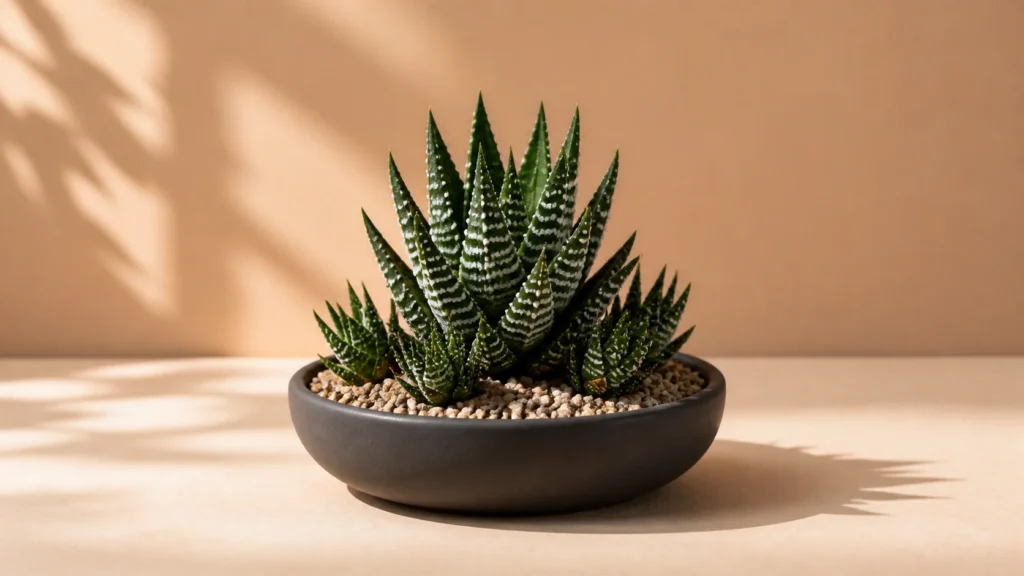
Zebra Haworthia
Haworthiopsis fasciata
A palm-sized zebra-striped succulent that survives the windowsill many plants can't — forgiving, pet-safe, and endlessly propagating itself.
Watering frequency
Every 2-3 weeks
Ideal temperature
60-80°F / 16-27°C
Humidity
30-50%
Care difficulty
Easy
Air purifying
No/Not Known
Growth rate
Slow
Plant size
4-6 in / 10-15 cm
Soil type
Fast-draining cactus or succulent mix
Fertilizer need
Once or twice, spring-summer.
Care summary
- Light: Bright indirect light; tolerates medium and low light.
- Water: Let the soil dry completely between waterings.
- Soil: Fast-draining cactus or succulent mix.
- Temperature: Normal household warmth.
- Maintenance: Remove old outer leaves; separate pups.
- Safety: Pet-safe.
Common problems
- Mushy, translucent leaves: overwatering.
- Deep red or pale white leaves: too much direct sun.
- Faded stripes: too little light.
- Stretched, leaning growth: insufficient light.
- Mealybugs: check the leaf bases.
Plant care guide
About Zebra Haworthia
The Haworthia — specifically Haworthiopsis fasciata, known as the zebra cactus, little zebra plant, or zebra haworthia — is a palm-sized succulent from South Africa's Cape region, where it grows half-buried in sand under harsh, sun-baked conditions. Its claim to fame is a tight rosette of thick, triangular, dark green leaves striped with raised white bands that look painted on: the zebra pattern that gives every one of its common names. The NC State Extension notes the plant was formerly classified as Haworthia fasciata and reassigned to the genus Haworthiopsis — a botanical reshuffle that explains why you'll see both names on plant tags.
Despite being called a "cactus," it is not a cactus at all: it belongs to the Asphodelaceae family, the same group as aloe and gasteria. What it shares with true cacti is a succulent's water-storing leaves and an extreme tolerance for neglect. It is one of the slowest growers in the houseplant world — NC State describes it as slow-growing with a lifespan up to 50 years — which makes it a plant you can literally keep for decades and hand down.
Its popularity rests on a rare combination: it looks like a collectible specimen (the stripes genuinely look like fine paintwork), it stays small enough for the tiniest desk, and it survives the low light and dry air that kill most succulents. If you want to own a succulent but your windowsill gets no direct sun, the zebra haworthia is the plant that actually works.
Why You'll Like It
The Haworthia is the succulent for people who've killed other succulents. Its two superpowers are light tolerance and drought tolerance: it grows happily in bright indirect light, and the NC State profile notes it is "somewhat tolerant of low-light conditions" — a claim almost no other succulent can make. It needs watering every two to three weeks, forgives a month of absence without complaint, and never outgrows its spot.
It's also genuinely beautiful up close. The raised white stripes are tactile and sculptural — this is a plant that rewards a magnifying glass and a place right on the desk where you'll actually look at it. It stays 4-6 inches tall and wide, so it fits a shelf, a windowsill, a terrarium, or the corner of a monitor stand without demanding space.
And it's a tireless self-propagator: healthy plants push out pups (offsets) at the base, which separate into whole new plants. One haworthia quietly becomes a colony of them, which means the plant pays for itself — and keeps giving you gifts for years.
What Kind of Plant Is It?
Three facts define how a haworthia behaves.
- It is a shade-tolerant succulent. Most succulents stretch and rot in dim rooms; the haworthia is adapted to grow in the filtered shade of rocks and scrub, so it accepts medium and even low light far better than its relatives. It's the succulent that lives on office desks and north windowsills.
- Its stripes are its identity. The raised white bands on the outer leaf surface are the species' signature. NC State offers a useful identification detail: H. fasciata has a smooth upper leaf surface with the zebra stripes on the outer side, while the commonly confused Haworthiopsis attenuata has white speckles on both surfaces. If your "zebra plant" looks different, you may have the cousin.
- It grows slowly and lives long. Growth is a few new leaves a year; the payoff is a plant that can outlive you. NC State puts its lifespan at up to 50 years. This is not a plant for people who want fast change — it's for people who want a permanent resident.
Where It Works Best
Give the haworthia bright indirect light — an east-facing windowsill, or a spot a few feet from a south or west window. It genuinely tolerates medium light, and the NC State profile says it handles low light as well, though growth slows and the stripes fade. The one thing to avoid is harsh direct afternoon sun: too much sun stresses the plant, turning the leaves a deep red or washing them pale and dry — NC State describes exactly this response. A few hours of gentle morning sun are fine; afternoon sun through glass is not.
Temperature is easy: normal household warmth of 60-80°F (16-27°C) suits it perfectly, and it only asks to be kept away from cold drafts and sudden temperature changes, as NC State notes. Humidity is a non-issue — ordinary dry household air is ideal, which makes it perfect for bedrooms and offices where other plants struggle.
Placement-wise, think small and personal: a bright windowsill, a desk, a bookshelf, or a terrarium. It's one of the few succulents that works on a north-facing windowsill, and it looks especially good clustered with other small succulents or alone in a ceramic pot that matches its graphic stripes.
How to Care for Haworthia
Watering: Let the soil dry out completely between waterings, then water thoroughly and let the excess drain — every 2-3 weeks in a normal room, less often in winter. The plant stores water in its leaves and roots, and wet soil is its only real enemy: overwatering turns the leaves mushy and translucent and rots the roots. When in doubt, wait — a slightly shriveled haworthia recovers in a day; a rotted one doesn't. The watering guide explains the "soak and dry" rhythm succulents want.
Light: Bright indirect light is ideal; medium light is fine; low light is survivable but the plant stretches and the stripes fade. Watch for the stress signals — reddish or pale leaves mean too much direct sun, faded stripes mean too little light. Adjust between the two and the plant settles quickly.
Soil: Use a fast-draining cactus or succulent mix — or a houseplant mix heavily amended with perlite and coarse sand. The roots need air and quick drying; a dense, moisture-holding soil is the fastest way to kill this plant.
Temperature: Normal household warmth of 60-80°F (16-27°C). Avoid cold drafts, icy windowsills, and sudden temperature swings. Outdoors it's hardy only to USDA zones 10-11, so it's an indoor plant for most of us.
Humidity: None required. Dry air is what it evolved for — no misting, no pebble trays, no humidifiers. This is the rare houseplant where your winter-heated, bone-dry apartment is exactly right.
Fertilizer: Feed lightly — once or twice in spring and summer with a diluted succulent or balanced fertilizer — and not at all in winter. A slow-growing plant needs very little food; overfeeding causes soft, stretched growth.
Maintenance: Remove old, dried outer leaves as they're spent — this keeps the rosette clean and exposes new pups. Every year or two, separate the pups and replant them; the parent's rosette stays tight and the colony spreads. Dust the leaves occasionally with a soft brush.
How to Propagate
Propagation is the easiest thing about this plant, and it's the reason haworthias spread through offices and families. Three methods work:
- Pups and offsets: The primary method. Healthy plants produce baby rosettes at the base; when a pup has several leaves and a few roots, gently remove it with a clean knife, let the cut dry for a day, and pot it in fresh succulent mix. Water sparingly until it establishes. NC State lists division of pups and offsets as the standard strategy.
- Leaf cuttings: Twist off a healthy outer leaf with its base intact, let it callus for several days, and lay it on moist succulent mix. Roots and a tiny rosette eventually form at the base — slow, but reliable, and NC State lists it as an accepted method.
- Seed: Possible but slow and rarely worth the effort for home growers.
Spring and early summer are the best time for all methods, when the plant is actively growing.
When to Repot
Repot every two to three years in spring, or when the pups crowd the pot and the root ball fills it. Move up only one pot size — haworthias prefer snug quarters — and use fresh fast-draining succulent mix. Gently shake off old soil, inspect the roots, and trim any that are dark and mushy before replanting. Water lightly for the first week while the roots settle, then resume the normal soak-and-dry rhythm. The repotting guide walks through the general technique, which applies with the usual succulent adjustments: dry soil, shallow pot, patience.
Toxicity and Pet Safety
The ASPCA lists Haworthia as non-toxic to cats and dogs, and the NC State profile also carries pet-friendly and non-toxic tags. Confirm the plant's identity, because “zebra plant” is used for more than one species and unrelated look-alikes may have different safety profiles. Even a non-toxic plant can cause stomach upset if a pet eats a large amount. The pet-safe plants guide offers other options for homes with animals.
Common Problems and Practical Fixes
- Mushy, translucent leaves: Overwatering — the classic succulent death. Let the soil dry completely, cut back watering, and if the roots are already dark and mushy, repot into fresh dry mix after trimming them.
- Deep red or pale, dry leaves: Too much direct sun. The reddening is stress pigment; move the plant to bright indirect light and it greens back up within a few weeks.
- Faded stripes: Too little light. The white bands lose contrast in dim conditions — NC State notes the pattern fades with inadequate light. Move it brighter and the next leaves come in with stronger stripes.
- Stretched, leaning growth: The rosette is elongating and leaning toward the light — etiolation. It needs more light; the stretched growth won't revert, but new leaves will grow tight and compact once it's moved.
- Mealybugs: White cottony clusters at the leaf bases and roots — the most common haworthia pest. Wipe with rubbing alcohol on a cotton swab, check the roots when repotting, and treat with insecticidal soap; the pest guide covers the routine.
- Root rot from wet soil: The plant's only serious disease, and always from overwatering. Prevention is the whole cure: fast-draining mix, a pot with drainage holes, and the discipline to wait until the soil is fully dry.
Frequently Asked Questions
How often should I water a haworthia?
Every 2-3 weeks, when the soil is completely dry — less often in winter. It's a drought-adapted succulent: a slightly thirsty haworthia is fine, a wet one is dying. When in doubt, wait another week.
Does haworthia need sun?
It wants bright indirect light and tolerates medium light unusually well for a succulent — it's one of the few that survives genuinely low light, though growth slows and the stripes fade. Avoid harsh afternoon sun, which stresses the leaves red or pale.
Why is my haworthia turning red?
Too much direct sun. The red tint is a stress response to intense light. Move it to brighter-indirect conditions and the color fades back to green within a few weeks.
Why are the leaves becoming mushy?
Overwatering. The leaves fill with water and turn translucent before the roots rot. Let the soil dry out completely, water far less, and check for root rot if the plant doesn't recover.
How do I get more haworthias?
They produce pups — baby rosettes at the base — on their own. Separate a pup once it has several leaves and a few roots, pot it up, and you have a new plant. Healthy haworthias produce them reliably every year.
Is haworthia toxic to pets?
The ASPCA lists Haworthia as non-toxic to cats and dogs. Confirm that the plant is correctly identified, discourage chewing, and contact a veterinarian if a pet develops symptoms after eating plant material.
Why are the stripes fading?
Not enough light. The white bands need bright indirect light to stay vivid — in dim conditions they fade as the plant shifts toward greener, more efficient growth. Move it brighter and the new leaves will carry stronger stripes.
Can haworthia live in a terrarium?
Yes, and it's a popular choice — it stays small, tolerates modest light, and looks at home in glass. Just use a cactus-mix substrate, skip the closed-lid high-humidity terrarium, and let the soil dry fully between waterings.
Final Thought
The haworthia is proof that a succulent doesn't need a sun-blasted desert windowsill to thrive. It asks for bright indirect light, a bone-dry soak-and-dry watering rhythm, and nothing else — no humidity, no fuss, no space — and in return it delivers a perfectly striped little rosette that can outlive you, quietly cloning itself into a family of zebras along the way. For the desk, the shelf, or the terrarium, it is the low-light succulent that actually works — and one of the safest plants you can keep around pets.