
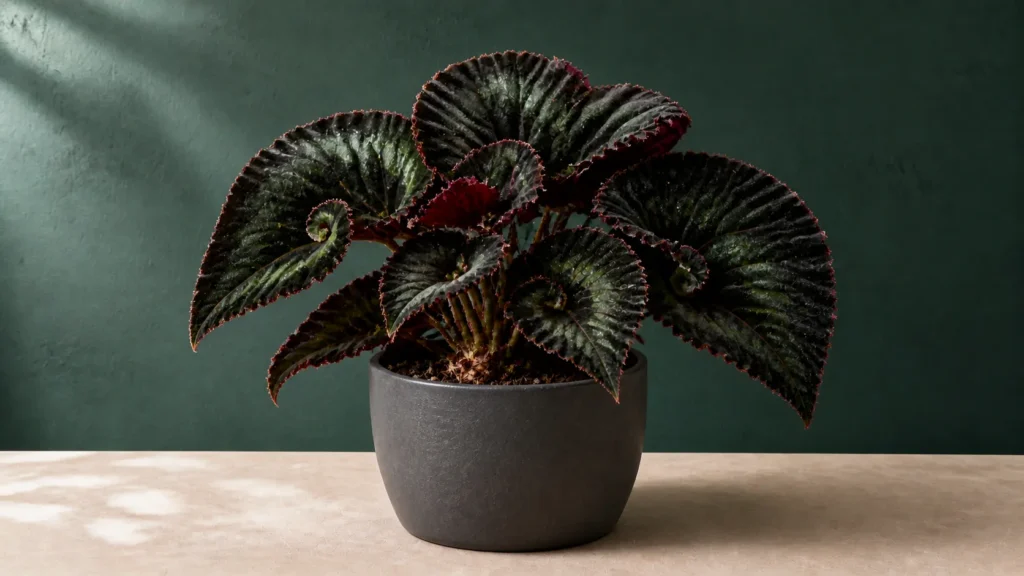
Rex Begonia ‘Midnight Magic’
Begonia 'Midnight Magic'
A dark-leaved rex-cultorum begonia with spiraling green leaves, red margins and undersides, best grown in bright filtered light, an airy shallow mix, and stable humidity.
Watering frequency
Every 5-7 days
Ideal temperature
60-75°F / 16-24°C
Humidity
50-70%
Care difficulty
Medium
Air purifying
No/Not Known
Growth rate
Moderate
Plant size
8-16 in / 20-40 cm
Soil type
Airy, moisture-retentive mix
Fertilizer need
Every 4-6 weeks, spring-early fall.
Care summary
- Light: Bright filtered light; avoid hot direct sun.
- Water: Let the surface approach dryness, then water and drain.
- Soil: Use a shallow pot and an airy, well-draining mix.
- Humidity: Stable humidity helps, but leaves need airflow.
- Safety: Keep away from pets and children who may chew it.
Common problems
- Wilting: dry root ball, root damage, or heat stress.
- Rot: mix stays wet or the crown is buried.
- Fading dark color: light is too weak or too intense.
- Brown edges: moisture swings, salts, or dry air.
- Mildew or spots: wet foliage and poor airflow.
- Pests: mites, thrips, or mealybugs.
Plant care guide
About Rex Begonia 'Midnight Magic'
Rex Begonia 'Midnight Magic' (Begonia 'Midnight Magic') is a dark-leaved rex-cultorum begonia grown for its foliage rather than its flowers. Its leaves are deep green and form a pronounced spiral as they twist from the petiole, with bright red margins and red undersides that glow when light passes through. It belongs to the Rex Cultorum group, the broad family of painted-leaf begonias descended from Begonia rex, which the American Begonia Society describes as foliage hybrids prized for "gloriously gaudy" leaves and generally grown from a thickened stem called a rhizome.
The Royal Horticultural Society records 'Midnight Magic' as a rhizomatous, tender, evergreen perennial with large dark green leaves, a pronounced spiral, and bright red leaf margins and undersides, producing small pink flowers in summer and autumn. The dark canopy makes it a dramatic contrast plant next to silver-leaved or pale-green foliage, and it stays compact enough for a shelf or side table.
Why You'll Like It
'Midnight Magic' delivers the drama of a nearly black-leaved plant with a subtle bonus: the red margins and undersides catch light from behind or the side, so the plant seems to glow at certain times of day. The spiral leaf form adds movement and texture that a flat, solid-colored leaf cannot. It also stays low and dense rather than sprawling, which makes it an easy fit for a desk, plant stand, or windowsill grouping.
It is a satisfying plant for growers who enjoy watching leaves develop. New leaves open softer and often lighter, then deepen into the dark green and red as they harden. Because the plant grows from a rhizome near the soil surface, propagation is relatively straightforward, and a single leaf with a main vein can produce several new plantlets.
The tradeoff is real. A dark begonia is not a "low-light plant" merely because its leaves contain dark pigments. Too little light produces weak, stretched growth and washed-out color; strong direct sun bleaches or scorches the surface. The fine roots also react quickly to saturated compost, and the soft leaves record dry spells and physical damage.
What Kind of Plant Is It?
'Midnight Magic' is a rhizomatous, evergreen perennial in the Begoniaceae family. It grows from a thickened, creeping stem called a rhizome, which sits at or just below the soil surface and produces leaves, roots, and flowers from growing points along its length. Leaves emerge on petioles from the rhizome and form an uneven, low mound rather than a single central stem. This is the defining trait of rex-cultorum begonias and is what separates them from upright cane begonias such as the Polka Dot Begonia, which grow on jointed, bamboo-like stems.
Small pale pink flowers may appear above the foliage in summer and autumn. They are normal, but many growers remove them to keep the plant's energy on the leaves, and lack of flowers says nothing about the plant's health.
History of Rex Begonia 'Midnight Magic'
The rex-cultorum group begins with the species Begonia rex, first introduced to European horticulture in the 1850s from the eastern Himalayas and immediately valued for its dramatic, patterned foliage. Breeders crossed it with other rhizomatous species to create thousands of hybrids, collectively called Rex Begonias or Rex Cultorum begonias.
'Midnight Magic' is an established rex-cultorum cultivar documented by the RHS. Its detailed parentage and introduction history are not consistently available in accessible primary records, so it is best treated as a named horticultural cultivar rather than a separate botanical species. If you can trace a plant back to a nursery label, keep that record, because it is more reliable than a visual match to a photograph.
Related Rex Begonias
'Midnight Magic' is best understood alongside other rex and cane begonias in the same database, since they share the Begoniaceae family but differ in habit and care.
- Rex Begonia 'Red Tango': A rex cultivar with red, purple, and silver-blushed leaves, offering a brighter mood than 'Midnight Magic' but the same rex-cultorum care framework.
- Polka Dot Begonia (Begonia maculata): A cane begonia with silver-spotted olive leaves and red undersides that grows upright on jointed stems, requiring staking and different pruning from a low rex.
- Aconite-leaf Begonia (Begonia aconitifolia): Another upright cane begonia with deeply lobed, silver-marked leaves and white or pink flowers.
None of these should be assumed to use the same watering schedule or support needs, even though they belong to the same genus.
Where Rex Begonia 'Midnight Magic' Works Best
Provide bright filtered light. An east-facing window, a bright north-facing window, or a position behind a sheer curtain can work well. Near strong south- or west-facing glass, increase distance and watch for hot sun; the Royal Horticultural Society's indoor Begonia guidance recommends bright filtered light for houseplant begonias and distinguishes the care of rex and rhizomatous types from other groups.
Dark color is best judged on newly mature leaves. If new growth becomes greener, smaller, or widely spaced, improve light gradually. If foliage pales, develops dry tan patches, or curls during sunny hours, reduce intensity or heat. Existing leaves will not fully reverse damage, so judge success by the next leaf.
A bathroom with a window can work if it also provides light and air exchange; humidity alone does not make a dark steamy room suitable. Avoid radiators, HVAC vents, cold windows, and kitchen grease.
Rex Begonia 'Midnight Magic' Care
Light
Give bright indirect light. 'Midnight Magic' needs good light to keep its dark color rich and its growth compact, but direct sun scorches the delicate leaf surface. An east or north window is ideal; a west window with a sheer curtain works; a south window should be filtered or set back. Under a grow light, use a full-spectrum LED and start with the fixture maker's foliage-plant guidance, adjusting based on new growth.
Watering
Water when the upper portion of the mix has begun to dry and the pot feels lighter, then wet the root ball thoroughly and allow all excess to drain. "Every 5–7 days" is a starting point, not an automatic schedule: a small pot in warm bright conditions may need water sooner, while a recently repotted plant in winter may take much longer. The American Begonia Society's rhizomatous Begonia guidance recommends a shallow container, coarse fast-draining mix, and moving up only one pot size after roots fill the current pot.
Apply water to the mix rather than repeatedly wetting the crown and leaves. Cool water trapped on foliage, especially overnight, can encourage spotting and rot. Bottom watering is acceptable for rehydrating an evenly rooted pot, but remove the pot from the water once the mix is moist and periodically water from above to flush salts.
Soil and Container
Use a porous mix that holds some moisture without collapsing. A peat-free indoor mix amended with perlite or fine bark is a practical starting point; it should wet evenly and drain promptly. Garden soil and compacted old compost restrict the fine roots.
Choose a shallow pot only slightly wider than the root system or active rhizome. Oversized containers stay wet long after the plant has used the available oxygen. Keep the rhizome at or near the surface rather than burying it deeply.
Humidity
Aim for stable humidity around 50–70% with air movement. Dry air can crisp leaf margins, but saturated air and wet foliage favor mildew and Botrytis. Misting creates only a brief humidity change and may spot the leaves, so a room humidifier is the more controlled option. A closed terrarium can work only if the plant fits, condensation is controlled, and air exchange prevents disease.
Temperature
Keep temperatures around 60–75°F (16–24°C) and protect the plant from cold below roughly 55°F (13°C), sudden chills, and hot glass. The warmer the room, the more important shade, humidity, and careful moisture become. Reduce watering when winter light or growth slows; some rex begonias enter partial dormancy and lose leaves, so keep the rhizome barely moist rather than following the summer schedule.
Fertilizer
Feed lightly every four to six weeks from spring through early fall while new leaves are forming, using a diluted balanced fertilizer on already moist mix; reduce or pause feeding in winter when growth slows. Pale leaves can reflect excessive light, root damage, or natural leaf hardening, so do not diagnose every color change as hunger. Flush accumulated salts occasionally and pause feeding after repotting.
Pruning and Grooming
Rex begonias need little structural pruning. Remove yellowed, damaged, or dead leaves by cutting the petiole at the base with sterile scissors. Keep the leaves clean with a very soft dry brush rather than leaf-shine products, and avoid rubbing the surface.
Propagating Rex Begonia 'Midnight Magic'
The most practical home method is rhizome or leaf propagation. A rhizome section with at least one growth point can be rooted in a lightly moist, airy medium; keep part of the rhizome exposed and provide warmth plus humidity without waterlogging.
Rex begonias also produce plantlets from leaf tissue. The American Begonia Society's vegetative propagation guide describes whole-leaf, wedge, and cone methods and notes that each leaf section needs a main vein. For a simple whole-leaf method, insert the petiole into propagation mix, keep the leaf supported, and wait for plantlets to form near the cut tissue. Propagation is slow and vulnerable to rot, so use a clean tool, do not let a cover touch the leaf, and vent heavy condensation.
Repotting Rex Begonia 'Midnight Magic'
Repot when roots have filled the container, the mix has broken down, water bypasses the root ball, or a root problem requires intervention. Choose a pot only slightly larger than the root system and keep the rhizome at approximately its previous level. Use fresh airy mix and keep the plant in slightly lower light and stable humidity for a week or two while it recovers. A rhizome creeping over the rim is not automatically an emergency.
Toxicity and Pet Safety
Rex Begonia 'Midnight Magic' is Not pet safe. The ASPCA Begonia profile lists soluble calcium oxalates, vomiting and salivation in cats and dogs, and identifies underground parts as the most toxic. Keep pots, fallen leaves, rhizome pieces, and propagation trays away from animals.
If a pet chews the plant, remove access and contact a veterinarian or an animal poison-control service for case-specific advice. Do not induce vomiting unless instructed. Wear gloves if sap irritates your skin, avoid touching your eyes, and keep discarded plant material away from children.
Common Problems and Practical Fixes
- Leaves lose their dark color: Compare new leaves under slightly brighter filtered light, but avoid sudden direct sun. Genetics and temperature also influence color.
- The plant collapses in wet mix: Inspect the rhizome and roots for soft brown tissue. Remove rot, save healthy leaf or rhizome cuttings, and repot into an airy mix.
- Brown crisp margins: Review drying, fertilizer salts, hot drafts, and humidity together.
- White powder or gray fuzzy patches: Isolate the plant, remove affected debris, keep leaves dry, and improve airflow. The American Begonia Society disease guide covers powdery mildew, Botrytis, bacterial spot, and root or crown rots.
- Tiny pale stippling or distorted new leaves: Inspect for mites or thrips with magnification.
- Cottony clusters: Mealybugs hide at petiole joints and along the rhizome. Treat with a product labeled for indoor begonias and test sensitive foliage first.
Frequently Asked Questions
Is 'Midnight Magic' hard to care for? It is more forgiving than many collector begonias once light, drainage, warmth, and watering are stable, but leaf damage is permanent and the roots dislike dense wet mix.
Does it need high humidity? It prefers stable moderate humidity with airflow. A humidifier helps new leaves expand cleanly; exact percentage matters less than consistency and healthy roots.
Why did it lose leaves in winter? Reduced light can trigger partial dormancy in rex types. If the rhizome is firm, reduce water and wait for renewed growth rather than saturating the pot.
Can one leaf make a new plant? Rex begonias commonly propagate from leaf tissue containing a main vein. Confirm the plant's growth type and keep conditions clean, warm, humid, and lightly moist.
Final Thought
Rex Begonia 'Midnight Magic' is most convincing when it is allowed to grow slowly and cleanly. Give it bright filtered light, a shallow airy root zone, stable humidity, and cautious watering, and protect each emerging leaf. Its dramatic dark color comes from the whole plant maturing over time, so be patient and judge success by new growth rather than by repairing old leaves.