
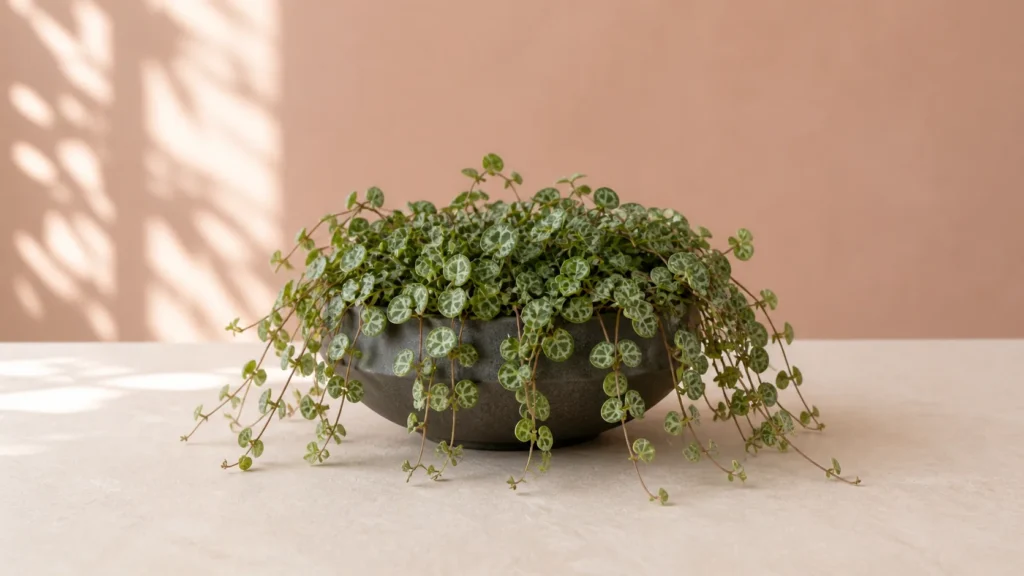
String of Turtles
Peperomia prostrata
A small trailing Peperomia with turtle-shell leaf markings, delicate stems, modest space needs, and genus-level pet-safety evidence.
Watering frequency
Every 7-14 days
Ideal temperature
65-80°F / 18-27°C
Humidity
45-70%
Care difficulty
Medium
Air purifying
No/Not Known
Growth rate
Slow
Plant size
6-12 in trailing / 15-30 cm
Soil type
Fine, airy, moisture-balanced Peperomia mix
Fertilizer need
Monthly, spring-summer.
Care summary
- Light: Give bright indirect light and protect the fine leaves from harsh midday sun.
- Water: Water after the upper layer dries, then drain the pot fully.
- Soil: Use an airy mix that holds modest moisture without staying saturated.
- Growth: Handle the fragile trailing stems gently and trim to encourage branching.
- Safety: Pet-safe status is based on multiple authoritative non-toxic Peperomia records, not an exact P. prostrata listing.
Common problems
- Yellow, translucent, or dropping leaves: Check for wet soil and root damage.
- Curling or crisp leaves: Review dryness, harsh sun, heat, and very low humidity.
- Faded markings or stretched stems: Increase bright indirect light gradually.
- Sudden stem loss: Inspect the crown for rot and preserve healthy tip cuttings.
- Pests: Check stem joints and leaf undersides for mealybugs, mites, and scale.
Plant care guide
About String of Turtles
String of Turtles is the consumer name for Peperomia prostrata, a miniature trailing plant whose round leaves carry a network of silver-green markings resembling turtle shells. It is also sold as Trailing Peperomia, String of Turtles Peperomia, and Turtle Shell Peperomia. The leaves are much smaller and the stems more delicate than those of many familiar upright Peperomias.
Kew Plants of the World Online accepts Peperomia prostrata as a species native to Ecuador and places it in the pepper family, Piperaceae. NC State Extension’s String of Turtles profile describes it as a slow-growing, trailing Peperomia suited to containers and hanging displays.
The plant is often grouped with “string” succulents because of its cascading habit, but it is not a true succulent in the same care category as String of Pearls. Its slightly fleshy leaves buffer some moisture, yet its fine roots and thin stems respond poorly to both prolonged saturation and severe repeated drought. Successful care is about balance rather than treating it as a desert plant.
Why You’ll Like It
String of Turtles delivers detailed pattern on a very small scale. A young plant fits on a desk, shelf, terrarium-style display, or bright bathroom ledge without dominating the space. As stems lengthen, the foliage forms a soft curtain over the rim of a shallow pot.
Its slow growth can be an advantage for small homes. It needs less frequent pruning than vigorous vines, and the compact root system does not demand constant pot upgrades. The plant also propagates from stem sections, so healthy trimmings can be used to make a pot look fuller.
It is especially rewarding for someone who enjoys close observation. New leaves are tiny, the surface pattern becomes clearer as they expand, and the slender flower spikes show the plant’s relationship to other Peperomias even though the foliage remains the main attraction.
What Kind of Plant Is It?
Peperomia prostrata is an evergreen epiphytic or trailing herb. An epiphyte grows on another plant for physical support without parasitizing it. In a humid forest setting, its roots encounter pockets of organic material, rainfall, airflow, and surfaces that drain quickly. Indoors, that translates to an airy container mix rather than compact garden soil.
Each trailing stem has nodes—the points where leaves and roots can emerge. Those nodes are essential for reliable propagation. The small root system absorbs water from a limited volume of mix, while the closely spaced foliage can conceal wet stems or early rot at the crown.
The upright, pale flower spikes are often called rat-tail flowers. They are typical of the genus and are not showy in the conventional sense. Removing them is optional; some growers keep them as a sign of mature growth, while others trim them so the plant directs attention to foliage.
Naming and Identification
The accepted name is Peperomia prostrata. “Prostrata” refers to its low, trailing habit. Retail listings sometimes collapse its name into generic labels such as mini Peperomia or turtle vine, but “turtle vine” is also used for unrelated plants, including Callisia repens. The round patterned leaves and verified botanical label are therefore more dependable than a loose common name.
Do not confuse it with String of Hearts, which has heart-shaped leaves on wiry stems, or with Dischidia species sold as Million Hearts. String of Turtles has visibly Peperomia-like flower spikes and small, nearly round leaves marked with an intricate surface pattern.
Botanical databases have discussed relationships among small creeping Peperomias, but this record follows Kew and NC State in using Peperomia prostrata. It does not treat another accepted species name as a synonym without a clear taxonomic basis.
String of Turtles and Related Plants
- Baby Rubber Plant: Baby Rubber Plant is Peperomia obtusifolia, an upright species with much larger leaves and a sturdier root system.
- Watermelon Peperomia: Watermelon Peperomia grows as a compact rosette with striped, shield-shaped leaves rather than trailing stems.
- String of Hearts: String of Hearts is Ceropegia woodii, a different family and a plant that generally tolerates a deeper dry-down.
- Peperomia rotundifolia: Another small trailing Peperomia, usually with plain green leaves and without the characteristic turtle-shell network.
These comparisons matter when buying an unlabeled cutting. Similar growth habits do not guarantee identical moisture needs, mature size, or pet-safety evidence.
Where String of Turtles Works Best
Place it where the pattern can be seen at eye level: a bright shelf, small hanging planter, bookcase edge, or home-office ledge. An east-facing window often provides useful gentle sun. Near a brighter south- or west-facing window, filter intense midday rays or move the plant back from the glass.
A bright bathroom can work if it also has airflow. Humidity is helpful, but a dim bathroom will not support dense patterned growth. In a mixed plant display, keep faster vines from shading the small pot.
The fine stems break when brushed repeatedly, so avoid a busy walkway or a low shelf where pets, sleeves, and vacuum cleaners catch the trails. A shallow wide planter can create a fuller surface display, but it must have drainage and should not hold a large reservoir of wet mix.
String of Turtles Care
Light
Provide bright indirect light for compact stems and clear leaf patterning. Medium light is tolerated, but growth may slow and the spaces between leaves may lengthen. Very low light also keeps the mix wet longer, increasing the chance of crown and root problems.
Gentle morning sun is usually manageable after acclimation. Harsh direct sun through hot glass can bleach the markings, curl the leaves, or create dry brown patches. Make light changes gradually and watch the newest growth rather than judging only older leaves.
If the plant leans toward one side, rotate it a quarter turn every week or two. A small grow light can help during dark winters, provided it is not so close that the foliage heats or dries rapidly.
Watering
Water when the upper layer of mix has dried but before the entire fine root system remains dry for a long period. A 7–14 day interval is only a starting observation range. Light, temperature, pot material, root density, and season determine the real schedule.
Apply water evenly until excess drains, then empty the saucer. Bottom watering can rehydrate a very dry pot, but do not leave it standing in water. If the mix has shrunk from the sides, water in two passes or soak briefly and drain completely.
Avoid tiny daily sips. They wet only part of the root ball and make it hard to know whether the center is dry or saturated. Also avoid watering solely because one leaf wrinkles; damaged roots, heat, and pests can produce similar symptoms.
Soil and Container
Use a fine but airy mix. A practical blend can combine quality houseplant mix or coco-based material with perlite or pumice and a small amount of fine orchid bark. Large bark chunks alone leave too many gaps for the plant’s delicate roots, while dense peat alone may remain wet too long.
Choose a pot only slightly larger than the root ball. Drainage holes are essential. Terracotta dries faster and can suit humid homes or attentive waterers; plastic retains moisture longer and may be easier in warm, dry rooms.
A shallow pot matches the modest root system, but shallow does not mean drainage-free. Decorative glass bowls and closed terrariums make moisture control much harder and can limit airflow around the crown.
Humidity
Average household humidity can be adequate, while roughly 45–70% supports smoother growth. Brown crisp edges in an otherwise correctly watered plant may indicate very dry air, heat, or mineral stress.
Raise room humidity with grouping or a humidifier rather than frequent misting. Misting provides only a short humidity change and may keep tightly layered foliage wet. Maintain gentle airflow, especially in a bathroom or cabinet.
Temperature
Keep the plant around 65–80°F / 18–27°C. Protect it from cold windows, air-conditioning drafts, and hot heating vents. A cold wet root ball is particularly risky.
Growth commonly slows in winter as light declines. Reduce watering frequency in response to slower drying rather than following the summer calendar.
Fertilizer
Feed monthly at a diluted label rate during active spring and summer growth. A balanced houseplant fertilizer is sufficient. Stop or reduce feeding when the plant is not producing new growth.
The small pot accumulates salts quickly, so avoid strong doses. Flush with plain water occasionally if white crust develops, and consider filtered or lower-mineral water if leaf edges repeatedly brown despite correct moisture and humidity.
Pruning and Grooming
Pinch or trim long sparse stems just above a node to encourage branching. Place healthy cuttings back into the same pot to fill thin areas. Use clean fine scissors because pulling can uproot connected stems.
Remove dead leaves and fallen debris from the crown. Do not repeatedly rearrange the trails; stems are easy to snap, and new roots at surface nodes can be disturbed.
Propagating String of Turtles
Stem cuttings are the most dependable method. Cut a healthy section with several nodes, remove one or two lower leaves, and place at least one node against a lightly moist propagation mix. A clear cover can slow moisture loss, but open it regularly for airflow.
Another method is to coil an attached or freshly cut stem across the surface of a small pot and pin several nodes into contact with the mix. Once multiple nodes root, divide the stem into sections if desired. This creates a fuller plant than placing one long cutting vertically.
Keep cuttings warm in bright indirect light. The mix should be lightly moist, not saturated. New top growth and gentle resistance indicate progress, but do not pull repeatedly to check roots.
Single leaves may sometimes root under favorable conditions, but a stem piece with a viable node gives a clearer path to a new trailing shoot. Use stem propagation when preserving a declining plant.
Repotting String of Turtles
Repot when roots densely fill the pot, water runs around a shrunken root ball, the mix has compacted, or drainage remains poor despite adjusted watering. Slow top growth alone is not a reason to choose a large container.
Move up only one pot size. Support the trails, loosen the outer roots gently, and keep the crown near its previous soil level. Burying the crown can invite rot. After repotting, return the plant to stable light and water according to the new mix rather than the old schedule.
Toxicity and Pet Safety
String of Turtles is classified as Pet safe under this project’s broader-evidence rule, but the evidence must be described accurately. No exact ASPCA Peperomia prostrata entry was found during this review. ASPCA does list several members of the same genus as non-toxic to cats and dogs, including Blunt Leaf Peperomia (P. obtusifolia), Vining Peperomia (P. serpens variegata), and Peperomia rotundifolia.
Those multiple genus-level records, together with no reliable contrary record found for P. prostrata, support the database status. They are not an exact toxicity trial for this species. “Pet safe” also does not mean edible: chewing plant tissue, potting mix, fertilizer, or pesticide residues can still cause illness. Consult a veterinarian if symptoms follow ingestion.
Common Problems and Practical Fixes
Yellow or translucent leaves
Check for saturated mix, blocked drainage, and soft roots. Let conditions normalize, remove damaged tissue, and propagate healthy tips if the crown is collapsing.
Crisp, curled leaves
Test the root zone before adding water. Severe dryness is one cause, but hot sun, heating vents, very low humidity, or failed roots can look similar.
Long gaps between leaves
Increase light gradually. Prune sparse stems and root the healthy tips back into the pot once conditions improve.
Faded pattern
Review light first. Both insufficient light and harsh sun can reduce the attractive contrast. Compare protected new leaves with those closest to the window.
Sudden stem breakage
Handle trails less often and move the pot away from traffic. Root intact broken sections rather than discarding them.
Mealybugs, mites, or scale
Isolate the plant and inspect leaf undersides and nodes with magnification. Treat repeatedly according to the product label because the small overlapping leaves hide pests.
Frequently Asked Questions
Is String of Turtles a succulent?
It has slightly fleshy leaves, but it is a tropical Peperomia rather than a desert succulent. Let the upper mix dry while avoiding both constant saturation and prolonged severe drought.
Why is my String of Turtles not growing?
It is naturally slow. Check season, usable light, root health, temperature, and pests before increasing fertilizer or pot size.
Can it grow in low light?
It may survive medium to somewhat lower light, but bright indirect light gives denser growth and clearer markings. Darkness is not a suitable condition.
Should I mist it?
Routine misting is unnecessary and can keep the crown wet. Use stable room humidity and airflow instead.
How do I make the pot fuller?
Trim healthy multi-node stems and pin or plant them across the surface. Several rooted nodes produce a denser display than one long hanging cutting.
Final Thought
String of Turtles is small but not careless-care proof. Give it bright filtered light, an airy moisture-balanced mix, careful full watering, and protection from rough handling. When the root zone and light are in balance, its patterned leaves slowly build one of the most intricate trailing displays in the plant database.