
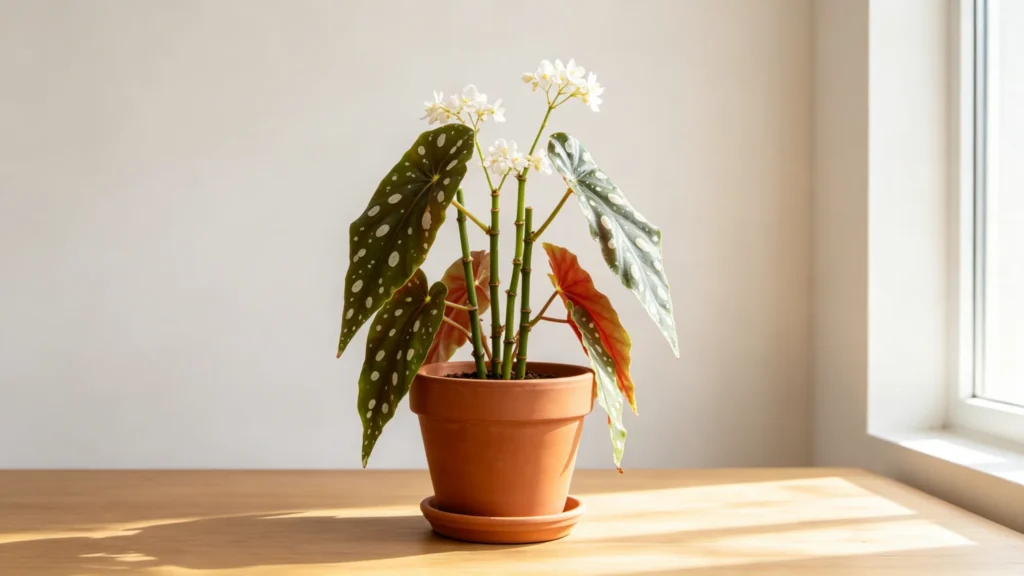
Polka Dot Begonia
Begonia maculata
A cane begonia with olive leaves dotted in silver and red undersides, growing upright on jointed bamboo-like stems with clusters of white or pink flowers.
Watering frequency
Every 5-7 days
Ideal temperature
60-75°F / 16-24°C
Humidity
50-70%
Care difficulty
Medium
Air purifying
No/Not Known
Growth rate
Fast
Plant size
2-5 ft / 0.6-1.5 m
Soil type
Airy, well-draining mix
Fertilizer need
Every 4-6 weeks, spring-early fall.
Care summary
- Light: Bright indirect light keeps the silver spots crisp.
- Water: Let the top of the mix partly dry, then water and drain well.
- Soil: Use an airy, well-draining mix with drainage holes.
- Humidity: Stable humidity with airflow; avoid wet leaves overnight.
- Support: Stake tall canes once the plant grows upright.
- Safety: Keep away from pets and children who may chew it.
Common problems
- Spots fading: insufficient light reduces contrast.
- Yellow leaves dropping: overwatering or poor drainage.
- Healthy leaves dropping: underwatering or a cold draft.
- Soft stems: saturated mix causing stem rot.
- Brown crispy edges: low humidity, salts, or inconsistent watering.
- Pests: mites, thrips, or mealybugs.
Plant care guide
About Polka Dot Begonia
Polka Dot Begonia (Begonia maculata) is a cane-stemmed begonia in the Begoniaceae family, grown for its striking foliage: olive-green leaves marked with round silver spots and backed by a deep red or burgundy underside. It grows upright on jointed, bamboo-like stems with swollen nodes, and it produces clusters of small white or pink flowers with yellow centers. It is one of the best-known cane begonias and is often called the Trout Begonia or Spotted Begonia because the silver dots resemble the markings on a trout.
The accepted botanical name is Begonia maculata, native to the Atlantic forest of Brazil. The cultivar most widely sold under this name is Begonia 'Wightii', a selection with pronounced silver spots; related selections such as 'Silverspot' are also distributed. Whatever the cultivar label, the care framework is the same: bright indirect light, even moisture, stable humidity with airflow, and upright support as the canes grow.
Why You'll Like It
Polka Dot Begonia delivers a strong foliage display with a fast, upright habit. The silver dots on the olive leaves are created by tiny air pockets just beneath the leaf surface that reflect light, which is why the spots can fade when light is too weak and sharpen again under brighter conditions. The red leaf undersides and the jointed, almost architectural stems add contrast even when the plant is not flowering.
It is also a generous bloomer indoors. Under bright filtered light, it produces pendulous clusters of small white or pink flowers, often in the cooler months, which makes it feel rewarding beyond the foliage. It grows quickly in good conditions, so it can fill a floor corner or a tall shelf within a season, though the tall canes may need staking to keep their shape.
The tradeoff is that it is a moderately demanding plant. It hates being too dry (lower leaves drop), too wet (stems soften and rot), or too dark (spots fade and growth stretches). Humidity matters, but stagnant, saturated air invites fungal disease, so the real challenge is balancing moisture, light, and airflow.
What Kind of Plant Is It?
Polka Dot Begonia is a cane begonia, meaning it grows on upright, segmented stems that look like bamboo, with regularly spaced swollen nodes. The leaves are asymmetrical, angel-wing shaped, with one side of the base wrapping further around the petiole than the other. This upright habit is the key difference from rex begonias such as Rex Begonia 'Red Tango' or Rex Begonia 'Midnight Magic', which grow low from a creeping rhizome and form a mound rather than a vertical plant.
Cane begonias are perennial and can become quite tall, reaching roughly 2–5 feet indoors. As the canes age, they may lean and benefit from a stake or moss pole. New growth comes from nodes along the stems and from the base, which is what makes stem cuttings such a reliable way to propagate the plant.
History of Polka Dot Begonia
Begonia maculata was first described in the early nineteenth century by the Italian botanist Giuseppe Raddi, who collected plants in Brazil, and the species is native to the Atlantic forest of southeastern Brazil. The name comes from the Latin maculata, meaning spotted, a direct reference to the silver dots on the leaves.
The plant entered horticulture as an ornamental and has remained a staple of cane-begonia collections. The cultivar 'Wightii' is a widely distributed selection prized for its clear silver spots, and it is the form most shoppers encounter under the "Polka Dot Begonia" or "Trout Begonia" name. As with many cane begonias, retail labeling may use the cultivar name, the species name, or a common name, so the exact label matters less than confirming the plant is a cane type before you choose a pot and support.
Popular Varieties and Related Plants
The name "Polka Dot Begonia" is used for the species and for a few close selections, and it is worth distinguishing them from other begonias in the same database.
- Begonia 'Wightii': The most common selection of B. maculata, with the classic silver dots on olive leaves and red undersides.
- Begonia 'Silverspot': A nursery selection of B. maculata with upright marked stems and elongated spotted leaves.
- Aconite-leaf Begonia (Begonia aconitifolia): A related cane begonia with deeply lobed, silver-marked leaves rather than the rounded polka-dot pattern; it shares the upright, bamboo-like habit and similar care.
- Rex Begonia 'Red Tango': A rex-cultorum begonia with a low rhizome habit, very different in form and pruning from a cane begonia.
Because these plants look different but belong to the same genus, do not assume they use identical care; the cane begonias need support and different pruning than the low rex types.
Where Polka Dot Begonia Works Best
Give Polka Dot Begonia bright indirect light. A position near an east-facing window is often straightforward, and a west or south window with a sheer curtain can work. In low light the silver spots fade and the stems stretch toward the window, so this is not a plant for a dark corner. Direct hot sun can bleach or scorch the leaves.
A bright bathroom with a window can work because the plant enjoys humidity, but it still needs light and air exchange. Avoid cold exterior doors, heating vents, and air conditioners that create abrupt temperature swings; a cold draft is a common cause of sudden leaf drop.
Polka Dot Begonia Care
Light
Provide bright indirect light. The silver spots are most crisp in good light, and new growth stays compact when the plant is not reaching for a window. An east window is ideal; a west window with a sheer curtain works; a south window should be filtered or set back. If the spots fade or the stems get long and weak, increase light gradually. Direct sun can burn the leaves, so filter harsh afternoon light.
Watering
Water when the top of the mix has begun to dry, typically every five to seven days in active growth, and then water thoroughly so excess drains away. The plant is sensitive at both extremes: a mix that stays wet invites stem and root rot, while allowing the plant to dry out completely makes the lower leaves yellow and drop. Let the surface approach dryness, then water; adjust the interval to your pot, light, and room rather than following a fixed calendar.
Soil and Container
Use an airy, well-draining mix that holds some moisture without collapsing, such as an indoor potting mix amended with perlite or fine bark. Choose a pot with drainage holes and one that matches the plant's size, since an oversized pot stays wet too long for cane begonias. Repot in spring when roots fill the container.
Humidity
Aim for stable humidity around 50–70% with good airflow. This is a plant that benefits from a humidifier or a pebble tray in dry rooms, but it does not tolerate wet leaves overnight or stagnant, saturated air, which promote fungal disease. Do not rely on misting as a universal fix; keep the leaves dry and the air moving instead.
Temperature
Keep temperatures around 60–75°F (16–24°C) and protect the plant from cold drafts and sudden temperature swings. Cane begonias are frost-tender, and a cold draft near a window can cause otherwise healthy leaves to drop. Keep the plant away from radiators, vents, and cold glass.
Fertilizer
Feed lightly every four to six weeks from spring through early fall while new leaves and canes are forming, using a diluted balanced fertilizer on already moist mix; reduce or pause feeding in winter when growth slows. Pale or weak growth is not automatically a deficiency, so check light, roots, and soil before reaching for fertilizer.
Pruning and Training
Pinch or trim the shoot tips during the growing season to encourage a bushier plant and prevent the leggy, open habit this species naturally develops. Cut just above a node with sterile scissors. As the canes grow tall, provide a stake or moss pole so the heavy stems do not lean or snap. Remove dead or damaged leaves at the base as needed.
Propagating Polka Dot Begonia
The most reliable home method is a stem cutting with at least one node. Take a cutting that includes a node, remove the lower leaves, and root it in water or a lightly moist, airy mix. Roots typically form at the node, and a node is the only part of the stem that can generate new roots and shoots, so a cutting without a node will not establish. Once roots are firm, pot the cutting in an airy mix and keep conditions warm, humid, and lightly moist while it adjusts.
Repotting Polka Dot Begonia
Repot when roots fill the container, the mix breaks down, or water bypasses the root ball. Choose a pot only slightly larger than the root system, use fresh airy mix, and keep the plant at approximately its previous depth. Water sparingly for the first week or two while the roots settle, and keep the plant in stable, bright indirect light.
Toxicity and Pet Safety
Polka Dot Begonia is Not pet safe. The ASPCA Begonia profile lists soluble calcium oxalates, vomiting and salivation in cats and dogs, and identifies underground parts as the most toxic. Keep pots, fallen leaves, and cuttings away from animals.
If a pet chews the plant, remove access and contact a veterinarian or an animal poison-control service for case-specific advice. Do not induce vomiting unless instructed. Wear gloves if sap irritates your skin, and keep discarded plant material away from children.
Common Problems and Practical Fixes
- Silver spots fading: Usually too little light. Move the plant to brighter indirect light gradually; the contrast between the air pockets and surrounding tissue improves as light increases.
- Yellow leaves dropping: Check for overwatering or poor drainage. Let the mix dry more between waterings and confirm the pot drains.
- Healthy leaves dropping: Often underwatering or a cold draft. Water more consistently and move the plant away from vents or cold glass.
- Soft or mushy stems: Saturated mix causing stem rot. Improve drainage, reduce watering, and remove affected stems with a clean tool.
- Brown crispy edges: Review low humidity, underwatering, fertilizer salts, or dry air together.
- Pests: Inspect leaf undersides and stem joints for mealybugs, spider mites, or thrips, and treat with a product labeled for indoor plants.
Frequently Asked Questions
Why are the spots on my Polka Dot Begonia fading? The silver spots are created by tiny air pockets under the leaf surface, and they lose contrast in weak light. Move the plant to brighter indirect light gradually; the spots usually sharpen as light improves.
Does it flower indoors? Yes, under bright filtered light it produces clusters of small white or pink flowers, often in cooler months.
Why is it dropping leaves? Leaf drop usually points to underwatering, overwatering, or a cold draft. Check the soil moisture and move the plant away from vents or cold windows, then adjust your watering to the plant's actual needs.
How do I keep it from getting leggy? Pinch the shoot tips during the growing season to encourage branching, and give the plant bright indirect light so the stems stay compact.
Final Thought
Polka Dot Begonia is a dramatic cane begonia that rewards consistent care. Give it bright indirect light to keep the silver spots crisp, water on a cycle of moisture and aeration rather than a rigid schedule, and keep humidity steady with good airflow. Pinch and stake the canes as it grows, and the plant will reward you with fast growth, spotted foliage, and clusters of delicate flowers.