
Star Cactus
Astrophytum asterias
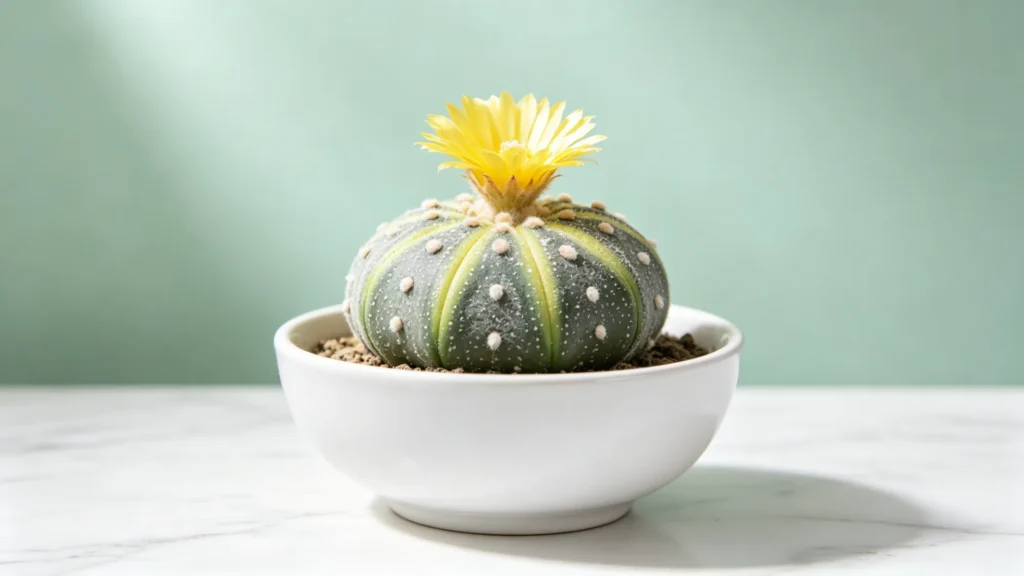
A small, nearly spineless globe cactus with a flattened sand-dollar body, white woolly flecks, and a sunny yellow flower, needing bright light and very sparse watering.
Watering frequency
Every 3-4 weeks
Ideal temperature
60-80°F / 16-27°C
Humidity
40-50%
Care difficulty
Medium
Air purifying
No/Not Known
Growth rate
Slow
Plant size
Up to 3 in tall, 1-6 in wide / 7 cm tall, 2.5-15 cm wide
Soil type
Well-draining cactus or succulent mix
Fertilizer need
Monthly, spring-early fall.
Care summary
- Light: Bright light with gradual sun acclimation; filter harsh midday sun.
- Water: Water only when the mix is fully dry, then drain well.
- Soil: Use a gritty, fast-draining cactus or succulent mix.
- Humidity: Average room humidity is fine; never mist the body.
- Blooming: Give bright light and a cooler, drier winter rest.
- Safety: Provisional Pet safe category from same-family evidence; species-specific safety is unverified.
Common problems
- No new growth: allow for seasonal rest; check light, temperature, roots, mix, and pests before feeding.
- Soft or mushy body: overwatering or poor drainage.
- Shriveled or wrinkled body: underwatering or root damage.
- Pale or stretched growth: too little light.
- No flowers: too little light or too warm a winter rest.
- Brown or sunken patches: sunburn or cold damage.
- Pests: scale, mealybugs, or root mealybugs.
Plant care guide
About Star Cactus
Star Cactus (Astrophytum asterias) is a small, nearly spineless globular cactus in the Cactaceae family, native to arid regions of northern Mexico and southern Texas. It is grown for its flattened, disc-like body with eight symmetrical ribs, dotted with small white woolly flecks, which gives it the look of a sea urchin or a sand dollar. In summer it produces a sunny yellow flower with an orange center at the crown.
The accepted botanical name is Astrophytum asterias. The common names describe the same shape: "Star Cactus" for the ribbed, star-like outline, "Sand Dollar Cactus" and "Sea Urchin Cactus" for the flattened, patterned body. It was described as Echinocactus asterias in 1845 and placed in Astrophytum in 1868. It is one of the most collectible small cacti, prized for its perfect geometry and its lack of spines.
Why You'll Like It
Star Cactus is a study in geometric beauty. The flattened body, usually only a few inches across, is divided into eight symmetrical ribs covered in small white woolly flecks, and it sits so low that it looks more like a patterned stone than a plant. Its almost spineless body is visually distinctive, and its small size suits a windowsill without taking over. Handle it gently nonetheless: the skin and woolly markings can be damaged by gripping or scrubbing.
Flowering is an additional reward once the plant is sufficiently mature. Under bright light, mature plants open a single, showy yellow flower with an orange center at the crown in summer, a striking contrast against the muted green body. Its slow growth means changes are subtle, so a short weekly inspection is more useful than frequent watering. Drought tolerance does not protect it from rotten roots, poor light, or sudden sun exposure.
The tradeoff is that it is unforgiving of two things: too much water, which rots the small body quickly, and too little light, which stretches and weakens it. Get bright light and sparse watering right, and the plant thrives for years.
What Kind of Plant Is It?
Star Cactus is a globular cactus, but unlike most globes it is strongly flattened, almost pancake-like, and sits close to the ground. The body has eight ribs, each dotted with small, fuzzy white areoles, and there are essentially no spines. The flowers are apical and solitary: up to about 2 inches (5 cm) across, with yellow petals that may carry an orange-red base, opening during the day in summer.
Because it is small, slow-growing, and nearly spineless, it is very different in habit from a trailing cactus like the Monkey Tail Cactus or a taller columnar form. It is closest in use to the Dwarf Chin Cactus, another low desktop globe, but with a flatter silhouette, no meaningful spines, and a different flower color.
History of Star Cactus
Kew accepts Astrophytum asterias and records its native range from southern Texas into Nuevo León and Tamaulipas in Mexico. The earlier name Echinocactus asterias is a botanical synonym, not another plant for the collection.
Its habitat should not be reduced to open sandy desert. The U.S. Fish and Wildlife Service's habitat account describes sites with grass and shrubs, including partial shade and clay or loam soils. Such field conditions do not mean compact local clay is suitable in an indoor pot: rainfall, drainage, root space, and evaporation differ substantially.
Buy Nursery-Propagated Plants, Not Wild Specimens
The U.S. Fish and Wildlife Service listed Star Cactus as endangered in 1993. Habitat loss and collection are important parts of its conservation story. Do not assume a retail listing automatically proves nursery propagation.
Choose a grower who can explain the plant's origin and confirm nursery propagation. Keep the label, receipt, and any provenance information, particularly for an unusually large or old-looking specimen. Avoid collecting plants or seed from wild populations. For cross-border purchases, check the applicable plant-health and protected-species requirements before ordering; a seller's willingness to ship is not proof that the transaction complies with them.
Related Cacti
Star Cactus is best understood alongside the other cacti in the same database, since they share the Cactaceae family but differ in habit and care.
- Dwarf Chin Cactus (Gymnocalycium baldianum): Another small, low desktop globe cactus, with curved spines and pink to crimson flowers; a natural companion on a windowsill.
- Monkey Tail Cactus (Cleistocactus colademononis): A trailing, white-fuzzy cactus with red or pink flowers, offering a hanging-basket alternative to the compact globe.
- Fishbone Cactus (Disocactus anguliger): A forest cactus with flattened zigzag stems and night-blooming flowers, needing more regular moisture and gentler sun.
These plants are related but not interchangeable; match the care to each plant's native habit rather than assuming they all behave the same.
Where Star Cactus Works Best
Choose a genuinely bright windowsill with space for a small, draining pot. Gentle morning sun is a useful starting point; strong south- or west-facing glass may require filtering during hot weather. A desktop is suitable only if it actually receives sufficient light, not merely because the plant fits there.
Keep it somewhere you can see the crown and soil surface for a quick check. A pot sunk into a deep decorative bowl can hide retained water, and a heavy layer of stones can conceal a deteriorating base. A ventilated, bright room is more appropriate than a dark, humid display case.
Star Cactus Care
Light
Provide bright light and introduce direct sun gradually. Star Cactus does not need to be abruptly placed in baking midday sun to remain compact. If moving it from nursery shade to a sunny window, increase exposure over one to two weeks and use a sheer curtain where the glass becomes very hot.
Look for healthy, compact new growth rather than a particular window direction. Stretching indicates inadequate light, while sudden pale, tan, or sunken patches after a move suggest damage. Scorched tissue does not turn green again; protect the remaining healthy body and avoid adding extra water as a treatment for sunburn.
Watering
Water an established, own-root plant when the entire root zone is dry. Three to four weeks is a starting indoor reference during growth, not a mandatory interval. Small pots in bright warmth may dry sooner; cool rooms or dense mixes may take longer. Check pot weight and deeper moisture before acting.
When watering is needed, wet the mix evenly and drain the pot completely. Avoid repeated tiny splashes that wet only the surface while leaving parts of the roots dry. Do not let water pool around the crown. During a cool winter rest, keep the pot substantially drier and pause routine calendar watering.
A slightly contracted but firm body during rest is not automatically an emergency. Wrinkling with wet soil, increasing softness, or discoloration at the base is more concerning and calls for a root inspection, not another drink.
Soil and Container
Use a fast-draining cactus mix with substantial mineral structure, such as pumice or perlite, rather than fine, compacted compost. A commercial cactus label is not enough: check how the mix behaves after watering. It should drain freely yet allow roots to become evenly wetted.
Choose a pot with drainage holes, sized to the actual root system rather than only the visible globe. Avoid a deep reserve of unused wet substrate. Do not bury the base in damp mix or seal the pot surface under dense decorative material. The aim is a root zone that can dry predictably, not simply a surface that looks dry.
Humidity
Star Cactus prefers low to average household humidity and does not need a humidifier. High humidity with wet soil is a common cause of rot, so keep it in a dry, bright room. Do not mist the body; the woolly flecks can hold moisture against the skin.
Temperature
Aim for 60–80°F (16–27°C) during growth. A cooler rest around 50–60°F (10–16°C), with very limited moisture, is a practical indoor approach. Set 50°F (10°C) as the firm minimum for this routine; it is a conservative care boundary, not an experimentally established lethal point. Protect the pot from frost and cold windows, and do not test cold tolerance while the roots are wet.
Fertilizer
Feed monthly from spring through early fall during active growth with a diluted balanced or low-nitrogen cactus fertilizer. Stop feeding in winter during the rest period, and avoid feeding a stressed or recently repotted plant.
Pruning and Grooming
Star Cactus needs no pruning. Remove dead or damaged tissue with a clean tool only if needed, and keep the body clean and dry. Otherwise leave the plant alone; it maintains its shape on its own.
Propagating Star Cactus
Seed is the usual propagation route because the species generally remains solitary. Plan sowing for late spring or early summer, with steady warmth and bright filtered light. Use nursery-produced seed from a documented source, clean containers, and a fine, freely draining seed medium.
During germination and early establishment, keep the surface lightly moist rather than applying the adult cactus's long dry intervals. Ventilate carefully, avoid stagnant wet conditions, and protect young seedlings from harsh sun. Timing varies with seed quality and temperature; expect slow development and judge progress by healthy growth, not a promised date.
This is a patient hobby project rather than an impractical method. However, cutting a healthy adult globe into pieces is not a routine substitute for seed sowing. If a plant is grafted, it may behave differently from an own-root specimen, and removal from the stock requires more experience than ordinary repotting.
Repotting Star Cactus
Inspect the roots and substrate in spring, with repotting roughly every two to three years only when required. Mix deterioration, drainage failure, and unhealthy roots matter as much as roots filling the pot. Use a container that accommodates healthy roots without adding a large volume of unused damp mix.
Support the plant gently and avoid rubbing its woolly markings. Remove loose old substrate and clearly dead roots without aggressively stripping every root clean. Keep the base at its previous level, allow cut roots to dry, and resume watering cautiously once conditions are warm. Do not fertilize immediately to compensate for transplant stress.
Own-Root Versus Grafted Plants
A plant growing directly from its roots is the basis for this care profile. A grafted plant has the Star Cactus body attached above another cactus's stem and roots. The stock can affect growth speed, watering needs, and cold response. Ask the seller which form you are buying; an unusually tall supporting stem is not the natural shape of A. asterias. Do not apply the same drying interval blindly to both.
Toxicity and Pet Safety
This database uses Pet safe as a provisional editorial category based on same-family evidence, not a species-specific veterinary assessment. The ASPCA Easter Lily Cactus record lists Echinopsis multiplex, another member of Cactaceae, as non-toxic to cats and dogs. This does not establish that every cactus, or this particular species, has the same safety profile. A species-specific non-toxic listing has not been verified for this profile.
Keep the plant out of reach rather than treating the category as permission to chew it. Physical injury, swallowed plant material, and residues from plant-care products are separate concerns from chemical toxicity. If a pet eats the plant or shows mouth discomfort or vomiting, contact a veterinarian and provide a photo and botanical name.
Its nearly spineless body reduces one obvious physical hazard compared with spiny cacti, but does not establish chemical safety. A grafted specimen may also have spines on the rootstock.
Common Problems and Practical Fixes
- Little or no new growth: Slow growth during cool or short-day periods can be normal. For a persistent stall in warm, bright conditions, check light, temperature, root health, compacted mix, pests, and genuine root crowding before adding fertilizer or repotting.
- Soft, mushy tissue: Check the base and roots immediately. If rot is present, simply drying the pot may not stop it; remove affected material with a clean tool and retain only firm, healthy tissue. Replace persistently waterlogged mix and correct the watering conditions.
- Wrinkling: Compare the stem's firmness with moisture deeper in the pot. Dry mix and healthy roots suggest thirst; wrinkling while the mix is wet suggests impaired roots, so do not automatically add water.
- Pale, stretched growth: Too little light. Move the plant to brighter light gradually.
- No flowers: Often too little light or a winter rest that was too warm or wet. Give the plant bright light and a cooler, drier rest.
- Brown or sunken patches: Sunburn from sudden direct sun, or cold damage. Acclimate to sun gradually and protect from frost.
- Pests: Scale and mealybugs can hide in the woolly areoles and under the ribs; inspect and treat with a product labeled for indoor plants.
Frequently Asked Questions
Why is it called Star Cactus? The ribbed, star-like outline of the flattened body gives it the name; "Sand Dollar Cactus" and "Sea Urchin Cactus" describe the same patterned, disc-like shape.
Does it flower? Yes. Under bright light, mature plants open a sunny yellow flower with an orange center at the crown in summer.
Is it safe for pets? The Pet safe label here is a provisional same-family classification, not a verified non-toxic finding for this species. Keep it away from chewing pets; the absence of obvious spines does not prove chemical safety.
How often should I water it? Very sparingly. Water only when the mix is fully dry, typically every three to four weeks in the growing season and much less in winter.
Final Thought
Star Cactus is a small masterpiece of cactus geometry: a nearly spineless, flattened globe that asks for bright light and very little water and rewards you with a sunny yellow flower. Give it a sunny windowsill, a gritty fast-draining mix, and a cooler, drier winter rest, and this slow-growing plant will stay beautiful for years.