
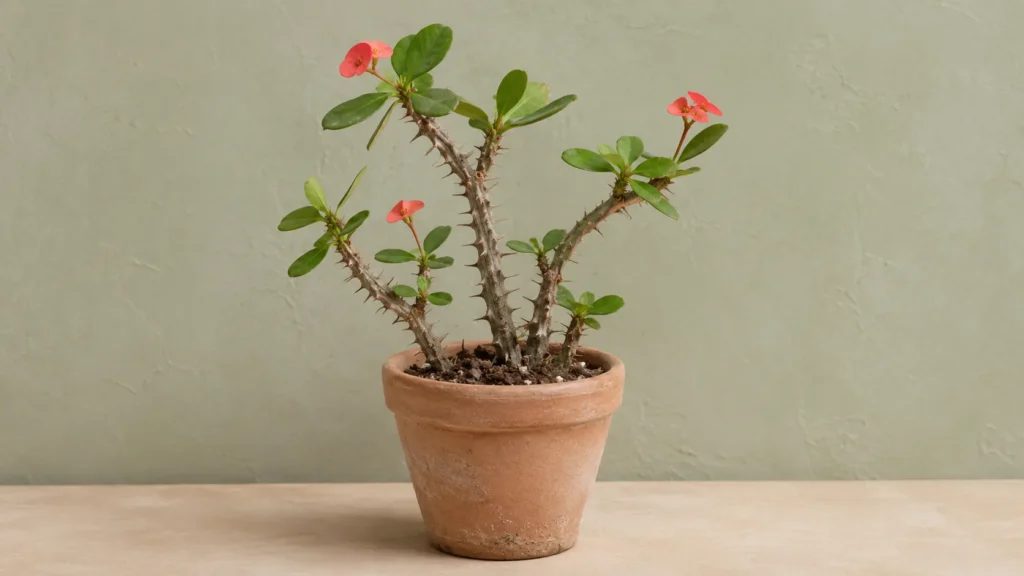
Crown of Thorns
Euphorbia milii
A thorny Madagascan Euphorbia with small true flowers framed by colorful red, pink, or pale bracts.
Watering frequency
Water after the upper mix dries; let more of the mix dry in cool, dim weather
Ideal temperature
About 65-80°F / 18-27°C; keep frost-free
Humidity
Average to dry indoor air
Care difficulty
Medium
Air purifying
No/Not Known
Growth rate
Moderate
Plant size
Often under 2 ft / 0.6 m in pots; may grow larger with age and suitable conditions
Soil type
Fast-draining succulent mix with a drainage hole
Fertilizer need
Feed lightly during active growth, especially if flowering declines in an otherwise healthy plant.
Care summary
- Light: Strong light, including some direct sun after acclimation.
- Water: Let the upper mix dry and drain thoroughly.
- Soil: Use a fast-draining mix in a modestly sized pot.
- Display: Colorful bracts surround tiny true flowers.
- Pruning: Cut cautiously around sharp thorns and irritating latex.
- Safety: Keep away from pets and children.
Common problems
- Few bracts or leggy stems: check whether the plant receives enough bright light.
- Yellowing leaves with wet mix: review drainage and watering frequency.
- Sudden leaf loss: check cold, drought, and recent environmental changes.
- Thorn injuries or latex exposure: use gloves and avoid handling near eyes.
Plant care guide
About Crown of Thorns
Crown of Thorns (Euphorbia milii) is a spiny, succulent shrub in the Euphorbiaceae family. Kew accepts the species and lists Madagascar as its native range. It is grown for clusters of tiny flowers surrounded by long-lasting colorful bracts. The combination of sharp stems and bright display makes it memorable, but also calls for a considered position in the home.
This page covers E. milii. “Crown of Thorns” is used loosely in horticulture for related plants and hybrids, so a common-name label alone may not establish an exact species or cultivar. In particular, Kew treats Euphorbia splendens as a separately accepted species, so it should not automatically be listed as a synonym of E. milii.
Why You'll Like It
Given enough light, Crown of Thorns can add color for a long stretch of the year. The display appears at the tips of branching stems, where red, pink, white, or yellowish bracts frame small true flowers. It suits a sunny indoor spot and asks for less frequent watering than many leafy flowering houseplants.
The plant is most comfortable in a dedicated place rather than a shelf that is handled daily. Its thorns catch sleeves and skin, while broken parts release irritating milky sap. If that placement is not possible, choose a less hazardous flowering plant.
How to Identify Crown of Thorns
Look for woody or semi-woody stems densely armed with thorns, with oval leaves near newer shoot tips. Flower clusters are small; the showy colored parts are bracts rather than oversized petals. The plant may shed some leaves and still retain healthy stems. RHS species details describe its prickly shrub form and red bracts around small yellow flowers.
Do not identify a cultivar by bract color alone. There are numerous selections and hybrids in cultivation, and growing conditions can change the intensity of color. Keep a documented cultivar name from a reliable label; otherwise, the species name or a cautious Euphorbia identification is more accurate.
How It Differs From Other Euphorbias
Poinsettia also has colorful bracts, but its leaves are much larger and its holiday display depends on long nights. African Milk Tree is upright and angular, with tiny leaves and paired spines on stem ridges. Crown of Thorns instead has a branching, thorny shrub habit and colorful bracts around small flower clusters. All three can release irritating latex; shared family membership does not mean identical care.
Where It Works Best
Place Crown of Thorns at a bright window where it receives strong light and, once acclimated, some direct sun. Good light helps maintain compact growth and bract production. A plant newly purchased from shade needs a gradual transition to intense sun. NC State Extension recommends strong light for indoor flowering and a well-drained medium.
Avoid a passageway where people will brush against it. Keep the pot beyond the reach of pets and children. A steady windowsill is useful if its thorns will not snag curtains and the leaves will not press against cold glass.
Crown of Thorns Care
Light. Give bright light, including direct sun if the plant has adjusted to it. Sparse flowers and stretched new growth often indicate that the position is too dim. A sudden move into hot midday sun may scorch a sheltered plant, so increase light in stages.
Water. Let the upper part of the mix dry, then water thoroughly and allow the pot to drain. Crown of Thorns is drought-tolerant once established, but repeated extreme dryness can cause leaf drop and reduce growth. In cool or dim conditions, the soil dries more slowly; check before watering. Persistently wet mix can damage roots.
Soil and pot. Choose a free-draining succulent mix and a pot with a drainage hole. Avoid an oversized container that holds damp soil around a small root system. A stable pot helps prevent thorny branches from toppling into people or nearby plants.
Temperature and humidity. Keep it frost-free and away from cold drafts. Ordinary indoor humidity is generally suitable; high humidity is not a substitute for root watering. Maintain air movement without placing the pot where it will be knocked over.
Feeding. A light, balanced feed during active growth is enough. If the plant is not flowering, fix weak light first rather than increasing fertilizer. Stop feeding when growth slows.
Pruning, Propagation, and Repotting
Prune to control size or remove damaged branches, using clean tools and thick gloves. Eye protection is sensible because cut stems release latex. Keep the work surface covered and do not touch your face while cutting. Allow cuttings to dry before rooting them in a gritty medium in a warm, bright place. Discard pruned parts where pets cannot reach them. RHS warns that the sap is a skin and eye irritant.
Repot only when the roots need more room or the mix has degraded. Move up gradually in pot size and preserve good drainage. If a plant is leafless after stress, inspect stem firmness and roots before assuming a bigger pot will help.
Is Crown of Thorns Safe for Pets?
No. Sharp thorns can injure, and broken stems release irritating latex. Keep the plant away from pets and young children, and wear gloves when handling it. Wash skin after sap contact. If latex enters an eye, rinse immediately and seek medical advice; if a pet chews the plant, contact a veterinarian. The same precautions apply to fallen cuttings after pruning.
Common Problems
- Few colorful bracts: Move toward brighter light gradually and check that the plant is actively growing.
- Yellow leaves and soggy soil: Improve drainage and review watering frequency; inspect roots if stems become soft.
- Leaf drop after a move: Check cold exposure, strong sun, and watering changes. Healthy firm stems may regrow leaves.
- Long, sparse stems: Give more light and consider cautious pruning after the plant is healthy.
- White cottony insects: Inspect leaf joints and bract clusters for mealybugs; isolate the plant and handle it with gloves.
Frequently Asked Questions
Are the colored parts flowers? They are bracts around small true flowers.
Does Crown of Thorns need full sun? Strong light is important for compact growth and flowering. Introduce direct sun gradually to prevent scorching.
Is it the same plant as Euphorbia splendens? Do not assume so. Kew currently accepts E. splendens separately; a nursery common name may cover more than one related plant.
Can I grow it near pets? Choose a location pets cannot access. The thorns and latex both create avoidable risks.
With abundant light, careful drainage, and a safe position, Crown of Thorns can be a distinctive flowering succulent for years.