
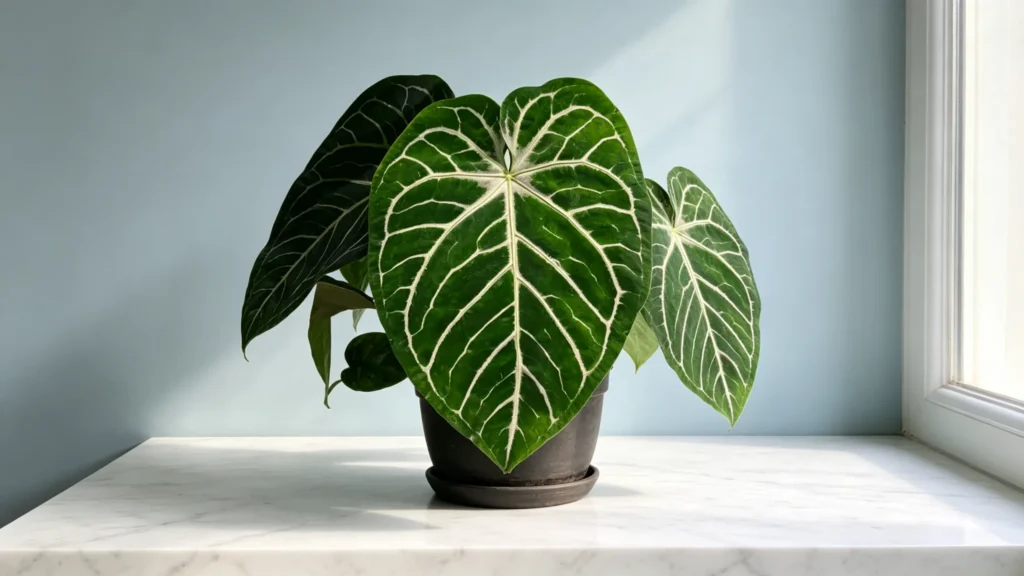
Anthurium Magnificum
Anthurium magnificum
A large velvet-leafed anthurium from Colombia with broad heart-shaped leaves and silver veins, most reliably identified by its four-angled petioles.
Watering frequency
Every 5-7 days
Ideal temperature
65-80°F / 18-27°C
Humidity
60-80%
Care difficulty
Hard
Air purifying
No/Not Known
Growth rate
Moderate
Plant size
1-4 ft / 0.3-1.2 m
Soil type
Chunky aroid mix
Fertilizer need
Every 4-6 weeks, spring-early fall.
Care summary
- Light: Bright indirect light; filter direct sun.
- Water: Let the upper mix partly dry, then water and drain well.
- Soil: Use an airy, chunky aroid mix around the roots.
- Humidity: Stable 60-80% humidity helps new leaves expand cleanly.
- Safety: Keep away from pets and children who may chew it.
Common problems
- Yellow leaves: overwatering, root stress, or normal aging.
- Brown crispy edges: low humidity, inconsistent watering, or fertilizer salts.
- Torn or misshapen new leaves: low humidity or physical damage during expansion.
- Faded leaves or tan patches: too much direct sun.
- Pests: thrips, spider mites, scale, or mealybugs on new growth.
Plant care guide
About Anthurium Magnificum
Anthurium Magnificum (Anthurium magnificum) is a large velvet-leafed aroid in the Araceae family, grown for its broad, heart-shaped leaves with prominent pale silver-green veins over a dark velvety surface. The accepted species is native to Colombia, where records place it in humid Andean and forest habitats rather than ordinary dry household conditions. In cultivation it is often grouped with the other velvet anthuriums, but it is reliably distinguished from most of them by its four-angled petioles — the leaf stalks feel squared or winged in cross-section, while similar species such as Anthurium crystallinum have rounded petioles.
The Royal Horticultural Society's Anthurium magnificum record describes the heart-shaped, dark green velvet leaves with prominent pale veins, notes the four-sided leaf stalks, and reports that in ideal cultivation the plant can grow to about 1.2 m with leaves up to 90 cm across. That gives a fair picture of the plant's ambitions: it is bigger, slower, and more demanding of stable warmth and humidity than a typical houseplant, and it is best suited to growers who can offer bright filtered light, an airy root zone, and steady conditions.
Why You'll Like It
Anthurium Magnificum is a statement foliage plant. Its broad, soft velvet leaves with silver veins read as almost architectural, and the four-angled petioles add a subtle squared structure that collectors learn to recognize at a glance. It offers the drama of the giant velvet anthuriums at a scale that, while still large, can be managed indoors for years.
It is also a plant with a clear developmental rhythm: new leaves often open with a bronze or reddish flush before darkening and firming as the veins become sharper. Watching that transition is one of the most rewarding parts of growing it. The honest tradeoff is that it is a slow, demanding grower — mistakes such as letting the roots stay soggy, exposing the velvet to direct sun, or letting the air stay very dry leave permanent marks on long-lived leaves.
What Kind of Plant Is It?
Anthurium Magnificum is a tropical, evergreen perennial in the Araceae family, growing as a terrestrial to hemiepiphytic plant in humid Colombian forest. It forms a central crown rather than a running vine, with leaves on long upright petioles. Leaves are the display: broadly heart-shaped (cordate), thick and softly velvet, dark green, with a prominent pale green or silver primary vein and a network of secondary veins. Mature blades commonly reach 40–60 cm long and can exceed that under ideal conditions. Petioles are the key identifying feature: they are four-angled or winged in cross-section, where A. crystallinum has rounded petioles. Stem and roots form a compact root system that prefers a coarse, well-aerated mix; the plant is not tolerant of dense wet soil.
Because the velvet surface is easily damaged, handle leaves as little as possible, avoid leaf-shine products, and lift dust with a very soft dry brush rather than rubbing. New leaves need stable humidity while they expand; if the air is dry they can emerge misshapen, torn, or with hardened dry margins.
History of Anthurium Magnificum
Anthurium Magnificum belongs to the group of velvet-leafed anthuriums that entered European horticulture in the nineteenth century, when plant hunters and commercial nurseries introduced tropical foliage aroids to conservatory growers. It is native to Colombia and has been in cultivation long enough to be a well-established species in collections, though popular sources record little of the exact collecting history in detail. The accepted name here is Anthurium magnificum Linden; a different historical name published as Anthurium magnificum W.Bull is treated as a synonym of Anthurium grande, so source checks should avoid mixing those records. The name magnificum means "magnificent" in Latin, a fitting epithet for one of the larger velvet anthuriums.
Like its relatives A. crystallinum and A. regale, it was prized first by greenhouse growers and later by the modern houseplant trade, where it is now sold both as a species and as a parent of velvet-leaf hybrids. If you buy a plant labeled simply "velvet anthurium," confirm whether it is this species, a different velvet-leaf species, or a hybrid, because mature size and tolerance can differ.
Related Velvet Anthuriums
Anthurium Magnificum is frequently confused with other velvet anthuriums, and the botanical label matters because size, petiole shape, and tolerance differ.
- Anthurium Crystallinum: Broad heart-shaped velvet leaves with rounded petioles; generally smaller and somewhat more tolerant than Magnificum.
- Anthurium Clarinervium: Compact habit with thick leaves and pale veins; much smaller, and more forgiving of average household humidity.
- Anthurium Regale: Can produce very large elongated velvet leaves with silver venation under suitable conditions; a different scale and less forgiving of poor acclimation.
- Velvet hybrids: Many nursery plants combine several species. Retain the full label, because appearance alone cannot reveal parentage.
These are related species rather than interchangeable varieties. If you want a flowering aroid instead, Red Anthurium (Anthurium andraeanum) is widely available and easier in average rooms.
Where Anthurium Magnificum Works Best
Give Anthurium Magnificum bright indirect light and stable warmth. An east-facing window, or a west or south window filtered by a sheer curtain, usually works well. Direct hot sun scorches the velvet leaves; too little light slows growth and produces smaller, paler leaves. Because the plant needs consistent humidity and warmth, a bright bathroom with a window or a living area with a humidifier is a practical home. Avoid cold drafts, exterior doors, heating vents, and air conditioners that cause abrupt swings.
Space is a real requirement. Between the broad leaves and the long upright petioles, a mature plant needs a floor stand or a sturdy low table, not a crowded shelf. Grow lights can provide consistency when natural light is limited; start with a full-spectrum LED 12–18 inches above the plant and run it 12–14 hours daily, adjusting by the plant's response.
Anthurium Magnificum Care
Light
Provide bright indirect light. Anthurium Magnificum needs good light to maintain compact growth and rich leaf color, but direct sun burns the velvet surface. An east window is ideal; a west window with a sheer curtain works; a south window should be filtered or set back. Long petioles reaching for the window or small pale leaves suggest too little light; bleached patches or crispy brown areas indicate too much direct sun.
Watering
Water when the upper portion of the mix has begun to dry and the pot feels lighter, then wet the root ball thoroughly and let all excess drain. A "every 5–7 days" note is a starting point, not a fixed schedule: a large plant in warm bright conditions dries faster, while a recently repotted plant in winter may go much longer between waterings. The goal is a cycle of moisture and aeration, not constant saturation or prolonged bone-dryness. Hard tap water can leave mineral salts; where water is hard, rainwater or filtered water reduces buildup, and an occasional flush helps.
Soil and Container
Use an airy, chunky aroid mix — for example fine or medium orchid bark, perlite or pumice, and a moisture-retentive component such as coco coir or quality potting mix. Adjust proportions to your room's drying speed. Use a pot with drainage holes only slightly larger than the healthy roots; an oversized pot holds moisture and raises rot risk. Plastic retains water; clay dries faster. Match the container to your mix rather than assuming one material is always best.
Humidity
Aim for stable moderate-to-high humidity, roughly 60–80%, and observe the plant. A room humidifier helps new leaves expand cleanly. Occasional misting is a poor substitute for ambient humidity and can encourage disease if leaves stay wet without airflow. High humidity with stagnant air is not an improvement; keep some gentle air movement.
Temperature
Keep temperatures around 65–80°F (18–27°C) and avoid prolonged cold below about 60°F (16°C). Anthuriums are damaged by much lower temperatures; the RHS Anthurium guidance recommends warmth, indirect light, and a well-drained acidic mix. Do not respond to cold by keeping the mix wet.
Fertilizer
Feed lightly every four to six weeks from spring through early fall, while new leaves are forming, with a diluted balanced or aroid fertilizer on already moist mix; reduce or pause in winter when growth slows. Pale new growth is not automatically a deficiency: root damage, intense light, pests, and normal leaf hardening all change color. Flush salts occasionally and pause feeding after repotting or when roots are stressed.
Pruning and Training
Remove yellowed or dead leaves by cutting the petiole at the base with sterile scissors. Clean the velvet leaves with a soft dry brush rather than leaf-shine products. If the plant becomes too large, divide it at repotting rather than cutting the crown aggressively. New leaves benefit from stable humidity; do not move the plant around while a leaf is expanding.
Propagating Anthurium Magnificum
The most practical home method is dividing the plant at repotting, separating sections that each have their own roots and growth point. Pot each division snugly in an airy mix and keep conditions warm and stable while roots reestablish. A detached leaf without a viable stem growth point cannot produce a new plant.
Advanced growers may root stem sections in a controlled high-humidity environment, but decay is a significant risk if the medium stays saturated. Seed propagation is possible after successful pollination and berry development, but seedlings vary genetically and take years to mature. Buy traceable nursery-propagated material rather than collecting wild plants.
Repotting Anthurium Magnificum
Repot when roots fill the container, the mix breaks down, water bypasses the root ball, or a root problem requires intervention. Do not disturb a healthy plant merely because spring arrived. When repotting, preserve firm roots, remove only dead or rotten tissue with a clean tool, and keep the crown at about its previous level. Use a pot only slightly larger than the root ball with fresh chunky mix. Keep the plant in slightly lower light and stable humidity for a week or two while it recovers.
Toxicity and Pet Safety
Anthurium Magnificum is Not pet safe. Like other anthuriums, it contains insoluble calcium oxalate crystals (raphides) that cause immediate oral irritation, drooling, vomiting, and difficulty swallowing when chewed. The RHS Anthurium safety guidance advises keeping all parts away from children and pets and wearing gloves when handling; sap may irritate sensitive skin or eyes.
If a pet bites the plant, remove access and contact a veterinarian or an animal poison-control service. Drooling, mouth pain or swelling, vomiting, and difficulty swallowing need prompt attention; breathing or swallowing difficulty is urgent. Do not induce vomiting or use home remedies unless directed by a professional.
Common Problems and Practical Fixes
- One lower leaf turns yellow: Can be normal aging, especially while a new leaf develops. Several yellow leaves with wet mix suggest root stress or overwatering.
- Brown edges or crispy tips: Check drying speed, water quality, salts, drafts, and humidity. Do not raise humidity blindly while roots stay wet.
- A new leaf tears or hardens misshapen: Low humidity, physical contact, pests, or an abrupt watering change during expansion may be involved. Judge the next leaf after correcting conditions.
- Leaves fade or develop tan patches: Direct sun can scorch the surface. Move to filtered light gradually.
- The plant droops in wet soil: Inspect roots before watering again. Rotten roots are dark, soft, or hollow and may smell sour.
- Small new growth: Review light and root health, then inspect for thrips or mites. A recently divided plant may temporarily downsize.
- Spots spread across leaves: Isolate the plant, keep foliage dry, improve airflow, and avoid splashing between plants.
- Thrips, mites, scale, or mealybugs: Inspect new leaves, petioles, and undersides with a magnifier. Isolate and treat with a product labeled for indoor ornamentals, testing on a small velvet area first.
Frequently Asked Questions
How do I tell Magnificum from Crystallinum? Check the petiole. Anthurium Magnificum has four-angled, squared petioles; Anthurium crystallinum has rounded petioles. Magnificum also tends to be larger overall.
Is Anthurium Magnificum hard to care for? It is more demanding than common houseplants because the velvet leaves are easily damaged and the roots dislike dense wet mix. It becomes manageable with stable light, drainage, warmth, and watering.
Does it need very high humidity? It prefers high humidity, and a humidifier helps new leaves expand cleanly. Stable moderate-to-high humidity with good airflow and healthy roots matters more than chasing an exact percentage.
Can I propagate it from a single leaf? No. A leaf without a viable stem growth point cannot produce a complete plant. Use a rooted division or offset.
Final Thought
Anthurium Magnificum rewards patience and stability. Give it bright filtered light, an airy root zone, steady warmth and humidity, and room to spread, and it repays you with some of the most dramatic velvet foliage a houseplant can offer. Protect each emerging leaf, accept the occasional mark on a long-lived leaf, and let the plant mature at its own pace — the result is a centerpiece that looks less like a potted plant and more like a living sculpture.