
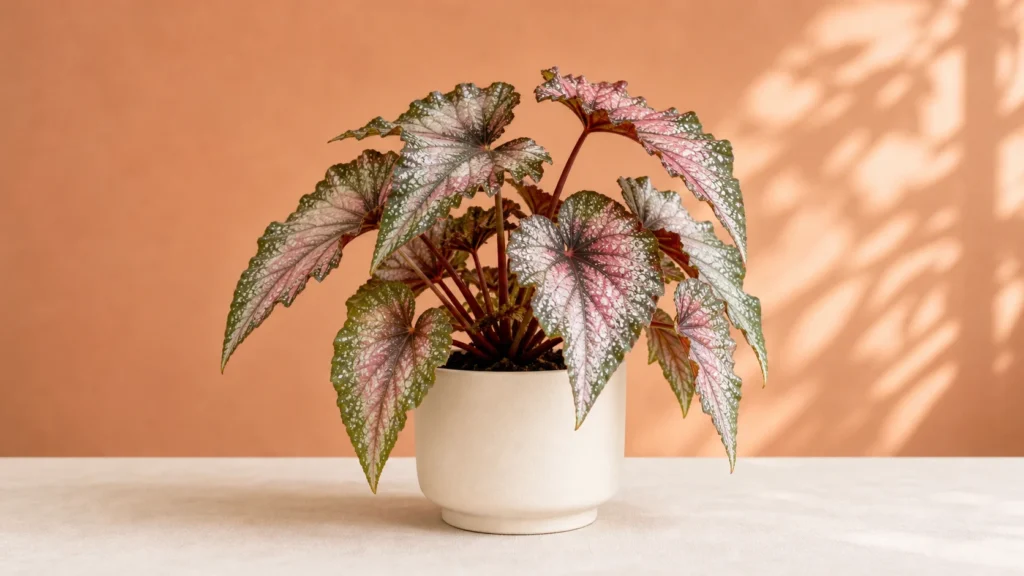
Begonia ‘Robert Golden’
Begonia 'Robert Golden'
A rhizomatous foliage begonia with lobed silver leaves, pink around dark veins, and a dark green edge.
Watering frequency
Check weekly; water when the upper mix is dry
Ideal temperature
About 65-75°F / 18-24°C; avoid cold drafts
Humidity
Moderately humid air with good circulation
Care difficulty
Medium
Air purifying
No/Not Known
Growth rate
Moderate
Plant size
Small nursery pot; older plants can spread and grow upright
Soil type
Shallow pot and airy, well-draining mix
Fertilizer need
Feed lightly during active growth; pause in winter.
Care summary
- Light: Bright indirect light supports the silver and pink pattern.
- Water: Water after the upper mix dries; drain the pot fully.
- Soil: Use an airy mix in a shallow pot with drainage holes.
- Growth: Keep the surface rhizome visible rather than burying it.
- Safety: Keep leaves and rhizomes away from pets that may chew them.
Common problems
- Soft stems or rhizome: Check for prolonged wetness and poor drainage.
- Crispy leaf edges: Review watering swings, dry airflow, and fertilizer salts.
- Faded pattern or stretched growth: Move to brighter filtered light.
- Bleached patches: Shield leaves from strong direct sun.
- Spots or mildew: Keep foliage dry and improve airflow.
- Pests: Inspect for mites, thrips, and mealybugs.
Plant care guide
About Begonia 'Robert Golden'
Begonia 'Robert Golden' is a named foliage hybrid, not a species from the wild. Its lobed leaves combine silver between the veins, pink around the darker center, and a dark green margin. Steve's Leaves describes short rhizomes along the soil surface with upright, jointed stems. Kartuz Greenhouses also places it among rhizomatous begonias and describes red, silver, green, and pink leaf markings. A plant may show different proportions of those colors as its leaves mature and its light changes.
The English cultivar name used by these nurseries is 'Robert Golden'. An independently documented equivalence with the spelling 'Robert Gordon' has not been found. Do not treat 'Robert Gordon' as a botanical synonym or label a cane begonia with round white spots as this cultivar.
Why You'll Like It
The color pattern makes 'Robert Golden' a strong small-space foliage plant. A young plant fits on a shelf or side table, where the pink-lined veins and silvery blade can be seen close up. As it matures, the rhizome and upright jointed stems can give the plant more height than a flat rex rosette. Its spread depends on container size, light, and pruning; do not promise that it will stay a tiny tabletop plant.
Compare multiple mature leaves, the growth habit, and a reliable plant label when cultivar identity matters. Several begonias share silver-and-pink leaves, so one image alone is not proof of a cultivar name.
What Kind of Plant Is It?
'Robert Golden' belongs with rhizomatous foliage begonias. Unlike a cane begonia such as Polka Dot Begonia, its growth begins from a rhizome at or near the potting surface. The rhizome stores some water, but fine roots still need an airy mix and careful drainage. The American Begonia Society's types guide lists rhizomatous, rex-cultorum, and cane-like begonias, while explaining that rex-cultorum plants are themselves rhizomatous. Its rhizomatous overview explains that upright-jointed rhizomatous begonias can develop upright stems while retaining a rhizomatous base.
One parent is described as an unnamed rex cultivar, which suggests rex ancestry, but the nursery records emphasize this plant's rhizomatous, upright-jointed habit. The ABS rex-cultorum definition depends on Begonia rex ancestry, not leaf color alone. The cultivar label and growth structure carry more weight than a single photograph when checking an individual plant.
Origin and Related Begonias
Steve's Leaves credits Brad Thompson with hybridizing 'Robert Golden' and introducing it in 2004. It lists Begonia 'Connee Boswell' as the seed parent and an unnamed rex cultivar as the pollen parent. These details are useful lineage information, but they do not establish a relationship with Begonia 'Garden Angel Blush'. The latter is a separately documented Terra Nova selection from a different cross.
For other foliage forms, compare Rex Begonia 'Midnight Magic', which has much darker spiral leaves, and Begonia 'Garden Angel Blush', whose breeder documents silver maple-like leaves with black veins and pink flowers. These are distinct named plants, not alternate names for 'Robert Golden'.
Light and Placement
Place the pot where it receives bright filtered light, such as near an east-facing window or set back from a brighter window behind a sheer curtain. Strong direct sun can bleach the silver areas or scorch thin leaf edges; a dark corner can lead to weak, stretched growth and a duller pattern. Rotate the pot occasionally for even growth.
Use an indoor location with steady warmth and moving air rather than a cold draft or a hot vent. The nursery's preferred temperature range is about 65-75°F (18-24°C). Humidity helps soft foliage remain attractive, but a humidifier or grouped plants should be paired with airflow. Wet leaves in still air increase the chance of spotting and mildew.
Watering, Soil, and Feeding
Check the upper layer of the mix before watering. When it feels dry, water the pot thoroughly and let excess water drain; do not leave the pot standing in a full saucer. The American Begonia Society's rhizomatous care guide recommends a shallow container and a coarse, fast-draining mix, and warns against overwatering or moving into a much larger pot. A calendar reminder can prompt a check, but it should not replace feeling the mix.
Keep the rhizome at the surface rather than burying it deeply. Repot only when the roots and rhizome have filled the container, moving up by one modest pot size. Feed lightly during active growth with a balanced houseplant fertilizer at a diluted label rate. Reduce both feeding and watering when growth slows in winter; do not try to force new leaves from a cold, wet pot.
Propagation and Pruning
A rhizome section with a healthy growing point is a practical way to preserve the cultivar. The American Begonia Society's propagation guide also describes leaf and leaf-wedge cuttings for rhizomatous and rex begonias. Use clean tools, a lightly moist propagation medium, warmth, and a label on every cutting. Seedlings are genetically variable and should not be distributed under the cultivar name.
Remove damaged leaves by cutting their petioles cleanly without cutting into the rhizome. If upright shoots become uneven, prune a small amount at a time and monitor how the plant branches. Do not apply cane-begonia staking and heavy stem-pruning advice automatically to this rhizomatous hybrid.
Common Problems and Pet Safety
Soft or collapsing stems in wet mix point first to drainage and root health. Brown dry edges can follow irregular watering, fertilizer buildup, or dry air. If the leaves lose color while growth stretches, increase filtered light gradually. If pale patches turn crisp after direct sun, move the plant away from that exposure. Check the leaf backs and new growth for mites, thrips, and mealybugs before treating a general care problem as a pest problem.
Begonias are not pet-safe. The ASPCA lists soluble calcium oxalates and identifies underground portions as especially toxic to cats and dogs. Keep the pot and any divided rhizome pieces out of reach. If a pet chews the plant, contact a veterinarian.
Frequently Asked Questions
Is this the same plant as 'Garden Angel Blush'? No. They are separately named cultivars with different documented parentage. Silver and pink leaves alone are not enough to merge them.
Does 'Robert Golden' need to grow as a cane? No. Its nursery description begins with a rhizome at the soil surface, although jointed shoots may rise above it. Check the base of the plant before assigning a growth type.
Is 'Robert Gordon' another name for this plant? No reliable cultivar source establishes that connection. Check the nursery label before treating the two names as equivalent.
Sources
- Steve's Leaves: Begonia 'Robert Golden' — cultivar appearance, parentage, and grower care notes.
- Kartuz Greenhouses: Begonia 'Robert Golden' — rhizomatous classification and appearance.
- American Begonia Society: Types of Begonias — horticultural group distinctions.
- American Begonia Society: Rhizomatous Begonias — growth-habit context.
- American Begonia Society: Rhizomatous Leaves and Flower Clusters — container and watering guidance.
- ASPCA: Begonia — pet safety.