
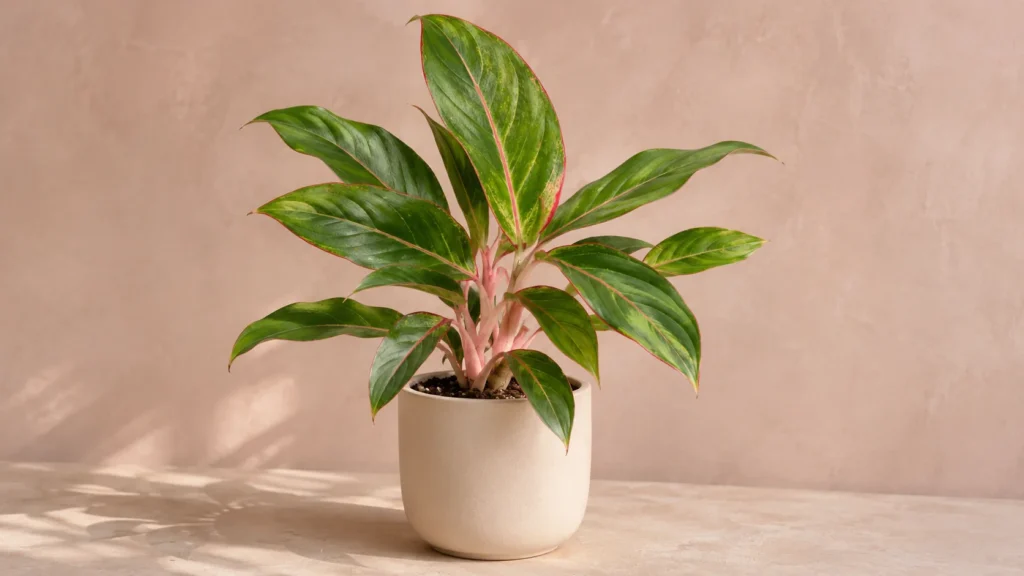
Chinese Evergreen ‘Crete’
Aglaonema 'Crete'
A green Aglaonema cultivar with irregular red leaf margins and pale pink leaf stalks.
Watering frequency
Check weekly; water when the upper mix is partly dry
Ideal temperature
About 65-80°F / 18-27°C; avoid cold drafts
Humidity
Average to moderately humid indoor air
Care difficulty
Easy
Air purifying
No/Not Known
Growth rate
Slow
Plant size
Commonly about 2-3 ft / 0.6-0.9 m tall in a container
Soil type
Airy, moisture-retentive mix that drains freely
Fertilizer need
Every 6-8 weeks, spring-summer.
Care summary
- Light: Bright indirect light keeps growth compact and color visible.
- Water: Let the upper mix partly dry, then water and drain.
- Soil: Use an airy mix in a pot with drainage.
- Pattern: Red margins vary in width around green leaves.
- Safety: Keep away from chewing pets and children.
Common problems
- Dull new color: Check whether indirect light is adequate.
- Brown scorched patches: Protect from hot direct sun.
- Yellow leaves and soft stems: Inspect wet mix and cold roots.
- Brown tips: Check dry airflow, fertilizer salts, and watering.
- Mealybugs or scale: Inspect leaf bases and undersides.
Plant care guide
About Chinese Evergreen 'Crete'
Chinese Evergreen 'Crete' is a red-edged cultivar of Aglaonema. Its green leaves carry red margins that change width along the leaf and may spread into blotches, while the leaf stalks are pale pink. Singapore NParks' cultivar description records these distinguishing traits. The Royal Horticultural Society describes green foliage marbled with reddish pink and cream above upright pale pink stems. Crete Aglaonema and Crete Chinese Evergreen are retail word orders for the same named cultivar.
Use Aglaonema 'Crete' as the botanical identity. Some trade or extension sources place it under A. commutatum, but the cultivar name is more useful than asserting a single-species pedigree for a plant whose breeding history is not established by the sources used here. “Red Chinese Evergreen” is a broad sales description, not a synonym for 'Crete'.
Why You'll Like It
'Crete' gives a green foliage plant a vivid edge of color. Its red is concentrated mainly at the margin, so the leaves remain legible as green rather than appearing uniformly pink. The variation among leaves makes a full clump lively without relying on flowers.
It stays manageable in a container, although size depends on pot, age, and growing conditions. The RHS describes it as slow-growing and commonly around 60–70 cm tall, while NParks notes that plants given ample space can grow taller. A small sale-stage pot should not be described as permanently miniature.
How to Identify 'Crete'
Look for a glossy, elliptic leaf with a long soft point, an irregular red border, occasional red patches expanding inward, and a pinkish leaf stalk. The red edge may be narrow in one place and wider in another. The red is not merely a fine vein drawn across the center. NParks notes that 'Crete' resembles 'Siam Aurora', but 'Crete' tends to have a wider, less even margin and pink venation concentrated mainly at the midvein.
Compare Chinese Evergreen 'Red Ruby', which has large pink splashes over green leaves, and Chinese Evergreen 'Silver Bay', which is green and silver rather than red-edged. A nursery tag remains important because color and variegation can shift with light and age, and many red Aglaonema cultivars overlap in photos.
Naming and Background
Chinese evergreen is the retail group name for Aglaonema, a genus with many species and cultivated hybrids. The genus occurs in tropical and subtropical Asia and New Guinea, but that does not locate the origin of 'Crete' itself. The consulted horticultural records document its appearance and care, not a secure first-cross or introduction date. This guide does not supply an invented breeding story.
The cultivar epithet 'Crete' is the precise identity worth retaining. Do not silently substitute 'Siam Aurora' because the two are similar, or use “red evergreen” as if it named one botanical entity. For an unlabeled purchase, describe it as a red-edged Aglaonema until the source plant is verified.
Where It Works Best
Place 'Crete' in bright, diffused light near an east-facing window or a little back from stronger south- or west-facing glass. NParks recommends bright diffused light for a bushy plant and warns that full sun can scorch leaves. Medium indirect light can be acceptable, but growth may be slower and new color less pronounced.
Keep it away from cold winter windows, outside-door drafts, and air-conditioning. Place it where the colored leaves can be seen without giving pets easy access. A cachepot is fine only if the inner planting pot drains and standing water is emptied.
Chinese Evergreen Crete Care
Light. Bright indirect light is the best starting point for compact growth and visible red margins. If a plant has lived in shade, move it gradually. Do not use hot direct sun to intensify color; damaged leaf tissue will not recover.
Water. Check the upper inch or two of mix and the weight of the pot. Water when the upper layer is partly dry, allowing excess to leave the drainage hole. Wait longer in cool or dim conditions. Yellowing accompanied by wet, heavy mix suggests checking roots before watering again. NC State Extension's Aglaonema profile identifies overwatering and root rot as common problems.
Soil and pot. Use an airy houseplant mix that can hold moderate moisture without staying sodden. Add bark or perlite if needed. Choose a pot only modestly larger at repotting; oversized containers stay wet for too long around a small root system.
Temperature and humidity. Warm, stable indoor conditions suit the plant. Average room humidity is usually manageable, though very dry heated air can brown margins. A humidifier may help a persistently dry room; frequent leaf misting does not solve low light or poor drainage.
Feeding and grooming. Feed lightly during spring and summer growth, and pause when the plant slows or roots are stressed. Remove dead leaves, wipe dust from glossy foliage, and rotate the pot so the clump remains balanced. Do not fertilize to compensate for inadequate light.
Propagation and Repotting
A mature clump can be divided when each section keeps roots and a healthy growing stem. Stem cuttings with viable nodes can root under warm, lightly moist conditions. A leaf blade on its own will not reproduce a full plant. Vegetative propagation can preserve the named cultivar's traits, provided the parent plant was correctly identified.
Repot when roots crowd the container, the medium has broken down, or drainage has become unreliable. Spring is convenient for recovery. After division, use small pots and protect the sections from strong sun while roots reestablish.
Problems to Watch
Less red on new leaves: Check the amount of indirect light, but compare several leaves. Natural pattern variation does not automatically mean the cultivar has changed.
Pale or brown scorch marks: Move the plant away from strong direct sun, especially behind hot glass. Old scorched patches do not turn green again.
Yellow leaves or soft stems: Check for soggy soil, cold roots, and root damage. A single aging lower leaf is less concerning than several soft yellow leaves.
Pests: Watch leaf axils and undersides for mealybugs, scale, and mites. Isolate a new or infested plant until it is clear.
Pet Safety
'Crete' is not pet-safe. Like other Aglaonema, it contains irritating calcium oxalate crystals that can cause mouth and throat discomfort when chewed. NParks' Aglaonema guidance documents this genus-level hazard; the RHS cultivar profile also marks 'Crete' as harmful if eaten. Keep it away from pets and children who chew plants. Contact a veterinarian or poison-control service after exposure; trouble swallowing or breathing needs urgent professional attention.
Frequently Asked Questions
Is 'Crete' the same as 'Siam Aurora'? No. Both have red edges, but NParks describes 'Crete' as having a wider, irregular red margin and pink mostly along the midvein.
Can it grow in low light? A green Aglaonema may tolerate lower light, but this colored cultivar is best shown in useful indirect light. Growth will slow and the pot will stay wet longer in shade.
Do the leaves stay exactly the same shade of red? No. Leaves and growing conditions vary. Maintain stable care and assess several new leaves rather than one unusual leaf.
Final Thoughts
'Crete' earns its own place in the collection for its uneven red margins and pale pink leaf stalks. Keep its label, give it filtered light and warm roots, and water according to the pot rather than a rigid calendar.