
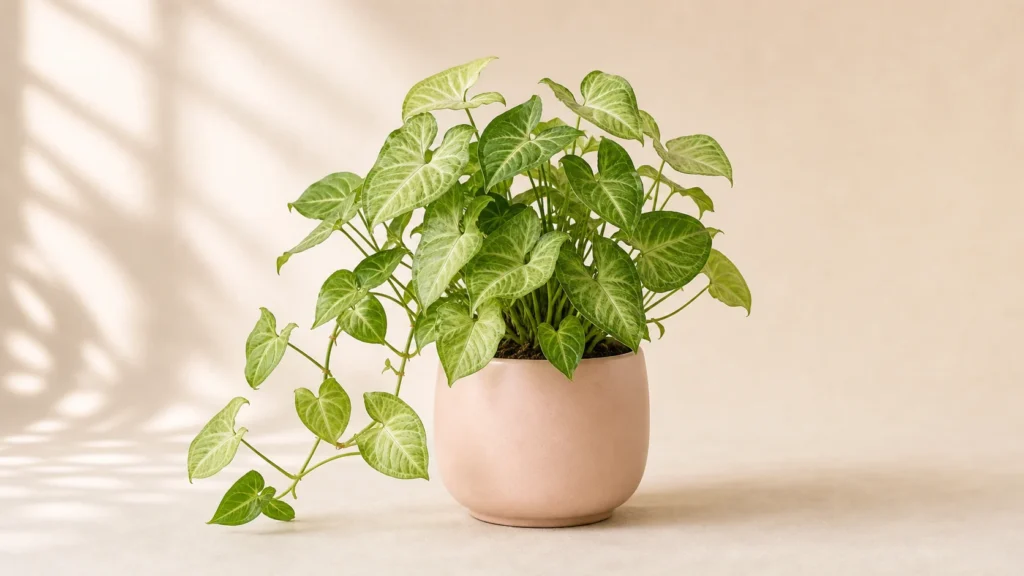
Arrowhead Plant
Syngonium podophyllum
A fast-growing tropical vine with arrow-shaped juvenile leaves that can trail, climb, or stay bushy with regular pruning; this page covers the classic all-green species form.
Watering frequency
Every 7-10 days
Ideal temperature
65-80°F / 18-27°C
Humidity
50-70%
Care difficulty
Easy
Air purifying
No/Not Known
Growth rate
Fast
Plant size
1-3 ft / 0.3-0.9 m
Soil type
Moist, well-draining mix
Fertilizer need
Monthly, spring-summer.
Care summary
- Light: Medium to bright indirect light.
- Water: Let the upper mix partly dry, then water and drain.
- Soil: Use an airy, well-draining mix in a pot with holes.
- Shape: Prune for fullness or give mature vines a support.
- Safety: Keep leaves, sap, and cuttings away from pets and children.
Common problems
- Yellow leaves: overwatering, poor drainage, or watering swings.
- Root rot: mix remains wet and airless.
- Brown tips: dry air, salt buildup, or inconsistent watering.
- Leggy growth: insufficient light or lack of pruning.
- Leaves dull or washed out: too little useful light for the leaf color.
- Pests: mites, mealybugs, scale, or thrips.
- Note: not pet-friendly.
Plant care guide
About Arrowhead Plant
The Arrowhead Plant (Syngonium podophyllum) is a tropical aroid that changes character as it matures. Young plants form a compact cluster of simple arrow-shaped leaves, which explains the common name. Older stems begin to vine, and a climbing plant can eventually produce deeply divided leaves with several leaflets.
This page covers the plain green species form—the all-green Syngonium podophyllum sold simply as "Arrowhead Plant" or "Arrowhead Vine." It is the classic baseline of the genus: no cream centers, no pink veins, no marbled sectors—just solid green leaves that tolerate more light than most variegated cultivars. Patterned selections such as 'White Butterfly', 'Pink Allusion', 'Milk Confetti', and 'Three Kings' are separate plants with their own pages, linked below.
Kew’s accepted record for Syngonium podophyllum identifies it as a liana native from Mexico through tropical America. A liana is a woody or semi-woody climbing plant that uses other structures for support. Indoors, Arrowhead Plant stays much smaller and can be displayed as a tabletop plant, trailing vine, hanging basket, or climber.
The plant is also sold as Arrowhead Vine, Goosefoot Plant (or Goosefoot Vine), American Evergreen, Trileaf Wonder, or Nephthytis. "Nephthytis" persists in the plant trade even though the houseplant belongs to Syngonium, not the separate African genus Nephthytis; the botanical name on a good nursery label is more dependable than the common name.
Why You’ll Like It
Arrowhead Plant grows quickly enough to make care feel rewarding. Pruning produces material for propagation, and rooted cuttings can be planted back into the same pot for a fuller display. It is flexible in form: keep it compact through regular trimming or let selected stems climb a pole or trellis.
The green form has one practical advantage over patterned cultivars: it does not need bright light to preserve variegation. It accepts the medium indirect light that would make a 'White Butterfly' or 'Three Kings' grow greener and leggier, and it never needs pruning decisions based on saving cream or pink sectors. If you want a low-fuss arrowhead, the plain green form is the most forgiving choice.
Beginner-friendly needs one qualification: Arrowhead Plant tolerates an occasional mistake, but not permanently wet roots, a dark corner, or access by pets. Fast growth also means more shaping than a slow ZZ Plant.
What Kind of Plant Is It?
This is an evergreen perennial vine in the Araceae family. Each stem has nodes—the joints where leaves, buds, and adventitious roots can form—and a cutting must contain a node to make a complete new vine. Long leaf stalks, called petioles, connect the leaf blades to the stem.
Leaf shape changes with developmental stage. NC State Extension’s Arrowhead Plant profile describes simple arrow- or heart-shaped juvenile leaves, transitional lobed leaves, and mature divided leaves with several leaflets; support, time, light, and vigor all influence the transition. Pruning encourages a more juvenile, bush-like appearance but cannot guarantee identical leaves.
Indoor flowers are uncommon. When they appear, they have the typical aroid structure: a central spadix of small flowers with a modified leaf called a spathe. Most owners grow the plant for foliage, not bloom.
History of the Arrowhead Plant
Syngonium podophyllum was described and validly named by Austrian botanist Heinrich Wilhelm Schott in 1851, in the journal Botanische Zeitung. Schott, the leading arum-family authority of his era, had used the genus name Syngonium as early as 1829. The genus name joins Greek syn ("together") and goné ("offspring"), a reference to the united ovaries of the flower; the species epithet combines podos ("foot") and phyllon ("leaf"), describing the arrow- or foot-shaped blade. Kew records earlier names for it—Pothos auritus (1827) and Arum auritum (1831)—both listed in the Botanical Synonyms field.
Indoors, the Arrowhead Plant became a global houseplant staple during the twentieth century, and its variegated cultivars—white, cream, and pink selections—turned the genus into one of the most widely produced foliage groups in the trade. It was also among the first aroids studied for tissue-culture propagation, beginning with a 1976 study by Lynn Miller and Toshio Murashige. The all-green form covered here remains the baseline most nurseries grow, and it matches the species in the wild.
Related Arrowhead Plant Cultivars
Most named arrowheads are cultivars of Syngonium podophyllum selected for patterned foliage. Cultivar names can be inconsistent in retail listings, so keep the original nursery label and compare several traits rather than relying on one photograph. The plain green form covered here is the species itself; the patterned cultivars below have their own plant pages:
- White Butterfly Syngonium: A widely grown selection with pale cream-to-light-green centers and darker green margins. It often becomes more vine-like with age.
- Pink Allusion Syngonium: Green foliage develops a warm pink cast or pinkish veins under suitable light. Color intensity varies with growing conditions and individual stock.
- Milk Confetti Syngonium: Creamy light-green foliage carries scattered pink markings. Bright indirect light supports patterning, while harsh direct sun can damage pale tissue.
- Three Kings Syngonium: Variegation combines several green and cream tones in irregular sectors or marbling. Highly pale sections may grow more slowly.
Other names circulate in retail without a dedicated page yet: 'Bold Allusion' (broad pale leaves, green margins, rose-toned venation) and 'Painted Arrow' are both recorded in the NC State cultivar profile. A patterned leaf does not mean the plant has "become" another cultivar; it usually means the growth point belongs to one of these selections, and the nursery label is the reliable way to tell them apart.
Not every plant sold as "Syngonium" is S. podophyllum. Dark-leaved Syngonium erythrophyllum and narrow-leaved species or hybrids deserve their own identification. Care may overlap, but a commercial name alone should not be used to declare the species.
For similar trailing forms, compare Golden Pothos, Heartleaf Philodendron, and Swiss Cheese Vine; they are all aroids, but their habits differ.
Where It Works Best
Medium to bright indirect light keeps growth relatively compact. An east-facing window or a filtered position near brighter glass is often suitable. Harsh afternoon sun can bleach or burn the leaves; deep shade lengthens the spaces between nodes and makes the green look dull.
A bathroom can work if it has a window or grow light; humidity cannot replace light. In an office, avoid placing the plant beneath an air-conditioning vent. Rotate a bushy pot every week or two; a vine trained toward a support does not need perfect symmetry.
With a grow light, use a consistent daily schedule with a timer and adjust according to new leaves. A plant leaning strongly or producing long bare intervals needs more usable light; bleached patches close to the fixture may indicate excess intensity.
Arrowhead Plant is invasive in some warm climates. UF/IFAS advises against its outdoor use anywhere in Florida because escaped vines can displace native vegetation and are difficult to remove. Florida owners should keep it contained indoors and dispose of trimmings securely rather than placing viable stems in yard waste or compost.
How to Water Arrowhead Plant
Water when the top inch or so of mix has dried and the pot feels lighter, then soak the root ball and let it drain. Every 7–10 days is a useful checking interval in active growth, not a fixed schedule; pot size, light, temperature, container material, root density, and season all change drying time.
Arrowhead Plant prefers more consistent moisture than Aloe Vera, yet constantly saturated mix still causes root loss. The ideal cycle leaves some moisture deeper in the pot while restoring air to the upper root zone. If the surface dries but the center stays wet for days, the pot may be too large or the mix too dense.
Do not react to every droop with water. Check the mix first: dry soil and a light pot suggest thirst; wet soil plus yellow leaves or soft stems suggests stressed roots. Repeated small sips can leave part of the root ball dry and concentrate salts, so water thoroughly when water is actually needed.
Use room-temperature water. If hard-water residue accumulates, occasionally flush the mix with clean water and allow full drainage. Misting is not a substitute for root watering or a room humidifier.
Soil, Pot, and Repotting
Use a loose houseplant or aroid mix that holds moderate moisture but drains freely—quality potting mix amended with perlite, pumice, or fine orchid bark often works. Very coarse mix may dry too quickly for a small Arrowhead Plant, while dense garden soil compacts and should not be used in a container.
Every pot needs a drainage hole. Plastic retains moisture and suits a plant that drinks steadily; unglazed clay dries faster and may help in humid conditions. A decorative cachepot is safe only when the inner pot drains and collected water is emptied.
Repot when roots circle densely, the plant dries unusually fast, mix has broken down, or a large vine becomes unstable. Move up only one pot size; a much larger container holds unused wet soil and does not automatically produce faster growth.
Spring and early summer suit routine repotting, but address active rot immediately: remove black, mushy, hollow, or foul-smelling roots with a clean tool, then use fresh airy mix and correct the watering environment.
Pruning, Training, and Propagation
Prune just above a node to shorten a vine and encourage buds lower on the plant to grow. Wear gloves because the sap can irritate skin. A single cut does not always create several branches; fuller retail pots usually contain multiple rooted stems, so returning propagated cuttings to the pot is the most dependable way to increase density.
For climbing growth, guide stems onto a trellis, plank, or moss-style pole with soft ties. Keep ties loose enough that they do not crush the stem. A support can encourage more mature growth, but it will not compensate for poor light or unhealthy roots.
To propagate in water:
- Cut below a healthy node, keeping one or two leaves above it.
- Remove any leaf that would sit under water.
- Submerge the node, not the remaining foliage, in a clean container.
- Keep the cutting warm in bright indirect light and refresh cloudy water.
- Pot it into a small container after several healthy roots develop.
- Keep the mix lightly moist during the initial transition, then resume normal partial drying.
Cuttings also root directly in moist potting mix. Stem sections without a leaf can root if they contain a viable node, but they are harder to monitor and more vulnerable to rot. A leaf and petiole with no node cannot create a new vine.
Humidity, Temperature, and Feeding
Average household humidity is often adequate, while roughly 50–70% supports clean growth. Brown tips are not proof that humidity alone is low; underwatering, root damage, fertilizer salts, and drafts can look similar. Use a room humidifier if necessary and maintain airflow rather than repeatedly wetting leaves.
Keep temperatures around 65–80°F (18–27°C). Protect the plant from cold glass, exterior doors, and heating or cooling vents. Growth and water use slow when temperatures and light fall.
Feed monthly during active spring and summer growth with a balanced fertilizer at reduced strength. Do not fertilize dry soil, a newly repotted plant, or damaged roots. If salts crust on the mix or leaf tips continue browning, pause feeding and flush the pot.
Pet and Human Safety
Arrowhead Plant is not pet-safe. The ASPCA Arrow-Head Vine profile identifies insoluble calcium oxalate crystals and lists oral irritation, swelling, drooling, vomiting, and difficulty swallowing among possible signs in animals. Sap can also irritate human skin and eyes.
If a pet chews the plant, remove access and contact a veterinarian or animal poison-control service promptly. Difficulty breathing or swallowing is urgent. Do not induce vomiting or administer a home treatment unless a professional instructs you.
Keep pruned stems, propagation jars, and fallen leaves out of reach; a hanging basket is not automatically safe because lengthening vines eventually descend. For a pet-compatible alternative with an arching silhouette, consider Spider Plant, while still discouraging routine chewing.
What About Air Purifying?
Arrowhead Plant is sometimes promoted as an air purifier, but ordinary potted plants should not be presented as substitutes for ventilation, filtration, or pollutant source control. Sealed-chamber experiments do not show that one houseplant meaningfully cleans a lived-in room. This candidate therefore records air-purifying performance as not established and recommends it for foliage, styling, and the care experience instead.
Common Problems
- Several leaves turn yellow while mix stays wet: Let the pot drain and inspect the roots if the pattern continues. Improve light, aeration, and the watering interval rather than merely removing leaves.
- One old lower leaf yellows: Occasional aging is normal. Diagnose a trend, not a single leaf in isolation.
- Long bare spaces form between leaves: Move gradually into brighter indirect light and prune. Replant rooted cuttings for fullness.
- Brown tips appear: Check inconsistent watering, dry drafts, hard-water or fertilizer salts, and root condition before assuming humidity is the only cause.
- Leaves curl: Dry mix, hot sun, cold air, pests, or root stress are possible. Check the environment systematically.
- Leaves look dull or washed out: Usually too little useful light. Move the plant gradually to brighter indirect light and judge the next flush of growth.
- Stems become soft at the soil line: Suspect rot. Take healthy node cuttings as insurance, remove damaged roots and stems, and repot into fresh mix.
- Mites, mealybugs, scale, or thrips appear: Isolate the plant and inspect nodes, new leaves, and leaf undersides. Use a treatment labeled for indoor ornamentals and repeat inspection through the pest’s life cycle.
The UF/IFAS commercial Syngonium guide also documents physiological and pest problems seen in production. Home growers should use such symptom lists as diagnostic possibilities, not proof that every brown patch has one specific cause.
Frequently Asked Questions
Are all Arrowhead Plants green?
No. The species is green, but most retail plants are cultivars with white, cream, or pink variegation. This page covers the green species form; patterned plants such as 'White Butterfly' and 'Three Kings' belong to the cultivar pages linked in the Related section.
Why are my Arrowhead Plant’s leaves changing shape? Leaf division is part of normal maturation, especially when a vine climbs. Pruning maintains a younger-looking, bushier plant, while support encourages the mature habit.
Can it live in low light? It may survive, but growth becomes slower and leggier and the green looks dull. Medium to bright indirect light gives a fuller plant.
How often should I prune it? Prune when vines exceed the space or the plant loses the shape you want; there is no required monthly schedule. Avoid removing most foliage from a stressed plant at once.
Can Arrowhead Plant grow permanently in water? Cuttings root readily in water. Long-term water culture needs clean conditions and diluted hydroponic nutrients; plain water alone is not complete nutrition.
Is Arrowhead Plant safe for cats? No. Its calcium oxalate crystals can cause painful mouth irritation and swelling. Choose secure containment or a genuinely non-toxic alternative.
Why is it called Nephthytis? The name persists from horticultural usage, but the common houseplant is botanically Syngonium podophyllum. Use the scientific label to avoid confusion with true Nephthytis species.
Final Thought
Arrowhead Plant is easy to enjoy because it does not have one fixed shape. Prune it into a compact cluster, trail it from a shelf, or give it a support and watch the leaves mature. In every form the essentials remain the same: useful indirect light, an airy root zone, condition-based watering, and safe placement away from pets.