
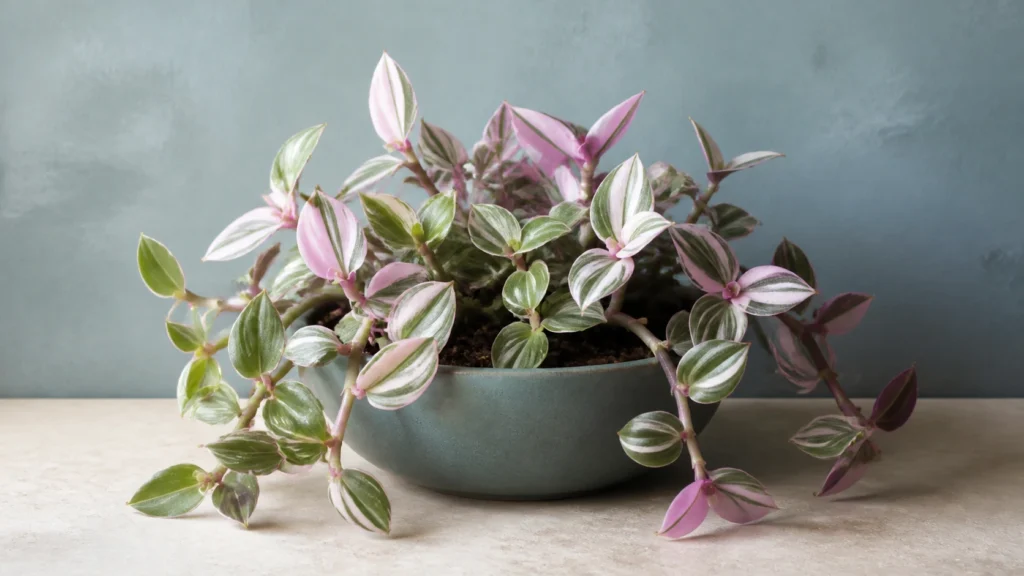
Tradescantia Nanouk
Tradescantia fluminensis 'Nanouk'
A brightly colored trailing plant bred in the Netherlands whose leaves carry stripes of pink, purple, and green, one of the most vivid and fastest-growing houseplants of the 2020s.
Watering frequency
Every 7-10 days
Ideal temperature
60-80°F / 15-27°C
Humidity
50-70%
Care difficulty
Easy
Air purifying
No/Not Known
Growth rate
Fast
Plant size
6-12 in tall / 15-30 cm, trailing to 3 ft
Soil type
Well-draining, peat-free mix
Fertilizer need
Monthly, spring-summer.
Care summary
- Light: Give bright, indirect light; the pink deepens with light.
- Water: Water when the top inch of mix dries; avoid soggy soil.
- Humidity: Average to high humidity keeps leaf tips clean.
- Prune: Cut back regularly to keep the plant full.
- Safety: Mildly toxic to pets; sap can irritate skin.
Common problems
- Dull, green-leaning leaves: Not enough light.
- Brown, crispy leaf tips: Low humidity or dry air.
- Leggy, bare stems: Needs more light or a haircut.
- Root rot: Soggy soil.
- Leaf drop: Cold drafts or overwatering.
Plant care guide
About
The Tradescantia Nanouk is a brightly striped trailing plant whose leaves carry bold bands of pink, purple, and green. It is a recent cultivar bred in the Netherlands and protected by US Plant Patent 29,711. The patent uses the botanical designation Tradescantia albiflora 'Nanouk'; Kew now treats T. albiflora as a synonym of Tradescantia fluminensis, so this record uses Tradescantia fluminensis 'Nanouk' while retaining the patent name under Botanical Synonyms. It belongs to the spiderwort genus alongside the familiar Tradescantia Zebrina.
The plant grows as a clump of upright stems that flop and trail as they lengthen, each stem carrying a tight stack of oval leaves striped like candy. It is one of the fastest-growing houseplants you can own, and it responds to pruning with a flush of new, even more colorful growth, which makes it endlessly productive and endlessly satisfying.
Why You'll Like It
The Tradescantia Nanouk is the closest thing the houseplant world has to instant gratification. It grows visibly, from week to week, not month to month; it colors up within days of being moved into better light; and it roots from any piece of stem you cut, so one plant becomes many within a single season. The pink and purple stripes are among the most saturated colors available in any easy houseplant, and the plant stays compact and full when you prune it, which makes it perfect for shelves, desks, and small spaces.
It is also a genuinely easy plant. It wants bright light, ordinary watering, and regular haircuts, and it will forgive the occasional lapse. For beginners it is one of the most rewarding plants to start with, because the progress is so visible and the propagation is so foolproof; for collectors it is a staple that always has a place.
What Kind of Plant Is It
The Tradescantia Nanouk is a cultivar in the spiderwort family (Commelinaceae). Its patent describes it as Tradescantia albiflora 'Nanouk', while current Kew taxonomy treats T. albiflora as a synonym of T. fluminensis. This is a nomenclatural update, not a claim that the cultivar was rebred. The patent also makes its origin more specific than many retail accounts: it came from a 2012 cross between two unnamed seedling selections in Sappemeer, the Netherlands.
The plant's color comes from a combination of pigments: chlorophyll for the green, anthocyanins for the pink and purple, and a structural element that gives the leaves their soft sheen. The stripes run lengthwise along each leaf, with the strongest pink on the newest growth, and the undersides are a deep purple that shows as the stems trail and the leaves angle toward the light. It is a chimeral cultivar in the sense that its variegation is a stable trait of the clone, but unlike the chimeral variegation of a Pink Princess Philodendron, the Nanouk pattern is consistent: every leaf carries the stripes, and every cutting comes true.
The plant's growth habit is sprawling. Stems rise from the base, flop over as they grow, and root wherever they touch moist soil, which is how the plant spreads in the wild and how the cultivar multiplies in the nursery trade. Indoors, it is grown either as a bushy pot plant with regular pinching or as a trailing plant from a hanging pot.
History
The story of Tradescantia Nanouk is unusually well documented because the cultivar has a plant patent. Inventor Wander Durk Tuinier conducted a planned breeding program in Sappemeer, the Netherlands. In 2012 he cross-pollinated two unnamed seedling selections, then selected one flowering plant from the resulting seedlings for its compact habit, strong foliage, and distinctive light-purple, green, and gray-green coloring. The public patent does not explain the origin or meaning of the name 'Nanouk', so stories connecting it to a nickname or film should be treated as unverified.
The US application was filed in 2017 and the patent was granted in 2018 to Dümmen Group B.V. Those dates document legal protection, not necessarily the first retail sale in every country. Wider commercial distribution and social-media exposure subsequently made Nanouk one of the most recognizable pink Tradescantia cultivars of the early 2020s.
The botanical update requires care. Kew's Plants of the World Online record for Tradescantia albiflora treats that patent name as a synonym of Tradescantia fluminensis, not T. cerinthoides. Retailers may continue using older or conflicting labels, so the patent designation remains useful for confirming the cultivar even when the accepted species name is updated.
Related Varieties
The Nanouk belongs to a large and variable genus, and the trade offers many related tradescantias, several of which are sold alongside it.
- Tradescantia fluminensis 'Nanouk' is the pink-striped star itself, with purple undersides and a compact, trailing habit; its patent uses the synonym T. albiflora.
- Tradescantia zebrina is the classic wandering jew, with silver and purple striped leaves and a very forgiving nature, documented in our tradescantia zebrina care guide.
- Tradescantia fluminensis is a plain green or lightly variegated form, often grown as a ground cover.
- Tradescantia pallida, the purple heart, has solid deep-purple stems and leaves and pink flowers.
- Tradescantia 'Tricolor' is a pink-heavy relative with dramatic white and green striping.
All of them share the genus's easy care, fast growth, and easy propagation, and all of them share the genus's toxicity and skin-irritation profile.
Where It Works
The Tradescantia Nanouk is a bright-light plant that looks best on a shelf or table where its trailing stems can cascade. It wants bright, indirect light, with the pink intensifying as light increases; in low light the stripes fade toward green and the stems stretch. A few hours of gentle morning sun is welcome, but harsh afternoon sun can bleach the colors and scorch the leaves.
It suits living rooms, home offices, kitchens, and bright bathrooms, and it is happy in average household humidity, though dry winter air makes the leaf tips crisp. Because it is compact and fast-growing, it is ideal for small spaces, shelves, and windowsill gardens, and it is a natural choice for anyone who wants a colorful plant that can be endlessly propagated and shared.
How to Care for a Tradescantia Nanouk
Light. Bright, indirect light is the key to the color. The more light, within reason, the deeper the pink and purple, so give it the brightest spot that is not in direct midday sun. If the leaves come out pale and greenish, move the plant brighter.
Water. Water when the top inch of mix has dried, then water thoroughly. The plant is forgiving of a missed watering, and it communicates clearly, drooping dramatically when dry and recovering within hours of a drink. It dislikes soggy soil, which rots the stems and roots, so good drainage matters more than frequency.
Soil. Use a well-draining houseplant mix, ideally peat-free, with perlite added. The plant's trailing stems root wherever they touch soil, so a loose, airy mix suits it.
Humidity. Average to high humidity keeps the leaf tips clean. In dry, heated rooms the leaf tips brown; a humidifier or pebble tray helps, and regular pruning hides any crispy edges anyway.
Fertilizer. Feed monthly in spring and summer with a balanced liquid fertilizer at half strength. Overfeeding produces soft, pale growth, so less is more.
Pruning. This is the maintenance secret. The plant grows leggy within weeks, so pinch or cut the stems back regularly, every few weeks if you want a full, bushy plant. Every cutting roots, so pruning is propagation; you can replant the cuttings in the same pot to keep the plant dense indefinitely.
How to Propagate
The Tradescantia Nanouk is one of the easiest plants in existence to propagate, which is a large part of its appeal. Cut a stem with a few leaves and at least one node, remove the lower leaves, and either stand it in water or plant it directly into moist soil. In water, roots appear within one to two weeks, and the cutting can be potted once the roots are an inch or two long. In soil, keep the mix lightly moist and the plant will root within a couple of weeks.
Because the variegation is stable, every cutting comes true: each new plant carries the same pink stripes as the parent. This is why the plant spread so fast through the nursery trade and among collectors. A single plant can become a shelf of plants in a season, and cuttings make excellent gifts. Replanting cuttings in the same pot as the parent is also the standard way to keep a mature plant full and bushy.
When to Repot
Repot a Tradescantia Nanouk when the roots fill the pot, generally every year in spring, or when the plant has become a dense, trailing clump that has exhausted its soil. The plant is shallow-rooted and happy in a modest pot; step up only one size, use fresh well-draining mix, and water in. Because the plant is so easy to propagate, many growers never repot at all, simply taking fresh cuttings every year and starting over, which is a perfectly legitimate way to keep the plant at its best.
Toxicity
The Tradescantia Nanouk is mildly toxic to cats and dogs, and the genus has a second issue that is less well known: skin irritation in people. The North Carolina State Extension records the genus as a low-severity poison, noting that ingestion can cause contact dermatitis and irritation of the mouth and stomach, and that the plants are a known problem for dogs and cats that chew them. The sap of some tradescantias has also been reported to cause contact dermatitis in humans, so it is worth wearing gloves or washing your hands after handling the plant, especially when pruning many stems at once.
The toxicity is genuinely mild, the mildest category in most references, and it rarely amounts to more than mouth irritation and mild stomach upset if a pet takes a bite. Still, keep the plant out of reach of chewing pets, and if your pet eats part of it, rinse the mouth, offer water, and contact your veterinarian if symptoms are more than mild. The sap irritation matters mostly to the gardener doing heavy pruning, and simple handwashing handles it.
Common Problems
Faded, green-leaning leaves. Not enough light. The pink and purple stripes need bright light to develop; move the plant to a brighter spot and new growth will color up within days.
Brown, crispy leaf tips. Dry air or underwatering. Raise humidity and check the watering schedule. Brown tips are cosmetic and can be trimmed or hidden by regular pruning.
Leggy stems with bare patches. The plant is not getting enough light, or it simply needs a haircut. Tradescantias grow leggy by design; cut the stems back hard and replant the cuttings for an instant full plant.
Mushy stems or root rot. Overwatering or soggy soil. Cut back on water, improve drainage, and take fresh cuttings from the healthy tops to restart.
Leaf drop. Cold drafts or overwatering. Move the plant away from cold windows and let the soil dry further between waterings.
Pests. Spider mites and aphids can bother tradescantias, especially in dry air. Check regularly, treat early with insecticidal soap or neem oil, and isolate the plant until clear.
FAQ
How do I make my Tradescantia Nanouk more pink? Give it more light. The pink and purple stripes deepen with light intensity, so move the plant to the brightest spot it can tolerate without direct midday sun.
Why is my Tradescantia Nanouk leggy? It grows leggy by nature and also in response to low light. Prune it hard and regularly, and move it brighter; the cuttings root instantly and can be replanted to fill out the pot.
Is Tradescantia Nanouk toxic to cats and dogs? It is mildly toxic. The NC State Extension records the genus as a low-severity poison that can cause mouth and stomach irritation and contact dermatitis, and it is a known problem for pets that chew it. Keep it out of reach.
Can Tradescantia Nanouk grow in low light? It survives, but it loses its color and grows sparse. It needs bright, indirect light to stay pink and full.
How often should I water a Tradescantia Nanouk? When the top inch of soil is dry, roughly weekly in summer and every ten days to two weeks in winter. It droops dramatically when thirsty and recovers quickly after a drink.
Final Thought
The Tradescantia Nanouk is a plant built for the social media age: saturated color, visible growth, effortless propagation, and a look that photographs better than almost anything else on a shelf. It is also, underneath the hype, a genuinely excellent houseplant, fast, forgiving, and endlessly renewable through cuttings. It asks for bright light, regular haircuts, and restraint with the watering can, and it returns the favor with the most vividly colored foliage in the easy-care category. It will stretch and fade if neglected, but a snip, a drink, and a brighter window bring it back to glory within a week. Few plants reward attention so quickly, and fewer still look this good doing it.