
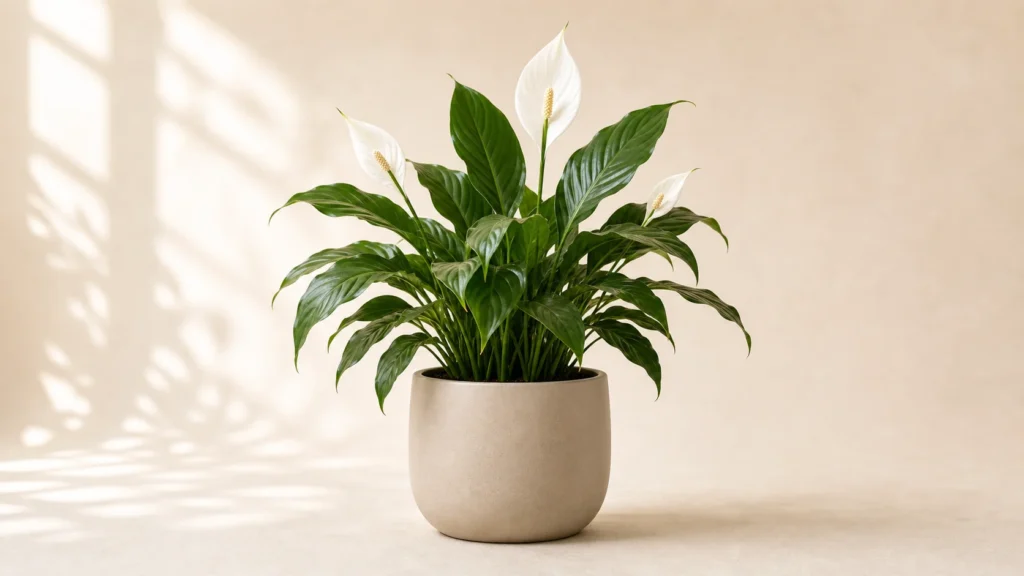
Peace Lily
Spathiphyllum spp.
A tropical foliage-and-flowering aroid with glossy leaves and elegant white spathes that prefers filtered light and even moisture.
Watering frequency
Every 5-7 days
Ideal temperature
65-80°F / 18-27°C
Humidity
50-70%
Care difficulty
Easy
Air purifying
Yes
Growth rate
Moderate
Plant size
1-3 ft / 0.3-0.9 m
Soil type
Moist, organic-rich mix
Fertilizer need
Every 4-6 weeks, spring-summer.
Care summary
- Light: Give medium to bright filtered light for healthy flowering.
- Water: Water when the surface begins to dry; never leave it submerged.
- Soil: Use an organic but aerated mix in a draining pot.
- Grooming: Remove spent spathes and fully yellow leaves at the base.
- Safety: Keep away from pets and children who may chew it.
Common problems
- Drooping: Check both soil moisture and root health before watering.
- Yellow leaves: Review saturation, drainage, light, and normal aging.
- Brown tips: Check salts, drought, dry airflow, and damaged roots.
- Few flowers: Improve useful filtered light and review plant maturity.
- Pests: Inspect for mites, scale, mealybugs, and fungus gnats.
Plant care guide
About Peace Lily
Peace Lily is the consumer name for cultivated plants in the genus Spathiphyllum. Retail plants include species selections and hybrids, so Spathiphyllum spp. is more honest for this general care page than pretending every unlabeled pot is one species. NC State Extension's Spathiphyllum profile describes a tropical group native across parts of the Americas, Malesia, and the western Pacific.
The white structure usually called a flower is a spathe—a modified leaf surrounding the upright spadix, which carries many tiny true flowers. A fresh spathe may be pale green before opening white or cream, then turn green again as it ages. That normal color cycle is not automatically a fertilizer deficiency.
Peace Lilies are valued for glossy foliage, manageable size, and the possibility of repeated indoor bloom. Their dramatic droop has earned them a reputation for “telling you” when to water. That signal is useful, but repeatedly waiting for complete collapse stresses fine roots and can create a cycle of drought followed by overwatering.
Why You'll Like It
A healthy Peace Lily combines the visual mass of a foliage plant with clean, upright inflorescences. It fits a tabletop as a compact cultivar or fills a floor pot as a large selection. The plant tolerates medium light better than many flowering houseplants, although brighter filtered light usually produces stronger growth and more blooms.
It is responsive enough to teach careful observation: leaves soften as moisture falls, new growth records light quality, and roots quickly expose poor drainage. It is not, however, a good choice where cats, dogs, or young children chew plants. For lower-risk pet households, consider Bird's-nest Fern or Parlor Palm. For a similarly adaptable but also toxic foliage plant, compare Chinese Evergreen.
What Kind of Plant Is It?
Peace Lily is a clump-forming aroid. Leaves and flower stalks emerge from short crowns at soil level rather than from a woody trunk. As the plant matures, side crowns develop and can eventually be separated by division. It cannot be propagated from one detached leaf in water.
The broad leaves lose moisture readily, while fleshy fine roots need oxygen as well as water. The plant therefore prefers an evenly moist but aerated mix. “Moisture-loving” must not be translated into a cachepot permanently filled with water.
Its forest-floor ancestry explains tolerance of shade, not a preference for darkness. Indoors, window glass, walls, and distance reduce usable light. A location that appears comfortably bright to a person may still be too dim for reliable flowering.
Popular Peace Lily Varieties
Retail labels are sometimes generic, but several established selections help explain the range of sizes and leaf patterns.
- 'Petite': A compact selection for desks and small pots.
- 'Mauna Loa': A classic medium-to-large selection associated with broad foliage and prominent white spathes.
- 'Sensation': A large form with strongly textured, ribbed leaves; it needs more floor space than a standard supermarket plant.
- 'Domino': A white-patterned cultivar whose mottled leaves need useful filtered light to retain vigorous growth.
- 'Gemini': Another patterned selection with cream or pale markings.
- 'Piccolino': A compact trade selection suited to smaller displays.
Named selections share the genus-level care pattern but are not identical in size or vigor. A cultivar name is more useful than a generic adjective such as “variegated,” particularly when planning future plant-to-plant links.
Where It Works Best
Place Peace Lily near an east or north window, or set it back from a brighter south or west window behind a sheer curtain. It can live in medium light, but deep room corners usually reduce flowering and slow water use. Gentle morning sun may be tolerated after acclimation; hard afternoon sun can bleach or scorch leaves.
A bright bathroom can provide useful humidity, but a windowless bathroom is still dark. A living room or bedroom works when the plant is close enough to a real light source. Avoid cold exterior-door drafts, hot vents, and crowded locations where leaves are repeatedly bent.
Choose a stable surface because a wilted canopy can become top-heavy. Keep the entire plant, drainage water, and fallen pruned pieces away from pets and children.
How to Care for Peace Lily
Light
Medium to bright indirect light is the practical range. If the plant grows leaves but rarely flowers, first increase useful light gradually rather than pouring on bloom fertilizer. Very intense direct sun creates pale patches, crisp brown burns, or curled leaves on the exposed side.
Rotate the pot periodically for a balanced clump. If flowering stems lean toward the window, that is a normal light response. A grow light can support a genuinely dim room when positioned and timed according to the manufacturer's plant-light guidance.
Water
Use five to seven days only as an inspection cue. Touch the surface and check slightly deeper; water when the upper layer begins to dry while the root zone still retains light moisture. Lift the pot to learn the difference between moist and dry weight.
Water thoroughly across the surface until excess drains, then empty the saucer. If a plant droops while soil is already wet, do not add more water. Wet-soil droop can indicate oxygen-starved or decaying roots, cold stress, or stem damage.
Peace Lilies can react to high mineral or fluoride levels with browned tips, although drought, excess fertilizer, and dry airflow can look similar. If other causes are controlled and your water is very hard, try filtered, distilled, or rainwater collected safely.
Soil and Container
Use an organic-rich houseplant mix amended for aeration with perlite, pumice, fine bark, or similar coarse material. It should hold even moisture but release surplus water promptly. Dense garden soil and containers without drainage are poor choices.
Keep the crown at the existing soil line. Burying leaf bases increases the risk of rot. A decorative outer pot is fine only when you remove the inner pot to water or reliably empty collected runoff.
Humidity and Temperature
Peace Lily adapts to ordinary indoor humidity but often looks best around 50–70 percent. A humidifier can help in very dry heating seasons. Pebble trays and occasional misting have limited room-scale effect; consistent root care and distance from vents matter more.
Keep it broadly between 65 and 80°F (18–27°C). Cold windowsills, air-conditioning blasts, and sudden moves can cause limp or marked foliage. Warmth without light does not guarantee active growth.
Fertilizer
Feed lightly every four to six weeks during active growth using a balanced houseplant fertilizer at a diluted label rate. Reduce or pause in winter or whenever growth has stalled. White crust on soil, repeated tip burn, or a recently damaged root system are reasons to flush and reassess before feeding.
Fertilizer supports growth; it does not trigger flowers in a plant receiving inadequate light. Excess can burn roots and worsen the very symptoms an owner hoped to fix.
Grooming
Remove a spent spathe and its entire stalk near the base once it has aged. Cut fully yellow leaves similarly with clean tools. Do not cut healthy green leaf tips except for cosmetic trimming of dead tissue.
Wipe broad leaves with a damp cloth to remove dust and inspect for pests. Support each leaf while cleaning so the petiole does not snap. Avoid oily shine products.
How to Propagate Peace Lily
Division is the reliable household method. Each new plant needs a crown with leaves and living roots.
- Water lightly the day before dividing.
- Slide the clump from its pot and locate natural crowns.
- Gently separate a section with several roots, cutting only when roots cannot be teased apart.
- Pot divisions at their previous depth in snug draining containers.
- Return them to warm, stable, indirect light and keep the mix evenly moist during recovery.
Very small divisions recover slowly. Expect temporary droop after root disturbance, but inspect persistent wet-soil collapse for rot. A single leaf or flower stalk placed in water cannot produce a new complete plant.
When to Repot
Repot when roots densely circle the pot, the plant dries abnormally fast, water no longer penetrates compacted mix, or multiple crowns make the container unstable. Peace Lily can flower while somewhat root-filled, so roots at one drainage hole do not demand immediate action.
Move up only one practical pot size. Oversized pots keep a large wet volume around a small root system. Spring or early active growth is convenient, but a plant in failing soil should be addressed when needed rather than waiting for a calendar date.
Toxicity and Pet Safety
Peace Lily is not pet-safe. ASPCA's Peace Lily guidance identifies insoluble calcium oxalate crystals that can cause oral burning, drooling, vomiting, and difficulty swallowing in cats and dogs.
Despite its common name, Peace Lily is not a true lily in the genera Lilium or Hemerocallis. ASPCA's pet-toxin myth clarification distinguishes its irritating oxalate exposure from the acute kidney failure associated with true lilies in cats. That distinction is medically important, but it does not make Peace Lily safe to chew.
Keep it out of reach and collect pruned material immediately. If exposure occurs, contact a veterinarian or animal poison-control service. For a child, contact human poison control or an appropriate medical professional. Breathing or swallowing difficulty requires urgent professional help.
Common Problems and Practical Fixes
Sudden drooping
Check soil before acting. If the root ball is dry, water thoroughly and let it drain. If it is wet, inspect drainage, temperature, crown firmness, and roots. Repeated dramatic wilting means the watering check is occurring too late or the root zone is unhealthy.
Yellow leaves
One old outer leaf can senesce naturally. Several yellow leaves may follow saturation, poor drainage, low light, cold, or root damage. If yellowing begins after a move, compare the old and new conditions before changing multiple inputs.
Brown tips
Common causes include inconsistent moisture, accumulated salts, hot dry airflow, hard water, and damaged roots. Trim dead tissue if desired, correct the likely driver, and judge results on later leaves.
Green or absent flowers
New and aging spathes may naturally be green. Few flowers often reflect insufficient useful light, plant immaturity, season, or recent stress. Improve light gradually and maintain roots; do not use concentrated fertilizer as a shortcut.
Pests
Spider mites cause stippling; scale appears as attached bumps; mealybugs form cottony clusters. Fungus gnats indicate consistently moist organic mix, though their larvae are usually more nuisance than primary cause. Isolate, identify, and treat with a product labeled for the pest and indoor use.
Frequently Asked Questions
Should I wait for it to droop before watering?
No. Use the earliest softening as information, but aim to water after the surface begins drying and before full collapse. Repeated wilt cycles stress roots and foliage.
Can Peace Lily grow in water?
Roots can adapt to managed hydroponic culture, but placing a soil-grown crown permanently in stagnant water often causes decay. Soil culture and hydroponics require different oxygen and nutrient management.
Why won't it bloom?
Useful light is the first factor to review. Then check maturity, season, root health, and feeding. A healthy foliage plant in deep shade may simply lack energy for repeated flowers.
Is Peace Lily safe because it is not a true lily?
No. It does not carry the same true-lily kidney risk, but its calcium oxalate crystals still make it toxic to cats and dogs and irritating to people.
Does it clean indoor air?
The database retains an air-purifying label, but ordinary numbers of potted plants do not replace ventilation or filtration. Keep Peace Lily for its foliage and flowers, not as a medical or air-quality device.
Final Thought
Peace Lily performs best when “moisture-loving” is paired with “well aerated.” Give it filtered light bright enough to support flowers, water after a modest surface dry-down, and keep salts and stagnant runoff under control. Its visible reactions make it communicative, but careful diagnosis—not automatic watering—is what keeps the clump healthy.