
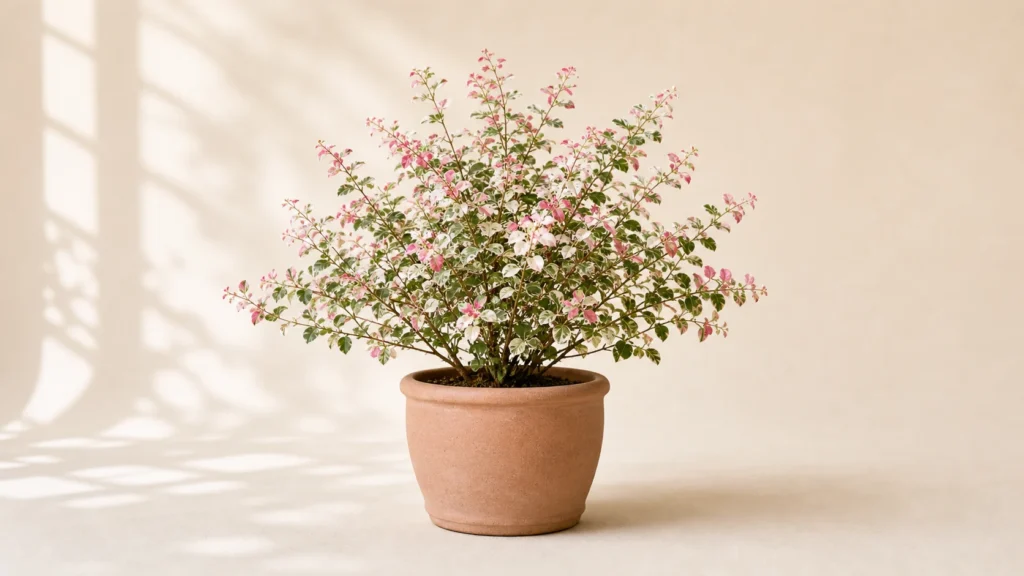
Spiral Snowbush
Breynia disticha
A colorful Snowbush selection with small cream, green, and pink leaves arranged along woody shoots, requiring strong filtered light and steady moisture.
Watering frequency
Every 5-10 days
Ideal temperature
68-86°F / 20-30°C
Humidity
50-70%
Care difficulty
Medium
Air purifying
No/Not Known
Growth rate
Moderate
Plant size
1-3 ft / 0.3-0.9 m
Soil type
Organic, well-draining mix
Fertilizer need
Every 4-6 weeks, spring-summer.
Care summary
- Light: Give bright filtered light and gentle acclimated sun for color.
- Water: Let the surface begin drying, then soak and drain.
- Soil: Use an organic but aerated mix in a draining pot.
- Shape: Pinch new shoots and prune lightly during active growth.
- Safety: Species-specific veterinary evidence is insufficient; prevent chewing.
Common problems
- Leaf drop: Review relocation, cold, dry air, drought, and wet roots.
- Faded color: Increase useful light gradually and check cultivar identity.
- Yellow leaves: Inspect saturation, drainage, roots, and natural aging.
- Crisp edges: Check drought, hot airflow, salts, and pests.
- Pests: Inspect young shoots for mites, scale, mealybugs, and whiteflies.
Plant care guide
About Spiral Snowbush
Spiral Snowbush is a consumer-facing trade name applied to a colorful Snowbush selection. The species behind ordinary Snowbush is Breynia disticha, also treated in some current horticultural references as Phyllanthus nivosus. The canonical record previously stored only the genus Breynia, which was too broad for a species-level plant page.
ITIS's verified Snowbush record accepts Breynia disticha and lists Phyllanthus nivosus and Breynia nivosa as synonyms. NC State Extension's Snowbush profile uses the accepted name Phyllanthus nivosus in its system and explains the older Breynia disticha identity. Because authoritative databases differ, this draft retains the widely used Breynia disticha while stating the synonym instead of hiding the disagreement.
The word “Spiral” may describe the presentation, leaf arrangement, or a commercial selection, but this review did not verify it as a registered cultivar name. It remains in the familiar display name without being placed in botanical quotation marks.
Why You'll Like It
Snowbush supplies small-scale color that reads differently from broad-leaved Croton or Persian Shield. New foliage can combine cream, pink, rose, and green along fine woody branches. Regular pinching maintains a dense miniature-shrub silhouette.
It can move between a bright indoor window and a warm-season patio, making it useful to owners who enjoy active pruning and seasonal care. It is less forgiving than the nursery pot suggests: weak light dulls color, dry indoor air encourages leaf drop, and saturated roots decline quickly.
Compare Coleus for easier renewal from soft cuttings, Croton for larger leathery multicolor leaves, or Persian Shield for metallic purple foliage. These are related only by display purpose, not care or taxonomy.
What Kind of Plant Is It?
Snowbush is a broadleaf evergreen shrub in Phyllanthaceae. Fine branches carry small leaves in orderly ranks that can appear spiraled as shoots twist and develop. It has a woody framework, unlike a soft annual bedding plant.
New growth carries the strongest pink and cream color. Older leaves may become greener before they age. Pruning stimulates new shoots but also temporarily removes photosynthetic area, so repeated severe cuts in weak light exhaust the plant.
Tiny flowers and fruit may appear outdoors in suitable conditions but are not the indoor attraction. The page should be sold on foliage rather than promising a conspicuous bloom.
Snowbush Forms and Related Names
- Snowbush (Breynia disticha): The species-level identity, with green foliage in wild-type material.
- Roseo-picta forms: Pink, cream, and green ornamental selections historically associated with names such as Breynia nivosa var. roseopicta.
- Dwarf Snowbush: Compact commercial material sometimes sold as 'Minima'; verify a nursery label before treating every small plant as that cultivar.
- Spiral Snowbush: The stable consumer title used by this database; cultivar status remains unverified.
- Phyllanthus nivosus: A current alternative accepted name used by NC State.
- Snow-on-the-Mountain: A confusing common name also applied to unrelated plants; botanical identity is essential.
Do not rename a plant solely from white or pink leaves. Preserve verified cultivar documentation when it exists.
Where It Works Best
Choose one of the brightest indoor positions: close to an east window or behind a sheer curtain at a south or west exposure. Gentle acclimated sun strengthens color, while hot abrupt afternoon sun can scorch cream tissue. Medium light may maintain the shrub temporarily but usually reduces pink and produces sparse growth.
A warm balcony or patio provides stronger seasonal light after gradual acclimation. Bring the plant inside before cool nights and inspect for pests. Indoors, keep it away from heating vents, cold glass, and door drafts.
Give the canopy airspace. Crowding a fine-branched shrub against other plants makes mites and scale harder to find and blocks light from inner shoots.
How to Care for Spiral Snowbush
Light
Bright filtered light is the primary color-management tool. If new growth emerges greener and internodes lengthen, improve light gradually. Do not use high fertilizer to force pink color. Some color shift is genetic and seasonal.
Rotate the pot for balanced growth. A grow light can support winter conditions when sufficiently strong and close, but the plant still benefits from a dark night period.
Water
Use five to ten days as an inspection interval. Let the surface begin drying while the root zone remains lightly moist, then soak thoroughly and drain. Do not allow the whole pot to remain bone-dry or waterlogged.
Leaf drop occurs under both drought and root rot. Check deep moisture, root smell, temperature, and recent moves before watering. Outdoor summer pots can dry much faster than indoor winter pots.
Soil and Container
Use an organic-rich houseplant mix amended with perlite, pumice, or fine bark. It should hold even moisture without collapsing. A drainage hole is mandatory.
Choose a pot only modestly wider than the root mass. Oversized containers remain wet around fine roots. Keep the woody stem base at its prior soil line.
Humidity and Temperature
Aim for 50–70 percent humidity with airflow. Dry heated air can accelerate edge browning and leaf drop, but high humidity cannot rescue saturated roots. A humidifier is more effective than misting.
Keep temperatures around 68–86°F (20–30°C). Cold drafts and sudden drops can trigger shedding. Warmth without useful winter light still slows healthy growth.
Fertilizer
Feed lightly every four to six weeks during active growth with a balanced fertilizer at a diluted label rate. Pause in winter or after stress. Excess salts damage leaf edges and fine roots.
Flush the mix periodically and never fertilize a dry or rotten root ball. Color comes principally from cultivar genetics and light, not a bloom booster.
Pruning and Training
Pinch a soft tip just above a leaf node to encourage side shoots. Use light repeated pruning rather than stripping the shrub severely. Remove crossing, dead, or pest-damaged stems with clean tools.
After a major winter leaf drop, wait for active buds before deciding which wood is dead. Scratch a tiny hidden area: green tissue beneath the bark remains alive.
How to Propagate Spiral Snowbush
Stem cuttings are the practical method.
- Take a healthy non-flowering tip with several nodes.
- Remove lower leaves and place a node in moist airy propagation medium.
- Keep warm in bright indirect light with stable humidity.
- Vent any cover so foliage does not remain wet.
- Pot after new roots and growth establish.
Water rooting may work but can produce fragile roots and increases stem-rot risk. Several cuttings planted together create a fuller future shrub. A detached leaf cannot reproduce the woody plant.
When to Repot
Repot when roots densely fill the pot, mix has compacted, drainage fails, or water use changes sharply. Do not increase pot size simply because top growth is sparse; first correct light and inspect roots.
Move up one modest size during active growth. Preserve fine roots, maintain the original stem depth, and avoid combining repotting with an abrupt light or temperature change.
Indoor and Outdoor Seasonal Transitions
Snowbush often looks easiest on a warm patio because outdoor light and humidity support dense colored growth. That summer success can make the autumn move indoors seem like sudden failure. The new room supplies less light, stiller air, and often lower humidity, while the same pot remains wet longer. Some shedding during adjustment is possible.
Before bringing it inside, inspect every shoot and leaf underside. Rinse the plant, remove dead material, and quarantine it from the permanent collection. Do not perform a severe repot, hard prune, and major light reduction on the same day. Stage changes so the shrub retains enough healthy foliage to adapt.
Indoors, place it in the brightest prepared position immediately rather than letting it spend weeks in an ornamental dark corner. Reduce watering according to dry-down and pause fertilizer until active new growth confirms adjustment. A grow light can reduce winter thinning.
When returning outdoors, begin in bright shade. Cream and pink tissues formed behind glass scorch readily. Increase morning or filtered sun over one to two weeks and protect from cold nights and strong wind.
Building a Fuller Shrub
A full Snowbush is created through light reaching multiple nodes, not simply repeated tip removal. First correct stretched growth. Then pinch selected leading shoots above outward-facing nodes so side buds have both space and light.
Stagger cuts rather than shearing every stem to one height. This retains foliage while creating layers. Turn the pot periodically and remove inward-growing or crossing branches. Root several pruned tips as backup plants; if the original woody base declines, the cuttings can renew the display.
Do not expect a bare shaded interior stem to fill instantly after pruning. Bud activation depends on stored energy, warmth, live cambium, and light. If a scratch test reveals brown dry tissue beneath the bark, prune back to living wood.
Buying and Identity Checks
Select a plant with firm stems, active colored tips, clean leaf undersides, and a root ball that is moist but not sour. Avoid relying on a tag that says only “tropical foliage.” The Snowbush identity should be supported by its small ranked leaves and woody branching.
Keep any cultivar or supplier label. “Pink,” “dwarf,” “spiral,” and “variegated” may describe appearance without establishing a formal cultivar. A future cultivar page should be created only after the name can be tied to reliable nursery or registration evidence.
Pet and Household Safety
The canonical record classified Spiral Snowbush as not pet-friendly, but this review did not find a species-specific ASPCA or equivalent veterinary toxicology record for Breynia disticha. Absence from a list is not evidence of safety, and the family or milky sap alone is not enough to invent a precise toxic syndrome.
The conservative Not pet safe value is retained pending authoritative evidence. Prevent chewing and contact a veterinarian or animal poison-control service after ingestion or symptoms. Wash skin after pruning if sap causes irritation and keep pesticides and fertilizer inaccessible.
Common Problems and Practical Fixes
Sudden leaf drop
Review relocation, cold, dry air, drought, saturation, and pests. Stabilize conditions and inspect stems for living buds. Do not respond with automatic daily watering.
Faded color
Increase useful filtered light gradually. Confirm that the plant is a colorful selection rather than wild-type material. Existing green leaves may not recolor; evaluate new growth.
Yellow leaves
Wet mix and sour odor indicate root stress. One lower leaf may age naturally. Check drainage and light before feeding.
Crisp edges
Check drought cycles, hot vents, fertilizer salts, sun scorch, and damaged roots. Humidity is only one possible factor.
Leggy growth
Improve light, then prune above nodes during active growth. Root removed healthy tips to renew the pot. A larger container will not correct shade.
Pests
Mites cause stippling; scale attaches to stems; mealybugs cluster at nodes; whiteflies lift from leaf undersides. Isolate, identify, rinse where practical, and use a labeled indoor treatment.
Frequently Asked Questions
Is Spiral Snowbush a verified cultivar?
The trade name is established in this database, but this review did not verify “Spiral” as a formal cultivar. The species identity is Snowbush, Breynia disticha.
Why do sources use Phyllanthus nivosus?
Taxonomic systems differ. NC State uses Phyllanthus nivosus, while ITIS accepts Breynia disticha and lists P. nivosus as a synonym. The page states both.
Can it live in low light?
It may persist in medium light, but strong color and dense growth require brighter filtered light. Deep shade is not a reliable long-term placement.
How often should I prune?
Pinch new tips as needed during active growth. Avoid rigid schedules and severe repeated cuts; prune according to vigor and the desired shape.
Is it pet-safe?
Species-specific veterinary evidence was not found, so the page does not promise safety. Keep it away from animals that chew plants.
Can it recover after dropping every leaf?
Possibly, if stems and roots remain alive. Stabilize warmth and light, check the root zone, and wait for buds. Do not keep a leafless plant saturated; water use is greatly reduced.
Why is new growth pinker than old growth?
Color is often strongest on young leaves and changes as they mature. Useful light and cultivar genetics affect the balance. Greener old leaves are not automatically deficient.
Final Thought
Spiral Snowbush succeeds as a bright-light woody shrub, not a dark-corner novelty. Give it filtered light strong enough to color new leaves, even moisture in an aerated root zone, warmth, humidity, and light pruning. Accurate species scope and an honest safety boundary make the colorful trade name more useful rather than less appealing.