
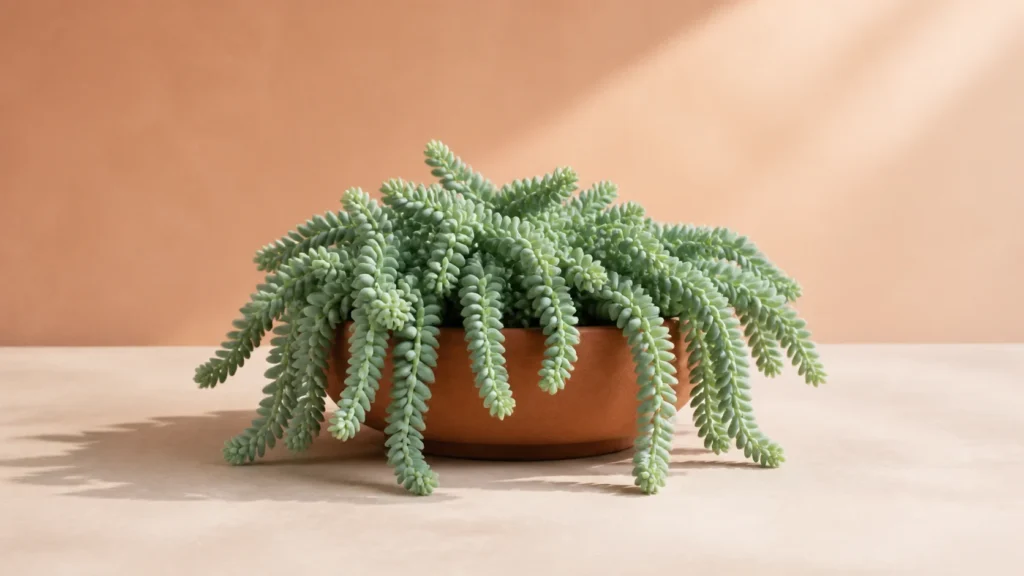
Burro’s Tail
Sedum morganianum
A cascading curtain of plump blue-green beads — the most dramatic trailing succulent, as long as you resist touching it.
Watering frequency
Every 2-4 weeks
Ideal temperature
60-80°F / 16-27°C
Humidity
30-50%
Care difficulty
Medium
Air purifying
No/Not Known
Growth rate
Moderate
Plant size
2-4 ft / 0.6-1.2 m trailing
Soil type
Fast-draining cactus or succulent mix
Fertilizer need
Once or twice while growing.
Care summary
- Light: Bright light to full sun; several hours of sun daily.
- Water: Soak thoroughly, then let the soil dry completely.
- Soil: Fast-draining cactus mix in a shallow pot.
- Handling: Leaves fall at a touch — handle by the pot, not the stems.
- Maintenance: Never brush against it; root dropped leaves.
- Safety: Pet-safe.
Common problems
- Dropped leaves: touching, overwatering, or repotting.
- Wrinkled, shriveled leaves: underwatering.
- Mushy, rotten stems: overwatering or poor drainage.
- Faded, pale color: too little light.
- Mealybugs: rare, but check the leaf joints.
Plant care guide
About Burro's Tail
The Burro's Tail (Sedum morganianum) — also called donkey's tail or horse's tail — is the houseplant equivalent of a beaded curtain: long, cascading stems completely wrapped in overlapping, plump, blue-green leaves that look like tiny jelly beans or peas. Kew's accepted record places its native range in the Mexican states of Veracruz, Puebla, and Chiapas. In a pot it spills over the rim, and NC State Extension notes that its stems can reach about 24 inches, with the leaves forming braided "tails" around each stem.
Its beauty is inseparable from its one serious flaw: the leaves fall off at the slightest touch. Brush against the plant, bump the pot, or try to untangle a stem, and you'll lose a shower of little blue-green beads. This fragility is the plant's natural survival strategy — in the wild, dropped leaves root into new plants — but it makes the Burro's Tail a "look, don't touch" houseplant, which is a genuine adjustment for most owners.
That single quirk is also why the plant is rated medium difficulty rather than easy, despite having the same drought-tolerant, sun-loving nature as other succulents. If you can learn to handle it by the pot and never brush past it, the care itself is straightforward — bright light, dry soil, rare water. The challenge is behavioral, not horticultural.
Why You'll Like It
Nothing else in the houseplant world looks quite like a mature Burro's Tail. A well-grown specimen is a waterfall of plump, blue-green beads cascading two or three feet over its pot — dramatic, textural, and completely unlike the upright succulents everyone else owns. It photographs beautifully, and it's the rare hanging plant that looks deliberate and sculptural rather than just trailing.
It's also genuinely low-maintenance in every way that matters: it needs watering every two to four weeks, thrives on bright light, tolerates neglect, and never needs pruning. A Burro's Tail on a sunny windowsill is a plant you can leave for a month and return to unchanged — as long as nobody brushes against it in the meantime.
And for pet owners, it's a rare find: the ASPCA lists Sedum as non-toxic to cats and dogs, so the same plant that looks like edible beads is actually safe for the animals most likely to be curious about them. It's one of the few trailing succulents that combines drama with genuine pet safety.
What Kind of Plant Is It?
Three facts explain how a Burro's Tail behaves.
- It is a "leaf-shedding" succulent. The leaves detach at the slightest touch — it's an evolutionary adaptation for propagation. Each dropped leaf can root into a new plant, which is why the plant sheds so freely. Understand that the leaf-drop is normal and designed-in, not a defect: it's the plant's backup plan for survival.
- It is a trailing, not climbing, plant. Stems grow outward and downward, hugging the ground in the wild and cascading over the pot indoors. It is built for hanging baskets, tall planters, and shelves — anywhere the tails can spill downward.
- It is a drought-adapted sun-lover. Like all stonecrops, it stores water in its plump leaves, wants bright light (NC State recommends "high light interior environments such as a windowsill with at least partial sun"), and hates wet soil. The blue-green color and the waxy "bloom" on the leaves are products of strong light and dry conditions.
Where It Works Best
The Burro's Tail wants the brightest window you have. NC State recommends a windowsill with at least partial sun — several hours of direct light a day — and the plant grows its densest, most colorful tails under strong light. A south- or west-facing windowsill is ideal; a bright room without direct sun works, but growth slows and the stems grow lankier with fewer leaves. The light guide helps you gauge whether your window delivers enough.
Because of the fragile leaves, placement is as much about traffic as light. Choose a spot where nothing brushes past the plant: a hanging basket in a corner, a shelf above head height, or a windowsill that isn't a walkway. Every time someone bumps it, you lose a handful of leaves — so position it for beauty and safety, then don't touch it.
It's happy in normal household warmth of 60-80°F (16-27°C), and while NC State notes it tolerates temperatures down to about 40°F outdoors, indoors it just wants to avoid cold drafts and freezing windows. Dry air is perfect — this is a plant that evolved on rocky, sun-baked slopes, so the humidity-raising techniques most plants need are actively unnecessary here. A bright kitchen windowsill, a sunny bedroom, or a living-room hanging basket all work.
How to Care for Burro's Tail
Watering: Water thoroughly, then let the soil dry out completely before watering again — every 2-4 weeks in a bright room, less often in winter. NC State's advice is to let the soil dry between waterings, use tepid (not cold) water, and reduce watering in winter. The plump leaves are the plant's water tank: when they look slightly wrinkled or shriveled, it's thirsty; when they're firm and full, leave it alone. Wet soil is the one thing that kills this plant — rot starts at the base and moves up through the stems. The watering guide covers the soak-and-dry method in detail.
Light: Bright light to full sun — several hours of direct sun a day keeps the tails dense and the blue-green color vivid. In dimmer light the stems stretch, the leaves space out, and the plant loses its braided look. If the color fades to pale green, it wants more sun.
Soil: Use a fast-draining cactus or succulent mix, and prefer a shallow pot — NC State specifically recommends shallow pots, because the roots stay near the surface and deep water-holding soil invites rot. Drainage holes are non-negotiable.
Temperature: Comfortable to warm rooms of 60-80°F (16-27°C). Protect it from frost and cold drafts; NC State gives about 40°F as the outdoor tolerance floor.
Humidity: None needed. Dry air is ideal — skip the humidifier, pebble trays, and misting entirely.
Fertilizer: Feed lightly — once or twice during the growing season with a diluted succulent or balanced fertilizer. NC State suggests fertilizing lightly once or twice a year. Overfeeding makes soft, floppy growth.
Handling (the rule that matters): Never grab the stems, never brush the leaves, never repot a mature plant unless you must. Always lift and move the plant by the pot. When leaves drop — and they will — collect them and root them; nothing is wasted with this plant.
How to Propagate
Propagation is so easy it happens by accident — every dropped leaf is a potential new plant. Three reliable methods:
- Leaf cuttings (the accidental method): Leaves that fall off and land on dry soil root on their own. Place dropped leaves on the surface of succulent mix, keep the soil barely moist, and tiny rosettes form at the base over several weeks. NC State notes that cuttings and dropped leaves "root easily, making propagation a simple process"
- Stem cuttings: Cut a stem section several inches long, let the cut end callus for a few days, then lay it on moist mix or insert the cut end shallowly. Roots form along the stem and new growth appears at the tip. Handle the cutting as little as possible — the leaves fall off at a touch.
- Division: If a plant produces multiple stems from the base, you can divide the root ball when repotting, though the leaf-loss from handling makes this the least pleasant option.
Spring and early summer are the best times. Expect slow but steady results — a leaf cutting takes months to become a visible tail, which is why most growers propagate a handful of leaves at once to hedge their bets.
When to Repot
Repot rarely — every three to four years, or when the roots fill the pot — and only when you truly must, because repotting a mature Burro's Tail is an exercise in patience: even gentle handling sheds leaves. NC State recommends shallow pots, so when you do repot, choose a wide, shallow container rather than a deeper one. Do it in spring, use fresh dry cactus mix, move the plant by grasping the root ball (not the stems), and water very lightly for the first week or two. Accept the leaf loss as unavoidable — every fallen leaf is a free propagation. The repotting guide covers the technique, adapted here with extra care and a smaller pot.
Toxicity and Pet Safety
The Burro's Tail is pet-safe. The ASPCA lists Sedum as non-toxic to dogs, cats, and horses, and the NC State profile carries pet-friendly tags. NC State notes the plant is technically edible — the stems and leaves can be eaten, with large quantities causing only stomach upset — which tells you the toxic risk is essentially nil. A cat that bats at the tails will shed leaves (the plant's defense) and may nibble one without harm. The bigger risk is physical: the plant is fragile, so a rowdy pet can strip a pot bare just by playing with it. Place it where pets can admire it from a distance, and sweep up dropped leaves promptly. The pet-safe plants guide includes the Burro's Tail among its recommended pet-friendly succulents.
Common Problems and Practical Fixes
- Leaves dropping: If it's constant and you haven't touched it, suspect overwatering or a draft; if you've bumped it, that's just the plant being itself. Shedding from handling is normal — reduce the handling, not the plant.
- Wrinkled, shriveled leaves: Underwatering. The plump leaves deflate when the plant is thirsty. Water thoroughly and the leaves plump back up within a few days.
- Mushy, blackening stems: Overwatering or poor drainage — rot spreading from the base. This is the plant's only serious disease. Cut away the affected stems, let the soil dry completely, and improve drainage; root the healthy cut ends as new plants.
- Pale, stretched, sparse growth: Too little light. Move it to a sunnier window; new growth will come in denser and bluer.
- Brown, scarred leaf tips: Sunburn from intense afternoon sun through glass, or salt buildup. Pull it slightly back from the window or switch to filtered water.
- Mealybugs: White cottony clusters at the leaf joints — uncommon but possible. Treat with rubbing alcohol on a cotton swab, then insecticidal soap; the pest guide covers the routine.
Frequently Asked Questions
Why are the leaves falling off my Burro's Tail?
Either someone touched it — the leaves detach at the slightest contact — or the plant is overwatered. If you've been handling the stems, stop: always move the plant by the pot. If leaves drop without any touching, check for soggy soil and cut back watering.
How often should I water Burro's Tail?
Every 2-4 weeks in a bright room, when the soil has dried completely — less often in winter. The leaves are the indicator: plump means fine, wrinkled means thirsty. Wet soil causes rot, so when in doubt, wait.
Does Burro's Tail need direct sun?
It does best with several hours of direct sun a day — NC State recommends a windowsill with at least partial sun. It tolerates bright indirect light but grows lankier and paler without real sun.
How do I propagate Burro's Tail?
Just root the dropped leaves: place them on dry succulent mix, keep it barely moist, and tiny rosettes form at the base over a few weeks. Stem cuttings work too — cut, callus, lay on mix. It's one of the easiest plants to propagate, because the plant does most of the work by shedding leaves for you.
Is Burro's Tail toxic to pets?
No. The ASPCA lists Sedum as non-toxic to cats and dogs, and NC State's profile carries pet-friendly tags — the plant is even technically edible, though you shouldn't encourage nibbling. The practical risk is the plant's own fragility, not toxicity.
Why is my Burro's Tail turning pale?
Not enough light. The blue-green color and waxy bloom depend on strong sun; in dim conditions the leaves fade to plain green and the stems stretch. Move it to the sunniest window you have.
Why are the stems rotting at the base?
Overwatering or a pot that holds water. Rot starts in soggy soil and climbs the stems. Cut the healthy tops, root them as cuttings, repot the remains in dry cactus mix, and water far less — this plant is drought-adapted, and wet feet kill it.
Can I plant Burro's Tail with other succulents?
Yes — it's a classic companion in mixed succulent pots and hanging baskets, where it drapes over the edge while upright plants fill the center. Just remember it's the fragile one: put the arrangement somewhere nothing brushes it, and water on the dry side for the whole group.
Final Thought
The Burro's Tail is the plant that teaches you a new rule: beauty and handling don't mix. Its cascade of plump blue-green beads is one of the most striking sights in the houseplant world, and the care is almost laughably simple — bright sun, dry soil, and a rare drink. The only discipline it demands is restraint: don't touch it, don't brush it, don't move it unless you must. Respect that one rule, and the tails will grow longer and denser every year, shedding free baby plants along the way. Few plants reward non-interference as generously as this one.