
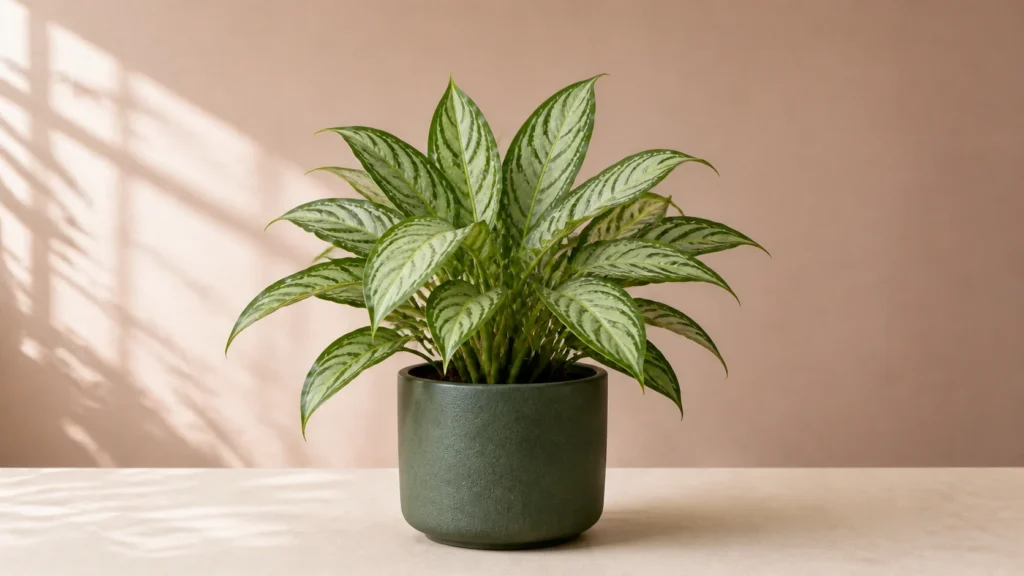
Chinese Evergreen
Aglaonema spp.
A consumer-favorite group of Aglaonema foliage plants with green, silver, pink, or red leaves and broad tolerance for ordinary indoor light.
Watering frequency
Every 7-14 days
Ideal temperature
65-80°F / 18-27°C
Humidity
40-60%
Care difficulty
Easy
Air purifying
Yes
Growth rate
Slow
Plant size
1-3 ft / 0.3-0.9 m
Soil type
Airy, well-draining houseplant mix
Fertilizer need
Every 6-8 weeks while growing.
Care summary
- Light: Low to bright indirect light; colorful cultivars need the brighter end.
- Water: Let the upper mix dry, then water thoroughly and drain.
- Soil: Use an airy mix in a pot with drainage holes.
- Temperature: Protect from cold drafts and cold wet roots.
- Safety: Aglaonema contains irritating calcium oxalate crystals.
Common problems
- Yellow leaves: Check wet soil, blocked drainage, cold exposure, and natural aging.
- Brown tips: Irregular watering, fertilizer salts, dry air, or root stress.
- Drooping: Soil may be very dry, roots may be damaged, or the plant may be chilled.
- Leggy growth: Light is too weak for compact growth.
- Fading pink or red color: Colored cultivars usually need brighter indirect light.
- Mealybugs, scale, or mites: Inspect leaf axils, stems, and undersides.
Plant care guide
About Chinese Evergreen
Chinese Evergreen is the common retail name for a broad group of Aglaonema species, hybrids, and cultivars grown for patterned foliage. The familiar name remains the best consumer-facing title, but a plant sold under it is not automatically Aglaonema commutatum. This candidate therefore uses Aglaonema spp. in the structured Botanical Name field and explains individual cultivar identity where it is known.
Many silver-green cultivars are associated with A. commutatum and its breeding lines. Kew Plants of the World Online accepts Aglaonema commutatum, records it as native to the Philippines and Sulawesi, and describes it as a wet-tropical subshrub. The wider genus includes plants from tropical and subtropical Asia.
Chinese Evergreens form upright clusters of leaves on short, increasingly visible stems. Leaf pattern varies enormously: dark green, silver bands, cream speckles, pink margins, red veins, or almost fully pink blades. That range is why a common-name category is more useful to consumers than forcing every unlabeled supermarket plant into one species.
Why You'll Like It
Chinese Evergreen offers one of the best combinations of color and adaptability among indoor foliage plants. A green-and-silver plant can remain presentable in medium or relatively low indirect light, while a pink or red cultivar adds flower-like color without needing to bloom.
It grows slowly enough for desks, side tables, and modest apartments. It does not need a climbing pole, and pruning is usually limited to removing old leaves or shortening a bare stem. Once watering and temperature are stable, it fits a routine that is less demanding than many aroids.
The familiar claim that it “thrives anywhere” still needs limits. No cultivar thrives in darkness, and colored plants lose intensity in weak light. If you need maximum tolerance for a dim position and want a non-toxic choice, compare Cast Iron Plant. ZZ Plant handles drying better but is also toxic if chewed. Dieffenbachia has a similar upright aroid form and the same calcium-oxalate safety concern.
What Kind of Plant Is It?
Chinese Evergreen is an evergreen aroid with a compact root system and cane-like stems that become more obvious with age. New leaves emerge rolled from the growing tips, then open and harden.
Four traits shape care:
- Shade adaptation supports tolerance. Green leaves can function in weaker indirect light, but lower energy means slower growth and slower water use.
- Color changes the light requirement. Pink, red, cream, and heavily silver cultivars generally need brighter indirect light to maintain compact growth and strong pattern.
- Warm roots matter. A cold plant uses water slowly, so a cool wet pot is more dangerous than either condition alone.
- Aroid sap contains irritants. Calcium oxalate crystals make this a plant to keep away from chewing pets and small children.
Popular Chinese Evergreen Varieties
NC State Extension's Aglaonema profile documents numerous species and cultivars in the trade. Keep the nursery label because color alone does not establish identity.
- 'Silver Bay' has a broad silver center surrounded by green margins and is one of the most recognizable larger cultivars.
- 'Maria' carries silver-green patterning on darker leaves and is widely valued for shade tolerance.
- 'Silver Queen' has elongated leaves with extensive silver-gray markings and green margins.
- 'Siam Aurora' is commonly sold for green leaves outlined and veined in red.
- 'Crete' combines green, pale patterning, burgundy-red margins, and pinkish stems.
- Pink and red trade cultivars such as 'Red Ruby', 'Wishes', and 'Red Zircon' need reliable labels and brighter indirect light than solid-green forms.
- Aglaonema pictum 'Tricolor' is a distinct collector plant with camouflage-like patterning and should not be treated as an ordinary A. commutatum cultivar.
Different cultivars share broad genus-level care, but they do not have identical growth rate, mature size, cold tolerance, or light response. Future cultivar pages should preserve exact labels rather than creating generic records such as “Red Chinese Evergreen.”
Buying and Identifying One
Treat the nursery label as part of the plant. Photograph it and keep the original tag, especially for red and pink hybrids whose names are easily lost in retail. A generic “Aglaonema” label supports genus-level care and safety guidance but does not justify inventing a cultivar identity from pattern alone.
Choose a plant with firm stems, an active rolled leaf or healthy crown, and no sour smell from the pot. Inspect leaf axils for white mealybug residue and check patterned areas closely for mite stippling. A single old yellow lower leaf is less concerning than several soft yellow leaves combined with saturated soil.
After bringing it home, isolate it from the collection and let it adjust before repotting. A sudden change in light can alter leaf angle or color, while cold transport can produce delayed damage. Keeping the first few weeks simple makes those responses easier to diagnose.
Where It Works Best
Green and silver cultivars work in bedrooms, offices, and living rooms with low-to-medium indirect daylight. “Low light” still means enough ambient light to navigate and read during the day without the room being effectively dark. A windowless office needs a suitable grow light.
Place pink, red, cream, or heavily patterned plants closer to an east window or in bright filtered light near stronger glass. Protect them from hot direct afternoon sun, which can bleach or scorch the foliage.
Keep every Chinese Evergreen away from exterior-door drafts, strong air-conditioning, and cold window glass. A warm stable position is often more important than high humidity. The plant accepts ordinary room air, although very dry heat can worsen edge damage.
How to Care for Chinese Evergreen
Light: Solid-green plants tolerate the lowest light; silver and colored cultivars need more. Bright indirect light supports the strongest growth, but harsh direct sun can burn leaves. If stems stretch and the distance between leaves increases, move the plant brighter gradually.
Watering: Let the upper few centimeters or roughly the top quarter of the mix dry, then water thoroughly until excess exits the drainage hole. Empty the saucer or cachepot. In a dim room, the pot may take much longer than seven to fourteen days to dry; in warm bright conditions, it may need checking sooner.
Avoid keeping the mix continuously wet. Yellow leaves on a saturated plant are not a request for more water. At the other extreme, repeated severe wilting can damage fine roots and brown tips. Aim for a predictable wet-to-partly-dry cycle.
Soil and container: Use an airy houseplant mix amended with bark, perlite, or pumice if necessary. A pot with drainage holes is essential. Chinese Evergreen has a relatively compact root system, so an oversized container creates a large reservoir of unused wet mix.
Humidity: Average indoor humidity around 40-60% is generally adequate. A humidifier helps when heated air is chronically dry. Routine misting provides only a brief change and can leave residue on patterned leaves; it is not required for successful care.
Temperature: Keep around 65-80°F / 18-27°C and avoid prolonged exposure below roughly 60°F / 15°C. Use room-temperature water and reduce watering when cooler or darker conditions slow growth.
Fertilizer: Feed lightly every six to eight weeks during active growth with a diluted balanced fertilizer, following the label. Skip winter feeding when the plant is not growing. Excess fertilizer can burn tips and roots, especially in low light.
Pruning and cleaning: Remove a fully yellow leaf at its attachment point. If an older cane becomes bare and top-heavy, it can be cut and propagated while the rooted base is allowed to resprout. Wipe foliage gently so dust does not obscure early pest damage.
Flowers: Mature plants may produce a small greenish-white spathe and spadix. The bloom is not the main ornamental feature. Removing it is optional; do not claim that every flower must be cut to keep the plant healthy.
How to Propagate Chinese Evergreen
Division is easiest when a pot already contains several rooted shoots. During repotting, separate a natural section with roots and foliage, then place it in a container sized to its root mass. Keep warm and moderately moist while it re-establishes.
Stem cuttings can rejuvenate a bare cane. Cut a healthy top section below a node and root it in water or an airy moist medium. A leaf without a section of stem and node cannot produce a new plant. Horizontal cane sections may also sprout, but orientation, warmth, and careful moisture control matter.
There is no reason to guarantee a fixed rooting time. Temperature, season, cultivar, cutting maturity, and root medium all change the pace. Wait for a functioning root system and sustained new growth before moving a water-rooted cutting into a large pot.
When to Repot
Repot when roots circle densely, the mix has compacted, drainage becomes unreliable, or the plant is physically unstable. Spring or active growth is ideal. Move up only one size and preserve the original planting depth.
Slow growth alone is not a repotting signal. A Chinese Evergreen in low light may remain stable in the same pot for a long time. Check roots, soil structure, light, temperature, and pests before assuming it needs more space.
Toxicity and Pet Safety
Chinese Evergreen is not pet-safe. ASPCA's Chinese Evergreen entry lists insoluble calcium oxalates and describes oral irritation, pain and swelling of the mouth, drooling, vomiting, and difficulty swallowing after chewing. Although that ASPCA page names Aglaonema modestum, NC State's genus-level profile also identifies calcium oxalate toxicity across the familiar Aglaonema group.
Keep the plant out of reach, remembering that fallen leaves and propagation pieces also contain sap. Wear gloves if sap irritates your skin and wash hands after pruning. If chewing or ingestion occurs, contact a veterinarian or animal poison-control service. Breathing or swallowing difficulty requires urgent professional care.
About Air-Purifying Claims
Chinese Evergreen is often marketed as an air-purifying plant because Aglaonema appeared in chamber experiments. Those experiments do not show that one or two pots meaningfully clean the air in an ordinary ventilated room. A review of potted-plant studies found that normal building air exchange outpaces the removal achieved by typical plant quantities. Choose Chinese Evergreen for durable foliage and the experience of growing it, not as a replacement for ventilation or an air purifier. Read the peer-reviewed review of potted plants and indoor VOC removal.
Common Problems and Practical Fixes
- Several yellow leaves with wet mix: Pause watering, check drainage, and inspect roots if decline continues. Cold can intensify the problem.
- One oldest lower leaf yellows: This may be normal aging if the rest of the plant is firm and growing.
- Brown tips: Review dry-down, fertilizer salts, very dry air, hot sun, and root condition. Changing water alone will not fix damaged roots.
- Drooping in dry soil: Water thoroughly. If the plant stays limp after rehydration, inspect roots and temperature.
- Drooping in wet soil: Do not add more water; check for oxygen-starved or rotting roots.
- Faded color: Move a pink, red, or silver cultivar into brighter indirect light. Existing leaves may not recolor fully, so judge new growth.
- Leggy cane: Improve light and consider top-cutting a healthy plant to restart a fuller pot.
- Mealybugs, scale, or spider mites: Inspect stems, axils, and undersides, isolate the plant, and follow a treatment labeled for indoor ornamentals.
Frequently Asked Questions
Is Chinese Evergreen one species?
No. The retail category includes several Aglaonema species, hybrids, and cultivars. Keep the plant label when exact identity matters.
Can it grow in low light?
Green cultivars tolerate low indirect light, but growth slows and the pot dries more slowly. Colorful plants need brighter indirect light, and no Aglaonema thrives in complete darkness.
Why are red leaves turning greener?
Insufficient light is a common reason, though genetics and leaf age also affect color. Increase indirect light gradually and evaluate future leaves.
Should I let tap water sit overnight?
That may allow some chlorine to dissipate but does not remove dissolved minerals. First correct watering and fertilizer; if new tips still brown, compare a lower-mineral water source.
Is it safe for cats or dogs?
No. Aglaonema contains insoluble calcium oxalate crystals that can cause painful mouth irritation and difficulty swallowing.
Final Thought
Chinese Evergreen earns its common name by combining consumer-friendly variety with practical tolerance. Match the light to the cultivar, keep the root zone warm and airy, water after partial dry-down, and feed lightly. It will not thrive in darkness or saturated soil, but within those limits it remains one of the most adaptable patterned foliage groups for ordinary homes.