
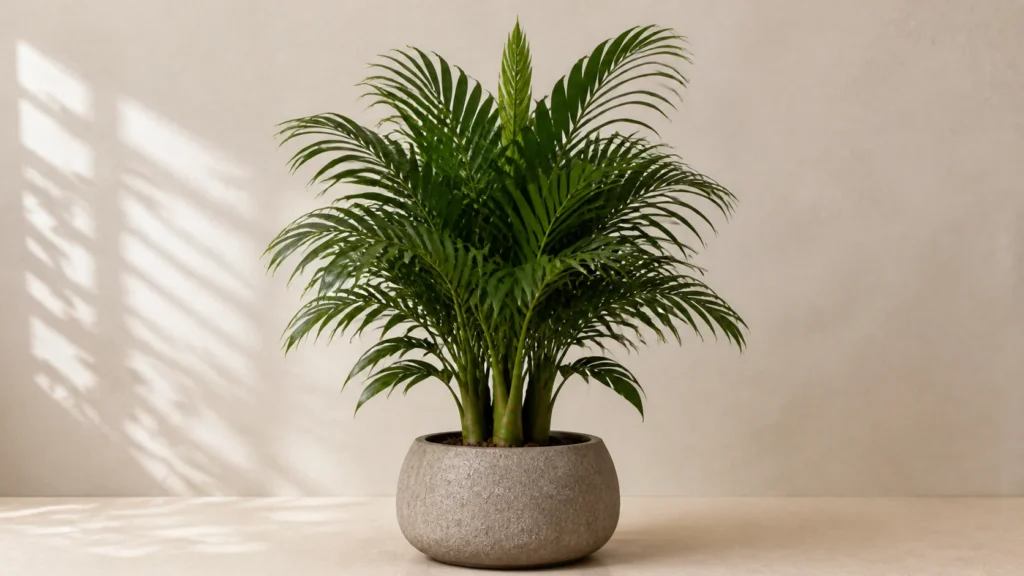
Majesty Palm
Ravenea rivularis
A lush, arching palm with feathery fronds that brings instant tropical presence — non-toxic to pets, though it asks for humidity and consistent moisture.
Watering frequency
Every 3-5 days
Ideal temperature
65-85°F / 18-29°C
Humidity
50-70%
Care difficulty
Medium
Air purifying
No/Not Known
Growth rate
Moderate
Plant size
5-10 ft / 1.5-3 m indoors
Soil type
Moist, well-draining potting mix
Fertilizer need
Monthly, spring-summer.
Care summary
- Light: Bright indirect light; avoid direct sun.
- Water: Keep soil consistently moist, never soggy.
- Soil: Moist, well-draining mix.
- Humidity: High humidity is a real need, not a bonus.
- Growth: Slow indoors; several young plants are often potted together.
- Safety: Pet-safe.
Common problems
- Yellow fronds: low light, thirst, overwatering, or low humidity.
- Brown crispy tips: dry air or underwatering.
- Spider mites: common when humidity is low.
- Root rot: soil staying soggy.
- Stunted growth: pot-bound or poor light.
Plant care guide
About Majesty Palm
The majesty palm (Ravenea rivularis) is the tropical statement plant you see in every big-box garden center — a cluster of feathery, arching fronds rising from a short trunk, sold in a pot that suddenly looks too small. Native to Madagascar, where it grows along the edges of rivers and streams, it belongs to the palm family (Arecaceae), and the species name rivularis literally refers to that riverbank habitat. The NC State Extension profile for the majesty palm notes that in the wild the species can reach 100 feet tall and is becoming rarer due to deforestation, while indoors it stays a manageable 5-10 feet.
The name deserves a small clarification: NC State lists both "Majesty Palm" and "Majestic Palm" as accepted common names for the same species, so the two spellings you see in stores are the same plant. It is also a botanical one-of-one in its group — NC State notes that Ravenea rivularis has no cultivars and is the only species in its genus cultivated as a houseplant.
Here is the single most useful fact about buying one: commercial growers typically plant three or more young palms together in one pot to create the lush, full look that sells. That means the "plant" you bring home is usually a cluster, and NC State points out the practical upside — you can divide the cluster and give each palm its own pot, multiplying your houseplant collection in one move. It also explains why majesty palms so often look crowded: they are.
Why You'll Like It
The majesty palm delivers the fastest, cheapest dose of "tropical resort" you can put in a living room. The fronds are large — up to 6-8 feet long even indoors, per NC State — medium to dark green, and arching, creating the soft, dense canopy that makes a corner feel like a lobby. For the price of a mid-range houseplant, you get a plant that instantly reads as expensive and lush.
It is also one of the safest statement plants you can own. The ASPCA lists the majesty palm as non-toxic to dogs, cats, and horses, and the NC State profile carries the same non-toxic tags. In a plant world where the biggest, most impressive specimens — fiddle leaf figs, philodendrons, sago palms — are often toxic, the majesty palm is a rare large-scale option for homes with curious pets. The pet-safe houseplants guide groups it with the palms that are genuinely safe for animal households.
And it rewards patience with scale: while it grows slowly indoors, a well-cared-for majesty palm adds height and fronds each season, slowly turning into the corner centerpiece you bought it to be.
What Kind of Plant Is It?
Three facts explain how the majesty palm behaves.
- It is a riverbank palm, which explains its thirst. In the wild it grows at the edges of rivers and streams in Madagascar, so it is adapted to consistently moist soil and humid air. This is the opposite of most houseplant palms' reputation and the source of its one real challenge indoors: it does not forgive neglect the way a parlor palm or kentia palm does. The NC State profile is blunt about it — the palm requires high humidity, bright indirect light, and consistent moisture, and "may be difficult to grow indoors."
- It is fast in the wild and slow in a pot. NC State notes it grows quickly in its native habitat but much more slowly as a houseplant. Do not expect the rapid growth of a pothos; expect steady, measured progress — a new frond or two at a time.
- What you buy is usually a cluster, not one palm. Because growers pot several plants together for fullness, your majesty palm is really several palms competing in one pot. This is why it looks lush, why it may look crowded, and why division is a legitimate propagation method.
Where It Works Best
The majesty palm wants the brightest spot you can give it without direct sun. NC State's light recommendation is bright, indirect light and explicitly warns that direct sunlight scorches the leaves. A few feet back from a south or west window, or right beside an east window, is ideal. In too little light the palm grows slowly and the fronds lose color.
Humidity is the second requirement, and it is a genuine need rather than a nice-to-have. NC State lists high humidity as a requirement and warns that low humidity brings unwanted insect pests — spider mites in particular. A bright bathroom, a kitchen near a sink, a room with a humidifier, or a spot on a pebble tray all work; the humidity guide covers the practical options. If your home is dry and you cannot raise the humidity, this may not be the palm for you — that is the honest trade-off with a majesty palm versus a more forgiving palm like a parlor palm.
Temperature is straightforward: NC State recommends 65-85°F (18-29°C), which covers any comfortable home. Keep it away from cold drafts, heat vents, and air-conditioning airflow — all of which brown the frond tips.
How to Care for Majesty Palm
Light: Bright, indirect light only. Direct sun scorches and yellows the leaves, while too little light starves it. A bright room with filtered sun is the target.
Watering: Keep the soil consistently moist — not soggy, not bone dry. In a typical warm room that can mean watering every 3-5 days, with the soil surface staying slightly damp to the touch. NC State describes the soil preference as moist, and warns that both overwatering (root rot) and underwatering show up as yellow leaves, so the goal is steady, even moisture. The watering guide explains how to keep soil consistently moist without tipping into soggy.
Soil: Use a rich, well-draining potting mix that holds moisture without staying waterlogged. Mixes with peat or coir plus perlite work well. Drainage holes in the pot are essential — this is a thirsty plant, and the excess water needs somewhere to go.
Humidity: This is the make-or-break factor for indoor majesty palms. NC State requires high humidity; in dry air the frond tips brown and spider mites move in. Use a humidifier, a pebble tray, or a bright bathroom, and group it with other plants if needed.
Temperature: 65-85°F (18-29°C). Avoid cold drafts and direct heat sources.
Fertilizer: Feed monthly in spring and summer with a balanced houseplant or palm-specific fertilizer at half strength, and reduce or stop in fall and winter. Underfeeding shows up as pale, slow growth; the fertilizing guide has the general timing.
How to Propagate
Majesty palms do not grow from cuttings — but the standard store-bought plant is already several palms, which gives you the only practical propagation method: division. As NC State describes, commercial growers pot three or more young palms together for fullness, and you can divide the cluster and give each palm its own pot.
To divide: in spring, unpot the cluster and gently tease the root balls apart, keeping as many roots attached to each crown as possible. Pot each division in its own container with fresh moist mix, water well, and keep it in bright indirect light with high humidity while it settles in. Some fronds may droop or yellow for a few weeks as the divisions recover — that is normal. The result is several separate palms, each slower-growing but healthier than the crowded original, and you have expanded your collection in a single repotting.
When to Repot
Majesty palms grow slowly indoors but are usually sold slightly root-bound in their nursery pots, so plan to repot within the first year, then every one to two years after, or whenever roots circle the pot and water runs straight through. Spring is the best time. Move up one pot size at a time — a much larger pot holds water the roots cannot use and invites root rot — and use fresh, well-draining, moisture-retentive mix. After repotting, keep the soil consistently moist and the humidity high for a few weeks. The repotting guide walks through the standard technique.
Toxicity and Pet Safety
The ASPCA lists Ravenea rivularis as non-toxic to dogs, cats, and horses, and the NC State profile carries the same non-toxic tags. A pet that eats plant material may still develop gastrointestinal upset. Correct identification matters because Sago Palm, which is not a true palm, is dangerously toxic. The pet-safe houseplants guide helps distinguish safer palms from misleading common names.
Common Problems and Practical Fixes
- Yellow fronds: The most common complaint, and NC State lists four overlapping causes: inadequate light, insufficient water, overwatering, and low humidity or nutrient deficiency. Work through them in order — light first, then watering consistency, then humidity, then feeding.
- Brown, crispy frond tips: Dry air or underwatering. Raise the humidity and check that the soil is staying consistently moist. Brown tips do not heal, so trim them at an angle and fix the cause for future fronds.
- Spider mites: The classic low-humidity pest on majesty palms — fine webbing and stippled, dusty-looking leaves. Raise the humidity and treat with insecticidal soap, repeating weekly; the pest guide covers the routine.
- Root rot: Soggy soil, often from a pot without drainage or watering too often. Yellowing lower fronds and a musty smell are the signs. Repot in fresh mix with better drainage and let the soil dry slightly between waterings.
- Slow or stunted growth: Normal indoors to a degree, but if it stalls entirely, check light, pot size, and feeding. A root-bound palm in low light simply stops.
- Cold or heat damage: Fronds brown near drafty windows, radiators, or AC vents. Move the palm to a stable-temperature spot.
Frequently Asked Questions
Why are the fronds on my majesty palm turning yellow? Usually one of four things: too little light, inconsistent watering (too much or too little), low humidity, or lack of nutrients. Fix light and watering consistency first — those cover most cases.
Is a majesty palm easy to keep alive indoors? It is more demanding than most palms. It needs bright indirect light, consistently moist soil, and genuinely high humidity, and NC State is candid that it "may be difficult to grow indoors." With a humidifier and steady care it thrives; in dry, dim corners it declines.
Is majesty palm toxic to cats and dogs? No. The ASPCA lists Ravenea rivularis as non-toxic to dogs, cats, and horses, and NC State carries the same tags. It is one of the safest large houseplants for pet households.
How often should I water a majesty palm? Keep the soil consistently moist — typically every 3-5 days in a warm room, checking the soil surface rather than following a calendar. Never let it dry out completely, and never leave it sitting in water.
Why are the tips of the fronds turning brown? Dry air is the usual culprit, with underwatering close behind. Raise the humidity around the palm and water more consistently; the browned tips will not recover, but new fronds will stay clean.
Can I split my majesty palm into multiple plants? Yes. Store-bought palms are usually several plants potted together. In spring, unpot the cluster, gently divide the root balls, and pot each palm separately — NC State confirms this is a legitimate way to multiply your collection.
Why does my majesty palm keep getting spider mites? Spider mites thrive in dry air, and majesty palms are mite magnets when humidity drops. Raise the humidity, rinse the fronds, and treat with insecticidal soap weekly until the mites are gone.
Final Thought
The majesty palm is the tropical statement plant with one honest condition attached: it asks for bright indirect light, consistently moist soil, and real humidity, and it does not thrive without them. Give it that, and it rewards you with arching fronds, a lush corner, and the rare combination of big-plant presence and genuine pet safety. If your home can provide the humidity — a bright bathroom, a humidifier, a plant group — this is the palm that turns a room into a lobby. If not, choose a more forgiving palm and enjoy the majesty palm at the garden center instead.