
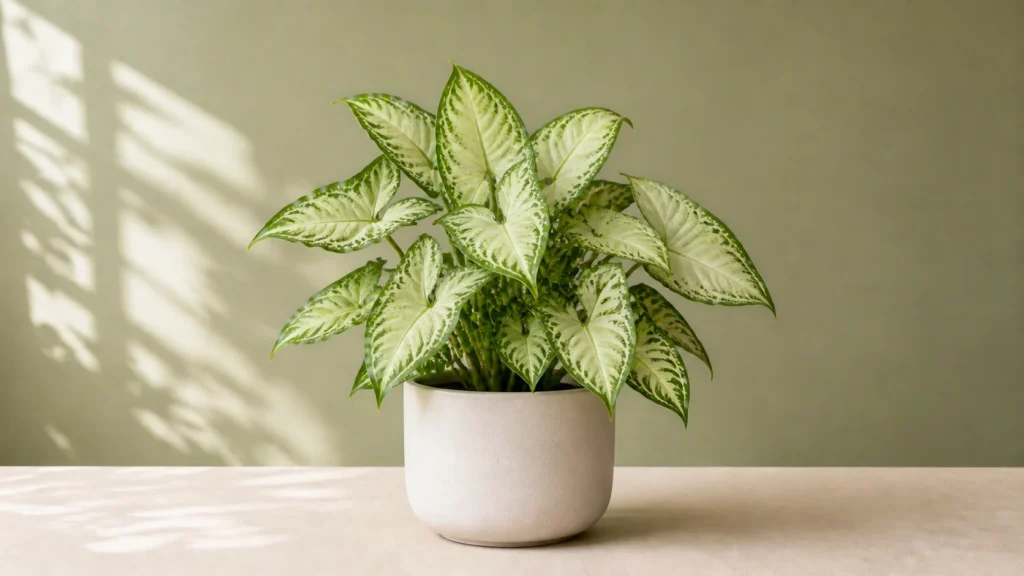
Syngonium ‘White Butterfly’
Syngonium podophyllum 'White Butterfly'
A classic arrowhead cultivar with creamy white leaf centers and green margins, combining a bright variegated look with forgiving Syngonium care.
Watering frequency
Every 7-10 days
Ideal temperature
65-80°F / 18-27°C
Humidity
40-60%
Care difficulty
Easy
Air purifying
No/Not Known
Growth rate
Fast
Plant size
Trails or climbs 2-6 ft / 0.6-1.8 m
Soil type
Loose, moisture-retentive aroid mix
Fertilizer need
Monthly, spring-summer.
Care summary
- Light: Medium to bright indirect light; brighter filtered light supports the pale pattern.
- Water: Water when the top inch dries, then drain thoroughly.
- Soil: Use an airy aroid mix that holds some moisture without staying soggy.
- Growth: Prune for a compact plant or give the vine a support.
- Safety: Not pet-safe; the sap contains irritating calcium oxalate crystals.
Common problems
- Green new leaves: insufficient useful light or natural variation.
- Brown pale areas: harsh sun, dry roots, or very dry air.
- Yellow leaves: overwatering or poor drainage.
- Long bare stems: low light or mature climbing growth.
- Spider mites or thrips: check curled and newly unfurled leaves.
Plant care guide
About the White Butterfly Syngonium
White Butterfly Syngonium (Syngonium ‘White Butterfly’) is a named arrowhead-vine cultivar grown for juvenile leaves with broad creamy centers and green margins. The Royal Horticultural Society accepts the cultivar name and describes its cream markings along the veins, while Singapore NParks records its climbing habit and pale young growth. It is more useful to treat this as its own plant than to hide it under a generic Arrowhead Plant record: the pale pattern changes the best light placement and the way stress appears.
Young leaves have the familiar arrowhead outline. As the vine matures and climbs, later leaves may become larger and more divided. That change is normal for the species and does not mean the cultivar has reverted.
How to Identify It
Look for a pale cream-to-light-sage center that follows the main veins, surrounded by a clearer green margin. The boundary is usually softer and more symmetrical than the irregular marbling of ‘Three Kings’. It should not have the scattered pink freckles of the Milk Confetti Syngonium or the rosy center veins of the Pink Allusion Syngonium.
Nursery labels are still important. Color varies with age and growing conditions, and very young leaves can look lighter before hardening.
Best Light and Placement
Give it medium to bright indirect light. Bright filtered light supports compact growth and makes the creamy pattern easier to see. Strong afternoon sun through glass can burn the pale tissue, while a dark corner produces longer internodes and greener new leaves.
An east-facing window, a bright room several feet back from a south or west window, or a filtered bright windowsill works well. Rotate the pot every week or two so the vine grows evenly. A small trellis or pole encourages larger leaves; pruning keeps it bushier for a desk or shelf.
Water, Soil, and Feeding
Water when the top inch of mix feels dry. Soak the root ball, let excess water leave the drainage holes, and empty the saucer. A fixed weekly schedule is less reliable than checking the soil because light, pot size, temperature, and season change the drying time.
Use a loose mix that holds moderate moisture but keeps air around the roots—for example, indoor potting mix amended with perlite and fine orchid bark. Feed at half strength about once a month during active spring and summer growth. Reduce or pause fertilizer when winter growth slows.
Average household humidity is acceptable, but 40-60% helps new leaves open cleanly. Keep the plant away from cold drafts and heating vents.
Pruning and Propagation
Cut a long vine just above a node on the parent plant to encourage branching. A propagation cutting needs at least one healthy node; a leaf without a node cannot produce a new vine. Root cuttings in water, damp sphagnum, or a light potting mix, then pot them together to create a fuller plant.
Variegation differs slightly from leaf to leaf. Select healthy cuttings with balanced green and cream rather than the palest possible section, because green tissue supplies the plant with energy.
Common Problems
- New leaves are much greener: Move the plant gradually into brighter indirect light. Judge several new leaves rather than one.
- Cream areas turn brown: Check for direct sun, prolonged dryness, low humidity, or damaged roots.
- Leaves yellow from the bottom: Let the mix dry a little further and confirm that the pot drains freely.
- Long gaps between leaves: Increase light and prune the bare vine back to a healthy node.
- Distorted new leaves: Inspect both leaf surfaces and the growing point for thrips or mites.
Pet Safety
This plant is not pet-safe. The ASPCA lists arrowhead vine as toxic to cats and dogs because of insoluble calcium oxalates, which can cause oral irritation, drooling, vomiting, and difficulty swallowing after chewing. Keep it away from pets and children and wear gloves if its sap irritates your skin.
Frequently Asked Questions
Why is my White Butterfly Syngonium turning green? Usually it needs more useful indirect light, although individual leaves naturally vary. Improve light gradually and judge the next few leaves.
Can it grow in low light? It may survive, but growth becomes looser and the pale pattern can weaken. Medium or bright indirect light is a better long-term choice.
Does it need a moss pole? No. It can trail or be pruned as a compact plant. A pole simply supports its natural climbing habit and can lead to larger, more mature leaves.
Is it the same as a generic Arrowhead Plant? It belongs to the same species as the Arrowhead Plant, but ‘White Butterfly’ is a named cultivar with a recognizable cream-and-green pattern and deserves a cultivar-specific record.