
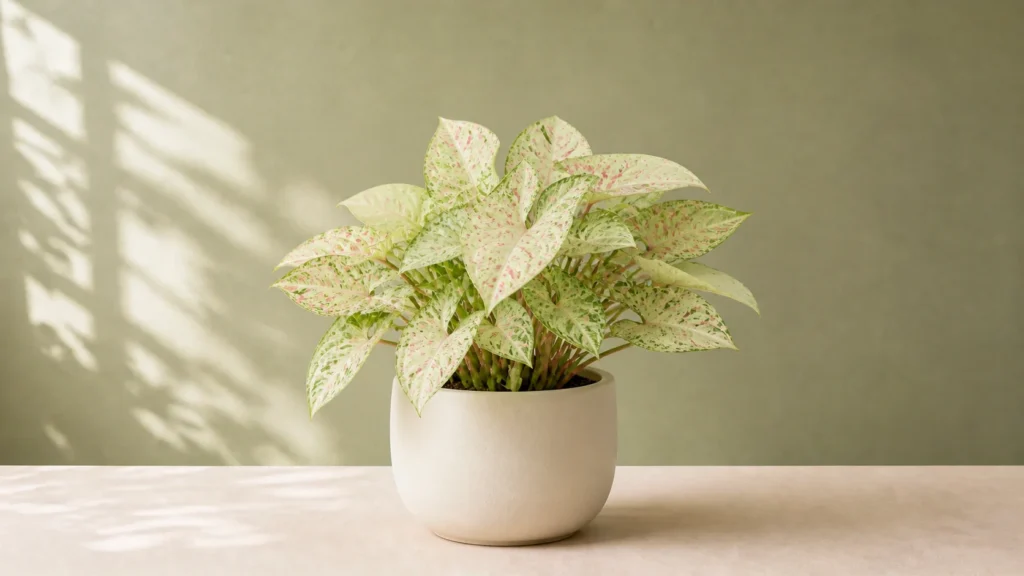
Syngonium ‘Milk Confetti’
Syngonium podophyllum 'Milk Confetti'
A pale mint arrowhead cultivar sprinkled with pink flecks, valued for playful variegation that differs on every new leaf.
Watering frequency
Every 7-10 days
Ideal temperature
65-80°F / 18-27°C
Humidity
50-70%
Care difficulty
Medium
Air purifying
No/Not Known
Growth rate
Moderate
Plant size
Trails or climbs 2-5 ft / 0.6-1.5 m
Soil type
Airy, moisture-retentive aroid mix
Fertilizer need
Every 4-6 weeks, spring-summer.
Care summary
- Light: Bright indirect light supports the mint base and pink flecks.
- Water: Water when the top inch dries and never leave the roots standing in runoff.
- Soil: Use a loose mix with perlite and fine bark.
- Variegation: Keep cuttings with both green tissue and a healthy node.
- Safety: Not pet-safe if chewed.
Common problems
- New growth becoming greener: low light or natural variation.
- Pale areas browning: sun scorch, root stress, or inconsistent watering.
- Leaves yellowing: soil staying wet too long.
- Weak growth: insufficient green tissue, weak light, or damaged roots.
- Distorted leaves: inspect for thrips and mites.
Plant care guide
About the Milk Confetti Syngonium
Milk Confetti Syngonium (Syngonium ‘Milk Confetti’) is a cultivated form of the Arrowhead Plant, the plain green Syngonium podophyllum, grown for pale mint-to-milky green leaves scattered with pink flecks and splashes. NC State Extension lists ‘Milk Confetti’ among the cultivars of Syngonium podophyllum. Its pattern is less symmetrical than the White Butterfly Syngonium and more speckled than the Pink Allusion Syngonium, so each new leaf becomes part of the appeal.
Trade labels are frequently confused with ‘Confetti’ and other pink-speckled Syngoniums. Keep the supplier label and evaluate the whole plant rather than assigning a cultivar from a single leaf.
How to Identify It
The useful way to identify Milk Confetti Syngonium is a very pale mint or milky green leaf blade plus scattered pink marks. Some leaves carry many freckles; others show larger irregular splashes or less pink. Pinkish petioles may also be visible. The pattern should not be a repeated cream center with a dark green frame.
Because online seller names are inconsistent, the cultivar name is a horticultural identity rather than a guarantee that every plant will look identical. This record describes the commonly traded ‘Milk Confetti’ form without claiming that color alone proves provenance.
Best Light and Placement
Give it bright indirect light. Its pale leaves have less green tissue than an ordinary arrowhead vine, so a dark position leads to weak, stretched growth. Strong direct sun is also risky because pale areas scorch first. Filtered east light or a position close to a bright window behind a sheer curtain is ideal.
Rotate the pot to expose all sides evenly. If growth leans, the problem is directional light rather than a need for more fertilizer. A small grow light can supplement a genuinely dark winter room, but introduce it gradually.
Water, Soil, and Humidity
Water when the top inch dries. Soak evenly and drain completely. Do not compensate for pale foliage by keeping the soil constantly wet; variegated roots still need oxygen, and prolonged saturation causes yellow leaves and rot.
Use an airy aroid mix that includes potting mix, perlite, and fine bark. A pot only slightly larger than the root ball dries more predictably than an oversized container. Aim for 50-70% humidity if practical, but prioritize stable moisture and airflow over frequent misting.
Feed lightly every four to six weeks in the growing season. Stop or reduce feeding when growth slows. Excess fertilizer can damage fine roots and brown leaf edges; it does not create more pink spots.
Managing Variegation and Propagation
Prune a vine above a node to encourage branching. To propagate, take a section with at least one node and one healthy leaf, then root it in water or a lightly moist medium. Choose stems that show healthy pale patterning plus enough green tissue to support growth.
One greener leaf is normal. If several consecutive leaves lose the cultivar’s pattern, first improve indirect light. If a particular vine continues to produce only green leaves, prune it back to a node that previously carried characteristic patterning.
Common Problems
- Pale areas turn tan or brown: Check for direct sun, dry roots, fertilizer buildup, or root damage.
- Plant becomes mostly green: Improve bright indirect light and watch the next several leaves.
- Yellow, soft leaves: Let the mix dry more and inspect drainage and roots.
- Very slow growth: Confirm warmth, light, and living roots before feeding.
- Twisted or scarred new leaves: Isolate the plant and inspect for thrips or mites.
Pet Safety
Milk Confetti is not pet-safe. The ASPCA identifies arrowhead vine as containing insoluble calcium oxalates. Chewing can irritate the mouth and cause drooling, vomiting, or difficulty swallowing. Keep the plant and pruning waste out of reach.
Frequently Asked Questions
What is the difference between Confetti and Milk Confetti? Plants sold as ‘Milk Confetti’ are generally paler or mintier, with pink flecks against that light base. Labels in the trade are inconsistent, so provenance and the original nursery label are more reliable than one photo.
Does every leaf need pink spots? No. The amount and distribution vary. Judge the pattern across several leaves and multiple growth points.
Can it tolerate medium light? It may survive, but bright indirect light is a better fit for compact growth and recognizable variegation.
Should I cut off an all-green leaf? Not immediately. Wait to see what the same stem produces next. Prune only when a growth point repeatedly produces foliage without the cultivar pattern.