
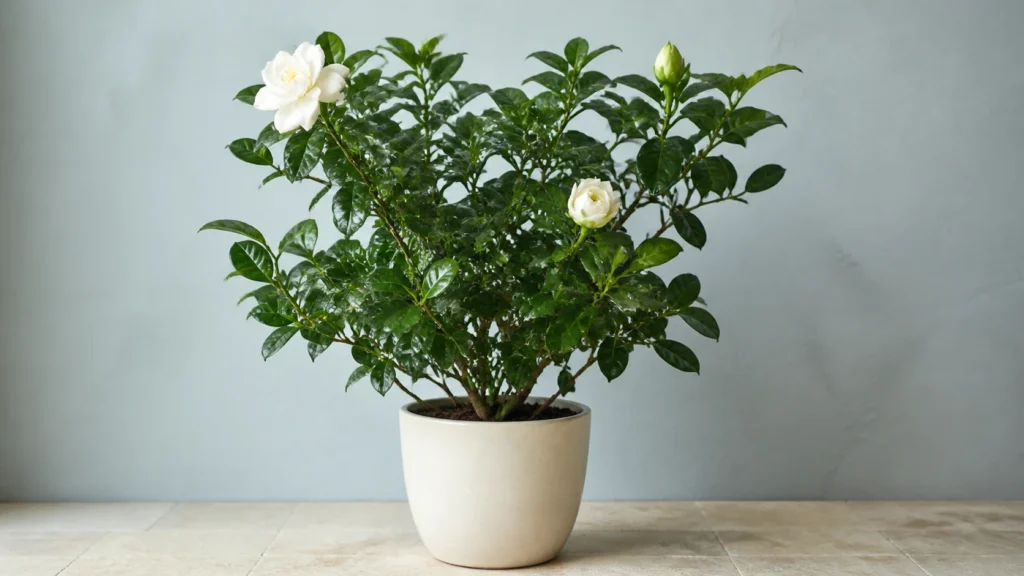
Gardenia
Gardenia jasminoides
A glossy evergreen shrub whose waxy white flowers release one of the most famous scents in the plant world, demanding but rewarding indoors with careful attention to acid soil and humidity.
Watering frequency
Every 7-10 days
Ideal temperature
65-75°F / 18-24°C, cooler at night
Humidity
60-80%
Care difficulty
Hard
Air purifying
No/Not Known
Growth rate
Moderate
Plant size
2-6 ft indoors / 0.6-1.8 m
Soil type
Acidic, well-draining mix (pH 5.0-6.0)
Fertilizer need
Monthly, spring-summer.
Care summary
- Light: Give bright light with morning sun; protect from harsh afternoon sun.
- Water: Keep the soil evenly moist; never let it dry out fully.
- Soil: Use an acid mix; treat iron deficiency promptly.
- Humidity: High humidity is essential for buds and clean leaves.
- Safety: Toxic to cats and dogs if ingested.
Common problems
- Bud drop: Fluctuating conditions or dry air.
- Yellow leaves with green veins: Iron deficiency from alkaline soil.
- Brown leaf tips: Low humidity or salt buildup.
- No flowers: Check light, plant maturity, and whether nights are cool enough for bud development.
- Pests: Aphids, whitefly, and mealybugs.
Plant care guide
About
The Gardenia is a glossy evergreen shrub native from the eastern Himalaya through central and southern China and Indo-China to southern Japan. Its waxy white flowers carry one of the most celebrated scents in horticulture. The most widely grown species is Gardenia jasminoides, a compact shrub with deep green, heavily veined leaves and flowers that open white and age toward cream or ivory.
The Gardenia's reputation as a fussy houseplant is earned but often overstated. It is not hard in the way a tropical orchid is hard; it is simply unforgiving of inconsistency. It wants steady moisture, steady temperature, acid soil, and real humidity, and when any of those wobble, it drops its buds and sulks. Give it the stability it asks for, and it rewards you with one of the most beautiful flowering houseplants that exists.
Why You'll Like It
The Gardenia offers the single most intoxicating flower scent available from any houseplant. One plant in a living room is enough to make the whole room smell like summer, and the flowers themselves, waxy, sculptural, and pure white against the dark leaves, are among the most beautiful in the plant world. The contrast between the deep green foliage and the white blooms is striking, and the plant has a classic, old-fashioned elegance that modern flowering houseplants rarely match.
It is also a plant with genuine prestige. Growing a Gardenia to bloom indoors is a quiet achievement, the kind of plant that experienced growers name when asked what they are proud of, and the flowers it produces are worth every bit of the attention it demands. For anyone who wants a flowering houseplant that smells as good as it looks, there is simply nothing else like it.
What Kind of Plant Is It
The Gardenia is a genus of evergreen shrubs in the madder family (Rubiaceae), the same family as the coffee plant, documented by the North Carolina State Extension. Kew's accepted record for Gardenia jasminoides gives a broader native range than the familiar China-Japan shorthand: eastern Himalaya through central and southern China and Indo-China to southern Japan, including Taiwan. The epithet jasminoides means "like jasmine," referring to its jasmine-like fragrance and flowers.
The plant is an acid-loving shrub often grown in the same ericaceous potting mixes used for camellias and rhododendrons, although Gardenia belongs to Rubiaceae rather than the heath family, Ericaceae. It prefers acidic soil, roughly pH 5.0 to 6.0, and can develop yellow leaves with dark green veins when high pH restricts iron uptake. Soil pH is an important diagnostic check, but watering, roots, pests, and temperature should also be reviewed when foliage declines.
Its flowers are its defining feature. The buds form over several weeks, and the plant is notorious for dropping them at the last moment if conditions fluctuate, a habit that frustrates growers but also reveals how sensitive the plant is to its environment. When everything is right, the buds swell and open in sequence, and each flower lasts several days before browning.
History
The Gardenia's botanical history is a small drama of eighteenth-century science and friendship. The genus was described in 1761 by John Ellis, a London merchant and naturalist, in a paper published in the Philosophical Transactions of the Royal Society. Ellis had received the plant from South Carolina, and he first offered to name it after a fellow horticultural patron, the nurseryman Richard Warner. When Warner declined the honor, Ellis named the genus instead for his friend and correspondent Alexander Garden, a Scottish-born physician and botanist living in Charleston, South Carolina, who had supplied the specimens. Garden never saw the plant named after him in a favorable light; the two men later quarreled over other matters, but the name stuck.
The species epithet records a second eighteenth-century story. When the German-born botanical artist Georg Dionysius Ehret saw the plant, he remarked that its flowers resembled those of a jasmine, and the observation found its way into the published description as jasminoides, "jasmine-like." The name has survived two and a half centuries, and it remains a slightly misleading but charming description of the plant's scent and flower form.
Kew's Plants of the World Online documents the full taxonomic tangle that followed, listing 56 synonyms for the species, including several names now rejected, such as Gardenia florida and Gardenia augusta, and an early, unpublished generic name, Varneria augusta, which Linnaeus himself had proposed before Ellis's Gardenia was published. The confusion reflects how widely the plant was grown and how many times European botanists independently tried to name it.
Long before Europe discovered it, the plant was a cultivated favorite in East Asia, where it was grown in China's gardens and recorded in literature as early as the Song dynasty, a thousand years ago. It reached England in the mid-eighteenth century, and in 1757 the London nurseryman James Gordon achieved the first successful propagation by cuttings, a breakthrough so remarkable that he sold the resulting plants for five guineas each, an enormous sum for the time. From that single success, the Gardenia spread through the gardens and conservatories of Europe, and it has been a symbol of refinement and fragrance ever since.
Related Varieties
The species has produced many cultivated forms, and the choice of variety matters for indoor growing.
- 'Veitchii' is the classic indoor variety, a compact form with smaller leaves and profuse, single flowers. It is the most reliable bloomer indoors.
- 'Mystery' is a larger, more vigorous plant with big double flowers, better suited to a conservatory than a living room.
- 'Radicans' is a dwarf, low-growing form with small leaves and small flowers, ideal for a small pot or a terrarium.
- 'August Beauty' is a mid-size variety with double flowers and a long bloom season.
Among indoor plants, the Gardenia shares its family and its acid-soil preference with the coffee plant, and it is often grouped with other fragrant, white-flowered plants like the star jasmine. Its reputation as a challenging indoor bloomer puts it in a different category from the easy-flowering phalaenopsis orchid, but the fragrance is in a class of its own.
Where It Works
The Gardenia needs bright light, steady conditions, and humidity, which makes the choice of room genuinely important. A bright conservatory is ideal; indoors, a bathroom with a large window, a bright kitchen, or a spot near an east-facing window works well, because these spaces tend to be more humid and more stable in temperature. The plant wants bright light with some direct morning sun but protection from harsh afternoon sun, which scorches the leaves and stresses the buds.
Keep it away from radiators, air-conditioning vents, and cold drafts, all of which cause the temperature swings and dry air that trigger bud drop. A room that stays between about 65 and 75°F (18 to 24°C) by day, with slightly cooler nights, suits it well. If your home is dry, a humidifier or a pebble tray under the pot is not optional; it is the difference between flowers and bare stems.
How to Care for a Gardenia
Light. Bright light with a few hours of morning sun is ideal. The plant needs strong light to form buds, but harsh afternoon sun burns the leaves and drops the buds. An east window, or a south window with sheer curtain, is the classic spot.
Water. Keep the soil evenly moist, never soggy and never bone dry. Water when the top half inch of soil begins to dry, and water thoroughly with room-temperature water. The plant is sensitive to both extremes, and erratic watering is a leading cause of bud drop. Use rainwater or filtered water if your tap water is hard; the plant is sensitive to mineral buildup.
Soil. Use an acidic, well-draining mix, ideally one formulated for acid-loving plants, with a pH between 5.0 and 6.0. Repot in spring every two years or so, moving up one pot size and disturbing the roots gently.
Humidity. High humidity, above 60 percent, is essential. Set the pot on a pebble tray with water, use a humidifier, or group it with other plants. Misting helps but is not a substitute; the air around the plant needs to stay humid through the day.
Fertilizer. Feed monthly through spring and summer with a fertilizer formulated for acid-loving plants. If the leaves yellow with green veins, the classic iron deficiency, treat with an iron supplement or chelated iron, and check that the soil pH has not drifted too high.
Temperature. Steady temperatures with cooler nights suit the plant best. Avoid warm, stuffy rooms at night, which can cause buds to drop; a drop of a few degrees at night actually helps them open.
How to Propagate
The Gardenia is propagated from cuttings, and it is a slow but satisfying process. Take semi-ripe stem cuttings, about four to six inches long, in spring or early summer, cutting just below a node. Remove the lower leaves, dip the cut end in rooting hormone, and plant the cutting in moist, acidic, airy mix. Cover the pot with a clear plastic bag or place it in a propagation box to hold humidity, and keep it in bright, indirect light with steady warmth. Rooting takes four to eight weeks, and the new plants need another year or two before they are strong enough to flower. Propagation is the way to get more plants from a favorite variety, but it is a project for the patient.
When to Repot
Repot a Gardenia every two years or so, in spring, when the roots fill the pot. Use a pot one size larger and an acidic, well-draining mix, and water in well. The plant dislikes having its roots disturbed, so handle it gently and keep it in a stable, humid spot for a week or two after repotting. If the plant is thriving and the buds are forming, postpone repotting until after flowering; repotting a plant in bud is a reliable way to lose the buds.
Toxicity
The Gardenia is toxic to cats and dogs. The ASPCA's toxic plant database records the plant under its common name Gardenia, classifying it as toxic to cats, dogs, and horses, with the toxic principles listed as geniposide and gardenoside, compounds that can cause mild vomiting and, occasionally, hives in pets that eat the flowers or leaves. The toxicity is on the mild end of the spectrum, and the typical outcome of a nibble is a brief bout of stomach upset rather than a serious emergency, but the flowers are fragrant and attractive, which is exactly why pets sometimes investigate them.
Keep the plant out of reach, especially the flowers. If a pet eats any part, contact a veterinarian or animal poison-control service for case-specific guidance rather than relying on a home remedy. The plant's sap can also irritate sensitive human skin, so wash your hands after pruning.
Common Problems
Bud drop. The signature Gardenia complaint. The buds form, then yellow and fall before opening, usually because of fluctuating conditions: dry air, temperature swings, erratic watering, or repotting at the wrong time. Stabilize everything, raise the humidity, and move the plant to a spot with steady temperature.
Yellow leaves with green veins. Iron chlorosis, caused by soil that is not acidic enough. Treat with an acid-loving plant fertilizer or chelated iron, and check the soil pH.
Brown leaf tips. Low humidity, hard water, or salt buildup from overfeeding. Raise humidity, switch to rainwater or filtered water, and flush the soil with plain water occasionally.
No flowers. Not enough light, or the plant is young, or it had a disrupted season. Give it more light and stable conditions, and be patient; buds take weeks to form and open.
Pests. Aphids, whitefly, mealybugs, and spider mites all favor gardenias. Check the undersides of leaves regularly, treat early with insecticidal soap or neem oil, and isolate the plant until the pests are gone.
FAQ
Why does my Gardenia drop its buds? Fluctuating conditions are the usual cause: dry air, temperature swings, erratic watering, or repotting while in bud. The plant needs steady moisture, humidity above 60 percent, and stable temperatures to hold its buds.
Why are the leaves on my Gardenia yellow? If the veins stay green, it is iron chlorosis, caused by soil that is too alkaline for the plant. Treat with an acid-loving fertilizer or chelated iron, and use rainwater or filtered water.
How much light does a Gardenia need indoors? Bright light with a few hours of morning sun. It needs strong light to flower, but harsh afternoon sun burns the leaves and drops the buds.
Is Gardenia toxic to pets? Yes, mildly. The ASPCA lists Gardenia as toxic to cats and dogs, with symptoms of mild vomiting and occasional hives. Keep the plant and its fragrant flowers out of reach.
How often should I water a Gardenia? Keep the soil evenly moist, watering when the top half inch begins to dry, roughly every seven to ten days. Never let it dry out fully, and never leave it sitting in water.
Final Thought
The Gardenia is the plant world's proof that the best things demand the most care. It asks for acid soil, steady moisture, real humidity, and a stable environment, and it punishes every inconsistency by dropping its buds. But when the conditions are right, it produces flowers whose scent has been treasured for centuries, from the gardens of Song-dynasty China to the conservatories of Georgian England, and one open bloom makes the whole room feel like a garden in high summer. It is not a plant for everyone, but for the grower willing to give it what it needs, it remains the most fragrant, most elegant, and most rewarding flowering houseplant there is.