
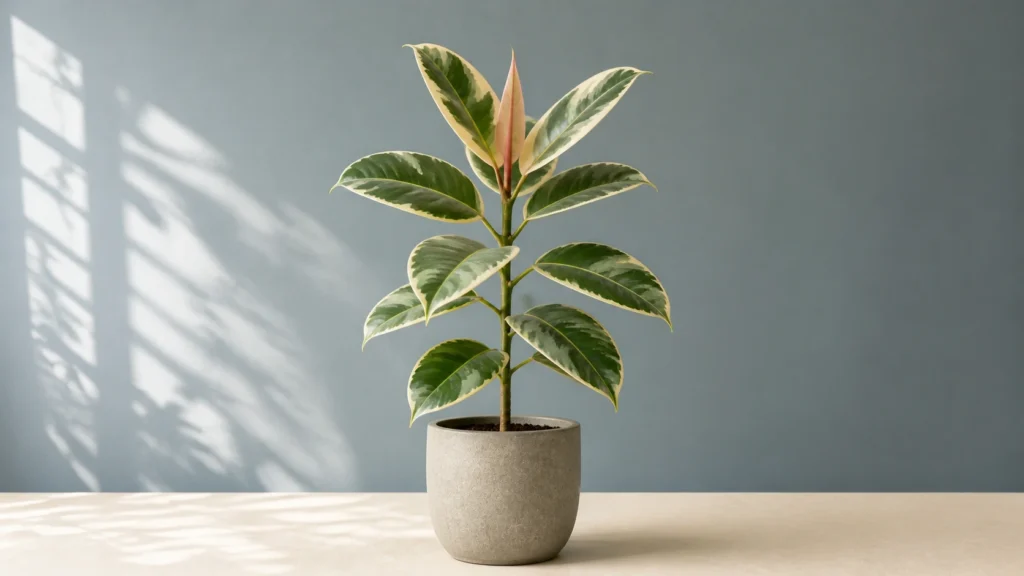
Tineke Rubber Plant
Ficus elastica 'Tineke'
A variegated Ficus elastica with cream-edged gray-green leaves, pink-flushed new growth, and the same easy, tree-like habit as the classic rubber plant.
Watering frequency
Every 7-14 days
Ideal temperature
65-80°F / 18-27°C
Humidity
40-60%
Care difficulty
Easy
Air purifying
Yes
Growth rate
Moderate
Plant size
3-8 ft / 0.9-2.4 m
Soil type
Well-draining houseplant mix
Fertilizer need
Monthly, spring-summer.
Care summary
- Light: Give bright indirect light; the white leaf sectors need extra light to stay healthy.
- Water: Let the upper mix dry, then soak and drain thoroughly.
- Color: Expect pink new growth to fade to cream as leaves mature.
- Shape: Prune above a node to encourage branching.
- Safety: Keep away from pets and children who may chew it.
Common problems
- Pale or fading variegation: Improve light so the green tissue can support the white sectors.
- Brown scorch patches: Move away from direct sun and cold drafts.
- Green reversion: Prune all-green branches back to keep the variegated growth.
- Leaf drop: Review watering swings, relocation, and drafts.
- Pests: Check leaf undersides for mealybugs and scale.
Plant care guide
About Tineke Rubber Plant
The Tineke Rubber Plant is a variegated selection of the classic rubber plant, Ficus elastica. Its broad, glossy leaves are edged and streaked with cream against a gray-green center, and new leaves emerge with a soft pink flush that fades as the leaf matures. The plant keeps the upright, tree-like habit of the species, which makes it a room-scale statement without any extra fuss.
The cultivar is often sold under the general label variegated rubber plant, alongside names like Variegata and Belga. In person it is easy to spot: each leaf is a mix of cream, soft green, and gray, with a pale midrib and a reddish line on the underside. If you already grow the plain green Robusta Rubber Plant, the Tineke is the same plant to care for, with one extra requirement: more light to keep the white tissue healthy.
Why You'll Like It
Most people choose a Tineke for the color, and it delivers more than any solid-green houseplant can. The cream margins give the plant a painterly look, and every new leaf briefly flushes pink, so there is always something changing at the top of the stem. Because the plant stays upright and grows slowly to a manageable size, it works as a floor plant in a living room corner or a large windowsill specimen for years without outgrowing the room.
It is also one of the easier variegated plants to keep alive. The care is the same as for a standard rubber plant, and the only real discipline is light. Given bright indirect light, a stable watering routine, and an occasional wipe of the leaves, a Tineke looks good with minimal effort. If you want the sculptural presence of a rubber plant but find the plain green version a little dull, this is the natural upgrade.
What Kind of Plant Is It?
Ficus elastica is a broadleaf evergreen tree from the Moraceae family, native to northeast India, the eastern Himalayas, and Southeast Asia. In the wild it grows into a large tree with aerial roots, but indoors it stays a single-stemmed shrub or small tree with thick, leathery leaves. The species was formally described in 1814, according to Kew's accepted botanical record, and it reached European gardens as an ornamental around 1815.
The Tineke is a variegated cultivar of that species. Variegation is caused by a chimeral mutation: some leaf tissue lacks chlorophyll, so those sectors show the cream or white color instead of green. Because the white areas cannot photosynthesize, the green tissue must work harder to feed the whole leaf. That is the single most important fact about caring for this plant, and it explains why variegated forms need brighter light than their solid-green parents.
History of Tineke Rubber Plant
The Tineke is believed to be a natural sport, or branch mutation, of the Decora rubber plant, a broad-leaved green cultivar. According to plant records, the mutation was spotted in a Belgian nursery in Assebroek, where growers tending a large field of Decora plants noticed a single stem with cream-and-green patterning. The unusual growth was propagated by cuttings to preserve the trait, and the variegated form entered the trade under several names, including Variegata and Belga.
The precise discovery year and the name of the person who first propagated it are not recorded in any reliable public source, so it is best to treat the exact timeline as undocumented. What is consistent across trade sources is the parentage: a sport of Decora, established in European nurseries in the late 20th century. The cultivar name Tineke is not a formally registered botanical name; it is a widely accepted trade name used by growers and retailers, which is normal for houseplant cultivars of this era.
Tineke Rubber Plant vs. Ruby and Tricolor
The three most common variegated rubber plants are regularly mixed up in retail, so it helps to know what sets the Tineke apart.
- Tineke vs. Ruby: The Tineke is cream and gray-green with a brief pink flush on new growth. The Ruby Rubber Plant keeps pink far longer, with whole sectors of pink and red that persist on mature leaves, and it demands even brighter light to hold that color.
- Tineke vs. Tricolor: Tricolor carries three tones at once, with pink, cream, and green on the same leaf, and it is less widely available. A Tineke in low light can look similar, but under good light the Tineke is clearly a cream-edged plant rather than a pink-and-green one.
- Tineke vs. the green rubber plant: The plain Robusta Rubber Plant is entirely green and tolerates lower light. Every difference in care comes down to the white sectors on the Tineke, which need brighter light and show damage more easily.
- Tineke vs. Burgundy: The Burgundy Rubber Plant is the dark-leaved opposite: solid near-black green with red new growth, no cream sectors, and no extra light requirement. Choose Burgundy if you want drama without the bright-spot demands of variegation.
Where It Works Best
The Tineke belongs in a bright room, ideally near an east-facing window or a few feet back from a south or west window, where it receives bright indirect light for most of the day. A north-facing windowsill can work in a very light room, but the cream color will be thinner and growth slower. Because the plant grows upright rather than wide, it fits corners, wall gaps, and entryways that a branching plant would crowd.
Keep it away from radiators, air-conditioning vents, and drafty doors, since Ficus plants drop leaves when conditions swing. A spot that stays between 65 and 80°F (18 to 27°C) with normal household humidity is ideal. If you have a sunroom or a spot with morning sun, the plant will reward you with faster growth and brighter color, as long as the light is filtered and not scorching.
How to Care for Tineke Rubber Plant
Light
Bright indirect light is the single most important requirement. The cream and white sectors of the leaves cannot photosynthesize, so the green parts must receive enough light to feed the whole leaf. Place the plant where it gets strong but filtered light, and avoid direct afternoon sun, which scorches the pale tissue quickly. If the new leaves come out smaller, the stems stretch toward the window, or the cream areas start to turn brown, the plant is telling you it needs more light. The baseline comes from the species itself: North Carolina State Extension documents rubber plants as preferring bright, filtered light, and the cream sectors on a Tineke simply push that need higher.
Water
Water when the top inch or two of potting mix has dried out, then soak the mix thoroughly and let it drain. The exact interval, often every 7 to 14 days, depends on pot size, light, and season. In winter, growth slows and the plant needs less water. The fastest way to damage a Tineke is to keep the roots constantly wet, so always check the soil before watering rather than following a fixed calendar.
Soil and Container
Use a well-draining houseplant mix, which is what the species grows in under cultivation. A mix with some perlite or bark drains faster and reduces the risk of root rot. Choose a pot with drainage holes and avoid letting the plant sit in a saucer of water.
Humidity and Temperature
Normal household humidity, roughly 40 to 60 percent, is fine. The plant tolerates drier air better than many tropicals, though very dry rooms can cause brown leaf edges over time. Keep temperatures comfortable and warm, between 65 and 80°F (18 to 27°C), and protect the plant from cold drafts and sudden swings, which are the usual cause of leaf drop in Ficus.
Fertilizer
Feed monthly with a balanced houseplant fertilizer at a diluted label rate during active growth in spring and summer. The pale sectors do not change the feeding needs much, since the plant is still a Ficus at heart. Stop feeding in fall and winter when growth slows.
Pruning and Support
Prune the stem just above a node, a bump on the stem where leaves attach, to encourage branching. The milky white sap that oozes from a cut can irritate skin and stain surfaces, so wear gloves and have paper towel ready. Dust the leaves with a damp cloth every few weeks; clean leaves photosynthesize better and look far better.
How to Propagate Tineke Rubber Plant
Stem cuttings are the reliable method. Take a cutting with at least one node and a leaf or two, let the cut end dry for a few hours, and root it in water or moist potting mix. Roots form over several weeks, though the exact timing varies with warmth and light, so do not expect a fixed schedule. A cutting with a solid green leaf roots as well as a variegated one, and variegation carries over reliably in cuttings.
For a multistem look, an alternative technique is air layering, which roots a branch while it is still attached to the parent plant. Both methods work for home growers, and neither guarantees a perfect success rate, so take a couple of cuttings and give them bright indirect light while they root.
When to Repot
Repot every 1 to 2 years, or when roots begin circling the drainage holes and growth slows in spring. Move up one pot size, about 2 inches (5 cm) wider, rather than jumping to a much larger container, which holds water around the roots. Spring is the best time, because the plant recovers fastest from root disturbance during active growth.
Toxicity and Pet Safety
The milky latex sap of Ficus elastica is irritating and mildly toxic. Chewing the leaves or stems can cause drooling, mouth irritation, and stomach upset in pets, and the sap can irritate human skin, so wear gloves when pruning. The Ficus genus is listed as toxic to cats and dogs by ASPCA poison control, and rubber plant sap carries the same irritating latex. Place it out of reach of pets and small children, and wash your hands after handling cut stems.
Common Problems and Practical Fixes
- Pink color fades: This is normal. New growth flushes pink, then matures to cream. It is not a sign of trouble, only a description of how the cultivar works.
- Cream edges turn brown: Usually scorch from direct sun or damage from cold drafts. Move the plant to filtered light and a steadier temperature.
- Leaves become mostly green: The plant is reverting to the solid-green form, often in lower light. Prune the all-green branches back to encourage variegated growth, and improve light.
- Leaf drop: Check for recent relocation, drafts, or watering swings. Ficus plants respond to change by shedding leaves, then usually settle once conditions stabilize.
- Pests: Inspect stems and leaf undersides for mealybugs and scale. Wipe them off and treat early, since pests spread quickly through the protected undersides of big leaves.
Frequently Asked Questions
Why did the pink on my Tineke disappear?
The pink is a feature of new growth only. Each new leaf emerges with a pink flush on the sheath and margins, then the color fades to cream as the leaf matures and hardens. If the plant is healthy and the mature leaves are cream and green, nothing is wrong.
Is the Tineke the same as the Ruby Rubber Plant?
No. The Ruby Rubber Plant keeps strong pink and red sectors on mature leaves and needs brighter light to hold them. The Tineke is a cream-edged plant whose pink is temporary.
How much light does it really need?
Brighter than you would give a green rubber plant. The white sectors cannot photosynthesize, so the green tissue needs strong, filtered light. In low light the plant survives but the color thins and growth slows.
Why are my new leaves smaller than the old ones?
Smaller new leaves usually mean insufficient light. Move the plant closer to a bright window and give it time to adjust. Watering problems and a too-small pot can also slow new growth.
Does it grow into a big tree indoors?
Indoors it stays much smaller than the wild tree, typically reaching 3 to 8 feet (0.9 to 2.4 m) over many years, and pruning keeps it at whatever height you prefer.
Final Thought
The Tineke is the easiest way to own a variegated rubber plant: same tough, tree-like Ficus as the classic, with cream-edged leaves and a dependable pink flush on every new leaf. Give it bright indirect light, water on a schedule based on the soil, and prune above a node when you want branching, and it will stay handsome for years. The one thing to remember is that the pink fades on purpose, and that the color you are really buying is the cream.