
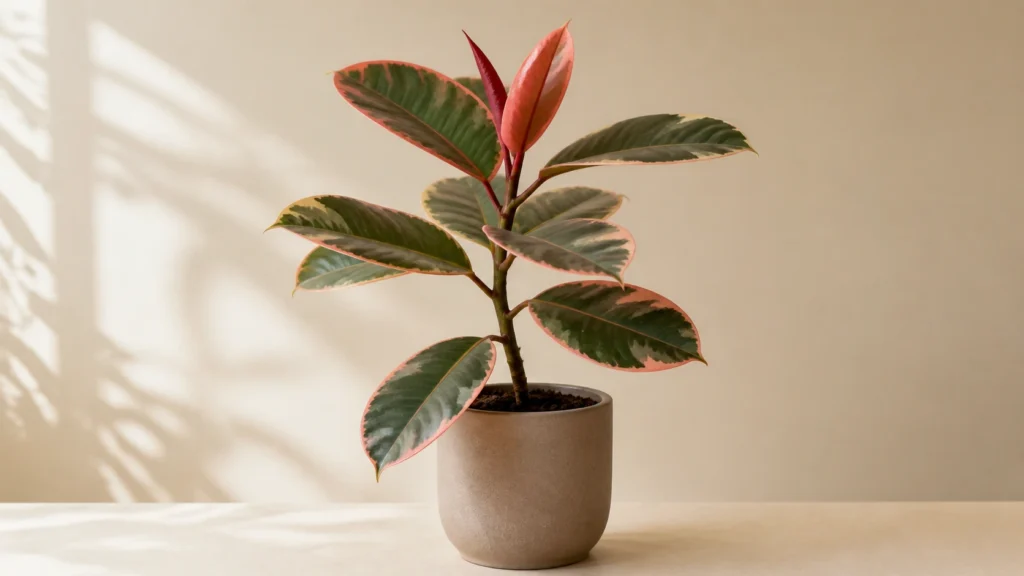
Ruby Rubber Plant
Ficus elastica 'Ruby'
A variegated Ficus elastica with strong pink, cream, and green leaf sectors, prized for color that stays vivid on mature leaves when given enough light.
Watering frequency
Every 7-14 days
Ideal temperature
65-80°F / 18-27°C
Humidity
40-60%
Care difficulty
Easy
Air purifying
Yes
Growth rate
Moderate
Plant size
3-6 ft / 0.9-1.8 m
Soil type
Well-draining houseplant mix
Fertilizer need
Monthly, spring-summer.
Care summary
- Light: Give the brightest indirect light you can without direct scorch.
- Water: Let the upper mix dry, then soak and drain thoroughly.
- Color: Pink sectors fade fast in low light; move the plant before they turn cream.
- Shape: Prune above a node to encourage branching.
- Safety: Keep away from pets and children who may chew it.
Common problems
- Pink fading to cream: Increase bright indirect light; the pink sectors need it most.
- Brown scorch on pale areas: Move away from direct sun and hot glass.
- Green reversion: Prune all-green branches to protect the variegation.
- Leaf drop: Review watering swings, relocation, and drafts.
- Pests: Check leaf undersides for mealybugs and scale.
Plant care guide
About Ruby Rubber Plant
The Ruby Rubber Plant is a variegated cultivar of Ficus elastica with leaves patterned in pink, cream, and green. What separates it from other variegated rubber plants is intensity: the pink sectors are broad and bold, and unlike the Tineke Rubber Plant, whose pink fades to cream, a well-grown Ruby keeps strong pink on mature leaves. The effect is a glossy, leathery-leafed tree whose canopy looks painted in rose and cream.
It keeps the same upright, single-stemmed habit as the classic Robusta Rubber Plant, so it works as a floor plant in a bright room. The care is the same as for any rubber plant, with one difference that matters more than anything else: Ruby needs excellent light to keep its pink, and it is less forgiving of low light than green or even cream-variegated forms.
Why You'll Like It
Ruby is the most colorful rubber plant you can buy, and it holds that color better than its rivals. Where a Tineke shows pink only on new growth, a Ruby keeps visible pink and red sectors on leaves that are months old. That makes it the plant for anyone who wants a big, statement-sized houseplant that does not look like every other green plant in the room.
It is also an easy plant in every way except light. It grows at a moderate rate, tolerates normal household humidity, and only needs water when the top of the soil dries. If you have one genuinely bright spot, a sunroom, or a south-facing window with sheer curtains, Ruby turns that spot into a focal point with very little effort.
One buying note: because Ruby loses pink in low light, a plant grown in a dim nursery can arrive looking mostly green or cream. That does not mean it is the wrong plant. Give it bright light for a few weeks and cut back any fully green shoots, and the pink usually returns on new growth. When you are choosing between a Ruby and a Tineke Rubber Plant at the garden center, look at the mature leaves: a true Ruby keeps visible pink and red on old foliage, while a Tineke is cream and green with pink only on the newest leaf.
What Kind of Plant Is It?
Ficus elastica is an evergreen tree from the Moraceae family, native to northeast India, the eastern Himalayas, and Southeast Asia, according to Kew's accepted botanical record. In cultivation indoors it grows as a thick-stemmed shrub or small tree with large, leathery, oval leaves. The Ruby is one of several variegated cultivars selected from the species, all sharing the same chimeral variegation: sectors of leaf tissue without chlorophyll show cream or pink instead of green.
The pink and red tones come from pigments, including anthocyanins, that build up in the non-green sectors. Because those sectors cannot photosynthesize, the green areas must feed the entire leaf, which is why the plant needs brighter light than a green rubber plant. Under strong light the pink deepens; under weak light the plant produces less pigment, and the pink sectors fade toward cream.
History of Ruby Rubber Plant
The Ruby is a relatively recent cultivar, believed to have been developed in the late 20th century from the variegated line of rubber plants that includes Tricolor and Doescheri. Its exact origin is not documented in any reliable public source: no plant patent, no published breeder record, and no official release notice has surfaced for this cultivar. Trade sources consistently describe it as a selection for stronger, more persistent pink color within the variegated group.
Like most Ficus elastica cultivars, it is propagated vegetatively by cuttings and tissue culture, which keeps the variegation stable across generations. The cultivar name Ruby is a trade name rather than a formally registered botanical name, which is typical for houseplant selections of its generation. The related Belize cultivar, often compared to Ruby, appears in some listings with more consistent red tones, but its own history is equally undocumented.
Ruby Rubber Plant vs. Tineke and Belize
Because the variegated rubber plants look alike to new buyers, the differences are worth stating clearly.
- Ruby vs. Tineke: The Tineke Rubber Plant is cream and gray-green, with pink only on new growth. Ruby keeps pink and red on mature leaves and needs stronger light to do so.
- Ruby vs. Belize: Belize is very similar, sometimes described as Ruby with more consistent pink and red across the leaf. In retail, the two are frequently confused, and some growers treat them as the same plant sold under two labels.
- Ruby vs. the green rubber plant: The plain Robusta Rubber Plant is entirely green and tolerates lower light. Ruby is the same species with the same structure, but its color depends on light in a way the green form's does not.
- Ruby vs. Burgundy: The Burgundy Rubber Plant has solid near-black leaves and no variegation at all. It needs less light than Ruby and holds its dark color in medium light, which makes it the better choice for rooms where Ruby would fade.
Where It Works Best
Ruby belongs in the brightest spot in the house. An east-facing window, a sunroom, or a spot a few feet back from a south or west window behind a sheer curtain all work well. The plant can tolerate a couple of hours of gentle morning sun, but keep it out of harsh afternoon sun, which scorches the pale leaf sectors faster than it damages green leaves.
Avoid dim corners and rooms with small windows. The plant will survive there for a while, then quietly lose its pink and stretch toward the light. Keep it away from radiators, vents, and drafty doors, since Ficus plants drop leaves when conditions swing. Normal household temperatures between 65 and 80°F (18 to 27°C) suit it year-round.
How to Care for Ruby Rubber Plant
Light
Bright indirect light is not a preference for Ruby, it is the whole game. The pink and cream sectors cannot photosynthesize, so the green tissue needs strong, filtered light to feed the plant, and the pink pigments themselves only form in good light. Give the plant the brightest spot you have without direct scorch. If the pink fades to cream or the new leaves come out mostly green, the plant needs more light, and it will recover if you move it before the reversion gets established. The same bright-filtered-light preference applies to the whole species, as North Carolina State Extension documents for rubber plants, and the non-green sectors on Ruby simply raise the floor.
Water
Water when the top inch or two of mix has dried, then soak thoroughly and drain. Intervals of every 7 to 14 days are typical but depend on pot size, light, and season. In winter, water less. Overwatering is the more common mistake; roots that sit wet fail quickly, and a plant with damaged roots cannot hold its color no matter how much light it gets.
Soil and Container
Use a well-draining houseplant mix with some perlite or bark, and always choose a pot with drainage holes. The soil should dry meaningfully between waterings rather than staying evenly damp, which suits the woody, tree-like root system of Ficus elastica.
Humidity and Temperature
Normal household humidity, around 40 to 60 percent, is enough. The plant tolerates dry air better than most tropicals, though very dry rooms can brown the leaf edges over months. Keep it comfortable and warm, between 65 and 80°F (18 to 27°C), and protect it from cold drafts and sudden temperature changes.
Fertilizer
Feed monthly with a balanced houseplant fertilizer at a diluted label rate during spring and summer growth. Do not overfeed, since excess salts in the soil can brown leaf tips. Skip feeding in fall and winter when growth slows.
Pruning and Support
Prune the stem just above a node, the bump where a leaf attaches, to encourage branching and a fuller shape. The milky latex sap oozes from cuts and can irritate skin and stain fabric, so wear gloves and keep paper towel ready. Wipe dust off the leaves with a damp cloth regularly, because clean leaves photosynthesize better and the plant's color shows far better.
How to Propagate Ruby Rubber Plant
Stem cuttings are the reliable method for home growers. Take a cutting with at least one node and a leaf or two, let the cut end dry briefly, and root it in water or moist potting mix. Roots form over several weeks, with the timing depending on warmth and light rather than a fixed schedule. Air layering, which roots a branch while still attached, is an alternative for a larger starting plant.
Variegation carries over reliably in cuttings, but a cutting taken from an all-green branch will grow into an all-green plant, so always take cuttings from the variegated growth. Take more than one cutting, since no home method guarantees success on every attempt.
When to Repot
Repot every 1 to 2 years, or when roots circle the drainage holes and growth slows in spring. Move up one pot size, about 2 inches (5 cm) wider, instead of a much larger container, which holds too much water around the roots. Spring is the best time because the plant recovers fastest from root disturbance during active growth.
Toxicity and Pet Safety
The milky latex sap of Ficus elastica is irritating and mildly toxic. Chewing leaves or stems can cause drooling, mouth irritation, and stomach upset in pets, and the sap can irritate human skin, so wear gloves when pruning. The Ficus genus is listed as toxic to cats and dogs by ASPCA poison control, and rubber plant sap carries the same irritating latex. Keep the plant out of reach of pets and small children, and wash your hands after handling cut stems.
Common Problems and Practical Fixes
- Pink fades to cream: The most common Ruby complaint, and almost always a light problem. Move the plant to brighter indirect light and cut back any all-green shoots that have taken over.
- Brown patches on pale areas: Usually scorch from direct sun or hot window glass. Move the plant to filtered light.
- Leaves drop: Check for recent relocation, drafts, or watering swings. Ficus plants shed leaves in response to change, then usually settle once conditions stabilize.
- Small new leaves: Often insufficient light or a pot that has become too small. Improve light first, then check the roots in spring.
- Pests: Inspect stems and leaf undersides for mealybugs and scale. Treat early, since pests spread quickly under large, crowded leaves.
Frequently Asked Questions
Why is my Ruby turning cream instead of pink?
Light. The pink pigments only form under strong light, and the variegation loses intensity when the plant is in shade. Move it to the brightest indirect light you have; existing pink often intensifies and new leaves come out pinker once light improves.
Is Ruby the same as the Tineke?
No. The Tineke Rubber Plant is cream and gray-green with temporary pink on new growth. Ruby keeps pink and red on mature leaves and demands stronger light to hold its color.
My Ruby arrived mostly green. Will it turn pink?
Possibly, if it was grown in low light. Move it to the brightest indirect spot you have and cut back any fully green shoots, which grow faster and crowd out the variegated growth. New leaves produced under good light usually come out pinker. If the whole plant was sold as a green rubber plant, it may be a different cultivar entirely.
Can Ruby grow in low light?
It survives, but it will not look like a Ruby. In low light the pink fades to cream, growth slows, and the plant stretches toward the window. If you do not have a bright spot, a green Robusta Rubber Plant is the better choice.
Why did my plant send out an all-green branch?
That is reversion, a return to the more vigorous solid-green form, and it usually signals that light is too low. The green branch grows faster than the variegated ones, so prune it back to the stem and improve light.
How big does it get indoors?
Indoors, Ruby typically reaches 3 to 6 feet (0.9 to 1.8 m) over many years. Pruning above a node keeps it shorter and bushier whenever you want.
Final Thought
Ruby is the rubber plant for people who want color: broad pink and cream sectors that stay vivid on mature leaves, on the same tough, tree-like Ficus that makes the green rubber plant such a reliable houseplant. The entire care routine is ordinary, and the single non-negotiable is light. Give it your brightest spot, water by feel rather than calendar, and prune above a node when you want branching, and the plant will do the rest.