
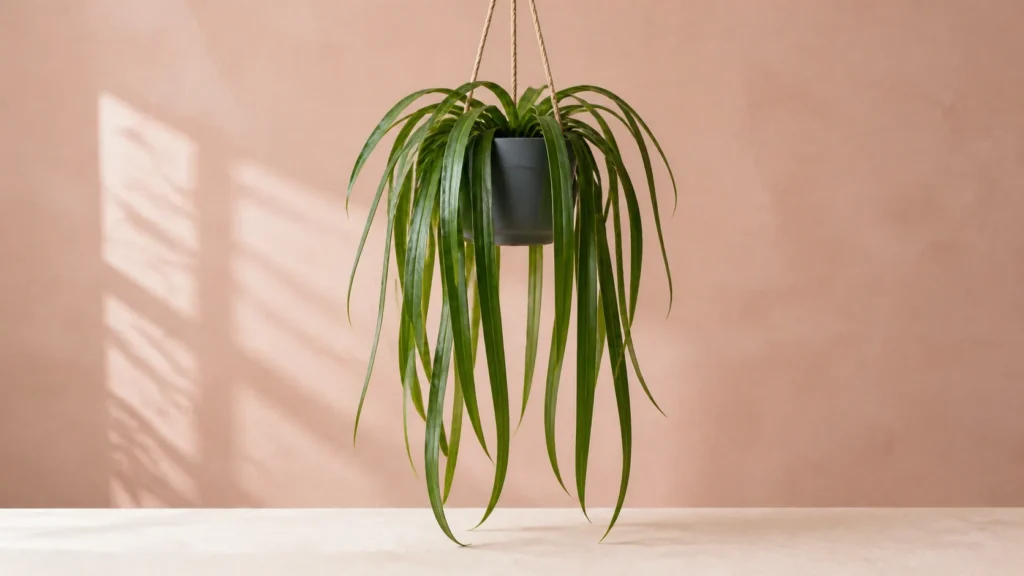
Strap-leaf Anthurium
Anthurium vittariifolium
A pendulous anthurium from tropical South America with long, ribbon-like green leaves that trail from a hanging basket, grown for its distinctive strap foliage.
Watering frequency
Every 5-7 days
Ideal temperature
65-80°F / 18-27°C
Humidity
60-80%
Care difficulty
Medium
Air purifying
No/Not Known
Growth rate
Moderate
Plant size
1-6 ft / 0.3-2 m
Soil type
Chunky aroid mix
Fertilizer need
Every 4-6 weeks, spring-early fall.
Care summary
- Light: Bright indirect light; filter direct sun.
- Water: Let the upper mix partly dry, then water and drain well.
- Soil: Use an airy, chunky aroid mix around the roots.
- Humidity: Stable moderate-to-high humidity helps leaves grow cleanly.
- Display: Best in a hanging basket or elevated planter so leaves trail.
- Safety: Keep away from pets and children who may chew it.
Common problems
- Yellow leaves: overwatering, root stress, or normal aging.
- Brown crispy tips: low humidity, inconsistent watering, or fertilizer salts.
- Pale or weak growth: insufficient light or root stress.
- Faded patches: too much direct sun.
- Pests: thrips, spider mites, scale, or mealybugs on new growth.
Plant care guide
About Strap-leaf Anthurium
Strap-leaf Anthurium (Anthurium vittariifolium) is a pendulous aroid in the Araceae family, grown for its long, narrow, ribbon-like leaves that trail gracefully from a hanging basket or elevated planter. It belongs to the informal group of “strap-leaf” anthuriums — species with elongated, strap-shaped blades instead of the broad heart-shaped leaves of the velvet anthuriums. The species is native to humid tropical forest in northern and western South America, with current botanical records centering it from southeastern Colombia to Peru and Brazil’s Amazonas region. It as a South American endemic whose narrow, tie-like leaves grow very long in shaded, humid forest.
In cultivation, Strap-leaf Anthurium offers a distinctive trailing silhouette that few other houseplants share. Mature leaves can reach impressive lengths while staying only a few inches wide, which makes the plant a natural candidate for hanging baskets, wall mounts, and elevated displays. It is generally considered one of the more tractable anthuriums among collectors, though it still prefers bright indirect light, an airy root zone, and steady humidity.
Why You’ll Like It
Strap-leaf Anthurium is one of the most architecturally unusual anthuriums you can grow. Instead of broad heart-shaped leaves, it produces long, leathery, ribbon-like blades that hang down in a graceful curtain, giving a hanging basket a cascading, almost grass-like texture. It is a plant that reads as both dramatic and low-key at once — visually distinctive from across a room, yet soft and calm up close.
It is also a good choice for growers who have already mastered a basic aroid but want something different. Compared with the velvet anthuriums, it is generally more tolerant of average conditions and less fragile, and its pendant habit means it takes up surprisingly little horizontal space. The main tradeoff is that it needs a display designed for trailing growth, and the long leaves can be damaged if they brush against walkways or furniture.
What Kind of Plant Is It?
Strap-leaf Anthurium is a tropical, evergreen, epiphytic-to-hemiepiphytic aroid, native to humid South American forest where it grows attached to tree trunks and branches in shaded understory. Leaves are the defining feature: long, narrow, strap-shaped (linear-lanceolate), leathery to softly textured, deep green, with a prominent midrib and fine longitudinal veins. Mature blades commonly reach 1–2 m long under good conditions while staying only a few centimeters wide, and they hang or trail rather than standing upright. Stem and roots form a compact root system adapted to coarse, airy substrates; in the wild the plant holds on to bark, and in cultivation it wants a chunky, free-draining mix rather than dense soil.
The pendant growth habit is what separates this species from most other anthuriums. Leaves emerge from a short central stem and lengthen over time, drooping under their own weight. Because the blades are long and thin, they are easily creased or torn if they are bent sharply or brushed repeatedly. Provide a display where the leaves can hang freely, and handle the plant by the pot and stem rather than by the leaves.
History of Strap-leaf Anthurium
Strap-leaf Anthurium is one of a group of strap-leaf anthuriums that have been known to horticulture since the nineteenth century, when tropical aroids entered European conservatories alongside the more famous velvet species. The specific epithet vittariifolium combines the Latin vittaria — a reference to the fern genus Vittaria, which has similarly long, narrow leaves — with folium, meaning “leaf,” so the name literally means “with leaves like a Vittaria fern.” The Shanghai Botanical Garden’s account notes that the plant’s narrow, tie-like leaves are the origin of its common names.
The plant has been widely collected and studied as part of the large Anthurium genus, and it has become a familiar species in specialized collections and the modern houseplant trade. Its exact discovery and first-description details are not recorded consistently in popular sources, but its name and range are well established.
Related Anthuriums
Strap-leaf Anthurium is one of several strap-leaf or pendant anthuriums, and the botanical label matters because leaf length, texture, and tolerance differ.
- Anthurium pallidiflorum: A close relative with similar strap-shaped leaves that are often longer and narrower; a popular companion species for collectors of pendant anthuriums.
- Anthurium bakeri: A smaller species with distinctive upright, arrow-shaped leaves; a different leaf form within the same genus.
- Anthurium vittariifolium is sometimes confused with the broad-leaved velvet anthuriums, but the strap-shaped pendant leaves are unmistakable. Related velvet species such as Anthurium Clarinervium and Anthurium Magnificum grow heart-shaped leaves instead.
If you want a flowering aroid instead, Red Anthurium (Anthurium andraeanum) is widely available and easier in average rooms.
Where Strap-leaf Anthurium Works Best
Give Strap-leaf Anthurium bright indirect light and stable warmth and humidity. An east-facing window, or a west or south window filtered by a sheer curtain, usually works. Direct hot sun scorches the leaves; too little light slows growth and produces weak, pale blades. Because the plant trails, it works best in a hanging basket, wall-mounted pot, or elevated planter where the leaves can hang freely without brushing against walkways or furniture.
A bright bathroom with a window or a living area with a humidifier is a practical home. Avoid cold drafts, exterior doors, heating vents, and air conditioners that cause abrupt swings. Grow lights provide consistency when natural light is limited; start with a full-spectrum LED 12–18 inches above the plant and run it 12–14 hours daily, adjusting by the plant’s response.
Strap-leaf Anthurium Care
Light
Provide bright indirect light. Strap-leaf Anthurium needs good light to maintain healthy leaf color and growth, but direct sun can scorch the narrow blades. An east window is ideal; a west window with a sheer curtain works; a south window should be filtered or set back. Long, weak, pale leaves or stretched growth suggest too little light; bleached patches or crispy brown areas indicate too much direct sun.
Watering
Water when the upper portion of the mix has begun to dry and the pot feels lighter, then wet the root ball thoroughly and let all excess drain. A “every 5–7 days” note is a starting point, not a fixed schedule: a plant in a warm bright room dries faster, while a recently repotted plant in winter may go much longer between waterings. The goal is a cycle of moisture and aeration, not constant saturation or prolonged bone-dryness. Where tap water is hard, rainwater or filtered water reduces mineral buildup, and an occasional flush helps.
Soil and Container
Use an airy, chunky aroid mix — fine or medium orchid bark, perlite or pumice, and a moisture-retentive component such as coco coir or quality potting mix. Adjust proportions to your room’s drying speed. Use a pot with drainage holes only slightly larger than the healthy roots; an oversized pot holds moisture and raises rot risk. Because the plant trails, a hanging basket with a removable liner or an elevated planter works well, as long as the pot itself drains freely.
Humidity
Aim for stable moderate-to-high humidity, roughly 60–80%, and observe the plant. A room humidifier helps new leaves grow cleanly. Occasional misting is a poor substitute for ambient humidity and can encourage disease if leaves stay wet without airflow. High humidity with stagnant air is not an improvement; keep some gentle air movement.
Temperature
Keep temperatures around 65–80°F (18–27°C) and avoid prolonged cold below about 60°F (16°C). Anthuriums are damaged by much lower temperatures; the RHS Anthurium guidance recommends warmth, indirect light, and a well-drained acidic mix. Do not respond to cold by keeping the mix wet.
Fertilizer
Feed lightly every four to six weeks from spring through early fall, while new leaves are forming, with a diluted balanced or aroid fertilizer on already moist mix; reduce or pause in winter when growth slows. Pale new growth is not automatically a deficiency: root damage, intense light, pests, and normal leaf aging all change color. Flush salts occasionally and pause feeding after repotting or when roots are stressed.
Pruning and Training
Remove yellowed or damaged leaves by cutting the petiole at the base with sterile scissors. The plant needs no staking; its pendant habit is the point, so give the leaves room to hang. Clean the leaves gently with a soft, slightly damp cloth if dust accumulates, but avoid leaf-shine products. New leaves benefit from stable humidity; do not move the plant while a leaf is lengthening.
Propagating Strap-leaf Anthurium
The most practical home method is dividing the plant at repotting, separating sections that each have their own roots and growth point. Pot each division snugly in an airy mix and keep conditions warm and stable while roots reestablish. A detached leaf without a viable stem growth point cannot produce a new plant.
Advanced growers may root stem sections in a controlled high-humidity environment, but decay is a significant risk if the medium stays saturated. Seed propagation is possible after successful pollination and berry development, but seedlings vary genetically and take years to mature. Buy traceable nursery-propagated material rather than collecting wild plants.
Repotting Strap-leaf Anthurium
Repot when roots fill the container, the mix breaks down, water bypasses the root ball, or a root problem requires intervention. Do not disturb a healthy plant merely because spring arrived. When repotting, preserve firm roots, remove only dead or rotten tissue with a clean tool, and keep the crown at about its previous level. Use a pot only slightly larger than the root ball with fresh chunky mix. Keep the plant in slightly lower light and stable humidity for a week or two while it recovers.
Toxicity and Pet Safety
Strap-leaf Anthurium is Not pet safe. Like other anthuriums, it contains insoluble calcium oxalate crystals (raphides) that cause immediate oral irritation, drooling, vomiting, and difficulty swallowing when chewed. The RHS Anthurium safety guidance advises keeping all parts away from children and pets and wearing gloves when handling; sap may irritate sensitive skin or eyes.
If a pet bites the plant, remove access and contact a veterinarian or an animal poison-control service. Drooling, mouth pain or swelling, vomiting, and difficulty swallowing need prompt attention; breathing or swallowing difficulty is urgent. Do not induce vomiting or use home remedies unless directed by a professional.
Common Problems and Practical Fixes
- One lower leaf turns yellow: Can be normal aging, especially while a new leaf develops. Several yellow leaves with wet mix suggest root stress or overwatering.
- Brown tips or edges: Check drying speed, water quality, salts, drafts, and humidity. Do not raise humidity blindly while roots stay wet.
- Pale, weak, stretched growth: Usually too little light. Move the plant to brighter indirect light gradually.
- Faded or bleached patches: Direct sun can scorch the leaves. Move to filtered light.
- The plant droops in wet soil: Inspect roots before watering again. Rotten roots are dark, soft, or hollow and may smell sour.
- Creased or torn leaf tips: Physical damage from brushing against surfaces. Give the leaves clear space to hang.
- Thrips, mites, scale, or mealybugs: Inspect new leaves and undersides with a magnifier. Isolate and treat with a product labeled for indoor ornamentals, testing on a small area first.
Frequently Asked Questions
How long do the leaves get? Under good conditions, mature leaves commonly reach 1–2 m long while staying only a few centimeters wide. Indoor size depends on light, humidity, pot, and genetics.
Does Strap-leaf Anthurium need a hanging basket? It trails by nature, so a hanging basket, wall mount, or elevated planter lets the leaves hang freely and is the most practical display. In a regular pot, the leaves will drape over the rim and can be damaged by contact with surfaces.
Is it as fragile as the velvet anthuriums? Generally no. Its leaves are leathery rather than soft-velvet, and it tolerates average conditions better than most velvet anthuriums, though it still needs bright indirect light, an airy root zone, and steady humidity.
Can I propagate it from a single leaf? No. A leaf without a viable stem growth point cannot produce a complete plant. Use a rooted division or offset.
Final Thought
Strap-leaf Anthurium is a graceful, unusual aroid that brings a trailing silhouette to the anthurium family. Give it bright filtered light, an airy root zone, steady warmth and humidity, and a display where its ribbon-like leaves can hang freely, and it rewards you with one of the most distinctive foliage forms in any indoor collection. It is a rewarding step up for growers who have mastered basic aroids and want something with real architectural character.