
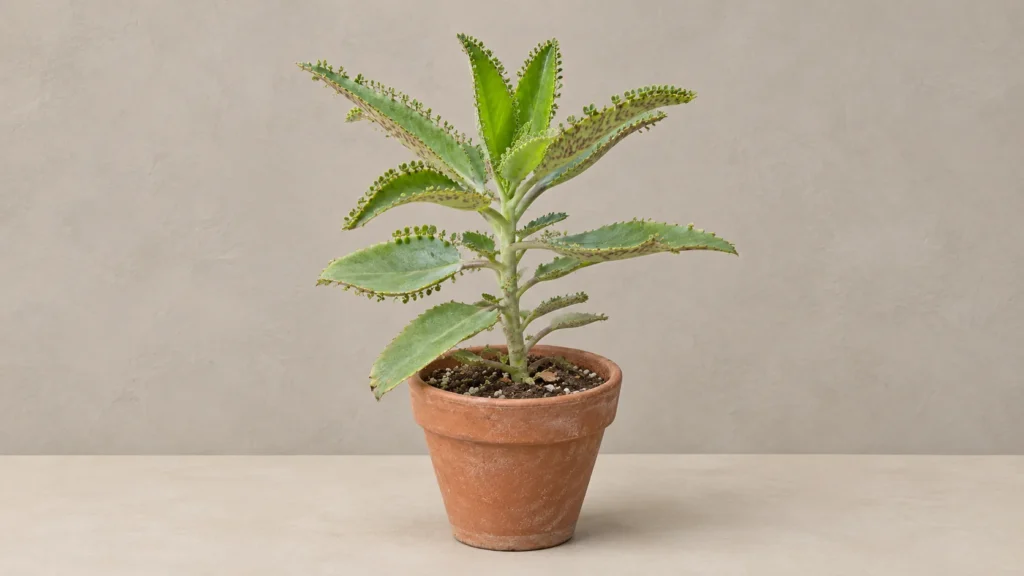
Mother of Thousands
Kalanchoe daigremontiana
A Madagascar succulent with narrow triangular leaves, spotted undersides, and tiny new plants forming along the leaf margins.
Watering frequency
Water after the mix dries; check more often in bright active growth
Ideal temperature
65-75°F / 18-24°C; protect from frost
Humidity
Dry to average room humidity
Care difficulty
Medium
Air purifying
No/Not Known
Growth rate
Moderate
Plant size
Small nursery plants; mature container plants may reach 1-3 ft / 0.3-0.9 m
Soil type
Fast-draining cactus and succulent mix
Fertilizer need
Light feeding during active growth only.
Care summary
- Light: Bright indirect light with gentle direct sun if acclimated.
- Water: Let the mix dry between thorough waterings.
- Soil: Use a fast-draining mix and a pot with a drainage hole.
- Growth: Plantlets form along the margins of mature leaves.
- Containment: Remove dropped plantlets from nearby pots and outdoor soil.
- Safety: Toxic to cats and dogs; keep out of reach of pets and children.
Common problems
- Soft stems or translucent leaves: overwatering or poor drainage.
- Long weak growth: too little light.
- Pale dry patches: abrupt harsh midday sun.
- Fallen plantlets growing in nearby pots: remove before they establish.
- Cottony insects: inspect the leaf bases and small plantlets for mealybugs.
Plant care guide
About Mother of Thousands
Mother of Thousands (Kalanchoe daigremontiana) is a succulent from southwestern Madagascar in the Crassulaceae family. The name describes its most memorable feature: tiny plantlets develop in the notches along mature leaf margins. They can already have roots before they detach, then establish wherever they land. Kew accepts Kalanchoe daigremontiana and lists Bryophyllum daigremontianum as a botanical synonym. “Alligator Plant,” “Mexican Hat Plant,” “Maternity Plant,” and “Devil's Backbone” are common names recorded by NC State Extension. Some of those names also refer to unrelated plants, so the scientific name is the reliable identity.
Mother of Thousands here means K. daigremontiana. A plant sold under the same common name may instead be the broad, pale-green K. laetivirens or the narrower-leaved hybrid K. × houghtonii. The shared ability to make leaf-edge plantlets does not make them varieties of one species. The RHS identification study of the group describes these naming problems and provides characters for separating the plants.
Why You'll Like It
Few houseplants show reproduction so visibly. Each established leaf can carry a row of miniature plants, making this an engaging subject for a bright windowsill or a propagation lesson. The upright, narrow triangular leaves also give it a different outline from rounded rosette succulents such as Mexican Snowball. It tolerates ordinary dry room air and does not need a humidifier.
The same trait that makes Mother of Thousands fascinating also creates work. Plantlets can drop into neighboring pots and root without being planted deliberately. Choose a place where you can collect them easily, especially if the pot spends time outdoors. Keep this plant away from animals and young children who might handle or eat the fallen plantlets.
How to Identify Mother of Thousands
Mature leaves are usually narrow triangular to lance-shaped, with a broad, often heart-shaped or ear-like base near the leaf stalk. The edges are notched and carry plantlets along much of their length. The undersides commonly show purple-brown blotches. These combined traits are more useful than the presence of plantlets alone. NC State's species profile describes the triangular leaves, underside blotches, and marginal plantlets.
The related K. laetivirens usually has broader, more uniformly pale-green leaves, often without the darker underside markings. K. delagoensis, often called Mother of Millions, has very narrow, almost tubular leaves with plantlets concentrated near the tips. K. × houghtonii is a hybrid between K. daigremontiana and K. delagoensis; it may resemble either parent in some features. The RHS diagnostic key emphasizes leaf shape, markings, and the form of the leaf base. A photo of only one upper leaf is often insufficient for a confident species label.
Related Forms and Cultivars
The RHS study identifies ‘Old Hat’ and ‘Felley Priory’ as two cultivated clones of K. daigremontiana, distinguished partly by how dark markings form on the leaf underside. These are cultivar-level identities, not names to assign from a distant photograph. The pink-plantlet cultivar ‘Pink Butterflies’ belongs with the hybrid K. × houghtonii and should not be entered as a variety of K. daigremontiana. Kew recognizes K. × houghtonii as a hybrid of K. daigremontiana and K. delagoensis.
For an ordinary plant without reliable provenance, keep the species name only when the diagnostic characters support it. Do not invent a cultivar from leaf color, and do not treat “Mother of Thousands” as a taxonomic rank.
Where It Works Best
A bright east-facing window or a protected south- or west-facing window gives the plant enough light for sturdy growth. If a plant has been grown under shade, introduce direct sun gradually; intense midday light can scorch leaves. Set the pot on a surface where plantlets are easy to collect. Avoid placing it above a collection of other pots, where dropped plantlets can establish unnoticed. A frost-free outdoor patio can work during a suitable season, but contain the plantlets and bring the plant inside before cold weather.
Mother of Thousands Care
Light. Give bright light, with some gentle direct sun if the plant is acclimated. Long, weak stems and widely spaced leaves suggest that a window is too dim. Move the plant closer to light in stages rather than exposing a sheltered plant to sudden hot sun. NC State Extension recommends bright indirect light or partial shade and cautions against harsh midday exposure.
Water. Let the mix dry between waterings, then water thoroughly and drain the pot. In a small sunny container this may happen faster than in a large cool one, so check the mix rather than following a fixed date. Do not leave water in a saucer. A plant that is not actively growing will need less water. Soft leaves with a wet stem base point toward root trouble; slightly thinner leaves in a fully dry pot are more consistent with thirst.
Soil and container. Use a cactus or succulent mix that drains promptly, and a pot with a drainage hole. An oversized pot holds too much damp mix around a modest root system. A wider tray or clearable surface beneath the pot can catch fallen plantlets. Decorative moss or a wet pebble tray is unnecessary and can make monitoring the soil harder.
Temperature and humidity. Ordinary dry indoor air suits this succulent. Protect it from frost and from prolonged cold, wet soil. Avoid trapping it against very hot glass in summer; heat stress and leaf scorch can occur even in a plant that needs bright light. Fresh air helps, but prevent plantlets from escaping into outdoor ground.
Feeding and pruning. Feed lightly only while new leaves and stems are forming. Excess fertilizer will not correct weak light. Remove damaged or dying lower leaves with clean tools. An old stem can be shortened, but first check that the remaining portion is healthy and that fallen plantlets are controlled. Wash hands after handling and avoid touching eyes after contact with sap.
Propagation and Containment
The easiest propagation is to lift a healthy plantlet from a mature leaf or from the catch tray and place it on a lightly moist, gritty mix. Give bright filtered light while it establishes. There is usually no need to bury the whole plantlet. Not every plantlet will root, but the plant produces so many that a few are sufficient. NC State Extension describes this leaf-margin method.
Do not scatter spare plantlets outdoors. Kew's distribution record lists the species as introduced in many regions beyond Madagascar. If you do not want new plants, collect dropped plantlets regularly and dispose of them according to local green-waste guidance rather than leaving them in soil where they can root. A plant grown outdoors should be checked around the pot after rain or wind.
Flowering and Repotting
Mature plants may produce hanging pink to lavender tubular flowers. Flowering is uncommon indoors, and NC State Extension describes the plant as monocarpic: the flowering plant can die after completing its bloom. Plan to retain a controlled plantlet if you want to keep the same stock. Repot when roots crowd the container, the mix no longer drains well, or the stem becomes unstable. Use only a modestly larger draining pot and inspect for dropped plantlets during the move.
Toxicity and Pet Safety
Mother of Thousands is not safe for cats or dogs to eat. ASPCA lists Kalanchoe species as toxic to cats and dogs, citing bufadienolides and signs that can include vomiting and diarrhea; abnormal heart rhythm is also reported but rare. NC State Extension's K. daigremontiana profile likewise warns of ingestion and possible skin irritation from sap. Keep the parent plant and fallen plantlets beyond the reach of pets and children. If ingestion is suspected, contact a veterinarian or poison-control service promptly and provide the botanical name; do not wait for symptoms or attempt home treatment.
Common Problems and Practical Fixes
- Stem base turns soft: Remove the plant from the pot and inspect roots for rot. Save healthy upper tissue or plantlets while correcting drainage and watering.
- Leaves stretch or angle strongly toward the window: Increase light gradually and rotate the pot. Existing stretched growth will not become compact again.
- Pale, dry sun patches: Consider a sudden move into midday sun. Acclimate future growth more slowly.
- Many plantlets appear in nearby pots: Remove them while small and change the plant's placement or catch tray.
- Mealybugs or aphids: Inspect leaf bases, undersides, and small plantlets; isolate and treat an infested plant.
Frequently Asked Questions
Is Mother of Thousands the same as Mother of Millions?
The names are used loosely in shops, but Mother of Millions usually refers to Kalanchoe delagoensis, which has narrow, almost tubular leaves and plantlets near the tips. Use the botanical name and visible leaf traits when buying or recording an individual plant.
Is every green, broad-leaved “Mother of Thousands” this species?
No. The pale, broader-leaved K. laetivirens is a separate accepted species and can be mislabeled as a green form of K. daigremontiana. Check mature leaves, especially the underside and the shape of the leaf base, before identifying a plant.
Can I remove the plantlets?
Yes. Gently collect mature plantlets before or after they detach. Removing them helps prevent unintended seedlings in nearby pots; it does not harm a healthy parent leaf when done carefully.
Can it grow in a pet household?
Only if the plant and fallen plantlets can be kept reliably inaccessible. A high shelf alone may not contain the detached plantlets.
Final Thought
Mother of Thousands is memorable for the tiny plants along its leaf edges. Give K. daigremontiana bright light, a drying potting mix, and deliberate containment, while keeping it away from pets and children.