
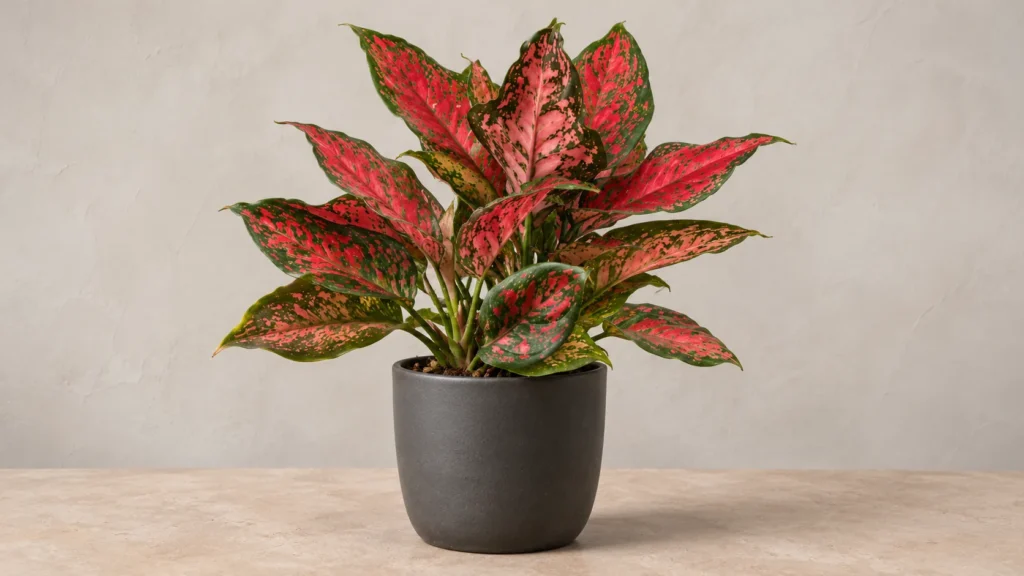
Chinese Evergreen ‘Red Ruby’
Aglaonema 'Red Ruby'
A colorful Aglaonema cultivar with green leaves splashed with rose-pink to red.
Watering frequency
Check weekly; water when the upper mix is partly dry
Ideal temperature
About 65-80°F / 18-27°C; avoid cold drafts
Humidity
Average to moderately humid indoor air
Care difficulty
Easy
Air purifying
No/Not Known
Growth rate
Slow
Plant size
Commonly about 1-2 ft / 0.3-0.6 m tall indoors
Soil type
Airy, freely draining houseplant mix
Fertilizer need
Every 6-8 weeks, spring-summer.
Care summary
- Light: Bright indirect light supports the colored foliage.
- Water: Let the upper mix partly dry, then water and drain.
- Soil: Use an airy mix in a draining container.
- Color: Rose-red splashes vary by leaf and growing conditions.
- Safety: Irritating sap makes it unsafe for pets to chew.
Common problems
- Dull new color: Check whether the plant receives enough indirect light.
- Brown or bleached patches: Protect leaves from harsh direct sun.
- Yellowing and soft stems: Inspect wet mix and root condition.
- Brown tips: Review dry airflow, fertilizer salts, and watering.
- Pests: Look for mealybugs, scale, and mites under leaves.
Plant care guide
About Chinese Evergreen 'Red Ruby'
Chinese Evergreen 'Red Ruby' is a named Aglaonema grown for green leaves with large pink to reddish splashes. The pattern is less restrained than the silver-centered Chinese Evergreen 'Silver Bay' and different from the red-edged Chinese Evergreen 'Crete'. NC State Extension's Aglaonema cultivar list records 'Red Ruby' as green with large pink splashes. Red Ruby Aglaonema and Red Ruby Chinese Evergreen are useful retail name orders for the same cultivar.
The botanical field uses Aglaonema 'Red Ruby' rather than assigning a species or parentage that the available cultivar listing does not establish. “Red aglaonema” is too broad to be a synonym: other named plants, including 'Siam Aurora', 'Crete', and 'Red Zircon', differ in where the red appears. Keep the supplier's cultivar label when buying or sharing this plant.
Why You'll Like It
'Red Ruby' gives a room color without flowers. The mix of green and rose tones changes from leaf to leaf, so an established clump has more visual variation than a uniformly colored plant. It works well on a tabletop, stand, or sideboard where its leaves receive filtered daylight.
It is still a tropical foliage plant with practical limits. A dark corner may keep a green Chinese evergreen presentable for longer, but a colorful cultivar generally needs brighter indirect light to sustain attractive new growth. Strong direct sun can damage pale leaf tissue. Choose the spot for light quality, then adjust watering to how quickly that specific pot dries.
How to Identify 'Red Ruby'
Look for broad green leaves with conspicuous pink to reddish patches across the blade, rather than a thin, continuous red outline. Mature foliage can show different amounts of pink on different leaves. The pattern alone is not conclusive: multiple red Aglaonema cultivars circulate under inconsistent retail labels. A plant tagged only “red Chinese evergreen” cannot safely be assigned to 'Red Ruby' from color alone.
Compare 'Crete', which Singapore NParks describes as having red margins that vary in width and pinkish leaf stalks. 'Siam Aurora' also emphasizes the margin and veins. 'Red Zircon' is described by NC State Extension as pinkish red with green edges. A good label matters more than a quick comparison with one photograph.
Naming and Background
Chinese evergreen is a consumer name for the genus Aglaonema, not the name of a single species. The genus comes from tropical and subtropical Asia and New Guinea, but a cultivated plant's precise breeding history cannot be inferred from that regional origin. We have not found a reliable original release or patent record establishing 'Red Ruby' parentage or a first introduction date, so this guide does not invent one.
When recording a colored plant, keep its cultivar name and the spelling on an authoritative label. Do not merge 'Red Ruby' with similarly named 'Ruby' or 'Dynamic Ruby' without documentation that they are the same cultivar. The descriptive word “ruby” is common in plant marketing and does not establish botanical identity.
Where It Works Best
Give 'Red Ruby' bright, filtered daylight close to an east-facing window or set back from a strong south- or west-facing window. Medium indirect light may be workable, but watch new growth for reduced color and stretching. Move the pot gradually if it has been grown in a much dimmer place. Avoid direct afternoon sun against glass.
Keep it warm and away from cold exterior doors, chilled windows, and air-conditioning. NC State Extension's genus profile describes Chinese evergreens as cold-sensitive. An uncovered porch or a cold, wet windowsill is not a suitable permanent home.
Chinese Evergreen Red Ruby Care
Light. Bright indirect light is the clearest starting point for a color-focused cultivar. A grow light can supplement poor natural light. More light is not always better: scorched white or brown patches indicate too much direct exposure, not a fertilizer problem.
Water. Check the top inch or two of mix and the pot's weight. When the upper layer has partly dried, water evenly until excess leaves the drainage hole, then empty the saucer. A warm, bright plant may use water faster than the same pot in winter. Do not keep roots permanently soggy to “support” colorful leaves. NC State Extension identifies root rot from overwatering as a concern.
Soil and container. Use an airy houseplant mix with drainage and some moisture retention. Add perlite or bark if the mix stays dense and wet for too long. A decorative pot without drainage should function as an outer cover, not as the sole planting container.
Temperature and humidity. Comfortable indoor warmth and ordinary household humidity are usually manageable. Very dry heated air can brown margins. A room humidifier can help in persistently dry conditions; misting does not fix bad drainage or insufficient light.
Feeding and grooming. Feed modestly in spring and summer when new leaves are forming. Pause in winter or when roots are stressed. Remove fully yellow leaves, wipe dust from the foliage, and rotate the pot for even growth. Do not expect fertilizer to restore variegation lost to poor light.
Propagation and Repotting
Divide a healthy multi-stem clump so each section retains roots and an active stem. A stem cutting with viable nodes can also root in warm, lightly moist conditions. A single leaf blade does not normally grow into a complete new Aglaonema. Vegetative propagation is the way to retain the cultivar's traits; seedlings may vary.
Repot only when the root system fills the pot, the medium has collapsed, or drainage has become poor. Move up a modest pot size and maintain warm conditions during recovery. Slow winter growth alone is not evidence that roots need more room.
Problems to Watch
Weak pink color: Compare new and old leaves and check the actual light reaching the plant. A dull new leaf can reflect low light, but color can also vary naturally among leaves. Do not diagnose from one leaf.
Yellow leaves with wet soil: Check drainage, root firmness, and cold exposure before watering again. One old lower leaf turning yellow can be ordinary aging.
Brown tips or spots: Review direct sun, dry airflow, fertilizer salts, and watering consistency. Isolate the plant if spots spread or pests are visible.
Pests: Inspect undersides, leaf axils, and stems for mealybugs, scale, and mites. Early detection is easier than treating a dense, established clump.
Pet Safety
'Red Ruby' is not pet-safe. Like other Aglaonema, it contains irritating calcium oxalate crystals; chewing can cause painful mouth irritation and swallowing discomfort. Singapore NParks' genus guidance supports this genus-level safety warning. Keep the plant out of reach of pets and young children. Contact a veterinarian or poison-control service if chewing occurs; breathing or swallowing difficulty requires urgent professional help.
Frequently Asked Questions
Is 'Red Ruby' the same as 'Crete'? No. 'Red Ruby' is recorded for large pink splashes on green leaves, while 'Crete' emphasizes irregular red margins and pinkish leaf stalks.
Will it stay red in low light? Color intensity and new growth can change in lower light. Give it bright indirect light and assess several new leaves before changing its location again.
Can I use a photo to confirm the cultivar? A photo can suggest candidates, but similar red Aglaonema cultivars overlap. Preserve a trustworthy label.
Final Thoughts
'Red Ruby' is a strong choice when you want pink-red foliage rather than silver patterning. Keep its cultivar label, give it useful filtered light, water according to the mix, and protect it from cold and chewing pets.