
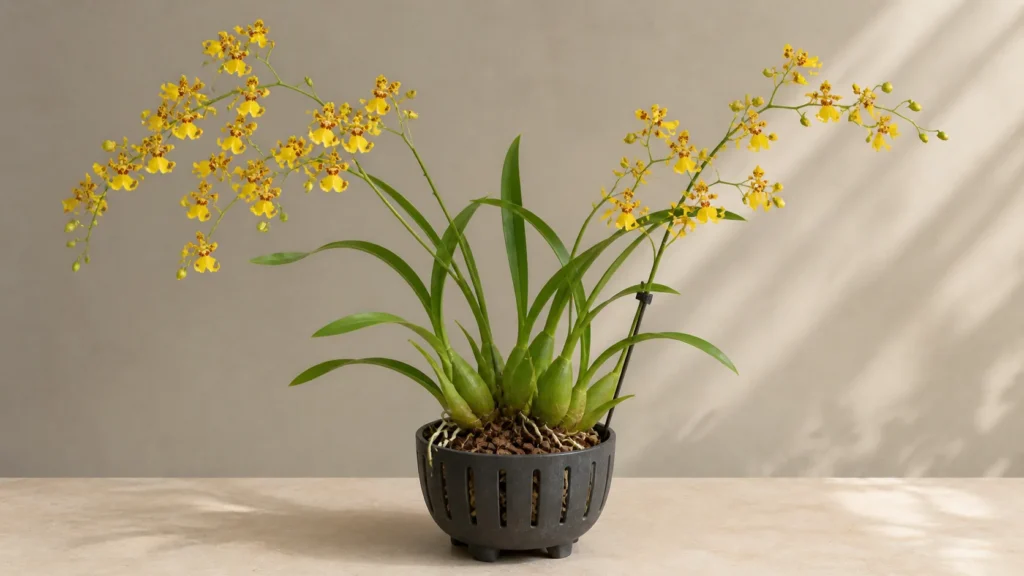
Oncidium Orchid
Oncidium spp.
A popular orchid with arching sprays of small ruffled flowers, needing bright indirect light, an airy orchid mix, regular watering in growth, and moderate household humidity.
Watering frequency
Every 5-7 days in growth (inspect the mix first)
Ideal temperature
60-85°F / 15-29°C
Humidity
40-60%
Care difficulty
Medium
Air purifying
No/Not Known
Growth rate
Moderate
Plant size
1-3 ft / 0.3-0.9 m tall and wide (flower spikes may arch longer)
Soil type
Orchid bark mix or sphagnum moss in a slotted pot
Fertilizer need
Weekly while growing; monthly in winter.
Care summary
- Light: Give bright indirect light; a little gentle morning sun is tolerated after acclimation.
- Water: Soak when the bark or moss approaches dryness, then drain completely; less in winter.
- Humidity: 40-60% is workable; group plants or use a tray if the air is very dry.
- Temperature: Intermediate to warm; protect from below 55°F (13°C) and hot dry vents.
- Fertilizer: Use a dilute orchid fertilizer weekly in growth, monthly in winter.
- Safety: Pet-safe status relies on non-toxic records for other cultivated orchids, not an exact Oncidium test.
Common problems
- Bud drop: Check sudden temperature change, dry roots, low humidity, or ethylene from ripening fruit.
- Yellow leaves: Review overwatering, root rot, too much direct sun, or natural aging of the oldest leaf.
- Wrinkled pseudobulbs: Usually underwatering or root loss; check roots before watering more.
- No rebloom: Confirm enough bright light, a slight cool-night drop, and a post-flowering rest period.
- Pests: Inspect leaf axils and undersides for scale, mealybugs, and spider mites.
Plant care guide
About Oncidium Orchid
Oncidium Orchid refers to a large group of orchids in the genus Oncidium and its intergeneric hybrids, cultivated for arching sprays of small, ruffled flowers. The common name "Dancing Lady Orchid" comes from the broad, flared lip resembling a dancer's skirt. Many plants sold as Oncidium are actually hybrids such as Aliceara or Miltonidium, but they share similar care requirements.
Kew Plants of the World Online recognizes Oncidium as a large genus in Orchidaceae, native to tropical and subtropical Americas. The American Orchid Society describes the alliance as adaptable to intermediate and warm conditions with bright light and regular watering during active growth. Oncidium orchids produce pseudobulbs — thickened stems that store water — and a mature plant sends up branching flower spikes with dozens of blooms in yellow, brown, white, pink, or red.
Why You'll Like It
Oncidium Orchid offers a different orchid experience from the familiar Moth Orchid, with graceful cascading sprays of intricate flowers that last several weeks, many fragrant with vanilla, chocolate, or citrus notes. The pseudobulb structure makes it more forgiving of occasional missed watering — a slightly wrinkled pseudobulb is a clear signal to water. With the right light, a healthy plant reblooms reliably, often once or twice per year.
For pet households, Oncidium orchids are classified as pet safe under the project's family-level evidence rule. The ASPCA lists Phalaenopsis Orchid as non-toxic to cats, dogs, and horses, and orchids in common cultivation have no known serious toxicity. This is family-level evidence, not a direct species test, so discourage chewing and see the Toxicity section for details.
What Kind of Plant Is It?
Oncidium Orchid is a sympodial epiphyte, growing horizontally with new growths emerging from the base of previous ones. Pseudobulbs are oval to round, green when young, slightly wrinkled when dry, each bearing one to three thin strap-shaped leaves; a mature plant sends up branching flower spikes from the newest pseudobulb. Roots are thin with a spongy velamen layer — healthy roots are firm and white/silvery when dry, green when hydrated, while brown mushy roots indicate rot. Stake top-heavy spikes but avoid cutting until fully browned, as they may produce secondary blooms.
History and Naming
The genus Oncidium was established by Swedish botanist Olof Swartz in 1800, named from the Greek onkos (swelling), referring to the prominent callus on the flower lip. Oncidium orchids have been cultivated in Europe since the early 19th century, and the development of artificial hybridization led to thousands of compact, free-flowering hybrids. Today the Oncidium alliance is one of the most commercially important ornamental orchid groups.
Oncidium Orchid and Related Plants
- Moth Orchid: Phalaenopsis Orchid is the most common houseplant orchid with larger flowers on upright spikes and lower light needs — a good beginner orchid, while Oncidium offers intricate sprays and fragrance.
- Cattleya Orchid: Another epiphytic orchid with large showy flowers and pseudobulbs, but needing brighter light and a more pronounced dry rest.
- Dendrobium Orchid: A diverse genus with cane-like pseudobulbs rather than round ones; many need a distinct cool, dry rest to rebloom.
Popular Oncidium-alliance varieties include Oncidium sphacelatum (Golden Shower), Oncidium Sharry Baby (chocolate/vanilla fragrance), and compact Tolumnia (equitant oncidiums).
Where Oncidium Orchid Works Best
Choose a position with bright filtered light and stable temperatures — an east-facing window is ideal, while a south or west window works with a sheer curtain. A north window is usually too dim for reliable reblooming unless supplemented with a grow light. Oncidium appreciates good air circulation; keep it away from hot dry vents, cold drafts, and radiators. Use a slotted orchid pot with good drainage, and ensure the inner pot never sits in standing water.
Oncidium Orchid Care
Light
Provide bright indirect light — Oncidium needs more light than Phalaenopsis to rebloom, but harsh midday sun through glass scorches thin leaves. Leaf color indicates conditions: medium to light green is good; very dark green soft leaves mean insufficient light; a slight reddish blush is the upper limit; yellow or brown crispy patches mean too much sun. Under a grow light, use a full-spectrum LED 12–18 inches above the plant, running 12–14 hours daily.
Watering
Water when the potting mix approaches dryness — roughly every 5–7 days in active spring/summer growth, every 7–10 days in winter, but always check the mix and pot weight first. Thoroughly soak the root ball until water runs through drainage holes, then drain completely — never let the plant sit in standing water. Pseudobulbs are the moisture indicator: plump and firm means adequate; wrinkled means too dry; if wrinkled but roots are brown and mushy, the problem is root rot, not underwatering.
Potting Medium and Container
Use an open, fast-draining medium — typically medium-grade orchid bark, sometimes with perlite, charcoal, or sphagnum moss added. Use a pot with multiple drainage holes, ideally a slotted orchid pot that allows air to reach roots from the sides; the pot should be only slightly larger than the root ball, as orchids prefer to be somewhat root-bound. Repot every 1–2 years or when bark decomposes (turns dark and mushy), best done just after flowering when new root growth begins — gently remove old bark, trim dead/mushy roots, and place in fresh bark at the same depth.
Humidity
Oncidium tolerates moderate household humidity (40–60%) better than many tropical orchids. Below 40%, the plant may develop brown leaf tips, bud drop, or slower growth — increase humidity by grouping with other plants, using a pebble tray, or a small humidifier. Misting provides only temporary relief and is not a substitute for ambient humidity. Good air circulation is as important as humidity; a small fan on low speed helps prevent fungal and bacterial growth.
Temperature
Oncidium are intermediate to warm growers — ideal daytime 70–85°F (21–29°C), nighttime 60–65°F (15–18°C), with a slight night drop in autumn helping trigger flower spikes. Protect from temperatures below 55°F (13°C), which cause damage or bud drop; keep away from cold window glass in winter and frequently opened exterior doors. Above 90°F (32°C) stresses the plant, especially with low humidity and airflow.
Fertilizer
Feed during active growth (spring through fall) with a balanced orchid fertilizer at one-quarter label strength, applied weekly — the standard "weekly, weakly" approach for epiphytic orchids with fertilizer-sensitive roots. Always apply to a moist root ball, never bone-dry soil. In winter, reduce to monthly or pause entirely; resume weekly feeding when new growth and roots appear in spring. Every few weeks, water thoroughly with plain water to flush accumulated fertilizer salts — white crust on bark or pot edges indicates salt buildup.
Pruning and Training
Remove a flower spike only after it has completely turned brown and dried — a green spike may produce secondary blooms, especially on hybrids. Cut spent spikes at the base with sterile scissors; remove yellowed or dead leaves when they pull away easily, but don't force off partially green leaves. Old fully yellowed pseudobulbs can be removed during repotting, but leave at least three to four healthy pseudobulbs. Stake top-heavy spikes with a thin stake and soft ties, avoiding tying too tightly as the spike grows.
Propagating Oncidium Orchid
The most reliable home method is division during repotting — a mature plant with at least six to eight healthy pseudobulbs can be divided into sections, each with at least three pseudobulbs and healthy roots. Remove from pot, shake off old bark, identify natural divisions along the rhizome, cut through with sterile tools, and pot each division in fresh bark, watering sparingly until new roots grow. Division is best just after flowering when new root growth begins; a plant with fewer than six pseudobulbs is usually too small. Spike propagation (keiki) is possible on some hybrids but less common than in Phalaenopsis; tissue culture is commercial-only.
Repotting Oncidium Orchid
Repot every 1–2 years, or sooner if bark decomposes (dark, mushy, foul-smelling), roots grow extensively through drainage holes, the plant is unstable/top-heavy, or water drains very slowly. Best time is immediately after flowering when new root growth emerges. To repot: water a day before to soften roots; gently remove from pot; remove old bark carefully; trim dead, mushy, or hollow roots with sterile scissors (healthy roots are firm, white/silvery when dry, green when hydrated); choose a pot only slightly larger; place fresh bark in bottom, position plant at same depth, fill in with fresh bark tapping to settle (don't pack tightly — air spaces matter); wait a day or two before watering to let damaged roots callus. Keep in slightly lower light and stable humidity for a week or two while recovering.
Toxicity and Pet Safety
Oncidium Orchid is classified as Pet safe under the project's family-level evidence rule. The ASPCA has no specific Oncidium entry, but lists Phalaenopsis Orchid as non-toxic to cats, dogs, and horses, and orchids in common cultivation have no known serious toxicity. This is family-level evidence (Orchidaceae), not a direct toxicology evaluation of Oncidium — the plant is not food, and chewing may still cause mild stomach upset in a sensitive pet. Potting medium, fertilizer, and pest-control products are separate hazards; contact a veterinarian if symptoms develop after ingestion.
Common Problems and Practical Fixes
Bud drop — caused by sudden temperature changes, dry roots, low humidity, ethylene from ripening fruit, or moving the plant as buds form; prevent by keeping position stable with consistent temperature/humidity, avoiding fruit bowls, and watering regularly during bud development.
Yellow leaves — a single yellow leaf at the base is natural aging; multiple yellow leaves with mushy bases suggest overwatering and root rot (check roots, repot if brown/mushy); yellow leaves with brown crispy edges indicate too much direct sun or very dry air.
Wrinkled pseudobulbs — usually means too dry; give a thorough soak and check watering frequency; if pseudobulbs stay wrinkled after watering or the pot stays wet long, the problem may be root rot (damaged roots can't take up water) — inspect roots and repot if needed.
No rebloom — most often insufficient light; Oncidium needs brighter light than Phalaenopsis, so if leaves are very dark green, move to a brighter position; a slight cool-night drop (10–15°F) in autumn also helps trigger flowering; allow a brief post-flowering rest with reduced water and fertilizer.
Scale, mealybugs, or spider mites — hide in leaf axils, on pseudobulbs, and leaf undersides; inspect regularly especially in warm dry conditions; isolate affected plants, treat with rubbing alcohol on a cotton swab or horticultural oil labeled for orchids, repeating per the pest life cycle; severe infestations may need systemic insecticide.
Crown or root rot — soft brown foul-smelling tissue at base or in roots, usually from overwatering, poor drainage, or decomposed mix; remove from pot, trim all dead/mushy tissue with sterile tools, repot in fresh dry bark, reduce watering until new growth appears; prevention is far more effective — use open bark mix, ensure drainage, water based on plant needs not a fixed schedule.
Frequently Asked Questions
How often does Oncidium Orchid bloom?
A healthy plant typically blooms once or twice per year, with flowers lasting 3–6 weeks depending on variety and conditions; some hybrids bloom more frequently, usually after a period of active growth, often in late summer or fall.
Should I cut the flower spike after blooming?
Wait until the spike has completely turned brown and dried before cutting at the base — a green spike may produce secondary blooms, especially on hybrid varieties, and cutting it removes that potential.
Can Oncidium Orchid grow in low light?
Oncidium needs brighter light than Phalaenopsis to rebloom reliably — a north window or dim room is usually insufficient unless supplemented with a grow light; if the plant produces leaves but no flowers, insufficient light is the most likely cause.
Is Oncidium Orchid pet safe?
This database classifies it as pet safe using family-level evidence: the ASPCA lists Phalaenopsis Orchid as non-toxic, and orchids in common cultivation have no known serious toxicity; no exact Oncidium ASPCA evaluation was found, so discourage chewing and keep potting materials and fertilizer out of reach.
Final Thought
Oncidium Orchid rewards an indoor grower who provides bright indirect light, regular watering during active growth, and an open orchid bark mix refreshed every year or two. Its pseudobulbs make it more forgiving than many orchids, and its arching sprays of intricate, often fragrant flowers create a display few houseplants can match. Read the pseudobulbs for water, give it enough light to rebloom, let it rest briefly after flowering — and this adaptable orchid alliance will return to bloom year after year.