
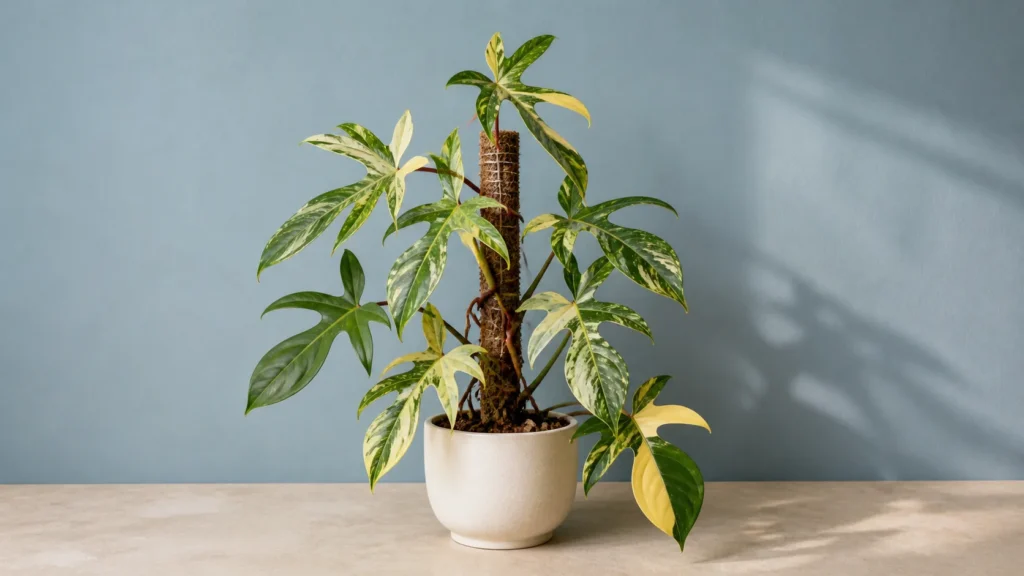
Philodendron ‘Florida Beauty’
Philodendron 'Florida Beauty'
A climbing Florida-line philodendron with deeply lobed leaves and unstable cream-to-yellow sectoral variegation; it needs bright filtered light and careful stem selection to retain its pattern.
Watering frequency
Every 7-10 days
Ideal temperature
65-85°F / 18-29°C; minimum 60°F / 15°C
Humidity
50-70%
Care difficulty
Medium
Air purifying
No/Not Known
Growth rate
Moderate
Plant size
4-8 ft / 1.2-2.4 m climbing indoors
Soil type
Airy, moisture-balanced aroid mix
Fertilizer need
Every 4-6 weeks, spring-early fall.
Care summary
- Light: Bright indirect light helps support balanced variegation; avoid hot direct sun.
- Water: Let the upper 1-2 inches dry, then water thoroughly and drain.
- Soil: Use a chunky, airy aroid mix in a pot with drainage.
- Support: Train the climbing stem on a moss pole, plank, or trellis.
- Variegation: Each node is different; cutting cannot guarantee the color of the next leaf.
- Safety: Not pet-safe; keep foliage and cuttings away from pets and children.
Common problems
- New leaves are all green: unstable variegation may be reverting, especially when the active stem no longer contains visible variegated tissue.
- Large white or cream areas turn brown: intense sun, severe drying, low humidity, or salt buildup can damage tissue with little chlorophyll.
- Long gaps between leaves: insufficient light or lack of climbing support.
- Yellow leaves while mix stays wet: overwatering, dense soil, cold roots, or root damage.
- Small or misshapen new leaves: root stress, pests, low humidity during expansion, or an unsupported vine.
- Thrips, spider mites, scale, or mealybugs: inspect new growth, leaf backs, and petiole joints.
Plant care guide
About Philodendron 'Florida Beauty'
Philodendron 'Florida Beauty' is a climbing aroid with changing, deeply lobed leaves splashed or sectorally marked in cream, pale yellow, and shades of green. Its leaf outline comes from the Florida hybrid line, while its most recognizable feature is chimeric variegation: chlorophyll-rich and chlorophyll-poor tissues grow beside one another in the stem and leaf.
That distinction matters. Florida Beauty is not simply a Florida Green plant receiving more light, and its pale pattern is not a nutrient deficiency that should be corrected. Each node contains its own distribution of variegated tissue, so one leaf may be marbled, another half-moon, and the next nearly green. Good care supports the plant, but it cannot order a particular pattern.
This page uses the established horticultural name Philodendron 'Florida Beauty'. It does not present the plant as a wild species. The Florida line is generally treated in horticulture as descending from a hybrid between Philodendron pedatum and Philodendron squamiferum, combining lobed adult foliage with a climbing habit and visibly textured petioles.
Why You'll Like It
Florida Beauty offers two forms of change at once. Young leaves are relatively simple and become more deeply divided as the vine matures, while the cream-to-yellow markings make every leaf visually individual. Given a vertical support, the plant can develop a compact column of increasingly dramatic foliage rather than a loose tangle of small leaves.
It is also a useful plant for learning how variegation really behaves. Bright filtered light helps the green tissue power growth, sensible pruning preserves a stem with a workable balance, and patience is more useful than chasing a perfect half-moon leaf. The tradeoff is that pale tissue scorches, browns, and grows more slowly than all-green tissue.
Florida Beauty vs Florida Green
Philodendron 'Florida Green' is the all-green reference plant in the Florida line. It has the same general climbing structure and lobed mature outline but produces fully green leaves. With more chlorophyll, it usually grows more vigorously and tolerates small care errors better than Florida Beauty.
Philodendron 'Florida Beauty' is the variegated form. Its cream, yellow, and multi-green pattern is carried in the growing stem, not painted onto leaves by light. An all-green run on a Florida Beauty vine may indicate reversion when several successive nodes and the active stem show no pale striping. Conversely, a plant sold as ordinary Florida Green should not be purchased on the assumption that stronger light will make it variegated.
One green leaf does not prove permanent reversion. Examine the stem and wait for the next leaf if the growing point still shows mixed-colored tissue. If several nodes are fully green, pruning back to the most recent clearly variegated node may restart patterned growth, but there is no guarantee. Leave enough green tissue for photosynthesis; an almost-white stem can be just as unsustainable as a reverted one.
Florida Green deserves its own profile later because its care emphasis differs: it is faster, greener, and less focused on managing unstable variegation. Here it is included to prevent the two market names from being treated as interchangeable.
Origin and Naming
The Florida hybrids are associated with mid-20th-century aroid breeding in Florida and with horticulturist Robert McColley. Public accounts do not all give the same year or equally complete original documentation, so it is safer to describe the line as a 1950s horticultural cross rather than assert a single precise origin date. A New Zealand Environmental Protection Authority assessment identifies the underlying cross as P. pedatum × P. squamiferum and ties it to Bamboo Nursery in Florida.
Florida Beauty is widely described as a variegated selection or sport from that line. A commercial history from Rare Plant Fairy likewise connects it with McColley's Florida hybrid and explains its chimeric variegation. Because cultivar histories in the plant trade are often repeated without surviving registration records, the practical identity should rely on the whole plant: a climbing Florida-type stem, progressively lobed leaves, characteristic petiole texture, and persistent cream-to-yellow variegation across multiple nodes.
Related Florida Philodendrons
- Philodendron 'Florida Green': The all-green baseline in the line; usually quicker and more forgiving.
- Philodendron 'Florida Ghost': Valued for new leaves that emerge very pale and gradually green rather than stable cream sectors on a green blade.
- Philodendron 'Florida Bronze': A market name associated with coppery or bronze new growth; provenance matters because trade usage varies.
- Philodendron pedatum: One generally accepted parent, contributing a climbing habit and deeply divided mature foliage.
- Philodendron squamiferum: The other generally accepted parent, known for bristly red-toned petioles.
- Philodendron 'Pink Princess': Another chimerically variegated climber, but with dark, entire leaves and pink rather than Florida-type lobing.
Do not identify a juvenile from color alone. Leaf maturity, petioles, stem, growth habit, and provenance are more reliable together than one striking leaf.
Where It Works Best
Place Florida Beauty near a bright east window or set it back from stronger south- or west-facing glass behind a sheer curtain. The plant needs enough usable light to support low-chlorophyll tissue, but intense midday sun can burn pale sectors first. A grow light can provide consistency when window light is weak; introduce it gradually and follow the manufacturer's safe distance.
Use a vertical support from an early stage. A moss pole, wooden plank, or narrow trellis gives the aerial roots something to approach and reduces sprawling. The support does not have to remain constantly wet, but the vine should be attached loosely and kept oriented so the back of the stem faces it.
Philodendron 'Florida Beauty' Care
Light
Provide bright indirect light for most of the day. Gentle morning sun may be acceptable after acclimation. If internodes lengthen, leaves shrink, and new growth becomes predominantly green, assess light before reaching for fertilizer. If cream areas bleach tan or crisp on the window-facing side, move the plant back from direct sun.
Light can improve overall vigor and may make existing patterns look clearer, but it cannot create variegated cells in a fully green stem. Never expose a reverted plant to harsh sun in an attempt to force color.
Watering
Water when the upper 1–2 inches (2–5 cm) of mix are dry and the pot feels lighter. Soak the root ball, allow excess water to drain, and empty the saucer. Every 7–10 days is a useful warm-season starting range, not a fixed appointment. Check sooner in a small, root-filled pot under a grow light and later in winter or in dense mix.
The goal is a lightly moist-to-drying rhythm, not permanent wetness. Pale sections cannot compensate for damaged roots, so chronic saturation often shows as stalled growth, yellow leaves, or soft dark roots. Repeated severe drought can crisp the variegation and abort emerging leaves.
Soil and Pot
Use an airy aroid mix containing potting mix or coco coir, fine orchid bark, and perlite or pumice. The blend should accept water evenly, hold a modest reserve, and still contain air after drainage. Use a pot with drainage holes; transparent nursery pots can make root and moisture checks easier.
Do not move a small root system into a dramatically oversized decorative pot. Excess unused mix stays wet longer. Increase only one practical pot size when roots are established throughout the current container.
Humidity
Aim for 50–70% relative humidity with gentle air movement. The plant can adapt to ordinary household humidity, but large swings or very dry air increase the risk of stuck, torn, or browned new leaves. A room humidifier is more effective than frequent misting. Avoid leaving water trapped on unfurled foliage.
Temperature
Keep Florida Beauty at 65–85°F (18–29°C), with a hard indoor minimum of 60°F (15°C). Below that point, growth slows and wet roots become riskier. Protect the plant from cold windows, exterior doors, air-conditioning streams, and heating vents.
Fertilizer
Feed every four to six weeks from spring through early fall while the vine is actively growing. Use a balanced houseplant fertilizer at a conservative label rate. Flush the mix occasionally if mineral crust develops, and pause feeding after root damage or during a winter slowdown. Fertilizer supports new tissue but does not increase genetic variegation.
Training and Pruning
Tie the stem loosely with soft plant tape, never around an expanding petiole. Guide aerial roots toward the support or potting mix. Remove fully yellow leaves, but retain healthy green foliage even when it is less visually dramatic because it supplies energy.
For reversion, mark the last node whose stem shows a clear variegated stripe. In spring or early summer, cut just above that node with a sterile blade, leaving the variegated node on the parent. The new bud may draw from mixed tissue, but its result remains unpredictable. Root the removed green cutting separately rather than discarding a healthy plant.
Propagation
Propagate Florida Beauty only from a stem cutting containing at least one viable node. A leaf and petiole without a node cannot produce a new vine. The best period is late spring through summer, when temperatures and growth are steady.
Choose a node whose stem shows both green and pale tissue, ideally with an aerial root. Let a fresh cut stop dripping, then place the node in damp sphagnum, perlite, water, or a very airy propagation mix. Keep it in bright indirect light at 70–80°F (21–27°C). Roots and bud activity commonly begin within four to eight weeks, though highly variegated or cool cuttings can take longer.
Pot into a small airy mix once several roots are established. The mother leaf's pattern does not predict the new shoot perfectly; the node and emerging bud determine the next growth.
Repotting
Inspect roots each spring and repot every 12–24 months, or sooner when roots circle densely, water runs straight through, or the plant dries much faster than before. Move up one pot size and refresh collapsed mix. Keep the stem base at the same depth and install the support at repotting time so later insertion does not spear roots.
After repotting, water once thoroughly, allow normal drainage, and resume the dryness test. Wait about four weeks before feeding heavily. A newly repotted vine may pause while roots re-establish.
Toxicity and Pet Safety
Philodendron 'Florida Beauty' is not pet-safe. The decision uses genus-level evidence because cultivar-specific feeding studies are neither necessary nor desirable: the ASPCA lists Philodendron spp. as toxic to cats and dogs due to insoluble calcium oxalates. Chewing can cause oral pain, swelling, drooling, vomiting, and difficulty swallowing.
Keep the plant, fallen leaves, pruning scraps, and propagation containers out of reach. Contact a veterinarian or poison-control professional after suspected ingestion; breathing or swallowing difficulty needs urgent care.
Common Problems
- Several all-green leaves: Inspect the active stem for variegated tissue and improve usable light. Prune to a proven mixed-color node only if the vine is clearly reverting.
- Almost-white growth: Preserve earlier green leaves. If the active stem continues without enough green, cut back to a balanced node; fully white shoots rarely sustain themselves.
- Brown cream sectors: Check hot sun, complete drying, root health, humidity swings, and fertilizer salts.
- Long internodes: Increase indirect light and give the vine a firm vertical route.
- Wet mix and yellow foliage: Stop calendar watering, improve drainage, and inspect roots if the stem becomes soft.
- Stuck new leaf: Stabilize humidity and root moisture; do not pull the tender leaf open.
- Thrips or mites: Inspect distorted new growth and leaf backs, isolate the plant, and use a treatment labeled for indoor ornamentals.
Frequently Asked Questions
Is Florida Beauty the same as Florida Green?
No. They share the Florida hybrid form, but Florida Beauty carries chimeric cream-to-yellow variegation while Florida Green is the all-green plant.
Can Florida Green become Florida Beauty?
Extra light does not convert a fully green stem into a stable variegated cultivar. Buy a correctly labeled, visibly variegated plant from a reputable source if Florida Beauty is the goal.
Can reverted Florida Beauty recover?
Sometimes. Cutting back to the last node with visible mixed-color stem tissue can activate a variegated bud, but the result is not guaranteed.
Does it need a moss pole?
It needs vertical support for orderly, mature climbing growth. A moss pole is useful, but a plank or trellis can also work.
Is Florida Beauty pet-safe?
No. It is treated as not pet-safe based on established genus-level Philodendron toxicity guidance.
Final Thought
Florida Beauty is best grown as a living chimera, not as a machine expected to produce identical leaves. Give it bright filtered light, warm roots, an airy mix, and a vertical route. Preserve enough green to power the vine and use node-level pruning carefully; the changing pattern is part of the plant's identity.