
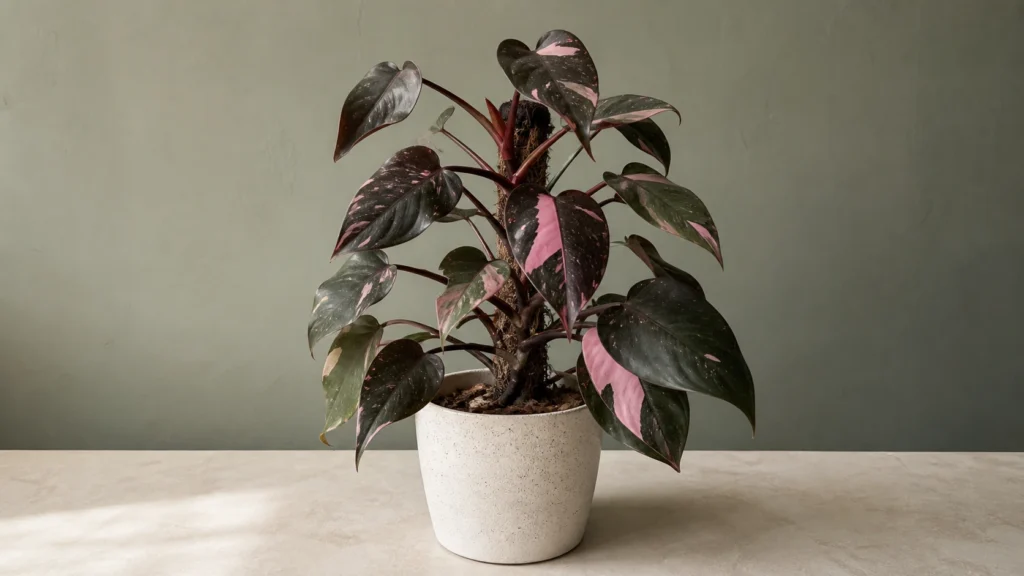
Pink Princess Philodendron
Philodendron erubescens 'Pink Princess'
A climbing Philodendron whose dark green leaves carry swaths of bubblegum pink, grown for a variegation that never repeats itself twice.
Watering frequency
Every 7-10 days
Ideal temperature
65-80°F / 18-27°C
Humidity
50-70%
Care difficulty
Medium
Air purifying
No/Not Known
Growth rate
Moderate
Plant size
2-4 ft indoors / 0.6-1.2 m, larger with support
Soil type
Chunky, well-draining aroid mix
Fertilizer need
Monthly, spring-summer.
Care summary
- Light: Give bright, indirect light; the pink tissue burns in direct sun.
- Water: Water when the top inch of mix dries; keep the mix airy.
- Humidity: Average to high humidity keeps new leaves from crisping.
- Support: Provide a moss pole or trellis to climb for larger leaves.
- Safety: Philodendrons are toxic to cats and dogs if ingested.
Common problems
- Reverted all-green leaves: Raise light and cut nitrogen-heavy fertilizer.
- Brown, crisp pink patches: Remove from direct sun.
- Curled, yellow leaves: Check for overwatering and soggy mix.
- Small pale leaves: Increase light intensity.
- Pests: Check leaf undersides for thrips and spider mites.
Plant care guide
About
The Pink Princess Philodendron is a climbing aroid whose dark, near-black green leaves are painted with irregular sectors and splashes of pink. No two leaves are alike: one may carry a single blush streak along the midrib, another may be half pink with a deep green rim, and a third may emerge almost entirely green before a future leaf brings the color back. That unpredictability is the whole point of the plant. It is a cultivar of Philodendron erubescens, a Colombian species whose name comes from the Latin for "blushing," and the pink is exactly that: a blush of anthocyanin pigment that the plant produces in unstable, chimeral patches rather than evenly.
The plant sits in a strange position in the houseplant world. Tissue culture has made it a supermarket staple in many regions, and prices have fallen hard since the pandemic peak. Yet it still carries the mystique of a collector plant, because every individual looks different and every grower is chasing a little more pink.
Why You'll Like It
The strongest appeal of the Pink Princess Philodendron is that it is genuinely different every day. A new leaf unfurls pink, then darkens and hardens as it matures, so the plant's appearance shifts as you watch. It photographs beautifully, which is why it dominated plant social media in the early 2020s, but the real satisfaction is checking the newest growth point for the color of the next leaf.
It is also a moderate challenge that most people can actually win. A Pink Princess does not need a greenhouse or a grow cabinet. It grows steadily in ordinary bright room light, tolerates normal household humidity, and rewards simple, consistent care. For someone who has mastered an easy philodendron like the heartleaf and wants a next step with more visual drama, the Pink Princess Philodendron is the natural upgrade. It gives collectors the thrill of variegation without the fragility of an albo Monstera, whose white sectors cannot photosynthesize and often die back.
What Kind of Plant Is It
The Pink Princess Philodendron is a cultivar of Philodendron erubescens, a hemiepiphytic climber native to Colombia and documented in detail by the North Carolina State Extension. Like most philodendrons it is a member of the arum family (Araceae), the same family as the familiar golden pothos and the Monstera genus, and it shares their signature chemistry: sap containing needle-like calcium oxalate crystals. It climbs by producing aerial roots along a sturdy stem, and its leaves, heart-shaped and deeply colored, mature larger when the plant is allowed to grip a support.
The pink is produced by a chimeral variegation. In a chimera, two genetically different cell types grow side by side in the same plant. Here, normal green cells sit next to cells carrying a mutation that suppresses chlorophyll and lets anthocyanin pigments show through, and the leaf develops pink where the mutant cell lines run. Because the mutation is not in the germline, it is not heritable through seed. Every Pink Princess Philodendron in the trade is propagated from cuttings, and the pattern of any individual cutting depends entirely on which cell layers its growth point inherited.
This mechanism explains the plant's behavior. Pink leaves photosynthesize less and grow slower; all-green leaves carry no color and outgrow them, which is why an unpruned plant under high-nitrogen feeding drifts toward green over time. Managing a Pink Princess is mostly managing this balance.
History
The species behind the cultivar has a longer paper trail than the pink form itself. Philodendron erubescens was described in the mid-nineteenth century from Colombian material, and the genus Philodendron, whose name combines the Greek words for "love" and "tree," had been established a few decades earlier by the Austrian botanist Heinrich Wilhelm Schott. Kew's Plants of the World Online records the species with its full synonym history. For more than a century it circulated among growers as a handsome red-stemmed climber under names like 'Red Emerald,' valued for its burgundy new growth rather than any pink.
Exactly where and when the pink mutation appeared is one of the genuine open questions in modern houseplant history. The story most often repeated online credits a Florida nurseryman named Robert McColley, who reportedly found the mutation among erubescens seedlings in the 1970s. The alternative account, favored by growers who have searched the trade records, holds that the mutation turned up in a commercial crop and was kept alive by cuttings. What is not in dispute is that no patent or documentation of McColley's work has ever surfaced. Both stories agree on the important part: the pink form is a chance somatic mutation of P. erubescens, not a deliberately engineered plant.
The plant crossed into the mainstream in the late 2010s, when social media discovered it. A well-variegated cutting that sold for around thirty dollars in 2018 could fetch several hundred by 2020, and during the pandemic boom single plants with dramatic pink sold for four figures. The bubble deflated as quickly as it inflated: large-scale tissue culture entered the market around 2022, prices collapsed, and the Pink Princess Philodendron became widely and cheaply available. That crash is a cautionary tale for anyone buying rare variegated plants today, but it also made the plant a practical, affordable purchase for the first time.
Related Varieties
The Pink Princess belongs to a small group of cultivated Philodendron erubescens forms, and knowing the group matters because the market is full of confusion and outright fraud.
- Pink Princess Philodendron is the plant itself: dark green leaves with pink sectors, the pink often strongest in new growth.
- 'Red Emerald' is the plain species form, with deep green leaves and dramatic red stems. It is often sold as a more affordable "solid" alternative.
- 'Imperial Red' is a self-heading (non-climbing) erubescens hybrid whose new leaves emerge vivid red and fade to green. It is a different growth habit entirely.
- 'Pink Congo' deserves a red flag. This plant, sold widely in big-box stores, produces bright pink leaves that turn solid green after a few months. It is generally believed to be a chemically induced or unstable color mutation, not a stable variegation like the Pink Princess, and it does not hold its color. If the plant you are buying is being sold as a "pink philodendron" for a bargain price, check whether the pink is uniform across whole leaves; that is the Pink Congo signature.
The closest genuinely stable relatives are the other popular philodendrons in the trade: the forgiving heartleaf philodendron, the long-leafed philodendron billietiae, and the bright philodendron lemon lime. Among collectors the Pink Princess is most often compared with the variegated Monsteras, especially the Thai Constellation Monstera and the albo variegata monstera, because all three are chimeral variegation projects with very different stability and care profiles.
Where It Works
The Pink Princess Philodendron is a bright-light plant, and that single requirement decides where it can live. It does best a few feet back from an east, west, or south window where it receives strong but filtered light, ideally several hours of it. It will survive in moderate light, but the leaves stretch, the internodes lengthen, and the pink fades because the plant produces more chlorophyll to compensate. If your home is dark, a grow light fixes the problem completely; a modest LED panel over a shelf is enough to keep the variegation bright.
Because it climbs, it is happiest where it can be given vertical room: on a shelf with a moss pole, on a trellis against a wall, or in a hanging pot where the stem can trail once it outgrows its support. It suits living rooms and home offices with decent natural light, and it makes a striking solo statement on a plant stand. It tolerates average household humidity, so there is no need for a greenhouse cabinet, though higher humidity does help new leaves unfurl cleanly.
How to Care for a Pink Princess Philodendron
Light. Bright, indirect light is the non-negotiable. Give it a spot near a window with sheer-curtained sun, and avoid direct midday sun, which burns the pale pink tissue into crisp brown patches. If the leaves are small and far apart, the plant needs more light, not more fertilizer.
Water. Water when the top inch or two of mix has dried, then water thoroughly until it runs from the drainage holes. The plant is not a succulent, but it dislikes sitting wet, and the chunky, airy aroid mixes that suit it dry out faster than standard potting soil. In practice this lands around once a week in summer and every ten days to two weeks in winter, but the soil check beats any calendar.
Soil and repotting. Use a chunky mix of potting soil, perlite, and bark, the same blend you would give a Monstera. The aerial roots appreciate the air pockets, and the bark prevents the root zone from staying soggy. Repot only when roots fill the pot, generally every one to two years, and only step up one pot size.
Humidity. Average home humidity of 40 to 50 percent is acceptable. If the plant lives in a dry, air-conditioned room, the newest leaves may come out with crispy edges; a humidifier nearby, or simply grouping it with other plants, usually solves that.
Fertilizer. Feed monthly through spring and summer with a balanced liquid fertilizer at half strength. Avoid high-nitrogen formulas: nitrogen pushes green growth at the expense of the pink sectors. In fall and winter, stop feeding and let the plant rest.
Pruning. Cut back any stem that has gone fully green for several leaves in a row, cutting back to a node with pink potential. This is the single most effective tool for managing variegation, and it gives you cuttings to propagate.
How to Propagate
The Pink Princess Philodendron roots easily from stem cuttings, and propagation is also the way to improve your plant's variegation, because you choose which growth points to keep.
Take a cutting with at least one node and one leaf, ideally two nodes, from a stem section that shows strong pink. Cut just below a node with clean scissors. You can root it in water, which makes the progress visible, or plant it directly into moist aroid mix. In water, roots appear within two to four weeks, and the cutting can be moved to soil once the roots are a couple of inches long. In soil, keep the mix lightly moist and the pot warm; a clear bag over the pot raises humidity and speeds rooting.
Aerial roots that form along the stem can be encouraged before you cut: wrap a bit of sphagnum moss around a node, keep it damp, and roots will grow into it, giving you a cutting with a head start. Propagated plants inherit the parent's chimeral pattern, so a cutting from a pink section tends to produce pink leaves, while a cutting from a green section tends to produce green ones.
When to Repot
Repot your Pink Princess Philodendron every one to two years, in spring, when roots begin circling the bottom of the pot or poking from the drainage holes. The plant prefers to be slightly root-bound and does not appreciate being stepped up too far, so move only one pot size at a time. Use fresh chunky aroid mix, water it in, and give the plant a week of lower light while it recovers. If the plant is thriving and the roots are healthy, skipping a year is entirely fine.
Toxicity
Like every philodendron, the Pink Princess Philodendron is toxic to cats and dogs. The plant contains calcium oxalate crystals, which are released when tissue is chewed and cause immediate pain, drooling, and swelling of the mouth and throat. The ASPCA's toxic plant database records the genus under the common name Fiddle-Leaf, listing it as toxic to cats, dogs, and horses, with the same insoluble oxalate chemistry that affects all philodendrons. Vomiting and difficulty swallowing are the typical signs after ingestion.
Practical steps matter more than alarm. Keep the plant on a shelf or in a room the pet cannot reach, and know that the dangling aerial roots are as tempting to a cat as the leaves. If your pet chews the plant, rinse its mouth, offer water, and call your veterinarian or the ASPCA Animal Poison Control hotline. The crystals cause pain and distress, but they do not typically cause life-threatening poisoning; the bigger risk is a pet that eats a large amount and develops swelling that interferes with breathing.
Common Problems
The plant is reverting to all green. The classic complaint. Low light and high nitrogen are the usual causes. Move the plant brighter, stop the nitrogen-heavy fertilizer, and prune the all-green stems back to a variegated node.
The pink is burning brown at the edges. Direct sun is scorching the chlorophyll-free tissue. Move it back from the window or filter the light with a sheer curtain.
New leaves are small and far apart. Etiolation from insufficient light. Increase light intensity before doing anything else; fertilizer will not fix this.
Leaves are yellow and soft, or the stem is mushy at the base. Overwatering or a mix that stays wet. Let the soil dry further between waterings, and if the stem is rotting, take cuttings above the rot and restart.
Crispy edges on new leaves. Low humidity. Raise it with a humidifier or by grouping plants.
Thrips and spider mites. Both are common on philodendrons. Check the undersides of leaves regularly; treat infestations early with insecticidal soap or neem oil, and isolate the plant until the pests are gone.
FAQ
How do I get more pink on my Pink Princess Philodendron? Bright light, low nitrogen, and pruning green growth back to variegated nodes. The plant produces pink when the growing conditions favor it, not when you feed it more.
Why is my Pink Princess turning green? It is not reverting at the genetic level; the plant is simply producing more chlorophyll because light is low or nitrogen is high. Fix the conditions and new leaves should bring the pink back.
Is the Pink Princess Philodendron rare? It was genuinely scarce during the pandemic boom, but tissue culture production has made it common and inexpensive in most markets. A stable, well-variegated plant is still worth paying for; the plain green ones are not.
Can I grow it in low light? It will survive, but it will stretch and lose its pink. If your space is dark, add a grow light rather than accepting a green, leggy plant.
Is Pink Princess the same as Pink Congo? No. The Pink Princess Philodendron has a stable chimeral variegation that persists through propagation. Pink Congo produces whole pink leaves that fade to green within months and is generally considered unstable or chemically induced. Learn to tell them apart before buying.
Final Thought
The Pink Princess Philodendron earned its hype for a real reason: it is a living lottery that almost anyone can play. The pink is not guaranteed, which is exactly what makes each new leaf interesting, and the care that maximizes it, bright light, restraint with fertilizer, and selective pruning, is simple enough to master. It is a plant for people who like a project, and it delivers a new surprise every time a leaf unfurls. Just verify that the plant you buy is genuinely a Pink Princess, keep it away from pets, and let the pink come to you.