
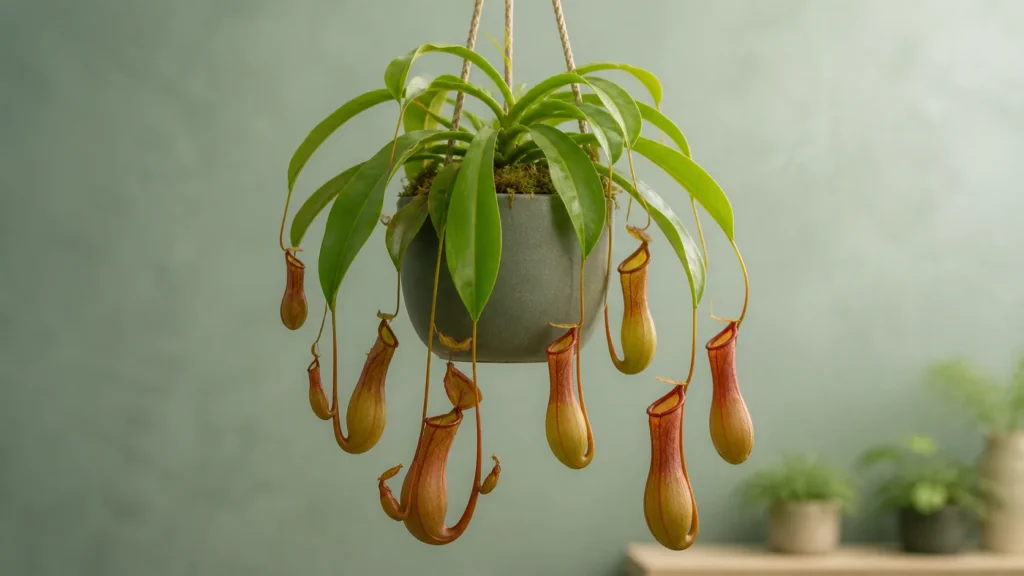
Pitcher Plant
Nepenthes spp.
A tropical carnivorous plant with hanging tube-shaped pitchers that trap insects, needing bright indirect light, consistently moist low-mineral water, high humidity, and a nutrient-free sphagnum mix.
Watering frequency
Keep moist; check every 2-3 days (use distilled or rain water)
Ideal temperature
65-85°F / 18-29°C (varies by species)
Humidity
50-80%+
Care difficulty
Hard
Air purifying
No/Not Known
Growth rate
Moderate
Plant size
1-3 ft / 0.3-0.9 m (vining species can grow longer)
Soil type
Long-fiber sphagnum moss or a low-nutrient mix of sphagnum, perlite, and orchid bark
Fertilizer need
No soil fertilizer; feed pitchers monthly.
Care summary
- Light: Give bright indirect light; avoid hot midday sun that can scorch leaves and pitchers.
- Water: Keep the medium consistently moist with distilled, rain, or reverse-osmosis water; never let it dry out.
- Humidity: 50% or higher is needed for pitcher production; use a terrarium, humidifier, or pebble tray in dry rooms.
- Medium: Use long-fiber sphagnum or a low-nutrient, well-draining mix; never use ordinary potting soil or fertilizer.
- Feeding: The plant catches insects; if indoors, offer one freeze-dried insect to a pitcher occasionally, or skip feeding entirely.
- Safety: Pet-safe status is based on the absence of known toxicity in cultivated carnivorous plants, not an exact Nepenthes test.
Common problems
- No pitchers or pitchers drying up: Check low humidity, insufficient light, or use of tap water with minerals.
- Yellow or brown leaves: Review root rot from compacted medium, mineral burn from tap water, or too much direct sun.
- Pitchers turning brown at the top: Usually natural aging of individual pitchers; trim when fully brown.
- Leggy growth with large leaves: Confirm insufficient light; move to brighter indirect light.
- Pests: Inspect for fungus gnats in moist medium, aphids on new growth, and scale on stems.
Plant care guide
About Pitcher Plant
Pitcher Plant refers to tropical pitcher plants in the genus Nepenthes, carnivorous plants that grow modified leaves forming tube-like pitchers filled with digestive fluid to trap and digest insects. Native to Southeast Asia — the Philippines, Malaysia, Indonesia, Borneo, Sumatra, and New Guinea — Nepenthes grow in nutrient-poor soils where carnivory provides essential nitrogen. There are over 170 recognized species plus thousands of hybrids, with pitchers ranging from a few inches to over a foot long in green, red, purple, and striped patterns.
Why You'll Like It
Pitcher Plant is one of the most fascinating conversation-starting houseplants — its modified leaves form elaborate tube-like traps that lure, capture, and digest insects, turning a common houseplant pest into fertilizer. The pitchers are visually striking with colorful lids, patterned bodies, and graceful shapes dangling from leaf tendrils, making Nepenthes an excellent hanging plant. Watching new pitchers form — from a tiny tendril to a fully formed colorful trap — is endlessly rewarding, and a well-grown plant can produce dozens of pitchers at once.
What Kind of Plant Is It?
Pitcher Plant (Nepenthes) is a carnivorous, climbing or trailing perennial that grows modified leaves forming pitcher traps. Leaves consist of a normal photosynthetic blade, a tendril extending from the leaf tip, and a pitcher — a modified tube-like structure at the tendril end filled with digestive fluid, with a colorful lid (operculum), a slippery rim (peristome), and downward-pointing hairs inside that prevent escape. Pitchers come in two types: lower pitchers near the ground are rounder and more colorful; upper pitchers on climbing stems are more slender and funnel-shaped. Stems are vining or trailing, growing longer over time with leaves and pitchers at each node. Roots are fine and fibrous, adapted to loose acidic nutrient-poor soils — they need excellent aeration and rot in dense, compacted, or waterlogged soil.
History and Naming
The genus Nepenthes was established by Carl Linnaeus in 1753, based on material from the Philippines collected by French botanist Georg Joseph Kamel (1661–1706), whose name also gives us the camellia. Linnaeus named it from Greek ne penthos (without grief), alluding to the nepenthe of Greek mythology — a potion causing forgetfulness of sorrow. The first species described was Nepenthes distillatoria from Sri Lanka. Nepenthes became popular in Victorian glasshouses as exotic curiosities, and late 19th/early 20th century hybridization produced the colorful, hardy hybrids most commonly grown today.
Pitcher Plant and Related Plants
- Venus Flytrap: Venus Flytrap (Dionaea muscipula) is the most famous carnivorous plant with hinged snap-traps — it needs very different care (full sun, pure water, winter dormancy) but shares the carnivorous fascination.
- Sundew (Drosera spp.): Carnivorous plants with sticky glandular tentacles that trap insects — generally smaller and easier than Nepenthes, with similar soil/water needs but often needing more direct sun.
- Cape Sundew (Drosera capensis): One of the easiest carnivorous plants, with long tentacle-covered leaves that curl around prey — a good beginner carnivorous plant, while Nepenthes offers dramatic pitcher traps and trailing habit.
Popular beginner Nepenthes hybrids include N. x ventrata (very tolerant, easy), N. 'Miranda' (large colorful red-speckled pitchers), N. x hookeriana (broad colorful pitchers), and N. sanguinea (red cylindrical pitchers, warm-growing).
Where Pitcher Plant Works Best
Choose a position with bright indirect light and high humidity — a bright bathroom with a window is often ideal, as the shower provides ambient humidity. An east or west window with a sheer curtain works well; a south window works if set back or filtered; a north window is usually too dim for vigorous pitcher production. Nepenthes are excellent hanging plants — trailing vines and dangling pitchers look best suspended, and hanging improves air circulation. Keep away from hot dry vents, AC outlets, cold drafts, and radiators. A terrarium or enclosed plant cabinet works well for high-humidity species, but many beginner hybrids do fine in average household humidity if acclimated gradually.
Pitcher Plant Care
Light
Provide bright indirect light — Nepenthes need more light than many tropical houseplants to produce colorful pitchers, but direct midday sun through glass scorches leaves. An east or west window with a sheer curtain is ideal; a south window works if set back/filtered; a north window is usually too dim.
Watering
Keep the medium consistently moist but not waterlogged — water thoroughly when the top feels slightly dry, typically every 2–3 days in warm weather, every 4–7 days in cooler conditions. Water quality is critical: use rainwater, distilled, reverse-osmosis, or deionized water — Nepenthes are sensitive to dissolved minerals and chlorine; tap water causes mineral buildup, root burn, and pitcher decline.
Potting Medium and Container
Use an open, acidic, well-draining medium — typically long-fiber sphagnum moss, or 50% long-fiber sphagnum + 25% perlite + 25% orchid bark. Avoid regular potting soil, peat moss (too dense), or any mix with fertilizer/mineral additives.
Humidity
Nepenthes need moderate to high humidity — ideally 50–80% depending on species/hybrid. High humidity is especially important for pitcher production; below 40%, pitchers may fail to form, dry quickly, or drop.
Temperature
Nepenthes divide into two temperature groups: lowland species prefer warm conditions year-round (70–90°F / 21–32°C daytime, 65–75°F / 18–24°C nighttime); highland species prefer cooler conditions with a significant day-night drop (65–80°F / 18–27°C daytime, 45–60°F / 7–15°C nighttime). Most beginner hybrids are intermediate/lowland types doing well in typical household temperatures (65–85°F / 18–29°C).
Fertilizer
Nepenthes get most nutrients from captured insects and are very sensitive to soil fertilizer — do not fertilize the soil. During the brighter spring-to-early-fall growth period, if the plant is not catching enough insects indoors, provide a very dilute foliar fertilizer at most once monthly, or place a single freeze-dried insect into one or two pitchers per month. Reduce or pause supplemental feeding in lower-light winter conditions; do not use it to compensate for weak light or poor root health.
Pruning and Training
Remove dead, brown, or dried pitchers by cutting the tendril at the base with sterile scissors — a pitcher typically lives several months to a year before naturally drying. Remove yellowed/dead leaves at the base when they pull away easily.
Propagating Pitcher Plant
The most common home method is stem cuttings. Take a cutting from a healthy mature vine, including at least 2–3 nodes with leaves and tendrils intact. Cut just below a node with sterile scissors, remove the lowest leaf, dip the cut end in rooting hormone (optional). Plant in moist long-fiber sphagnum or 50/50 sphagnum-perlite, with at least one node buried. Enclose in a plastic bag or propagation dome to maintain 70–80% humidity, place in bright indirect light at 70–80°F (21–27°C). Roots and new shoots develop in 4–8 weeks. Once rooted, gradually acclimate to lower humidity, then pot up normally.
Repotting Pitcher Plant
Repot every 1–2 years in spring, or sooner if medium decomposes (dark, mushy, foul-smelling), roots grow extensively through drainage holes, or water drains very slowly. Best time is when new growth emerges in spring. Signs needing repot: medium broken down to dense peat-like consistency; white/brown mineral crust on medium surface (from hard tap water); roots growing out in large numbers; or plant producing fewer/smaller pitchers despite adequate light/humidity. To repot: gently remove from pot, taking care not to damage fine roots or pitchers; gently remove old medium, teasing it from roots; inspect roots, trim dead/mushy/brown roots with sterile scissors (healthy roots are firm, white or light brown); choose a pot only slightly larger with good drainage; place fresh medium in bottom, position plant at same depth, fill in with fresh medium tamping gently (don't pack tightly — air spaces matter); water thoroughly with pure water, keep in slightly lower light and stable high humidity for 1–2 weeks while recovering. The plant may drop some pitchers while adjusting — normal.
Toxicity and Pet Safety
Pitcher Plant (Nepenthes) is classified as Pet safe under the project's family-level evidence rule. The ASPCA has no specific Nepenthes entry, but carnivorous plants in common cultivation have no known serious toxicity to cats or dogs. The digestive fluid inside pitchers is primarily weak enzymes (proteases) and organic acids, similar to weak stomach acid — a brief lick/taste is unlikely to harm, though large amounts could cause mild GI upset. This is family-level evidence (Nepenthaceae), not a direct toxicology evaluation of Nepenthes. The plant is not food; chewing leaves/pitchers may still cause mild stomach upset in a sensitive pet. Potting medium, fertilizer, and pest-control products are separate hazards. Contact a veterinarian if symptoms develop after ingestion.
Common Problems and Practical Fixes
Pitchers drying out or failing to form — the most common problem, usually from low humidity, insufficient light, or hard tap water. Below 40% humidity: increase with humidifier, pebble tray, or enclosure.
Yellow or brown leaves — several causes. Yellow leaves with mushy bases = overwatering/root rot — check medium and roots, repot if brown/mushy.
Root rot — brown, mushy, foul-smelling roots, usually from overwatering, poor drainage, decomposed medium, or oversized pot. Remove from pot, trim all dead/mushy roots with sterile tools, repot in fresh dry medium, reduce watering until new growth.
No pitchers or very few pitchers — usually insufficient light, low humidity, or nutrient deficiency. Nepenthes need bright indirect light — if leaves are dark green/soft, move brighter.
Aphids, mealybugs, or scale — affect Nepenthes, especially new growth and leaf undersides. Inspect regularly, especially new growth.
Fungal or bacterial leaf spot — brown/black spots on leaves, often with yellow halo, usually from poor air circulation or water sitting on leaves. Improve air circulation with a small fan, avoid getting water on leaves when watering, remove severely affected leaves with sterile scissors.
Frequently Asked Questions
How often does Pitcher Plant produce new pitchers?
A healthy well-grown Nepenthes produces new pitchers continuously throughout the growing season, with each leaf potentially developing a pitcher at its tendril tip. A single pitcher lives several months to a year before naturally drying.
Should I add water to the pitchers?
If a pitcher has dried out or fluid level is very low, add a small amount of pure water (rainwater/distilled/RO) to about one-third full — this maintains the digestive environment and prevents drying. Don't overfill — too much water dilutes enzymes and can cause rot.
Can Pitcher Plant grow in low light?
Nepenthes need bright indirect light to produce pitchers — a dim room or north window is usually insufficient, resulting in dark green leaves and few/no pitchers. If you can't provide enough natural light, use a full-spectrum LED grow light 12–18 inches above the plant, running 12–14 hours daily.
Is Pitcher Plant pet safe?
This database classifies it as pet safe using family-level evidence: carnivorous plants in common cultivation have no known serious toxicity, and digestive fluid is primarily weak enzymes/acids posing no significant risk from brief contact. No exact Nepenthes ASPCA evaluation was found, so discourage chewing and keep potting materials and pest-control treatments out of reach.
Final Thought
Pitcher Plant (Nepenthes) is a fascinating, otherworldly houseplant that rewards attentive care with a continuous display of dramatic, colorful, insect-trapping pitchers. Its key needs are straightforward: bright indirect light to trigger pitcher production, consistently moist but well-drained open medium (never regular potting soil), pure water free of dissolved minerals, moderate to high humidity, and warm stable temperatures. The most common mistakes — hard tap water, dense soil, or too dim a position — are easy to avoid once understood. Read the pitchers for cues: colorful well-formed pitchers mean the plant is happy; drying or absent pitchers signal light, humidity, or water quality needs adjustment. With proper care, a Nepenthes can be a long-lived, ever-changing centerpiece that turns the common housefly into plant food.