
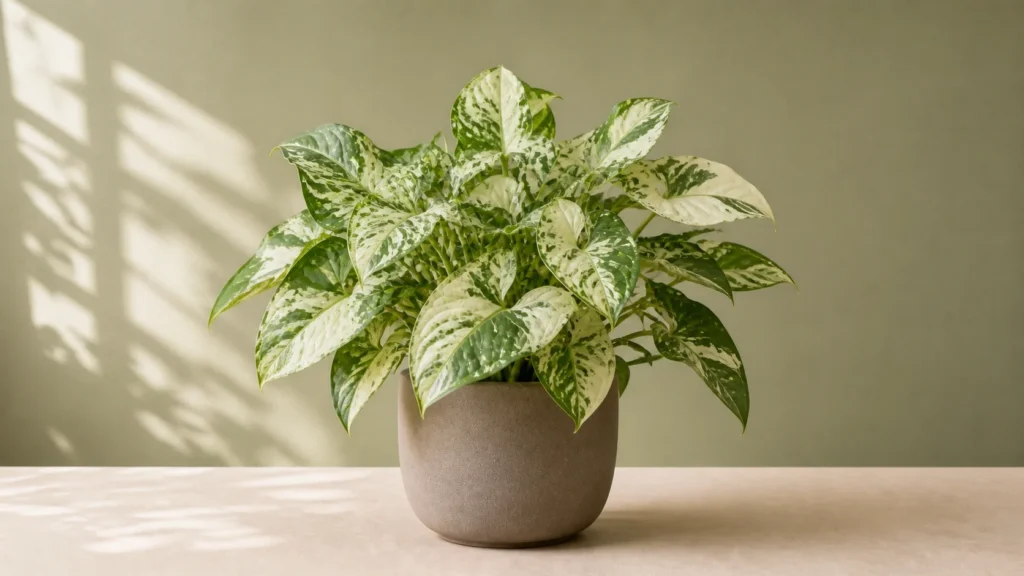
Syngonium ‘Three Kings’
Syngonium podophyllum 'Three Kings'
A highly variable arrowhead cultivar with cream, sage, and deep-green marbling that makes every leaf look different.
Watering frequency
Every 7-10 days
Ideal temperature
65-80°F / 18-27°C
Humidity
50-70%
Care difficulty
Medium
Air purifying
No/Not Known
Growth rate
Moderate
Plant size
Trails or climbs 2-6 ft / 0.6-1.8 m
Soil type
Airy, moisture-retentive aroid mix
Fertilizer need
Every 4-6 weeks, spring-summer.
Care summary
- Light: Bright indirect light maintains compact growth and balanced marbling.
- Water: Let the top inch dry, then water thoroughly and drain.
- Soil: Use an open aroid mix and a pot with drainage.
- Variegation: Propagate balanced stems rather than nearly white sections.
- Safety: Not pet-safe if chewed.
Common problems
- Greener successive leaves: low light or a reverting growth point.
- White areas browning: direct sun, drought, or root stress.
- Yellow leaves: excess moisture or poor drainage.
- Slow growth: limited chlorophyll, cool conditions, or weak light.
- Distorted new leaves: check for thrips and mites.
Plant care guide
About the Three Kings Syngonium
Three Kings Syngonium (Syngonium ‘Three Kings’) is a cultivated Syngonium podophyllum recognized for irregular green, sage, and cream-white marbling. NC State Extension lists ‘Three Kings’ among the species’ cultivars. Some leaves are finely mottled, some show broad pale sectors, and others remain greener. That unpredictability is the defining feature rather than a perfectly repeated pattern.
It shares the Arrowhead Plant's climbing habit. Young plants form a compact cluster of arrow-shaped leaves; older supported vines develop larger, more mature foliage.
How to Identify It
Look for irregular marbling in at least three tones—the signature of Three Kings Syngonium: deep or medium green, pale sage, and cream-white. Green flecks may sit inside pale sections, and neighboring leaves often differ dramatically. This separates it from the more consistent pale center and green edge of the White Butterfly Syngonium.
Very pale examples can be confused with other variegated Syngoniums. Retain the nursery label and avoid promising an exact pattern from future leaves—the living growth point, light, and leaf age all influence the result.
Best Light and Placement
Bright indirect light gives the best combination of strong growth and visible variegation. Low light can stretch the vine and favor greener growth. Harsh direct sun scorches cream sections, so move the plant back from intense south or west glass or use a sheer curtain.
A bright office or living-room position works well. Rotate the pot regularly. Let stems trail for a hanging display, prune them for a fuller pot, or give them a trellis or pole to express the natural climbing habit.
Water, Soil, and Humidity
Water after the top inch of mix dries. Saturate the root ball and drain it completely. Pale-leaved plants are sometimes overprotected with too much water, but wet roots reduce oxygen and create the yellowing growers are trying to avoid.
Use a loose aroid blend with potting mix, perlite, and fine bark. Keep it warm at 65-80°F (18-27°C). Humidity around 50-70% helps delicate new leaves unfurl, though stable root moisture and airflow matter more than misting.
Feed lightly every four to six weeks during active growth. If the plant is stalled because of low light, cold, or root rot, fertilizer will not solve the underlying problem.
Pruning, Reversion, and Propagation
Follow the stem, not a single leaf. If a growth point produces several fully green leaves in a row under good light, cut the vine back to the last node that displayed balanced variegation. Do not remove every greener leaf: green tissue powers the pale parts of the plant.
Propagate a stem cutting with at least one node. Choose a section showing both green and pale patterning. Root it in water, sphagnum, or a light potting medium and keep it warm. A nearly white cutting may root but struggle to sustain growth because it has too little chlorophyll.
Common Problems
- Several new leaves are green: Improve light, then consider pruning a repeatedly green growth point.
- Cream sections turn brown: Reduce direct sun and check watering consistency, roots, and salt buildup.
- Leaves yellow while soil is wet: Increase drying time and inspect drainage.
- Growth is slow: Variegation naturally reduces photosynthesis; also verify warmth and light.
- New leaves are scarred or misshapen: Check the growing tips for thrips and mites.
Pet Safety
Three Kings is not pet-safe. The ASPCA’s arrowhead-vine guidance identifies insoluble calcium oxalates that can irritate the mouth and trigger drooling, vomiting, or swallowing difficulty after chewing. Place it beyond the reach of pets and children.
Frequently Asked Questions
Why is every Three Kings leaf different? Irregular marbling is characteristic of the cultivar. Leaf age, the active growth point, and light all contribute to the variation.
How is it different from White Butterfly? Three Kings has unpredictable marbled or sectoral patches across the blade. The White Butterfly Syngonium is more consistent, with a pale center and clearer green margin.
Should I remove mostly white leaves? Only if they are failing or the whole growth point cannot sustain itself. Balanced green-and-cream growth is more vigorous than chasing the whitest possible plant.
Can it grow without a pole? Yes. It can trail or be pruned into a compact pot. Support is optional and mainly encourages climbing and larger mature leaves.