
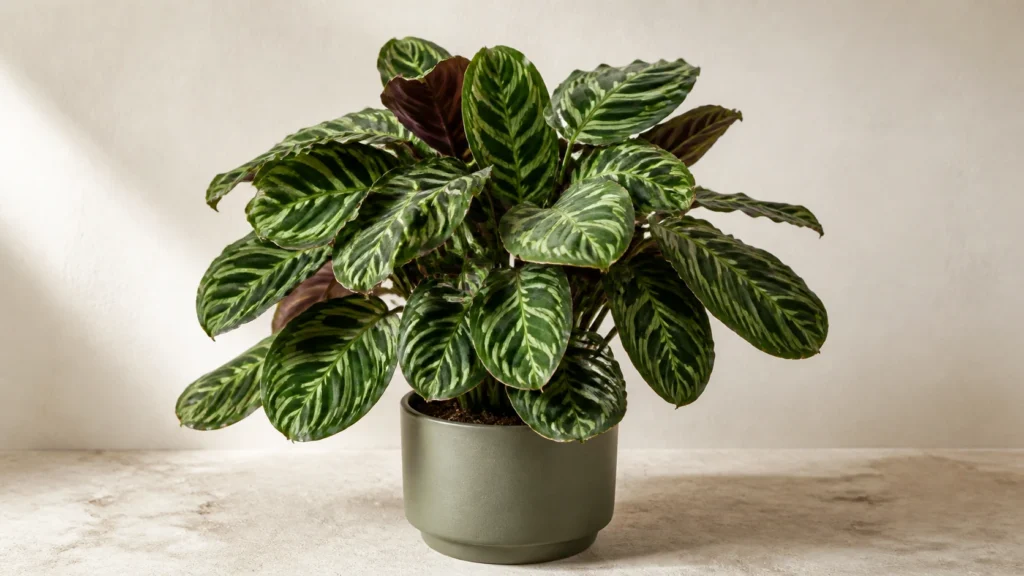
Zebra Plant
Goeppertia zebrina
A velvet-leaved Brazilian prayer plant with pale green stripes over deep green, purple undersides, and leaves that fold upward like praying hands at dusk.
Watering frequency
Every 5-7 days
Ideal temperature
65-80°F / 18-27°C
Humidity
50-70%
Care difficulty
Medium
Air purifying
No/Not Known
Growth rate
Moderate
Plant size
24-36 in / 60-90 cm
Soil type
Moist, airy houseplant mix
Fertilizer need
Every 4-6 weeks while growing.
Care summary
- Light: Give medium to bright filtered light; avoid direct hot sun.
- Water: Keep evenly moist, allowing only the surface to begin drying.
- Humidity: Maintain stable humidity with airflow and warm roots.
- Water quality: Use lower-mineral water if tip burn persists.
- Safety: Marantaceae prayer plants are treated as pet-safe.
Common problems
- Brown edges: Review low humidity, hard water, and fertilizer salts.
- Curling leaves: Check dry air, dry soil, cold, and excess light.
- Faded stripes: Improve useful filtered light without harsh sun.
- Yellow leaves: Inspect saturated mix, drainage, and roots.
- Pests: Inspect leaf undersides for mites, mealybugs, and scale.
Plant care guide
About the Zebra Plant
The Zebra Plant (Goeppertia zebrina) is a velvet-leaved prayer plant from Brazil whose broad, oval leaves are striped pale yellow-green over deep green, like a zebra's hide rendered in soft fabric. The undersides flush rich purple, and every evening the leaves lift upward into a prayer position, the nightly movement that gives the whole family its name. With leaves that can reach a foot long, it is one of the larger and more dramatic prayer plants you can grow.
One caveat: the name "Zebra Plant" also belongs to an unrelated houseplant, Aphelandra squarrosa, a white-veined shrub with yellow flower spikes from the acanthus family. The two look nothing alike and need different care; everything here refers to the prayer plant.
Why You'll Like It
It moves. Like all prayer plants, this species raises its leaves at night and lowers them again by day, a behavior called nyctinasty. A healthy Zebra Plant visibly changes shape between morning and evening, which makes it feel almost animate.
The texture is unlike anything else. The leaves are covered in fine hairs that make them soft, almost velvety to the touch, a world away from a glossy Monstera or a waxy rubber plant.
It does not need direct sun. Medium to bright filtered light is enough, so it thrives several feet from a window in rooms where many flowering houseplants would struggle.
It is a statement plant without taking over the room. At 2 to 3 feet tall and wide at maturity, it fills a plant stand on its own, and the foliage carries the show.
It is pet-safe. Marantaceae prayer plants are not considered toxic to cats and dogs, making this one of the boldest patterned options for households with pets. The Toxicity section explains what the evidence actually covers.
What Kind of Plant Is It
The Zebra Plant is a species in the genus Goeppertia, which until 2012 was treated as part of Calathea by almost everyone outside botanical circles. Both genera sit in the Marantaceae family alongside Maranta, Ctenanthe, and Stromanthe. If you already grow a prayer plant, a rattlesnake plant, or a fishbone prayer plant, you already know the care routine; the Zebra Plant follows the same family script with a bigger body and softer leaves.
In the wild it is a clumping, rhizomatous perennial of Brazil's Atlantic forest understory, native from Bahia to Santa Catarina, where it receives dappled light, high humidity, and steady warmth. NC State Extension's Zebra Plant profile describes the same clumping habit and the filtered-light, even-moisture, high-humidity preferences that define the species. Indoors, that habit produces a dense mound of foliage rather than a single upright stem. Among prayer plants it sits on the larger end of the scale, with leaves up to 12 inches long, comparable in boldness to the round-leaved calathea orbifolia. It is also a species, not a hybrid, so every plant you see is the same wild plant botanists have known since the early 1800s.
History of the Zebra Plant
The naming history of the Zebra Plant is unusually well documented, because the species reached European gardens early and received a new name almost every decade.
The plant entered science in 1817, when the English botanist John Sims published it in the Botanical Magazine (t. 1926) as Maranta zebrina. The epithet zebrina refers to the stripes, and the name stayed in horticulture for a century even as botanists moved the species between genera. In 1829, John Lindley transferred it to Calathea in the Botanical Register (t. 1210), giving the familiar name Calathea zebrina. Just two years later, in 1831, the German botanist Christian Gottfried Daniel Nees von Esenbeck placed the species in Goeppertia, publishing Goeppertia zebrina in the journal Linnaea (volume 6, page 337). That name was validly published but immediately forgotten, because the genus itself was not widely accepted.
For the next 180 years everyone used Calathea zebrina. Then, in 2012, botanists Borchsenius and Suárez resurrected Goeppertia for a large group of former Calathea species, and Nees's 1831 name became the accepted scientific name again. Kew's Plants of the World Online now lists Goeppertia zebrina (Sims) Nees with 16 synonyms attached, including Maranta zebrina, Calathea zebrina, Maranta bicolor, and the vividly named Maranta tigrina published by William Bull in 1904.
Two details round out the story. The species has been an ornamental since the 1820s and performs reliably enough that the Royal Horticultural Society has given it the Award of Garden Merit. The common-name confusion with Aphelandra squarrosa appears to be a 20th-century retail accident: both were Victorian conservatory favorites with striped foliage, and the shared name has caused mix-ups ever since.
Related Varieties
Goeppertia zebrina is a species, so it has no true cultivar siblings in the way the lemon lime maranta has its named forms. Instead, the plant world offers a family of striped and velvet-leaved prayer plants that scratch the same itch.
Goeppertia zebrina 'Humilior'. A smaller, lower-growing form recorded in cultivation since the 1860s (originally Calathea zebrina var. humilior). It behaves like the species but stays compact, suiting shelves and terrariums.
Goeppertia warszewiczii. Often sold as the Velvet Calathea. It shares the velvet texture but has softer stripes, and it flowers indoors more readily.
Ctenanthe oppenheimiana 'Tricolor'. The tri-color member of the family, with cream, green, and pink variegation. Its upright, lance-shaped leaves give a completely different silhouette while sharing the same care philosophy.
Maranta leuconeura. The classic prayer plant with oval leaves and dark blotches, smaller and more trailing, and a better fit for hanging baskets.
Goeppertia makoyana. The peacock plant, whose leaves carry feather-like markings rather than stripes; it occupies the same "intricately patterned prayer plant" niche and is covered in our peacock plant guide.
Stromanthe thalia 'Triostar'. The boldly variegated member of the family, with pink, green, and cream leaves that need the same high-humidity care; see the stromanthe triostar record.
Where It Works
The Zebra Plant's tolerance for ordinary indoor light makes it one of the more flexible prayer plants when it comes to rooms.
Bathrooms and kitchens are natural homes, because these rooms run more humid than living spaces, and the plant's native habitat is a warm, damp forest floor. Home offices and bedrooms work well a few feet from an east- or north-facing window, or near a brighter window behind a sheer curtain; the stripes hold without intense light, but very dim corners will fade the pattern. Dining rooms and entryways suit its size: a mature plant on a stand becomes the visual anchor of the room.
Avoid cold drafts and direct afternoon sun, which scorches the velvet leaves. In winter, dry heating air demands attention; a humidifier, pebble tray, or grouping with other tropicals compensates. This is the same care logic used for the calathea medallion and other high-humidity prayer plants.
How to Care for a Zebra Plant
The Zebra Plant is not a beginner's plant, but it is forgiving once you understand its three non-negotiables: steady moisture, stable humidity, and no direct sun.
Light. Give medium to bright indirect light, a few feet from an east or north window. The stripes are most vivid in brighter filtered light and fade in deep shade, but harsh sun burns the soft leaf tissue quickly.
Water. Keep the soil evenly moist from spring through autumn, watering when the top inch has begun to dry. The plant dislikes both complete dryness and standing water. In winter, water less and let the surface dry a little more. If tips keep browning despite correct watering, switch to filtered, distilled, or rainwater.
Humidity. Aim for 50 to 70 percent. Brown, crispy edges and curling leaves are almost always humidity problems; a humidifier is the most reliable fix, a pebble tray weaker. Avoid misting the velvet leaves, since water on the fine hairs invites fungal spotting; raise humidity around the plant, not on it.
Temperature. Keep the plant in the comfortable room range of about 65 to 80°F (18 to 27°C). It is a tropical understory plant and dislikes cold; extended periods below 60°F (15°C) damage the leaves, so keep it away from drafty windows in winter.
Soil and potting. Use a light, airy houseplant mix that holds moisture but drains freely, such as potting soil amended with perlite and a little orchid bark. The rhizomes appreciate a wide, shallow container more than a deep one, because the plant spreads horizontally.
Fertilizer. Feed lightly every 4 to 6 weeks during the growing season with a balanced houseplant fertilizer at half strength. Prayer plants are light feeders, and excess salts brown the leaf tips, so flush the pot with plain water every couple of months.
Cleaning. The velvet leaves attract dust, which dulls the pattern. Wipe the upper surfaces gently with a soft, dry cloth every few weeks, and rotate the pot a quarter turn at each watering.
How to Propagate
Division is the reliable way to make more Zebra Plants, and the species divides almost eagerly because it spreads by rhizomes underground.
Do this in spring or early summer, when the plant is actively growing. Water it a day beforehand, then remove it from the pot and look for natural separations in the root ball. With clean hands or a sterilized knife, separate a cluster with at least three to four leaves and a decent root system. Pot it in fresh, airy mix in a container only slightly larger than the root ball, water well, and keep it in bright indirect light with higher than normal humidity for the first few weeks.
Never divide a plant that is not yet crowded, and never split it into tiny pieces; each new plant needs enough roots to support its leaves. The parent recovers within a couple of weeks, and divisions usually establish without drama. The same spring timing applies to its relatives, as described in the propagation notes for the rabbit's foot prayer plant.
When to Repot
Repot the Zebra Plant every 1 to 2 years, in spring, when it enters its growth phase. The signals to watch for are roots growing out of the drainage holes, water running straight through the pot because the mix is root-bound, and growth slowing despite a healthy appearance.
Move up only one pot size with good drainage; a pot that is too large holds water in unused soil and invites root rot, the most common fatal mistake with prayer plants. While it is out of the pot, divide it if you want more plants and trim any soft, brown rhizome sections. After repotting, keep the soil evenly moist and hold off on fertilizer for about a month.
Toxicity
The Zebra Plant is a Marantaceae prayer plant, and the family has a strong reputation as pet-safe. The ASPCA lists Calathea as non-toxic to cats and dogs, and because Goeppertia species were classified as Calathea until 2012, the same assessment is routinely applied to the whole group.
To be precise about the evidence: the ASPCA record is at the genus level, not a species-specific study of Goeppertia zebrina, so the assessment rests on the family record. No significant illness from eating prayer plant leaves has been reported; the main risks are mild stomach upset from heavy chewing and cats treating the velvety leaves as toys. If your pet is a determined chewer, place the plant out of reach. The same family-level reasoning applies to the calathea medallion and the rattlesnake plant, which share this classification.
Common Problems
Most Zebra Plant troubles trace back to a handful of causes, and the symptoms are easy to read.
Brown, crispy leaf edges or tips. The classic humidity complaint, worsened by hard water and fertilizer salts. Raise the humidity, switch to low-mineral water, and flush the soil periodically. If only the tips are brown, water quality is usually the culprit.
Curling leaves. Leaves curling inward are the plant asking for help. The causes, in order of likelihood, are dry air, dry soil, cold air, and excessive light. Check soil moisture first, then room conditions.
Faded or washed-out stripes. The pattern fades in light that is too dim and burns in light that is too strong. Move the plant to a brighter filtered spot and the stripes usually deepen again over a few weeks.
Yellow leaves. Usually overwatering, especially if the soil feels wet and drainage is poor. Check for saturated mix and inspect the roots for soft, brown sections, repotting in fresh mix if the soil has broken down.
Leggy growth with small leaves. The plant is reaching for light. Move it closer to a window, keeping the light filtered.
Pests. The velvet leaves hide trouble well, so inspect the undersides regularly for spider mites, mealybugs, and scale. Spider mites love dry air, another reason to maintain humidity. Wipe affected leaves with a damp cloth and treat with insecticidal soap, repeating as needed.
FAQ
Is the Zebra Plant a calathea? In everyday nursery terms, yes: it was sold as Calathea zebrina for generations and still carries the common name Zebra Calathea. Scientifically, the accepted name is now Goeppertia zebrina, following the 2012 reclassification. Care guidance written for calatheas applies to it unchanged.
Is the Zebra Plant the same as the Aphelandra Zebra Plant? No, and this is the most common mix-up in houseplant retail. Aphelandra squarrosa, also called the Zebra Plant, is a shrubby tropical from the acanthus family with dark green leaves marked by white veins and showy yellow flower spikes. It grows upright on a woody stem, tolerates brighter light, and needs different care. If your "Zebra Plant" has white veins and yellow flowers, you have an Aphelandra, not a prayer plant.
Why are the leaves curling even though the soil is moist? When the soil is fine, curling is almost always a humidity problem: the plant loses water through its large leaf surface faster than the air returns it. Raise the surrounding humidity and the leaves usually relax within a day or two.
Does the Zebra Plant flower indoors? It can, though rarely, producing small white or pale tubular flowers held close to the leaf clusters in spring or summer on mature plants. The flowers are modest; the foliage is the point. Never blooming is normal and not a sign of a problem.
How big does it get? A mature plant reaches about 2 to 3 feet tall and wide, with leaves up to a foot long. Growth is moderate, and the plant spreads by rhizomes into a full, clumping mound over several years.
Is it hard to care for? Moderate. The three rules are steady moisture, high humidity, and filtered light. Beginners who succeed usually own a humidifier or live in a naturally humid climate; everyone else should manage humidity deliberately.
Final Thought
The Zebra Plant delivers a lot of plant for the effort it asks: striking stripes, a velvet texture, and a nightly leaf movement that gives the room a living rhythm, all on a care routine of simple, consistent habits rather than a demanding schedule. It also teaches the whole prayer plant family in miniature, and the same skills carry over to lemon lime maranta, fishbone prayer plant, and every other member of the group. If you have a humid room and a bright, indirect spot, this is one of the most rewarding plants that spot can hold.