
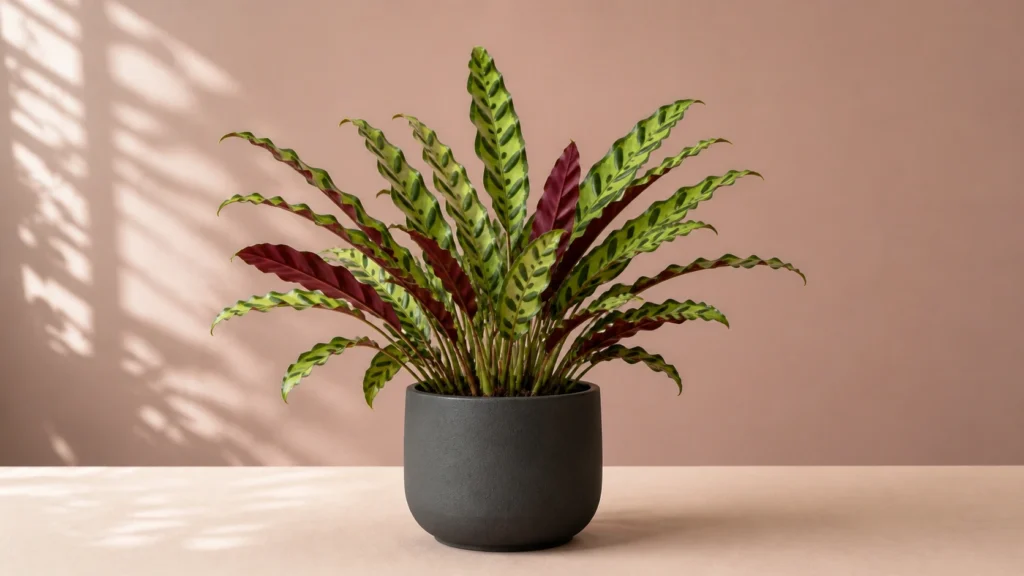
Rattlesnake Plant
Goeppertia insignis
A striking Brazilian prayer plant with long wavy leaves, alternating dark blotches, and purple undersides, folding upward each night like a rattlesnake coiling.
Watering frequency
Every 5-7 days
Ideal temperature
65-80°F / 18-27°C
Humidity
50-70%
Care difficulty
Medium
Air purifying
No/Not Known
Growth rate
Moderate
Plant size
18-30 in / 45-76 cm
Soil type
Moist, airy houseplant mix
Fertilizer need
Every 4-6 weeks while growing.
Care summary
- Light: Give medium to bright filtered light; avoid direct hot sun.
- Water: Keep evenly moist, allowing only the surface to begin drying.
- Humidity: Maintain stable humidity with airflow and warm roots.
- Water quality: Use lower-mineral water if tip burn persists.
- Safety: Marantaceae prayer plants are treated as pet-safe.
Common problems
- Brown edges: Review low humidity, hard water, and fertilizer salts.
- Curling leaves: Check dry air, dry soil, cold, and excess light.
- Yellow leaves: Inspect saturated mix, drainage, and roots.
- Faded pattern: Improve useful filtered light without harsh sun.
- Pests: Inspect leaf undersides for mites, mealybugs, and scale.
Plant care guide
About Rattlesnake Plant
Rattlesnake Plant (Goeppertia insignis) is the long-leafed member of the prayer plant family: a Brazilian tropical perennial whose slender, wavy-edged leaves carry alternating large and small dark green blotches on a pale green field, with deep purple undersides that show every evening when the leaves fold upward. The common name comes from the way those blotches resemble the markings of a rattlesnake, and the scientific epithet insignis carries a similar idea, meaning "remarkable" or "distinguished by a mark."
The plant is still widely sold under its older names. Most nursery tags read Calathea lancifolia, and you will also see Calathea insignis or Goeppertia lancifolia; all of these refer to the same species, and Kew's accepted botanical record places the current name as Goeppertia insignis. NC State Extension's Rattlesnake Plant profile describes the fountain-like clumping habit, the purple-maroon leaf undersides, and the filtered-light, even-moisture, high-humidity preferences that define this species.
Like its relatives the Red Prayer Plant and the Rabbit's Foot Prayer Plant, it is a member of Marantaceae and moves its leaves on a daily rhythm. What sets it apart is the leaf shape: long, narrow, and strongly rippled, rather than the broad oval blades of the other prayer plants.
Why You'll Like It
This is the most architectural prayer plant in the group. Instead of a broad painted blade, each leaf is a long, wavy spear with a dark spot pattern and a rich purple reverse, and a mature clump looks like a fountain of striped spears. The contrast between the green topsides and the purple undersides doubles the show every evening when the leaves lift and fold.
It is also one of the more forgiving Goeppertia species. The Rattlesnake Plant tolerates a wider range of ordinary room conditions than the fussier rounded-leaved calatheas, which makes it a reasonable first step into the family for someone coming from the easier Maranta side. It stays a manageable clump of about 18 inches indoors, and it rarely flowers inside, so the foliage does all the work.
The pattern is genuinely distinctive. No other common houseplant combines wavy margins, blotched topsides, and purple undersides in the same way, so a single specimen reads clearly from across a room.
What Kind of Plant Is It?
Goeppertia grows from creeping rhizomes, horizontal underground stems that produce roots and shoots. Above ground, leaves rise on long slender stalks directly from the rhizome, so the plant forms a clump rather than a branching stem. This rhizomatous habit makes division the natural propagation method.
Leaves can reach about 18 inches long indoors, with strongly wavy margins and a lance shape. The upper surface alternates small and large dark green elliptical blotches along the lateral veins, while the underside is a deep purple-maroon. The purple reverse is an adaptation to the shaded forest floor: it helps the leaf capture light that has already passed through the canopy.
The plant rarely flowers indoors. When it does, small light green to yellow flowers appear on short conical spikes in late spring or early summer, and the flower spike is not a sign of distress.
History of Rattlesnake Plant
The species has a long and slightly tangled naming history that explains why so many labels coexist. The first published name, Maranta insignis, was coined in 1902 by William Bull and W.E. Marshall in the Gardener's Chronicle. In 1955 the Dutch botanist Boudewijn Boom described what he took to be a separate species as Calathea lancifolia, and that name became the one used by nurseries and plant books for decades.
Modern molecular work reorganized the prayer plant family. In 2012, Borchsenius and Suárez moved the species into the genus Goeppertia, and in 2017 a team working on Brazilian Marantaceae settled the accepted name as Goeppertia insignis, published in the journal Phytotaxa. Under this classification, Calathea lancifolia becomes a later synonym, and Kew's record lists the species as native to the state of Rio de Janeiro in southeastern Brazil.
What this history means for a buyer is simple: the rattlesnake plant you see labeled Calathea lancifolia today is the same species as the one botanists now call Goeppertia insignis. The name changed, the plant did not.
Related Prayer Plant Varieties
This page covers the species Goeppertia insignis. Several cultivated selections exist, and they are worth knowing when shopping:
- 'Fun Star': Vibrant green leaves with purple markings.
- 'Saint Paul': A popular choice with green leaves and white brush-stroke patterns.
- 'Silver Lance': Silvery green leaves with dark green stripes.
Beyond these selections, the prayer plant family includes the Red Prayer Plant and Rabbit's Foot Prayer Plant in Maranta, the rounded-leaved Calathea Orbifolia and Peacock Plant in Goeppertia, and the striped Fishbone Prayer Plant in Ctenanthe. They share family habits but not identical care; do not assume that what works for one works for all.
Where It Works Best
Choose a warm place near an east or north window, or a spot a few feet back from a brighter exposure. Bright filtered light keeps the blotches crisp and the growth compact, while medium light is tolerated better than with the rounded-leaved calatheas. Direct hot sun bleaches the pattern and crisps the leaf edges.
A bright bathroom is ideal because of the humidity, but a windowless humid room remains too dark. Offices and kitchens work when the plant is away from HVAC vents. Avoid cold windowsills and exterior doors; roots in a wet pot are especially vulnerable when chilled.
The upright, fountain-like habit suits a floor stand or a tabletop away from traffic. Because the leaves are long, give the plant a little breathing room so the blades are not constantly brushed against walls or furniture.
How to Care for Rattlesnake Plant
Light
Provide medium to bright indirect light. This is a more light-tolerant prayer plant than most, and it will hold its pattern in ordinary bright rooms, but very dim corners still slow growth and fade the blotches. Gentle early sun may be tolerated, but harsh direct sun causes bleached tan patches. Turn the pot periodically to keep the clump balanced.
Leaves folding upward at night are normal. Persistent vertical curling during the day with dry soil indicates stress rather than prayer movement.
Water
Use five to seven days as an inspection cue. Water when the surface begins to dry but before the entire root ball becomes dry. Soak evenly until water exits the drainage holes, then empty the saucer.
Water use changes with season, pot size, light, and humidity. In winter the interval may lengthen, but do not force a complete succulent-style dry-down. A wet pot with curled leaves can indicate damaged roots, not thirst.
Goeppertia can be sensitive to accumulated minerals and fluoride. If brown tips persist after correcting moisture, humidity, and roots, try rainwater collected safely, distilled water, or another lower-mineral source. Flush the pot periodically rather than letting salts concentrate.
Soil and Container
Use a moisture-retentive but airy houseplant mix. Potting mix amended with perlite, pumice, fine bark, or coco chips can balance water and oxygen. Dense garden soil stays wet; an extremely chunky aroid blend may dry too unevenly for fine roots.
Choose a pot with drainage only modestly wider than the root mass. Plastic retains moisture and can simplify consistent care, while terracotta may dry quickly. Keep crowns and stems at their existing depth.
Humidity and Temperature
Aim for stable humidity around 50-70 percent. A room humidifier is more effective than misting, which changes humidity briefly and can spot leaves. Grouping plants may modestly improve the immediate microclimate but does not replace measurement in a very dry room.
Keep temperatures around 65-80°F (18-27°C), and do not let the plant sit below about 59°F (15°C) for long. Cold drafts, air-conditioning, and chilled wet soil cause curling, yellowing, or growth arrest.
Fertilizer
Feed lightly every four to six weeks during active growth using a balanced fertilizer at a diluted label rate. Reduce or pause in winter. Prayer plants are sensitive to fertilizer salts, so more is not better.
White crust, worsening brown tips, or stressed roots call for a plain-water flush and reduced feeding. Never fertilize dry or rotten roots in an attempt to restore color.
Pruning and Grooming
Remove fully yellow or damaged leaves at the base of the stalk. A sparse plant can be renewed by dividing the clump rather than by pruning the stalks, which do not branch the way vining stems do.
Clean leaves gently with water and a soft cloth while supporting the blade. Avoid leaf-shine products. Regular inspection of undersides catches mites before damage becomes widespread.
How to Propagate Rattlesnake Plant
Division is the reliable method. During repotting, separate a natural section of the rhizome that carries several leaves and healthy roots, then pot it at the same depth in a snug container with fresh mix.
Stem cuttings are not practical for this species because leaves rise directly from the rhizome without the nodes that vining plants root from. If you want more plants, wait for the clump to fill out and divide it; each healthy division will establish on its own with consistent moisture, warmth, and filtered light.
Rooting and establishment speed vary with season and warmth. A division that loses a leaf or two while settling in is normal; keep the soil evenly moist and let new growth emerge.
When to Repot
Repot when roots and rhizomes crowd the pot, water penetration becomes uneven, mix has compacted, or the plant dries much faster than before. Annual size increases are unnecessary.
Move up one modest size or divide the clump. Preserve fine roots and maintain the original depth. A wide pot can accommodate horizontal rhizome growth without surrounding the root system with excessive wet soil.
Pet Safety
ASPCA's Calathea listing classifies the genus as non-toxic to cats and dogs, and NC State Extension's profile of this exact species carries no toxicity warning. The project therefore retains Pet safe for correctly identified Goeppertia insignis, while noting that the ASPCA record is written at the genus level and does not test every individual species.
Non-toxic plants can still cause stomach upset if heavily chewed. Secure the plant and keep fertilizers, systemic pesticides, and decorative materials inaccessible. Contact a veterinarian if an animal develops symptoms.
Common Problems and Practical Fixes
Brown edges and crispy tips
Low humidity, hard water, fertilizer salts, and hot vents are the usual drivers. Raise humidity, switch to lower-mineral water, and flush the pot periodically. Change one likely cause at a time and assess new leaves; existing brown tissue will not recover.
Curling leaves
Check dry soil, dry air, cold drafts, excess light, and roots. Dry warm air may curl edges; wet cold soil can damage roots and produce similar water stress. Nighttime folding alone is normal.
Yellow leaves
One old leaf can age naturally. Several yellow leaves with wet soil suggest poor drainage or cold root stress. Yellowing with bone-dry mix points toward drought. Inspect before watering.
Faded blotches
Weak light is the usual cause. Move the plant gradually to brighter filtered light and judge by new leaves. Direct sun can also bleach the pattern, so "more light" should not mean abrupt hot exposure.
Spider mites, mealybugs, and scale
Mites cause stippling and fine webbing; mealybugs gather as cottony clusters; scale appears as small brown bumps on stalks and undersides. Isolate the plant, rinse where practical, and use an indoor product labeled for the confirmed pest. Repeat as directed.
Root rot
Persistent wetness, cold, and dense soil create soft dark roots and sour odor. Remove decay, repot healthy material into fresh airy mix, and discard unsalvageable sections.
Leaves stop moving
Movement amplitude varies with leaf age, light cycle, hydration, temperature, and individual genetics. A healthy plant may not fold every leaf dramatically. Check whether new growth is firm and patterned before treating subtle movement as a problem.
Frequently Asked Questions
Is Rattlesnake Plant the same as Calathea lancifolia?
Yes. Calathea lancifolia is an older synonym of the accepted name Goeppertia insignis. The plant sold as Calathea lancifolia is the same species covered on this page.
Why are the leaves folding up at night?
That is normal prayer-plant behavior called nyctinasty. Pressure changes in the leaf base joints lift the leaves at night and lower them by day.
Why are the leaf edges turning brown?
The usual causes are low humidity, mineral-heavy tap water, fertilizer salts, or hot air vents. Raise humidity, use lower-mineral water, and flush the pot; existing brown edges will not regreen, so judge by new leaves.
Does the Rattlesnake Plant need a lot of light?
It prefers medium to bright indirect light. It tolerates ordinary bright rooms better than the fussier rounded-leaved calatheas, but very dim corners will slow growth and fade the pattern.
Is Rattlesnake Plant toxic to pets?
No. ASPCA lists the genus as non-toxic to cats and dogs, and NC State's profile of this species carries no toxicity warning. Heavily chewed leaves can still cause stomach upset.
Should the soil stay wet?
It should stay evenly moist but aerated. Let the surface begin drying, water thoroughly, and drain. Permanent saturation causes root rot.
Why are the new leaves pale?
New leaves normally emerge lighter and darken as they mature. Review useful light, root condition, recent division, and feeding before assuming a problem.
Final Thought
Rattlesnake Plant rewards consistency with one of the most distinctive foliage displays in the prayer plant family. Give it filtered light, an airy mix kept evenly moist, warm roots, stable humidity, and lower-mineral water, and it will keep its wavy blotched leaves and purple undersides for years. It is the architectural middle ground of the family, more forgiving than the rounded calatheas and more dramatic than the green Marantas.