
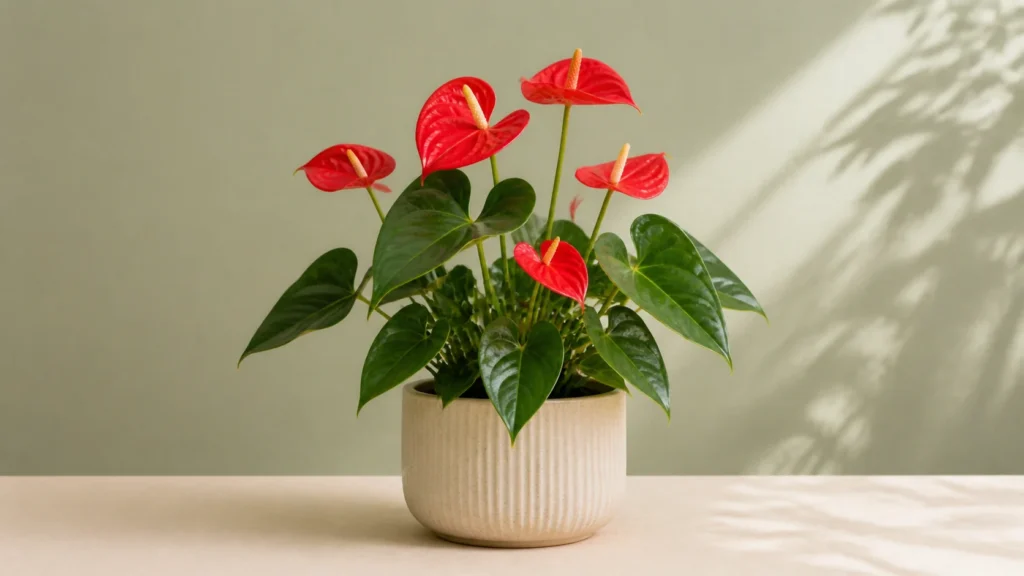
Red Anthurium
Anthurium andraeanum
A glossy tropical with waxy heart-shaped "flowers" that bloom for weeks at a time — elegant and long-blooming, but toxic to pets and children.
Watering frequency
Every 7-10 days
Ideal temperature
65-80°F / 18-27°C
Humidity
60-80%
Care difficulty
Medium
Air purifying
Yes
Growth rate
Slow
Plant size
1-1.5 ft / 0.3-0.5 m
Soil type
Well-draining, airy potting mix
Fertilizer need
Weekly or biweekly while growing.
Care summary
- Light: Bright indirect light; no direct sun.
- Water: Water when the top inch of soil dries.
- Soil: Airy, well-draining mix; it grows as an epiphyte.
- Humidity: 60-80% humidity keeps it happy.
- Blooms: Long-lasting spathes; blooms repeatedly with good light.
- Safety: Not pet-safe — calcium oxalate crystals.
Common problems
- Yellow leaves: overwatering, poor drainage, or nutrient deficiency.
- No flowers: not enough light or feeding.
- Brown spots on leaves: poor air circulation or wet foliage.
- Root rot: soil staying soggy.
- Pests: aphids, spider mites, mealybugs, and scale.
Plant care guide
About Red Anthurium
The red anthurium (Anthurium andraeanum) is the plant florists and homeowners alike reach for when they want a flower that never seems to quit. Its glossy, waxy, heart-shaped spathe — the red "petal" — surrounds a yellow-tipped spadix, and together the pair reads as one long-lasting bloom. Native to the tropical rainforests of Colombia and Ecuador, it belongs to the arum family (Araceae), and its common names are as colorful as the plant: flamingo flower, flamingo lily, tail flower, painter's palette, and laceleaf. The NC State Extension profile for Anthurium andraeanum notes that in the wild it grows as an epiphyte — rooted on tree branches in warm, humid, shaded rainforests — and that indoors it stays a compact 1-1.5 feet tall.
The name needs one clarification if you shop online: "anthurium" is both a huge genus and, in retail, shorthand for this species, Anthurium andraeanum, the classic red-flowered flamingo flower. It is a different plant from the darker, velvety-leaved Anthurium Clarinervium, which is grown for its leaves rather than its flowers. Where clarinervium is a foliage collector's plant, andraeanum is the anthurium that blooms — reliably, repeatedly, and for weeks at a time.
What makes it such a fixture in homes and offices is the combination of the flower's longevity and the plant's rhythm: each spathe lasts about four weeks, and a healthy plant produces new blooms multiple times a year. Few houseplants offer that much color for that many months, which is why the flamingo flower has been a staple of the houseplant trade for generations.
Why You'll Like It
The red anthurium gives you something most houseplants cannot: real, waxy, unmistakable flowers for weeks at a time, several times a year. The spathe holds its color and gloss long after cut flowers would have wilted, and because the plant reblooms on its own with reasonable care, you do not need to force or schedule anything — the color just keeps coming. Cut stems even last well in vases, which is why NC State notes the flowers are popular with florists.
It is also an elegant foliage plant between blooms. The leaves are large, glossy, heart-shaped, and dark green — up to 12 inches long per NC State — and the plant has a clean, architectural habit that suits desks, side tables, and entryways. It looks expensive, and it reads as tropical without taking over a room.
NC State mentions the plant's air-purifying reputation, but the limits of that claim matter. Chamber studies of VOC removal do not translate to meaningful room-scale cleaning by a few plants in an ordinary ventilated home. The air-purifying houseplants discussion explains that distinction. Enjoy the anthurium for its flowers and foliage, not as a replacement for ventilation or an air purifier.
What Kind of Plant Is It?
Three facts explain how the red anthurium behaves.
- It is an epiphyte at heart. In the rainforest it grows on tree branches, its roots exposed to air and rain rather than buried in soil. This explains its two quirks indoors: it wants an airy, chunky potting mix rather than dense soil, and it is sensitive to being overwatered — roots adapted to open air rot quickly in soggy soil. The NC State profile describes this epiphytic habit directly.
- What you think of as the flower is actually a spathe. The red "petal" is a modified leaf called a spathe, and the true flowers are the tiny bumps on the yellow spike (spadix) at its center. The spathe is waxy and long-lasting — NC State says blooms last up to four weeks — which is why the plant always looks freshly flowered.
- It is toxic, in the classic aroid way. Like all aroids, it contains calcium oxalate crystals. NC State grades the poison severity as low but explicitly lists the plant as toxic if ingested by pets or humans, causing oral pain, drooling, swelling, and difficulty swallowing, with the sap irritating skin and eyes. This is not a plant for reachable nibbling.
Where It Works Best
The red anthurium wants bright, indirect light — the same bright-but-filtered spot tropicals prefer. NC State recommends bright indirect sunlight and warns that direct sun scorches the leaves. A few feet back from a south or west window, or right beside an east window, is ideal. Light is also the driver of flowering: too little light and the plant grows but stops blooming, so the brightest filtered spot you have is the one that keeps the color coming. The light guide explains why flowering plants like this one are more demanding about light than foliage-only tropicals.
It is a natural desk and side-table plant — compact, elegant, and self-contained — and it does well in a bright bathroom, where the humidity it loves comes free. NC State specifies temperatures of 65-80°F (18-27°C) and humidity of 60-80%, and warns against cold drafts and sudden temperature changes. Keep it away from exterior doors, radiators, and AC vents.
One placement warning: because the plant is toxic to pets and children, choose its spot with reach in mind — a high shelf, a desk away from curious pets, or a room where toddlers do not roam. A glossy red "flower" is exactly the thing a child or kitten will grab.
How to Care for Anthurium Red
Light: Bright, indirect light only. Direct sun scorches the leaves; dim light stops the blooms. This is the one factor that controls whether you get flowers.
Watering: Water when the top inch of soil feels dry — typically every 7-10 days in a normal room — then water thoroughly and let the excess drain. NC State gives exactly this cue: water when the top inch of soil is dry. The plant hates soggy soil (root rot) and is also unhappy bone dry; the watering guide explains the even-moisture rhythm it wants.
Soil: Use an airy, well-draining mix — aroid or orchid-style mix with bark, perlite, and coir suits its epiphytic roots far better than dense potting soil. Drainage holes are essential.
Humidity: 60-80% is the target per NC State. A bright bathroom, a humidifier, or a pebble tray all work; the humidity guide covers the options. In dry air the leaf edges brown and the plant sulks.
Temperature: 65-80°F (18-27°C), steady. Cold drafts and sudden temperature changes cause leaf damage and bud drop.
Fertilizer: NC State recommends liquid fertilizer weekly during the growing season — a light, half-strength feeding works well in practice. Reduce feeding in fall and winter. Feeding drives flowering, so a plant that stops blooming often needs both more light and more food; the fertilizing guide has the general timing.
Flower care: Wipe the spathes gently if they gather dust, and remove spent blooms at the base to keep the plant tidy. With good light and steady feeding, new blooms follow through the year.
How to Propagate
Division is the most reliable method for the red anthurium — NC State lists division and stem cuttings as the propagation options, and for the typical potted plant, division is the practical one.
To divide: in spring, unpot the plant and gently separate the root ball into sections, each with several stems, leaves, and a healthy root system. Pot each division in fresh, airy, well-draining mix, water lightly, and keep it in bright indirect light with high humidity while it settles. The divisions may pause for a few weeks before pushing new growth — that is normal. A large, mature anthurium can be divided every few years, giving you several blooming plants from one.
When to Repot
Repot every two to three years, or when roots fill the pot — NC State recommends repotting every 2-3 years or when the plant appears root-bound, in spring. Move up one pot size at a time and use fresh airy mix. Because the roots are epiphytic and resent being waterlogged, choose a pot with good drainage and do not overpot — a too-large pot holds water the roots cannot use. After repotting, water lightly for a week or two while the roots settle, then resume the normal rhythm. The repotting guide walks through the standard technique.
Toxicity and Pet Safety
The red anthurium is not pet-safe. The NC State profile grades the poison severity as low but states plainly that the plant is toxic if ingested by pets or humans, and the ASPCA's database lists the Anthurium genus (sold as flamingo flower and tail flower) as toxic to cats and dogs. The toxic principle is calcium oxalate crystals: chewing or biting the plant releases them, causing drooling, oral pain, swelling of the mouth, lips, and tongue, difficulty swallowing, decreased appetite, and vomiting. The sap also irritates skin and eyes on contact.
Because the "flower" is the most attractive part of the plant to a curious pet or child, this is one toxic plant where placement really matters — high shelves, pet-free rooms, or out of reach entirely. If ingestion happens, do not wait for symptoms: contact a veterinarian or poison control immediately. The pet-safe houseplants guide lists genuinely safe flowering alternatives for homes with animals.
Common Problems and Practical Fixes
- Yellow leaves: NC State lists three overlapping causes — overwatering, poor drainage, or lack of nutrients. Check the soil moisture first; if the plant is sitting in soggy soil, improve drainage, and if the soil is fine, review feeding.
- No flowers: Almost always light or feeding. The plant needs bright indirect light and regular feeding to bloom; move it brighter and feed during the growing season.
- Brown spots on the leaves: Poor air circulation or wet foliage, per NC State. Improve airflow and water the soil, not the leaves.
- Crispy brown leaf edges: Low humidity. Raise the humidity around the plant.
- Root rot: Soggy soil from overwatering or a dense mix. Yellowing lower leaves and a musty pot are the signs; repot in fresh airy mix with better drainage.
- Pests: NC State lists aphids, spider mites, mealybugs, and scale. Treat with insecticidal soap, repeating weekly; the pest guide covers the routine.
Frequently Asked Questions
Why is my anthurium not flowering? Almost always too little light or not enough feeding. Move it to the brightest spot you have without direct sun and feed regularly during the growing season — blooms usually follow within a few weeks.
Is anthurium toxic to cats and dogs? Yes. It contains calcium oxalate crystals that cause oral pain, drooling, swelling, and vomiting if chewed or eaten. The ASPCA lists the genus as toxic to cats and dogs, and NC State grades it toxic to pets and humans. Keep it out of reach and call a vet if ingestion happens.
How often should I water an anthurium? When the top inch of soil dries — typically every 7-10 days in a normal room. It wants even moisture, never soggy soil and never bone dry.
Why are the leaves turning yellow? Usually overwatering, poor drainage, or lack of nutrients. Check the soil first: if it stays wet, the roots are the problem; if it dries normally, review feeding.
How long do anthurium flowers last? Each spathe lasts about four weeks, and a healthy plant blooms multiple times a year — with good light and feeding, the color returns in waves rather than once a season.
Can I grow an anthurium in a bathroom? A bright bathroom is actually ideal — the humidity it provides (60-80%) is exactly what the plant wants, as long as the light is bright and indirect.
What's the difference between this and Anthurium Clarinervium? Clarinervium is grown for its dark, velvety, silver-veined leaves and rarely flowers indoors; this species (andraeanum) is the classic red-flowering flamingo flower. Both are toxic aroids with similar care.
Final Thought
The red anthurium is the houseplant that delivers flowers the way foliage plants deliver leaves — continuously, with minimal ceremony. Give it bright indirect light, water when the top inch dries, feed it through the growing season, and it repays you with glossy heart-shaped blooms for weeks at a time, several times a year. Its two cautions are real but manageable: it wants humidity, and it is genuinely toxic to pets and children, so place it with reach in mind. Meet those conditions, and this is one of the most rewarding blooming houseplants you can own.