
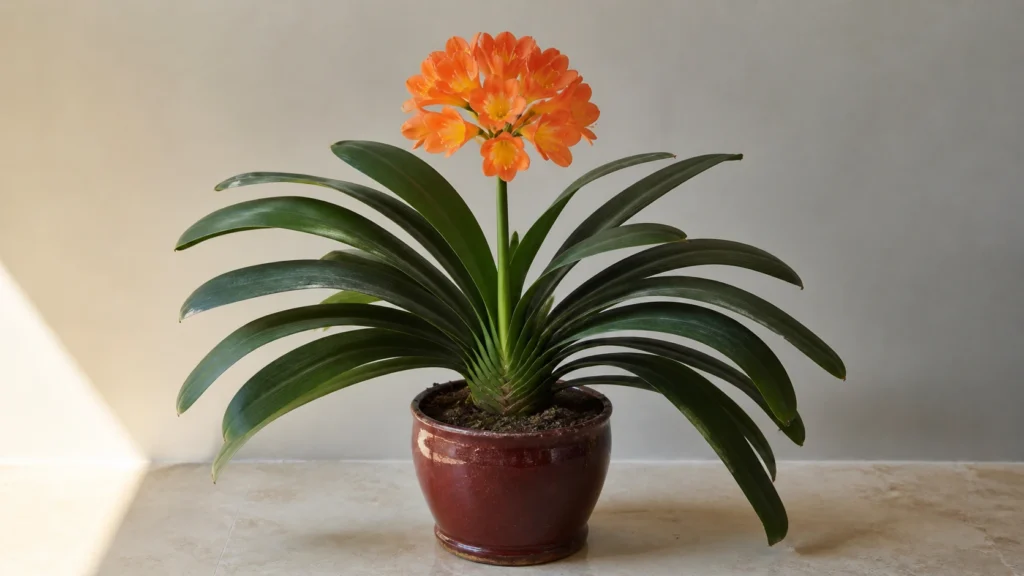
Clivia
Clivia miniata
A shade-loving South African plant with strap-shaped leaves and a winter crown of orange trumpet flowers, prized for blooming indoors when little else does.
Watering frequency
Every 10-14 days
Ideal temperature
65-75°F / 18-24°C, cooler in winter
Humidity
40-60%
Care difficulty
Medium
Air purifying
No/Not Known
Growth rate
Slow
Plant size
1-2 ft / 0.3-0.6 m
Soil type
Well-draining, slightly acidic mix
Fertilizer need
Monthly, spring-summer.
Care summary
- Light: Give bright, indirect light; morning sun only.
- Water: Water when the top inch of mix dries; reduce in winter.
- Rest: Provide a cool, dry 6-8 week rest in winter to trigger blooms.
- Pot: Keep root-bound; repot rarely.
- Safety: Toxic to cats and dogs; the fleshy roots and basal tissues contain concentrated alkaloids.
Common problems
- No flowers: Plant missed its cool winter rest.
- Brown leaf tips: Overwatering or salt buildup.
- Rotting base: Soggy soil or crown moisture.
- Pale leaves: Too much direct sun.
- Yellow leaves: Overwatering or cold damage.
Plant care guide
About
The Clivia is a clump-forming, evergreen perennial from the forests of South Africa, grown for its arching, strap-shaped leaves and its dramatic winter crown of trumpet-shaped flowers in orange, red, yellow, or cream. What makes it remarkable indoors is the timing: it blooms in the darkest months of the year, when most flowering houseplants are resting, and it does so in surprisingly low light. It is a plant that rewards patience, blooming only when mature and often skipping a year after a disruption, but the wait is repaid with one of the most spectacular flower shows a windowsill can host.
The most common species, Clivia miniata, is the plant most people mean when they say Clivia. It is not a lily, despite its common name "Kaffir lily," and it is not an amaryllis, though its flowers resemble one. It belongs to the amaryllis family, but unlike amaryllis bulbs, it grows from a thick mat of fleshy roots with no true bulb.
Why You'll Like It
The Clivia earns its place in a home through a combination few flowering houseplants can match: it is shade-tolerant, long-lived, and reliable once established, and it blooms in winter. A well-grown Clivia can live for decades, forms a handsome evergreen clump that needs almost no attention between flowerings, and produces a bouquet of trumpet flowers that lasts for weeks on the plant. Plants passed down through families are common, and mature specimens are genuinely treasured.
It is also a plant with real personality. It likes to be root-bound, resents being disturbed, and flowers best when left alone, which makes it a natural choice for people who want a beautiful plant without a demanding care schedule. The flowers, held in tight clusters above the foliage, come in warm oranges and reds that brighten a winter room.
What Kind of Plant Is It
The Clivia is a genus of evergreen perennials in the amaryllis family (Amaryllidaceae), native to forest and woodland habitats in South Africa. The most widely grown species, Clivia miniata, is documented by the North Carolina State Extension, which describes its clumping habit, strap-shaped leaves, and winter to spring flowering. Unlike true bulbs, Clivia plants grow from a fleshy rhizome-like root system, and the leaves emerge directly from the base, fanning outward in an elegant arch.
The genus is distinctive for its willingness to bloom in shade. In its native habitat the plant grows on the forest floor under a tree canopy, so it receives dappled light rather than full sun, and it has adapted to make the most of it. That shade tolerance is what makes it such a successful houseplant: it thrives in the bright, indirect light of an interior room where sun-loving flowering plants would struggle.
History
The Clivia genus was established in 1854 by the British botanist John Lindley, who named it in honor of Lady Charlotte Clive, the Duchess of Northumberland, a prominent patron of horticulture in nineteenth-century Britain. The name is a botanical thank-you to a woman whose gardens at Syon House and Alnwick Castle helped popularize new plants from around the world. The most famous species, Clivia miniata, was described by the Belgian nurseryman Ambroise Verschaffelt in the 1850s, after plants were introduced into European cultivation from South Africa, where the species is native from the Eastern Cape to KwaZulu-Natal.
For over a century the plant was a conservatory favorite in Britain and Europe, admired for its winter flowers and its tolerance of cool, dim conditions. It entered the mainstream houseplant trade in the twentieth century, and in a twist of history, it became a cultural phenomenon far from its native range. In China, where the plant is known as junzi lan, or "gentleman's orchid," the Clivia became a status symbol and, briefly, a speculative mania. In the 1980s, in the northeastern city of Changchun, prices for choice plants reached extraordinary heights, and the plant was treated almost like an investment asset before the bubble burst. The cultural reverence for the plant, which is still considered a plant of good fortune and refinement, has no equivalent in the West.
The plant's collectibility was reinforced in the late twentieth century by the discovery of rare color forms. The yellow Clivia, a mutation of the orange species, became a holy grail for collectors: in 1994 a single yellow plant, the cultivar 'Sir John Thouron,' was sold for nine hundred and fifty dollars per plant, with just thirty-six plants changing hands. Today, yellow and peach forms are more widely available, but they still command a premium, and the search for new color breaks continues among dedicated growers.
Related Varieties
The genus contains a handful of species and many cultivated hybrids, and the trade now offers a broad palette.
- Clivia miniata is the classic: orange flowers with a yellow throat, the plant most people picture.
- Clivia miniata var. citrina is the yellow-flowered form, once a rarity and now more available.
- Clivia nobilis is a less common species with smaller, tubular, drooping flowers in orange and green.
- Hybrids bred in South Africa and elsewhere now come in peach, apricot, cream, and near-white, often with larger flowers and more petals.
Among flowering houseplants, the Clivia is most often compared with other winter- and early-spring bloomers such as the Christmas cactus, the phalaenopsis orchid, and the African violet, though its shade tolerance and its patience make it a different kind of project entirely.
Where It Works
The Clivia is one of the few flowering plants that genuinely works in a dimmer room. It wants bright, indirect light, but it will accept a north-facing window or a spot several feet back from a brighter one, and it will still bloom, though perhaps a little less freely. Keep it out of direct sun, which bleaches the leaves and scorches the tips. A cool hallway, living room, or conservatory suits it well, and it does not need high humidity, which makes it a good choice for dry apartments.
It is a natural fit for spaces where other flowering plants fail: a bright hallway, a landing, an entryway, or a room that gets good morning light but no harsh sun. In summer the plant can move outdoors to a shaded patio, which often helps it build strength for the following winter's flowers.
How to Care for a Clivia
Light. Bright, indirect light most of the year. The plant grows in shade in the wild, so it tolerates lower light than most flowering houseplants, but brighter light, without direct sun, produces more flowers.
Water. Water when the top inch or two of mix has dried, and water thoroughly. The fleshy roots store water, so the plant tolerates the occasional missed watering, but it rots if left standing in wet soil. Cut water back sharply during the winter rest.
The winter rest. This is the secret to reliable flowering. From late autumn through winter, give the plant six to eight weeks of cooler temperatures, roughly 50 to 60°F (10 to 15°C), reduced watering, and no fertilizer. The cool, dry rest sets the flower buds. Without it, the plant may skip flowering or bloom poorly. In spring, as growth resumes, return to normal warmth, watering, and feeding.
Soil and potting. Use a well-draining, slightly acidic mix. The Clivia likes to be root-bound, so repot rarely, only every three to five years, and only when the roots are pushing the plant out of the pot. Step up only one pot size, in spring, and disturb the roots as little as possible.
Fertilizer. Feed monthly in spring and summer with a balanced liquid fertilizer at half strength. Stop feeding during the winter rest. A high-phosphorus feed in early spring can help flower development.
How to Propagate
The Clivia is propagated by division or by seed, and both are slow, which is part of why mature plants are treasured.
Division is the practical method for the home grower. When you repot a mature clump in spring, separate the offshoots, the small plantlets that form at the base of the parent, making sure each division has its own set of roots. Pot each division into a small pot with fresh mix and keep it warm and lightly watered until established. Divisions take one to three years to reach flowering size.
Seed is the method for breeders and the patient. The orange berries that follow the flowers each contain several seeds. Sow them fresh in moist mix; germination takes weeks, and seedlings take three to five years or more to flower, but seed-grown plants are how new color forms appear. If you are not interested in seed, remove the berries once they form, since fruiting drains energy from the plant.
When to Repot
Repot a Clivia only when it is genuinely pot-bound, generally every three to five years, in spring just as growth resumes. The plant flowers best when its roots are crowded, and repotting too often is the fastest way to lose a season of blooms. When you do repot, move up only one pot size, use fresh well-draining mix, and do not water heavily for the first week or two, since the fleshy roots are prone to rot when disturbed and watered at once.
Toxicity
The Clivia is toxic to cats and dogs. The plant contains lycorine and other alkaloids, which are present throughout the plant but most concentrated in the fleshy roots. The North Carolina State Extension records the toxicity explicitly, noting that ingestion can cause drooling, vomiting, and diarrhea, and that large doses can produce more serious effects including seizures and irregular heart rhythm. The ASPCA's toxic plant database does not currently carry a species-level entry for Clivia, so the NC State record is the most authoritative source available.
The practical risk profile is moderate. A pet that chews a leaf will likely vomit and salivate, which is unpleasant but rarely life-threatening; the roots are the dangerous part, and they are only accessible if the pet digs into the pot. Keep the plant out of reach, especially if you have a digger, and contact your veterinarian if your pet has eaten any part of it.
Common Problems
No flowers in winter. The classic disappointment, and almost always a missed winter rest. The plant needs six to eight weeks of cooler temperatures and reduced water to set buds. Move it to a cooler room in late autumn and cut back watering.
Brown leaf tips. Usually overwatering, salt buildup, or both. Let the soil dry further between waterings and flush the pot with plain water occasionally.
Mushy, rotting base. Soggy soil or water sitting in the crown. Improve drainage, water less, and avoid pouring water into the center of the plant.
Pale, bleached leaves. Too much direct sun. Move the plant to brighter indirect light without harsh sun.
Yellow leaves. Overwatering or cold damage. Check the roots for rot and move the plant away from cold drafts.
Red scale insects. Clivia is prone to a specific scale pest that looks like reddish bumps on the leaves. Wipe them off with rubbing alcohol and treat with horticultural oil if they persist.
FAQ
Why is my Clivia not blooming? The most common cause is a missed winter rest. The plant needs six to eight weeks of cooler temperatures and reduced watering in late autumn and winter to set flower buds. Maturity also matters; young plants need several years before they first flower.
How much light does a Clivia need? Bright, indirect light is ideal, but it tolerates lower light than most flowering plants. Keep it out of direct sun.
How often should I water a Clivia? When the top inch or two of soil is dry, roughly every ten days to two weeks, and much less during the winter rest. The fleshy roots store water, so dryness is safer than sogginess.
How long does a Clivia live? Decades. Established clumps are often passed down through generations and can be divided and shared. The plant's longevity is one of its greatest appeals.
When does Clivia bloom? Winter to early spring, which is what makes it so valued as a houseplant. The flowers last for weeks on the plant.
Final Thought
The Clivia is a plant for people who understand that the best things take time. It asks for little, tolerates the dim corners that defeat other flowering plants, and then, in the middle of winter, produces a crown of trumpet flowers that looks like it belongs in a conservatory. The patience it demands, years to maturity, a missed bloom if the rest is skipped, is repaid with a plant that can outlive you and keep blooming for decades. It is not the easiest flowering houseplant, but it is one of the most rewarding, and its quiet, old-fashioned elegance has earned it admirers on every continent, from British conservatories to the windowsills of northeastern China.