
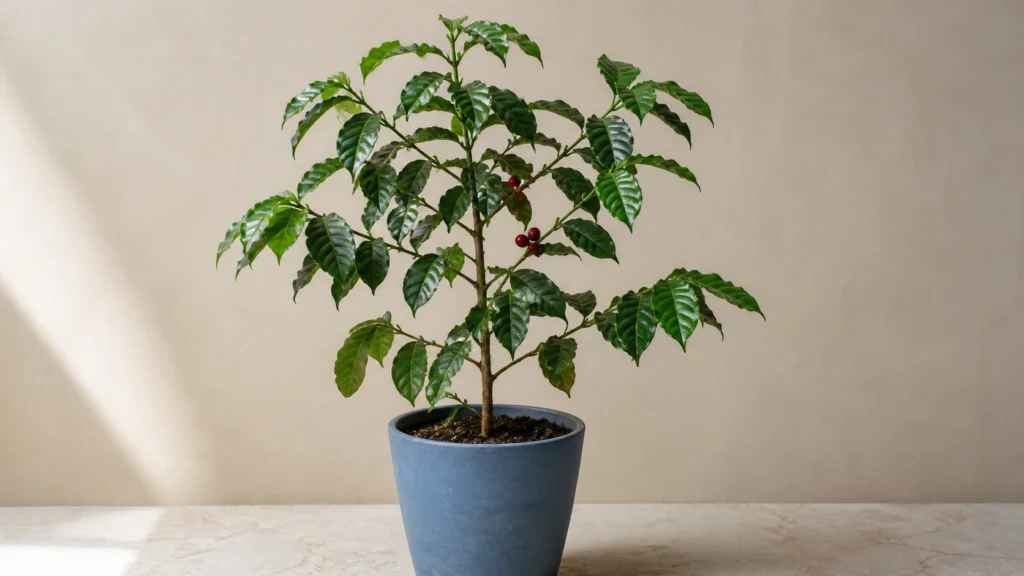
Coffee Plant
Coffea arabica
The glossy-leaved shrub that produces the world's most popular drink, grown indoors as an elegant houseplant that may reward patient owners with fragrant white flowers.
Watering frequency
Every 7-10 days
Ideal temperature
65-75°F / 18-24°C
Humidity
50-70%
Care difficulty
Medium
Air purifying
No/Not Known
Growth rate
Moderate
Plant size
3-6 ft indoors / 0.9-1.8 m
Soil type
Well-draining, slightly acidic mix
Fertilizer need
Monthly, spring-summer.
Care summary
- Light: Give bright, indirect light; a little morning sun is fine.
- Water: Water when the top inch of mix dries; keep it evenly moist.
- Humidity: High humidity keeps leaf edges clean.
- Prune: Pinch young plants to encourage branching.
- Safety: Coffee contains caffeine; toxic to pets if ingested.
Common problems
- Brown leaf edges: Low humidity or underwatering.
- Yellow leaves: Overwatering or nutrient deficiency.
- Drooping leaves: Underwatering.
- Pale leaves: Too much sun.
- Leaf drop: Cold drafts or sudden change.
Plant care guide
About
The Coffee Plant is the glossy-leaved shrub that produces the beans behind the world's most consumed beverage. As a houseplant, it is grown for its handsome, dark green, deeply veined leaves, its upright, architectural habit, and, with patience, its clusters of fragrant white flowers and red cherries. The species most often grown indoors is Coffea arabica, the same plant that produces most of the world's specialty coffee, and a mature indoor specimen is one of the most elegant statement plants available.
The plant is not demanding in the way people expect. It does not need a tropical greenhouse, it does not need to be coddled, and it will happily live as a foliage plant for years. The famous flowers and fruit are a bonus for the patient: indoor plants typically need three to five years and good light before they bloom, and a single plant can produce a modest handful of cherries, each holding two coffee beans.
Why You'll Like It
The Coffee Plant offers a rare combination of beauty and meaning. The glossy, rippled leaves look almost artificial in their perfection, and the plant's upright, layered habit gives it a quiet, expensive presence in a room. But the real appeal is the story: this is the plant behind the coffee you drink, and watching it flower and fruit at home turns a commodity into something personal.
It is also genuinely easy to care for. It tolerates normal room conditions, grows steadily without drama, and is forgiving of the occasional missed watering. It is a satisfying plant for beginners who want something more interesting than a pothos, and it is a delight for coffee lovers who want a conversation piece that actually produces something. If conditions are right, the white flowers are powerfully fragrant, and the red cherries that follow are a small, satisfying payoff.
What Kind of Plant Is It
The Coffee Plant is Coffea arabica, an evergreen shrub in the madder family (Rubiaceae), the same family as gardenia, documented by the North Carolina State Extension. It is native to the highlands of Ethiopia, where it evolved as an understory plant at elevations between four and six thousand feet, which explains its preferences indoors: bright, indirect light, cool-to-warm temperatures, and consistently moist, well-drained soil.
Botanically the plant is a curious hybrid. Coffea arabica is a tetraploid, meaning it carries four sets of chromosomes, and it arose naturally as a cross between two other coffee species, Coffea canephora, known in the trade as robusta, and Coffea eugenioides. That hybrid origin is why arabica, uniquely among coffee species, is self-fertile, able to pollinate itself without needing another plant. It is also why every arabica plant in the world is descended from a remarkably narrow genetic base.
The cherries are the point in cultivation, but indoors the plant is grown for its foliage. The leaves are elliptical, glossy, and deeply veined, and the plant produces them in pairs along a single upright stem. With pruning it branches into a small, shrubby tree; unpruned, it grows tall and slender.
History
The Coffee Plant has one of the most consequential botanical histories of any plant on earth, and it begins with a naming accident. When Carl Linnaeus formally described the species in his Species Plantarum in 1753, he gave it the epithet arabica, believing it was native to Arabia. It is not. The plant is native to the highlands of Ethiopia, and the name, which persists to this day, records Linnaeus's error rather than the plant's origin. Kew's Plants of the World Online lists the native range as Ethiopia and the surrounding highlands and documents the species' early synonym history, including the name Jasminum arabicum used before coffee was recognized as its own genus.
How the plant reached Arabia is the subject of the most famous legend in coffee history. The story of Kaldi, an Ethiopian goat herder, tells of goats that danced after eating red coffee cherries, leading the herder to share his discovery with a local monastery, where the monks used the fruit to stay awake through prayers. The legend is almost certainly folklore, but it captures the plant's defining effect: coffee contains caffeine, a stimulant that humans have been trading, brewing, and fighting over for centuries.
The historical record is more certain about the journey. From the Ethiopian highlands, coffee cultivation spread to the Arabian Peninsula, where it was being grown and traded by the fifteenth century, and from Yemen's port of Mocha it reached the wider world: Turkey, Europe, and eventually the colonial plantations of Asia and the Americas. By the nineteenth century, coffee had become a global commodity and the engine of vast colonial economies, and today it is the second most traded commodity in the world after oil, with an estimated two billion cups consumed daily. The glossy shrub on a windowsill is a direct descendant of that history.
Related Varieties
The coffee genus contains over a hundred species, but the trade focuses on a few, and houseplant buyers should know the difference.
- Coffea arabica is the standard houseplant and the source of most specialty coffee. It is self-fertile, elegant, and the best choice indoors.
- Coffea canephora, or robusta, is hardier and more disease-resistant but has harsher, more bitter beans. It is rarely grown as a houseplant.
- 'Nana' is a dwarf cultivar of arabica that stays small and branches densely, ideal for a windowsill.
Among indoor plants, the Coffee Plant is a member of the same family as the gardenia, and the two share glossy leaves, fragrant flowers, and a preference for slightly acidic soil. It is also often grouped with other fragrant, elegant indoor plants like the star jasmine.
Where It Works
The Coffee Plant wants bright, indirect light and moderate to high humidity, which makes a bright bathroom, a kitchen with a window, or a spot near an east window ideal. It can take a couple of hours of gentle morning sun, but harsh afternoon sun bleaches the leaves. In a dry living room it does fine with a little help, a humidifier, a pebble tray, or simply regular misting during the heating season.
It grows best as a single specimen in a well-lit spot where it has room to become a small tree. It suits living rooms, home offices, and conservatories, and it makes a particularly meaningful gift for anyone who loves coffee. In summer it can move to a sheltered, shaded spot outdoors, which often stimulates a growth flush.
How to Care for a Coffee Plant
Light. Bright, indirect light is the requirement. A few feet back from a south or west window, or right at an east or north window, works well. Too little light produces sparse, leggy growth and no flowers; too much sun bleaches and scorches the leaves.
Water. Keep the soil evenly moist but never soggy. Water when the top inch of mix has dried, and water thoroughly until it drains. The plant dislikes both extremes, and its leaves are an excellent early warning system: they droop dramatically when dry and yellow when waterlogged.
Soil. Use a well-draining, slightly acidic mix, such as houseplant soil amended with perlite and a little peat or coco coir. Coffee plants are acid-loving, like gardenias and camellias.
Humidity. The plant comes from cloud forests and appreciates humidity above 50 percent. In dry rooms, brown leaf edges are the first sign of trouble; raise humidity before the problem spreads.
Fertilizer. Feed monthly in spring and summer with a balanced liquid fertilizer at half strength. A fertilizer formulated for acid-loving plants works well. Stop feeding in winter.
Pruning and shaping. Pinch the tips of young plants to encourage branching and a fuller shape. In spring, you can prune harder to control size; the plant responds with fresh growth.
How to Propagate
The Coffee Plant propagates most easily from stem cuttings, and with patience from seed.
For cuttings, take a semi-ripe stem cutting with two or three leaf pairs in spring or early summer. Dip the cut end in rooting hormone if you have it, and plant it in moist, airy mix. Keep the cutting warm, bright, and humid, ideally under a clear bag or in a propagation box; roots form in four to eight weeks.
From seed, the process is slow but satisfying: fresh green coffee cherries contain the seeds, which you can sow in moist, acidic mix. Germination takes several weeks, and seedlings grow slowly at first. Seed-grown plants take several years to flower. If you simply want more plants, cuttings are the faster route, and they produce plants identical to the parent.
When to Repot
Repot a Coffee Plant every one to two years, in spring, when roots fill the pot. The plant grows steadily and will happily step up a size each year while young; older plants can be top-dressed with fresh soil instead of repotted. Use a slightly acidic, well-draining mix, and water in well. After repotting, keep the plant out of direct sun for a week while it recovers.
Toxicity
The Coffee Plant is toxic to cats and dogs, though the toxicity profile is a little different from most houseplants. The concern is caffeine, a methylxanthine alkaloid concentrated in the leaves and, most of all, in the seeds, the coffee beans. The ASPCA's guidance on people foods records the risk explicitly: chocolate, coffee, and caffeine are grouped together as methylxanthine sources, and ingestion in pets can cause vomiting, diarrhea, restlessness, rapid heart rate, tremors, and in severe cases seizures. Dogs are the most commonly affected species, both because they are likelier to eat plant material and because they scavenge dropped coffee beans and grounds.
The North Carolina State Extension profile of the species notes that the plant, of course, contains caffeine, and the practical risk indoors is moderate: a nibble of a leaf is unlikely to cause serious harm, while a pet that eats a quantity of leaves or beans can develop real symptoms. Keep the plant, and any fallen cherries or beans, out of reach, and contact your veterinarian if your pet has eaten any part of it.
Common Problems
Brown, crispy leaf edges. Low humidity or underwatering. Raise humidity and check that the plant is not drying out between waterings.
Yellow leaves. Overwatering, cold drafts, or a nutrient deficiency. Check the roots for rot, move the plant away from drafts, and resume regular feeding.
Drooping leaves. The plant is dry. It recovers quickly after a thorough watering; the dramatic droop is one of the plant's most useful signals.
Pale, washed-out leaves. Too much direct sun or a nutrient deficiency. Move the plant to brighter indirect light and feed regularly.
Sparse, leggy growth. Not enough light. Move the plant to a brighter spot and pinch the tips to encourage branching.
Pests. Coffee plants attract mealybugs, scale, and spider mites, especially in dry indoor air. Check the undersides of leaves regularly and treat early with insecticidal soap or neem oil.
FAQ
Can I grow coffee beans indoors? Yes, but slowly. Indoor plants need three to five years and good light before they flower, and each red cherry holds just two beans, so a single plant yields only a handful, enough for a single cup at best. It is a novelty, not a coffee supply.
How much light does a Coffee Plant need? Bright, indirect light. It tolerates a couple of hours of morning sun but burns in harsh afternoon sun.
How often should I water a Coffee Plant? When the top inch of soil is dry, roughly weekly in summer and every ten days to two weeks in winter. Keep the soil evenly moist, never soggy.
Why are the leaves on my Coffee Plant turning brown? Usually dry air or underwatering. Raise the humidity and check the watering; the plant is a fast and clear communicator.
Is the Coffee Plant the same as the plant that makes coffee? Yes. The houseplant is Coffea arabica, the same species that produces most of the world's coffee, though commercial plants are grown in tropical highland plantations rather than living rooms.
Final Thought
The Coffee Plant is the rare houseplant that carries its entire story in its leaves. Every glossy, veined leaf is a reminder that the drink on your desk comes from a plant very much like the one in your living room, an understory shrub from the Ethiopian highlands that conquered the world through caffeine and trade. As a houseplant it asks for simple things, bright light, even moisture, humid air, and patience, and it gives back an elegant, architectural presence, and, with time, the fragrance of coffee flowers and the small miracle of red cherries forming at home. It is a plant with history, and it will happily grow that history in front of you.