
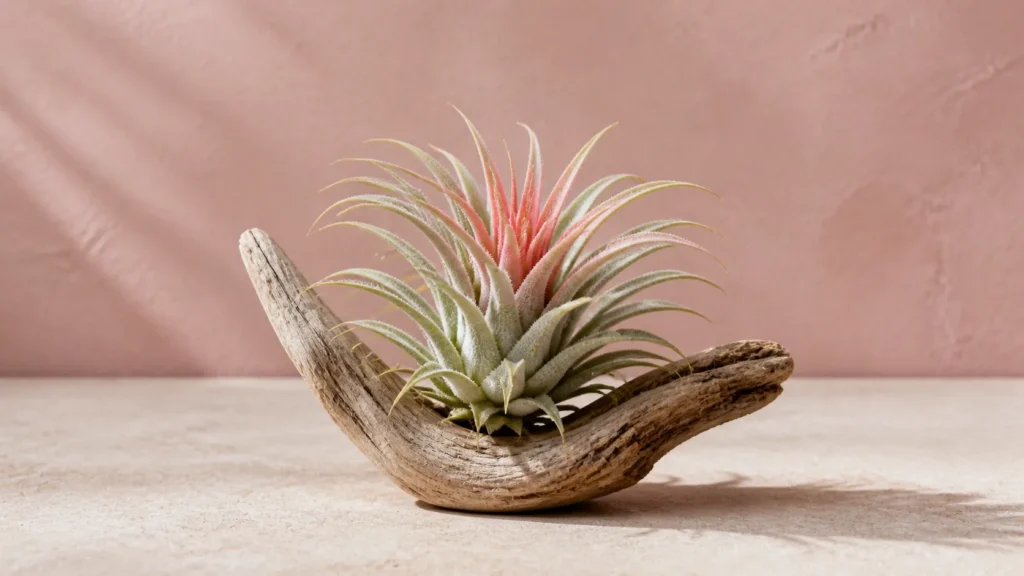
Ionantha Air Plant
Tillandsia ionantha
A small, popular air plant with silvery-green leaves that blush pink or red before blooming, needing no soil, regular soaking, bright indirect light, and good air circulation.
Watering frequency
Soak 2-3 times per week for 20-30 minutes, then dry upside down
Ideal temperature
50-90°F / 10-32°C
Humidity
40-60%
Care difficulty
Easy
Air purifying
No/Not Known
Growth rate
Slow
Plant size
2-6 in / 5-15 cm tall and wide
Soil type
No soil — epiphytic; display on wood, stone, shell, or in an open holder
Fertilizer need
Monthly at most while growing.
Care summary
- Light: Give bright indirect light; a little gentle morning sun is tolerated.
- Water: Soak in room-temperature water for 20-30 minutes 2-3 times per week, then dry upside down thoroughly.
- No soil: The plant absorbs water and nutrients through leaf trichomes, not roots.
- Airflow: Good air circulation is essential; never let the plant stay wet for more than a few hours.
- Temperature: Protect from frost and below 50°F (10°C); most household temperatures are fine.
- Safety: Bromeliads can cause mild gastrointestinal upset; no exact Tillandsia toxicity test was found, so keep out of reach of pets that chew.
Common problems
- Brown crispy leaf tips: Check underwatering, low humidity, or too much direct sun.
- Soft brown or gray base: Usually rot from staying wet too long or poor drying after watering.
- Leaves curling inward: A sign of dehydration; soak immediately and review watering frequency.
- No bloom: Confirm enough bright light, maturity, and a proper watering and drying cycle.
- Pests: Inspect leaf bases and crevices for mealybugs and scale, especially in humid conditions.
Plant care guide
About Ionantha Air Plant
Ionantha Air Plant (Tillandsia ionantha) is one of the most popular and widely cultivated air plants — small, rosette-forming epiphytes in the bromeliad family (Bromeliaceae) that require no soil and absorb water and nutrients through specialized leaf scales called trichomes. Native to Mexico, Guatemala, El Salvador, Honduras, Nicaragua, and Costa Rica, it grows on tree branches and rocks in dry to moderately humid forests, from lowlands to moderate elevations. Its small size (typically 2–6 inches), silvery-green foliage, and dramatic blushing pink/red before blooming make it a favorite for terrariums, driftwood displays, hanging glass orbs, and creative indoor arrangements.
Kew Plants of the World Online recognizes Tillandsia ionantha as a species in the Bromeliaceae family, distributed across Mexico and Central America. The genus Tillandsia contains over 650 species of epiphytic air plants, with T. ionantha being among the most adaptable and widely traded. As a houseplant, it offers the unique appeal of growing without soil, making it versatile for displays where a traditional pot would be impractical.
Why You'll Like It
Ionantha Air Plant is one of the most accessible and rewarding air plants for beginners. Its small size makes it versatile for display in terrariums, on driftwood, in hanging glass orbs, on magnets, on seashells, or simply sitting in an open dish. It requires no pot, no soil, and minimal space, making it ideal for apartments, offices, and small living areas.
What Kind of Plant Is It?
Tillandsia ionantha is an epiphytic bromeliad — a plant that grows on other plants (typically tree branches) for support, without drawing nutrients from its host. It is not a parasite. Leaves are the plant's primary organs for both photosynthesis and water/nutrient absorption.
History and Naming
The genus Tillandsia was established by Carl Linnaeus in 1753, named in honor of Elias Tillandz (1640–1693), a Finnish-Swedish physician and botanist. The story goes that Linnaeus named the genus after Tillandz because Tillandz had once traveled by boat from Turku to Stockholm and, being severely seasick, reportedly never traveled by water again — an ironic tribute for a genus of plants that depend on water from the air. Tillandsia ionantha was first described in 1880 by French botanist Émile Rodigas, based on material from Guatemala.
Ionantha Air Plant and Related Plants
- Pink Quill: Pink Quill (Wallisia cyanea, formerly Tillandsia cyanea) is another bromeliad commonly grown as a houseplant, with a large, flat, pink paddle-shaped inflorescence and violet flowers. It is in the same family but a different genus, grows larger, and has different care requirements (it is typically potted in an orchid mix rather than grown as a soilless air plant).
- Xerographica Air Plant (Tillandsia xerographica): A larger, more dramatic air plant with broad, silvery-gray leaves that form a large rosette up to 12 inches across. It is more drought-tolerant than *T.
- Spanish Moss (Tillandsia usneoides): A distinctive, trailing air plant with long, threadlike stems that hang in curtains from tree branches. It is in the same genus but has a very different growth form and is typically grown hanging rather than in a rosette.
Other popular Tillandsia species for indoor growing include T. aeranthos (blue-flowered, easy), T. capitata (larger rosette, colorful blush), T. stricta (slender leaves, bright pink blush), and T. bulbosa (bulbous base, twisting leaves). All share the same basic care: bright indirect light, regular soaking, good airflow, and no soil.
Where Ionantha Air Plant Works Best
Choose a position with bright, indirect light and good air circulation. An east, west, or south-facing window with a sheer curtain or a position a few feet back from an unobstructed window is ideal. A bathroom with a window is often excellent, as the humidity from showers benefits the plant, as long as there is enough light.
Ionantha Air Plant Care
Light
Provide bright indirect light. Tillandsia ionantha needs more light than many people assume — it is not a low-light plant.
Watering
Water by soaking the entire plant in room-temperature water for 20–30 minutes, 2–3 times per week. After soaking, shake off excess water and place the plant upside down on a towel to drain thoroughly — this is critical to prevent water from getting trapped in the center of the rosette, which causes rot.
Humidity
Tillandsia ionantha prefers moderate humidity (40–60%), which is typical of most indoor environments. It is more tolerant of average household humidity than many tropical houseplants, thanks to its succulent leaves and trichomes that reduce water loss.
Temperature
Tillandsia ionantha is adaptable to a wide range of temperatures, thriving in typical household conditions of 60–80°F (15–27°C). It can tolerate brief periods down to 50°F (10°C) and up to 90°F (32°C), but prolonged exposure to temperatures outside this range stresses the plant.
Fertilizer
Fertilize lightly, if at all, from spring through early fall while new leaves are developing; pause in the lower-light winter months. Tillandsia ionantha gets most of its nutrients from atmospheric dust and debris absorbed through its trichomes, and it can thrive without any supplemental fertilizer.
Air Circulation
Good air circulation is essential for Tillandsia ionantha health. After each watering, the plant must dry completely within a few hours — if it stays wet for too long, especially in the center of the rosette, rot sets in quickly.
Pruning and Grooming
Tillandsia ionantha requires minimal pruning. Remove dried or brown leaf tips by trimming with sterile scissors — you can cut at an angle to make the trimmed tip look more natural.
Propagating Ionantha Air Plant
The most common and reliable home propagation method is removing and growing on offsets (pups). After a mature plant blooms, it will produce pups at its base. A mother plant may produce 1–4 pups over several months to a year.
Repotting / Remounting Ionantha Air Plant
Since Tillandsia ionantha needs no soil, "repotting" usually means remounting or moving the plant to a new display. You may want to remount if the current mount is deteriorating (e.g., driftwood is rotting, glue is failing), the plant has outgrown its display or you want a new arrangement, the plant is in a display that traps moisture and causes rot, or you want to separate pups from the mother plant and display them individually. To remount: gently remove the plant from its current mount (if it is glued or tied, carefully cut the ties or gently pry the glue free, taking care not to damage the leaves); trim any long or unsightly roots if desired; choose a new mount or display (driftwood, cork, shell, stone, glass orb, dish, etc.); attach the plant with fishing line, cotton string, plant-safe wire (avoid copper), or a small amount of non-toxic glue on the root base — do not cover the center of the rosette or the base of the leaves with glue or material that could trap moisture; water the plant as usual after remounting.
Toxicity and Pet Safety
Tillandsia ionantha is classified as Not pet safe under the project's conservative evidence standard. The ASPCA does not have a specific Tillandsia ionantha entry, and there is limited published toxicology data for air plants specifically. Bromeliads as a family (Bromeliaceae) can cause mild gastrointestinal upset — including vomiting, diarrhea, or mouth irritation — if ingested, although they are not known to contain highly toxic compounds.
Common Problems and Practical Fixes
Brown crispy leaf tips are usually a sign of underwatering or low humidity. If the tips are brown and crispy and the leaves feel slightly curled or dry, the plant needs more frequent or longer soaking. Soft brown or gray base is a sign of rot, usually from staying wet too long after watering or poor air circulation. If the base feels soft, mushy, or smells foul, act immediately: remove the plant from its display, gently shake off excess water, and place it upside down in a well-ventilated area to dry completely. Leaves curling inward is a sign of dehydration. The leaves curl to reduce surface area and conserve water. No bloom can be due to insufficient light, immaturity, or improper watering. Tillandsia ionantha needs bright indirect light to trigger blooming — if the plant is in a dim position, move it brighter.
Frequently Asked Questions
How often should I water my Ionantha Air Plant?
Soak the entire plant in room-temperature water for 20–30 minutes, 2–3 times per week, then dry it upside down thoroughly. Adjust based on conditions: more often in hot, dry, bright weather; less often in cool, humid, dim weather.
Do Ionantha Air Plants need soil?
No. Tillandsia ionantha is an epiphyte that absorbs water and nutrients through leaf trichomes, not roots.
How long do Ionantha Air Plants live?
An individual Tillandsia ionantha plant lives 2–5 years, blooming once at maturity and then slowly declining while producing pups. However, because pups grow on to become new plants, a clump can live indefinitely — each generation produces the next.
Final Thought
Ionantha Air Plant is a delightful, low-fuss introduction to air plants that rewards consistent care with striking blushing and violet blooms. Its key needs are simple: bright indirect light, regular thorough soaking followed by complete upside-down drying, good air circulation, and no soil. Read the leaves for water cues — curling means thirsty, a soft base means too wet — and give it enough light to trigger blooming. With proper care, a single plant becomes a self-perpetuating clump, producing pups and blooms year after year, making it one of the most charming epiphytes for indoor growing.