
Pink Quill
Wallisia cyanea
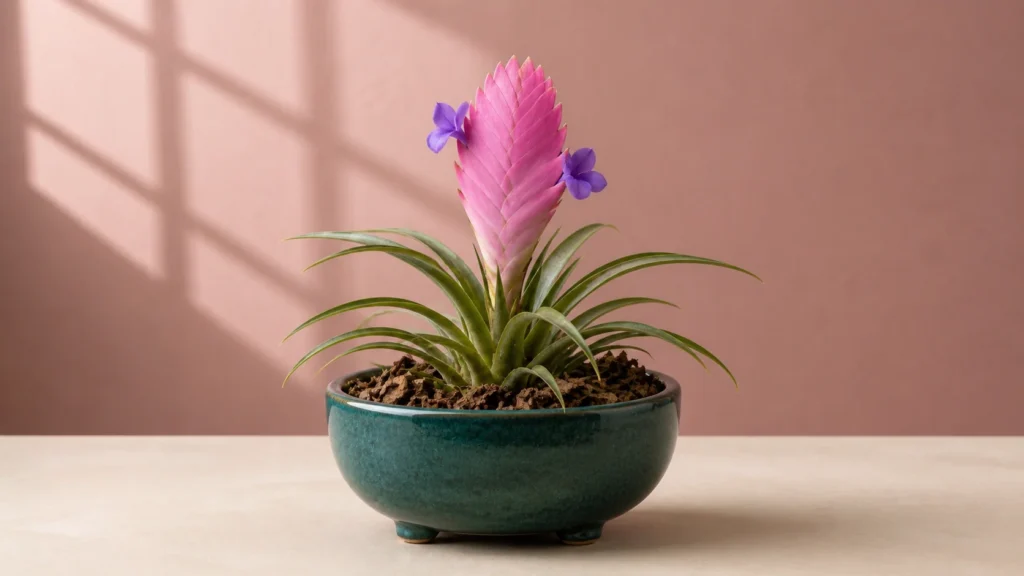
A tropical epiphytic bromeliad with narrow green leaves, a hot-pink paddle-shaped bract, and violet flowers.
Watering frequency
Soak 20-30 min every 10-14 days; mist between soaks
Ideal temperature
60-80°F / 16-27°C
Humidity
40-60%
Care difficulty
Easy
Air purifying
No/Not Known
Growth rate
Slow
Plant size
8-12 in / 20-30 cm
Soil type
No soil needed — epiphytic; pot in orchid bark or mount on wood
Fertilizer need
Monthly while growing.
Care summary
- Light: Bright indirect light; some morning sun is fine, harsh midday sun is not.
- Water: Soak 20-30 minutes, then drain upside down so the crown stays dry.
- Soil: None required — mount it or pot it in coarse orchid bark.
- Bloom: The pink bract lasts for weeks; the plant then produces pups.
- Humidity: Average household air is fine, with extra help between soaks.
- Safety: Species-specific pet-safety evidence is limited; keep out of reach.
Common problems
- Brown or crispy leaf tips: Usually underwatering or hard water residue on the trichomes.
- Dark, mushy leaf bases: Water left trapped in the crown instead of being drained.
- Pale, stretched growth: Light is too dim.
- Bleached or scorched patches: Direct sun is too harsh.
- Loss of the pink bract: Normal aging after blooming, not a disease.
- Mealybugs or scale: Check the leaf axils and the base of the bract.
Plant care guide
About Pink Quill
Pink Quill (Wallisia cyanea, widely sold under the older name Tillandsia cyanea) is a bromeliad from the tropical forests of Ecuador and northwestern Peru. The accepted record from Kew Plants of the World Online identifies Wallisia cyanea as the accepted name and Tillandsia cyanea as a synonym. It grows as an epiphyte on trees rather than rooting in ordinary ground soil.
Older references place the species in Tillandsia, a large group within the pineapple family (Bromeliaceae). The NC State Extension profile describes Tillandsia as evergreen, often epiphytic perennials whose leaves bear shield-shaped scales. Pink Quill shares that water-absorbing leaf adaptation, even though the accepted name now places it in Wallisia.
What separates this plant from many other bromeliads is its flower display. From the center of the rosette rises a flattened, paddle-shaped bract in hot pink, often described as a quill. Small violet-blue flowers open from it in sequence. The combination of a green leaf rosette, pink bract, and violet flowers is the main reason the species is grown.
Why You'll Like It
Many air plants are appreciated mainly for foliage and unusual form. Pink Quill adds a strong flowering display: the hot-pink bract remains decorative after individual violet flowers fade. It also does not need a heavy, moisture-retentive potting mix.
It is also more forgiving than the silvery xeric air plants that dominate stores. Because Tillandsia cyanea comes from humid forest habitat rather than desert, it tolerates ordinary indoor air and recovers more readily from the occasional missed soak. Cornell Cooperative Extension notes that mesic air plants from humid regions have greener, softer leaves and are often the easier category for a first air-plant owner.
If you already keep low-maintenance plants such as ZZ Plant or Spider Plant, the Pink Quill fits the same "set it up, check on it weekly" rhythm, with the added payoff of a genuinely showy bloom indoors.
What Kind of Plant Is It?
Pink Quill is an epiphytic, rosette-forming bromeliad. In nature it grows attached to tree trunks and branches, using small roots mainly for anchorage. Its leaves also absorb moisture and dissolved nutrients through specialized surface scales called trichomes.
Three traits matter most for home care:
- Trichomes do the feeding. The gray-white fuzz you can see on the leaves is the plant's root system in disguise. It pulls moisture and minerals from rain, fog, and the air. This is why the plant needs neither soil nor a normal watering schedule.
- The retail name may lag behind the taxonomy. Plant labels and care guides still commonly use Tillandsia cyanea, while Kew accepts Wallisia cyanea. Both names refer to the species covered here.
- It is monocarpic, but it reproduces before it fades. After blooming, the mother plant slowly declines over a year or more. Before that happens, it sends up small offshoots, called pups, from its base. The RHS air plant guide explains this life cycle and recommends separating pups only once they are a reasonable size.
The pink bract itself is not the flower. The flower is the violet bloom that emerges from between the pink scales. After the flowers finish, the bract dries and can be trimmed away; the plant continues growing from the rosette.
Related Air Plants
If you enjoy this plant, the same care rhythm applies across the genus, but appearance and watering differ noticeably:
- Tillandsia ionantha — a small, silver-green rosette that blushes red before flowering. More forgiving of irregular watering than the Pink Quill.
- Tillandsia xerographica — a large, silvery, sculptural species with wide curling leaves. It is a xeric type that wants less frequent soaking and stronger light.
- Tillandsia caput-medusae — named for the Medusa-like twisted, snake-shaped leaves. Gray-green and drought-tolerant.
- Tillandsia usneoides (Spanish moss) — a thin, wiry, trailing form often draped rather than mounted. It is the most different in both look and watering.
These plants share the soak-and-dry method described below, but a silvery, stiff-leaved species tolerates a missed soak far better than a green, soft-leaved one. Match watering to the leaf type, not to the name "air plant."
Where It Works Best
Give the plant bright, filtered light for most of the day. An east-facing windowsill is often useful; near a south or west window, use distance or a sheer curtain if the leaves bleach or scorch. The RHS profile for Pink Quill recommends partial shade and bright, diffused light under glass, so do not assume every hot window is safe.
It suits a bright bathroom, where steam adds humidity, but remember that humidity does not replace light. A windowless bathroom or a dark office shelf will cause slow decline no matter how faithfully you soak it. A grow light is a dependable option for rooms without a good window.
Because the plant needs no soil, it is one of the most flexible display plants you can own. It looks natural mounted on cork bark or driftwood, tucked into a glass vase, or seated in a small bowl of pebbles. Just keep two rules: the display must let water drain away from the crown after soaking, and the plant must be removable for its weekly bath. Avoid sealed glass globes, which trap moisture against the leaf bases and invite rot.
How to Care for Pink Quill
Watering: Soak the entire plant in room-temperature water for 20-30 minutes every 10-14 days, then shake off the excess and set it upside down to dry for a few hours so no water collects in the crown. Between soaks, a light misting every few days helps in dry homes, but the RHS is explicit that misting alone is not enough hydration — it should supplement soaking, not replace it. Use rainwater, filtered water, or tap water that has sat out overnight; hard water leaves mineral deposits on the trichomes that reduce their ability to absorb moisture.
Light: Bright filtered light is the target. If the rosette starts to stretch or the green looks pale, the light may be too weak. Move it closer to a window gradually rather than exposing a shade-grown plant to harsh sun in one jump.
Temperature: Comfortable household temperatures of about 60-80°F (16-27°C) suit it well. Protect the plant from cold drafts and never leave it below about 50°F (10°C). Warmth plus airflow after watering matters more than chasing high humidity.
Humidity: Ordinary indoor humidity in the 40-60% range is enough for this mesic species. If the air is very dry, a soak on schedule and occasional misting will do more than any humidifier.
Fertilizer: Once a month during spring and summer, mist the leaves with a bromeliad or air-plant fertilizer diluted to half strength. The plant takes nutrients through the foliage, so soil-applied fertilizer is irrelevant. Skip feeding in winter.
Potting or mounting: If you prefer a pot, use coarse orchid bark or a loose bromeliad mix in a small container with drainage — this is a "potting" purely for stability, not for feeding. If mounted, use a dab of waterproof glue, soft wire, or fishing line to secure the base; the holdfast roots will grip the surface over time.
How to Propagate
Pups are the practical way to multiply the plant. After blooming, the mother rosette produces one or more offsets at its base.
- Wait until a pup is roughly one-third to half the size of the mother plant, which usually takes several months.
- Gently twist or cut it away from the base with a clean, sharp knife.
- Let the cut base dry for a day, then mount or pot it like a mature plant.
- Care for it exactly as you would the parent — the soak-and-dry routine applies from the start.
Seed propagation is possible but slow and impractical for most homes. Separating established offsets is the more accessible way to produce another plant that matches the parent.
Toxicity and Pet Safety
The ASPCA's searchable toxic and non-toxic plant list does not provide a species-specific Pink Quill entry that confirms it as non-toxic to cats and dogs. Family-level assumptions and the absence of a toxic listing are not enough to promise that an exact species is pet-safe. Under this database's conservative two-value system, Pink Quill is therefore marked Not pet safe until authoritative species-specific evidence is available. Keep it out of reach, discourage chewing, and contact a veterinarian if a pet eats it and develops symptoms.
For humans, the plant is not considered poisonous, but the sap can irritate sensitive skin. Wash your hands after trimming leaves or the old bract.
Common Problems and Practical Fixes
- Crispy, brown leaf tips: Usually a sign of underwatering, or of mineral buildup from hard water blocking the trichomes. Soak more regularly and switch to filtered or rainwater.
- Dark, mushy leaf bases: The plant was left wet in the crown. Shake it well after soaking and dry it upside down before returning it to its display. If the base is already soft, remove the affected outer leaves and let the center dry out.
- Pale or stretched growth: The plant may need brighter filtered light. Increase exposure gradually.
- Bleached or scorched patches: Direct sun may be too harsh. Move the plant back from the glass or add a sheer curtain.
- The pink bract turning brown: Normal after flowering. Trim it at the base; the rosette keeps growing.
- Mealybugs or scale: Air plants can pick up both, usually hidden in the leaf axils or under the bract. Wipe affected areas with a cotton swab dipped in rubbing alcohol and recheck weekly, as a single pass rarely clears every life stage.
Frequently Asked Questions
How often should I soak my Pink Quill air plant?
Start with a 20-30 minute soak every 10-14 days, then adjust to your home. Warm, bright, dry rooms push the interval shorter; cool, humid rooms let it stretch longer. The reliable signal is the plant itself: leaves that feel slightly less firm and show crispy tips are asking for water.
Why is my air plant not blooming?
Bloom depends most on light. Bright indirect light for most of the day is the usual missing ingredient. Age matters too — the plant needs to reach maturity, which can take a couple of years from a small pup. When the bract does form, enjoy it for weeks; the plant will not bloom again from the same rosette.
Can I grow it in a sealed glass terrarium?
Not well. Closed containers trap moisture, slow drying, and increase the chance of crown rot. An open glass holder works if the plant can be removed to soak and dry. Air movement is part of the care — the RHS air plant guide stresses ventilation as a core requirement.
Is Pink Quill safe for cats and dogs?
Species-specific non-toxic evidence was not found in the veterinary source used for this database, so the page does not promise pet safety. Keep the plant out of reach and contact a veterinarian if chewing causes symptoms.
Final Thought
Pink Quill earns its place in a plant collection through the contrast of its green rosette, vivid pink bract, and violet flowers. Its practical care priorities are bright filtered light, watering followed by thorough drainage and airflow, and patience while offsets mature. The accepted botanical name has changed, but the older Tillandsia cyanea label remains useful when shopping for the same species.