
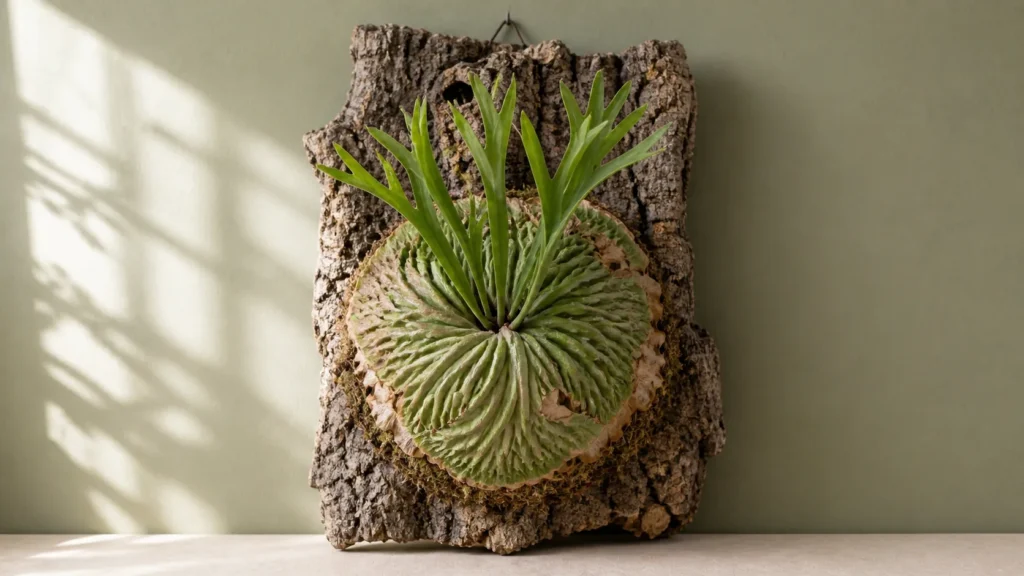
Ridley’s Staghorn Fern
Platycerium ridleyi
A sought-after epiphytic fern with deeply wrinkled brain-like shield fronds and upright antler-shaped fertile fronds, requiring bright indirect light, high humidity, warm temperatures, and constant airflow.
Watering frequency
Every 7-10 days (inspect by weight)
Ideal temperature
75-90°F / 24-32°C
Humidity
60-80%
Care difficulty
Hard
Air purifying
No/Not Known
Growth rate
Slow
Plant size
1-2 ft / 0.3-0.6 m shield diameter; fertile fronds to 2 ft
Soil type
Airy sphagnum mounted on cork bark, teak, or cedar board
Fertilizer need
Monthly, spring-summer.
Care summary
- Light: Give bright indirect light; avoid direct sun which scorches fertile fronds.
- Water: Soak when the mount feels light and sphagnum approaches dryness, then drain completely.
- Humidity: Maintain 60-80% relative humidity with constant gentle airflow.
- Temperature: Keep above 65°F (18°C); cold damage is rapid and irreversible.
- Propagation: Solitary species that does not produce pups; propagate from spores only.
- Safety: Not independently evaluated by ASPCA; the related Common Staghorn is listed non-toxic.
Common problems
- Soft black base: Check prolonged wetness, cold, and poor airflow; P. ridleyi is highly rot-prone.
- Shriveled fertile fronds: Review drought, low humidity, and root health.
- Brown shield fronds: Usually normal maturation; do not remove them.
- Pale or scorched fronds: Confirm too much direct sun or heat from grow lights.
- Pests: Inspect beneath shields and along frond midribs for scale and mealybugs.
Plant care guide
About Ridley's Staghorn Fern
Ridley's Staghorn Fern (Platycerium ridleyi) is one of the most distinctive and sought-after species in the staghorn fern genus. Native to the high forest canopies of the Malay Peninsula, Borneo, Sumatra, Singapore, and southern Thailand, it grows as an epiphyte — a plant that attaches to tree trunks and branches for support without drawing nutrients from its host. Kew's Plants of the World Online record recognizes Platycerium ridleyi as a distinct species within the Platycerium genus.
The species is named in honor of Henry Nicholas Ridley (1855–1956), the British botanist who served as the first director of the Singapore Botanic Gardens and authored the seminal work Ferns of the Malay Peninsula. Ridley was a towering figure in Southeast Asian botany, and several plant species bear his name.
What immediately sets P. ridleyi apart is its shield frond morphology. The rounded sterile shield fronds are deeply wrinkled and ridged, folding over one another to form a dense, three-dimensional basket-like structure. Collectors in East Asia often call it the "Monkey Brain" staghorn fern because the textured, convoluted surface of the mature shield resembles the surface of a brain. This is not a superficial resemblance — the radial ridges and deep furrows are a defining species trait.
The fertile fronds are equally distinctive. Unlike the Common Staghorn Fern (P. bifurcatum), whose fertile fronds arch outward and downward, P. ridleyi produces upright, antler-shaped fertile fronds that stand erect from the shield. The spore-producing structures are not scattered across the frond underside in a broad patch but are concentrated in specialized, elevated spore patches — a trait that helps distinguish it from similar species.
Ridley's Staghorn Fern has a fascinating ecological relationship with ants. In the wild, the hollow chambers formed by its overlapping shield fronds provide nesting sites for arboreal ants, and the plant benefits from the nutrients in ant debris and the protection ants offer against herbivores. This myrmecophytic relationship is shared with Platycerium madagascariense (the Madagascar or African Monkey Brain staghorn), and both species are sometimes grouped as "monkey brain" staghorns by collectors.
Unlike the offset-forming Common Staghorn Fern, P. ridleyi is a solitary species. It produces a single growing point and does not form pups or side colonies. This makes division impossible and means that propagation is exclusively from spores — a slow and technically demanding process. It also means that each plant is a single, slowly maturing specimen rather than a spreading colony.
Why You'll Like It
Ridley's Staghorn Fern is a collector's plant that rewards attention with one of the most sculptural forms in the fern world. The brain-like shield fronds develop more texture and depth with each growing season, and the upright antler fronds create a vertical silhouette unlike any other common houseplant. Mounted on a board and hung on a wall, it functions as living art that changes character as it matures.
It is also a plant with genuine rarity value. Because it does not produce offsets and spore propagation is slow, well-grown specimens command premium prices in the houseplant trade. Owning a healthy P. ridleyi is a signal of serious plant cultivation skill, and the species has a dedicated following among staghorn fern enthusiasts worldwide.
For pet households, the picture is more nuanced than with the Common Staghorn. ASPCA lists Platycerium bifurcatum as non-toxic to cats, dogs, and horses, but P. ridleyi has not received an independent species-level toxicology evaluation. Ferns are rarely highly toxic, and the genus-level evidence is reassuring, but the conservative approach is to treat this species as unconfirmed rather than proven safe. See the Toxicity and Pet Safety section for details.
What Kind of Plant Is It?
Platycerium ridleyi is an epiphytic fern with two functionally distinct frond types, a trait shared by all staghorn ferns.
The shield fronds (also called sterile or basal fronds) are rounded, deeply ridged structures that press against the mounting surface. They emerge green and pliable, then harden and turn brown and papery with age. In P. ridleyi, the shield fronds are exceptionally thick and textured, with deep radial furrows that give the brain-like appearance. They overlap in layers to form a basket or nest that traps organic debris and moisture. In nature, this nest also houses ant colonies. The shield fronds are not decorative dead tissue — young green shields are actively photosynthetic, and even mature brown shields continue to protect the rhizome and roots and store moisture.
The fertile fronds (also called antler fronds) are the reproductive structures. In P. ridleyi, they grow upright rather than cascading, with a shape that genuinely resembles a set of antlers. The surface carries a fine, pale felt of protective hairs (trichomes) that should not be wiped or scrubbed away. Spores develop in distinct, raised patches on the frond — not in a diffuse brown felt across the entire underside — and these spore patches are a useful identification feature.
The rhizome is short, upright, and hidden beneath the shield fronds. It does not branch to produce offsets, which is why the species remains solitary. Roots are fine and wiry, occupying the thin layer of sphagnum or organic material between the shield and the mount. This root zone is small relative to the plant's total size, which means it can dry quickly but also rots rapidly if kept saturated.
History of Ridley's Staghorn Fern
Platycerium ridleyi was first scientifically described in 1898 by the British botanist John Gilbert Baker, who named it in honor of Henry Nicholas Ridley. Baker, a fern specialist at the Royal Botanic Gardens, Kew, described numerous tropical fern species from specimens collected across the British Empire. The type specimen was collected in the Malay Peninsula, where Ridley had been actively collecting and documenting the fern flora.
Henry Ridley himself was a remarkable figure. Arriving in Singapore in 1888 as the first director of the newly established Singapore Botanic Gardens, he spent 24 years systematically documenting the flora of the Malay Peninsula. His five-volume Flora of the Malay Peninsula and his work on ferns remained standard references for decades. Ridley was also instrumental in establishing the rubber industry in Southeast Asia, a contribution that had enormous economic consequences for the region. The species that bears his name is a small but enduring botanical tribute.
Platycerium ridleyi entered cultivation slowly. For many decades it was known primarily in botanical gardens and among specialist fern growers. Its rise in popularity as a houseplant coincided with the broader staghorn fern trend of the 2010s and 2020s, driven by social media plant communities in East Asia, Europe, and North America. The "Monkey Brain" nickname — used by collectors in China, Taiwan, Japan, and Southeast Asia — helped propel its visibility, and the species is now one of the most coveted staghorn ferns in the specialty plant trade.
Because P. ridleyi does not produce offsets and spore-grown plants take years to reach saleable size, supply has never kept pace with demand. This has contributed to its reputation as a premium collector's plant and has also encouraged the development of selected forms, such as broad-shield and narrow-frond variants, though none have received formal cultivar registration.
Popular Varieties or Related Plants
Platycerium ridleyi is a single species with no formally registered cultivars, but growers recognize several naturally occurring forms selected for particular traits:
- Broad-shield form: Selected individuals with wider, more expansive shield fronds that develop exceptionally deep brain-like ridging. Sometimes marketed as "wide leaf" or "thick shield" P. ridleyi.
- Narrow-frond form: Individuals with slender, finely divided fertile fronds that create a delicate, lacy silhouette.
- Dwarf or compact form: Smaller-growing individuals that mature at a reduced size, sometimes offered as "mini ridleyi." These are not genetically distinct cultivars but rather selected seed-grown individuals.
These forms are not patented or registered cultivars. They represent the natural variation found in spore-propagated populations, and a given plant's expression may change as it matures.
Related species worth knowing:
- Common Staghorn Fern (P. bifurcatum): The most widely grown staghorn, with cascading fertile fronds and offset-forming habit. Easier to grow and the only Platycerium species with an ASPCA non-toxic listing. See the Common Staghorn Fern care guide.
- Madagascar Staghorn (P. madagascariense): The African counterpart to P. ridleyi, with similar brain-like shield fronds and ant symbiosis. Unlike P. ridleyi, it produces offsets and has fertile fronds that may curl or twist.
- Queen Staghorn Fern (P. wandae): The largest staghorn species, with towering basket-shaped shields and dramatic two-lobed fertile fronds. Solitary like P. ridleyi but requires even more heat and humidity. See the Queen Staghorn Fern care guide.
- Superb Staghorn Fern (P. superbum): A large Australian species with tall nest shields, often confused with P. grande. Solitary and cannot be divided.
Where It Works Best
Ridley's Staghorn Fern needs a position with bright, consistent indirect light and enough space for air to circulate around the mount. An east-facing window that receives gentle morning sun and bright filtered light for the rest of the day is ideal. A south or west window works only if a sheer curtain or similar filtration prevents direct midday sun from reaching the fronds. Deep shade is not suitable — it weakens growth, narrows the fertile fronds, and keeps the root pad wet for too long, increasing rot risk.
A bright bathroom with a window can supply the humidity this species needs, but a windowless bathroom is unsuitable. Living rooms and home offices work when the mount is accessible for regular soaking and the room does not become excessively dry from heating or air conditioning. Avoid placing the mount directly above a heating vent, beneath an air conditioning outlet, or in a narrow corner where air becomes stagnant.
Because P. ridleyi is highly sensitive to cold, it should not be placed near cold window glass in winter, near exterior doors that open frequently, or in any position where nighttime temperatures might drop below 65°F (18°C). If you move the plant outdoors in summer, keep it in filtered shade, protect it from wind, and bring it indoors well before nighttime temperatures fall.
The mount should be hung on hardware rated for the weight of a fully watered specimen. Even a medium-sized P. ridleyi mount can be surprisingly heavy when saturated, and the shield fronds add weight as they accumulate. Use wall anchors appropriate for your wall type and consider a removable hanging system so the mount can be taken down for soaking.
Ridley's Staghorn Fern Care
Light
Give bright indirect light. P. ridleyi grows in the upper canopy of tropical forests in nature, so it is adapted to receive a good deal of filtered light, but it is not a full-sun plant. Direct midday sun will scorch the fertile fronds, causing pale or brown crispy patches, and can overheat the root pad through the board. Gentle morning sun for an hour or two is usually tolerated after acclimation, but afternoon sun should be filtered.
If using grow lights, provide a broad, even wash of light at a comfortable distance. LED fixtures work well, but avoid positioning the light so close that it heats the fronds or the mount. A consistent photoperiod of 12–14 hours during the growing season supports steady growth; reduce to 10–12 hours in cooler, darker months.
Weak, floppy new growth with long gaps between fronds suggests insufficient light. Pale, bleached, or crispy patches on the side facing the light suggest too much intensity. Adjust gradually — P. ridleyi does not respond well to sudden changes in light level.
Watering
Water by weight and texture, not by a fixed calendar. When the mount feels light and the sphagnum at the root zone approaches dryness, submerge the root pad in room-temperature water for several minutes, then allow it to drain completely before rehanging. A typical interval is 7–10 days in warm, bright conditions, but this varies with mount size, humidity, temperature, airflow, and season. A large, dense shield may retain moisture far longer than a small young mount.
P. ridleyi is more rot-prone than the Common Staghorn Fern. The thick, layered shield fronds trap moisture against the root zone, and if the sphagnum stays saturated for days at a time, the rhizome and roots can decay rapidly. It is safer to err on the side of slightly too dry than consistently too wet, but do not allow the mount to become bone-dry for extended periods — prolonged drought causes the fertile fronds to shrivel and may damage the fine roots.
Water earlier in the day so the mount has time to partly dry before cooler nighttime temperatures. Avoid forcing water into the enclosed pockets between shield fronds where it cannot evaporate. If the shield surface gets wet during watering, that is fine — it is designed to shed and distribute water — but the root zone must not stay swampy.
In winter, when growth slows and light levels drop, extend the watering interval. The mount may need water only every 10–14 days or even less. Check by weight and by gently probing the sphagnum at the edge of the shield.
Soil and Container
Platycerium ridleyi is an epiphyte and should not be potted in ordinary potting soil. It is typically mounted on a board of cork bark, teak, cedar, or another rot-resistant wood, with a pad of long-fiber sphagnum moss between the root zone and the board. The sphagnum should be loose and airy, not packed densely — air spaces are as important as water-holding capacity.
Some growers keep young P. ridleyi in shallow baskets or pots with an epiphyte mix of large-grade orchid bark, charcoal, and sphagnum. This can work for small plants, but as the shield develops, mounting on a board or slab is preferable because it allows the shield to form its natural basket shape and provides the airflow the species needs.
When mounting, position the growing point upright (at the 12 o'clock position) and secure the root pad with plant-safe wire, line, or nylon stockings without crushing the rhizome. Leave room around the growing point for new shield fronds to expand. Do not bury the growing point in sphagnum — it should sit at or just above the surface of the moss pad.
Humidity
Maintain 60–80% relative humidity. P. ridleyi comes from consistently humid tropical forests and does not tolerate dry indoor air well. At humidity below 50%, the fertile fronds may develop brown tips, growth slows, and the plant becomes more susceptible to mite damage.
A humidifier is the most reliable way to maintain consistent humidity. Grouping the plant with other humidity-loving plants can create a beneficial microclimate, but it is not a substitute for a humidifier in a dry room. Misting the surrounding air provides only temporary relief and does not meaningfully raise humidity around the mount.
Crucially, humidity must be paired with airflow. P. ridleyi is highly susceptible to fungal and bacterial problems in stagnant, humid air. A gentle fan running continuously near the plant — not blowing directly on it — provides the air movement that keeps the shield surface and root zone healthy. The combination of high humidity and constant airflow is the single most important factor in successfully growing this species indoors.
Temperature
Keep P. ridleyi consistently warm. The ideal range is 75–90°F (24–32°C), and the plant should never be exposed to temperatures below 65°F (18°C) for any extended period. Growth slows significantly below 70°F (21°C) and stops below 65°F (18°C). Cold damage is rapid and often irreversible — exposure to temperatures in the 50s°F (10–15°C) for even a short period can cause blackening and collapse of the shield and rhizome.
This species is significantly more cold-sensitive than the Common Staghorn Fern (P. bifurcatum), which can tolerate brief dips into the 50s°F. Do not assume that because a position works for P. bifurcatum, it will work for P. ridleyi.
Avoid placing the plant near cold windows in winter, near exterior doors, or in rooms that are allowed to cool significantly at night. If your home runs cool in winter, a supplemental heat source near the plant — such as a small space heater with a thermostat — may be necessary, but take care not to dry the air or create hot spots.
Fertilizer
Feed monthly during the active growing season (spring and summer) at a very diluted rate — typically one-quarter to one-half of the label's recommended strength for houseplants. Use a balanced, water-soluble fertilizer and apply it to a moist root pad, never to a bone-dry mount. The fine roots of P. ridleyi are easily burned by concentrated fertilizer, so when in doubt, use less.
Reduce feeding to every 6–8 weeks in early fall and pause entirely in winter when growth is slow. Resume dilute feeding in spring when new shield or fertile frond growth is visible.
Do not place banana peels, food scraps, or other organic matter behind the shield fronds as a homemade fertilizer. While this practice is sometimes recommended for staghorn ferns, it can attract pests, introduce uncontrolled salts, and promote rot in the moist, enclosed environment behind P. ridleyi's thick shields. A measured, diluted synthetic or organic fertilizer is more predictable and safer.
Pruning and Training
Platycerium ridleyi requires very little pruning. The brown, papery shield fronds should never be removed — they protect the rhizome, store moisture, and contribute to the plant's structural and nutritional system. Removing a shield exposes the growing point and roots and can set the plant back significantly or kill it.
Fertile fronds that have completely browned and died back may be trimmed at the base with sterile scissors, but this is optional. Dead fertile fronds are not harmful to the plant, and some growers leave them in place for a natural appearance. If you trim, cut cleanly without damaging the adjacent shield or growing point.
The plant does not need training in the way a vining plant does. The fertile fronds grow upright naturally, and the shield develops its form without intervention. If a fertile frond is growing at an awkward angle due to light direction, you may rotate the mount occasionally, but do so gradually to avoid shocking the plant.
Ridley's Staghorn Fern Propagate
Platycerium ridleyi is a solitary species that does not produce offsets or pups. This means it cannot be propagated by division, the method used for the Common Staghorn Fern. Propagation is exclusively from spores, a process that is slow, technically demanding, and not practical for most home growers.
Spore propagation requires:
- Collecting spores: Harvest mature spore patches from a healthy fertile frond. The spores are ready when the patch turns brown and releases a fine dust when touched. Place the frond section in a paper envelope and allow the spores to drop.
- Sterilizing equipment and medium: Spore propagation is vulnerable to contamination from mold, algae, and fungi. All containers, tools, and the growing medium (typically a sterile mix of peat moss and perlite, or agar) must be sterilized before sowing.
- Sowing: Sprinkle spores thinly on the surface of the moist, sterile medium. Do not bury them — they need light to germinate. Cover the container to maintain high humidity and place it in bright indirect light at warm temperatures (70–80°F / 21–27°C).
- Gametophyte stage: Spores germinate into tiny, heart-shaped gametophytes (prothalli) over several weeks. This stage requires consistent moisture and is the most contamination-vulnerable period.
- Sporophyte stage: After fertilization (which requires free water on the gametophyte surface), tiny fern plants (sporophytes) emerge. This can take 2–3 months or more from sowing.
- Growing on: Once the young sporophytes have developed a few small fronds, they can be carefully pricked out and grown on in individual pots or mounts with sphagnum. It takes several years for a spore-grown P. ridleyi to reach a saleable or displayable size.
For most home growers, purchasing a nursery-grown plant is far more practical than attempting spore propagation. If you do attempt it, maintain scrupulous hygiene and be prepared for a long timeline and possible losses to contamination.
Repot Ridley's Staghorn Fern
Because P. ridleyi is typically mounted rather than potted, "repotting" usually means remounting — transferring the plant to a larger or fresh board when it has outgrown its current mount or when the board is deteriorating.
Signs that remounting may be needed include:
- The shield fronds have grown well beyond the edges of the board and the plant is unstable.
- The board is rotting, warping, or developing soft spots.
- The root pad has become so dense that water no longer penetrates evenly.
- The mount hardware is failing or the wall attachment is no longer secure.
To remount:
- Prepare the new board with a fresh pad of loose, moist long-fiber sphagnum moss.
- Carefully remove the plant from the old board. Preserve as much of the root pad and old shield material as possible — do not strip the plant bare.
- If the root pad is densely matted, you may gently tease apart the outer layer to encourage new root growth, but avoid cutting into the rhizome or the base of the shield.
- Position the plant on the new board with the growing point upright and the root pad centered on the sphagnum.
- Secure with plant-safe line or wire, taking care not to crush the rhizome or the base of the shield fronds.
- Water thoroughly after remounting and maintain slightly higher humidity and reduced light for a week or two while the plant recovers.
Remounting is stressful for the plant and should be done during warm, active growth in spring or early summer. Do not remount in winter or when the plant is already stressed. A healthy P. ridleyi may only need remounting every 3–5 years, or even less frequently if the board is durable and the plant's growth rate is slow.
Toxicity and Pet Safety
Platycerium ridleyi has not been independently evaluated for toxicity by the ASPCA or other major veterinary poison-control organizations. The ASPCA's non-toxic listing for staghorn fern applies specifically to Platycerium bifurcatum (the Common Staghorn Fern), and that listing does not automatically extend to every species in the genus.
That said, there are reasons for cautious optimism. Ferns as a group are rarely highly toxic, and the Platycerium genus has no documented history of causing serious poisoning in pets or humans. The closely related P. bifurcatum is explicitly listed as non-toxic to cats, dogs, and horses by ASPCA, and no Platycerium species is known to contain dangerous levels of toxic compounds. However, one safe relative is not conclusive proof for an entire genus, and P. ridleyi's specific chemistry has not been studied.
Given this uncertainty, the conservative approach is to treat P. ridleyi as toxicity-unconfirmed rather than proven safe. If you have pets that chew on plants, place the mount out of reach — which is generally easy given that staghorn ferns are wall-mounted. The mounting wire, board finishes, fertilizer, and any pest treatment products are separate hazards regardless of the plant's own toxicity.
If a pet ingests frond material and develops vomiting, diarrhea, lethargy, or other symptoms, contact a veterinarian or an animal poison-control service promptly. Do not assume that because the plant is a fern, ingestion is automatically harmless.
Common Problems and Practical Fixes
Soft black base or rhizome rot
This is the most serious and common problem with P. ridleyi. It is caused by prolonged wetness at the root zone, often combined with cool temperatures and poor airflow. The thick, layered shield fronds trap moisture against the rhizome, and if the sphagnum stays saturated, rot can set in quickly.
If you detect soft, black, foul-smelling tissue at the base of the shield or around the growing point, act immediately. Remove the plant from its mount, inspect the rhizome and roots, and cut away any soft, rotten tissue with a sterile blade. Allow the cut surfaces to dry, then remount on fresh, dry sphagnum on a clean board. Reduce watering until new growth appears. Prevention is far more effective than treatment — water by weight, ensure excellent drainage, and maintain constant airflow.
Shriveled or wilting fertile fronds
This usually indicates underwatering or low humidity, but it can also be caused by root rot that prevents the plant from taking up water. Before increasing watering frequency, check the root pad: if it is heavy and wet, the problem may be root damage rather than drought. If the mount is light and the sphagnum is dry, give a thorough soak and review whether your watering interval has become too long for the current conditions.
Brown shield fronds
This is normally maturation. Shield fronds emerge green, then turn brown and papery as they age. This is not a problem — the brown shields continue to protect the rhizome and store moisture. Do not remove them. Concern is warranted only if the shield is soft, black, foul-smelling, or collapsing rather than drying to a firm, papery texture.
Pale, bleached, or crispy patches on fertile fronds
This is usually sun scorch from too much direct light, or heat damage from a grow light positioned too close. Move the plant to a position with more filtered light or raise the grow light. The damaged patches will not recover, but new growth should emerge normally once the light is corrected.
Scale or mealybugs
These pests can hide beneath the edges of shield fronds and along the midribs of fertile fronds, where they are difficult to detect and treat. Inspect regularly, especially in warm, dry conditions. Do not tear away shield fronds to reach pests — this damages the plant. Isolate the affected plant, treat visible pests carefully with a fern-safe product labeled for scale or mealybug, and repeat according to the pest life cycle. A cotton swab dipped in rubbing alcohol can spot-treat individual insects on accessible frond surfaces.
No new growth
P. ridleyi is naturally slow-growing, and it may pause growth in cooler, darker months. If no new shield or fertile fronds appear for an extended period during the growing season, review light (is it bright enough?), temperature (is it consistently above 70°F?), humidity (is it above 60%?), and root health (is there rot?). Fertilizer cannot substitute for inadequate light, temperature, or viable roots.
Frequently Asked Questions
Is Ridley's Staghorn Fern the same as "Monkey Brain" staghorn?
Yes. "Monkey Brain" is a collector nickname, most commonly used in East Asian plant communities, for Platycerium ridleyi because its deeply wrinkled shield fronds resemble the surface of a brain. There is also an "African Monkey Brain" staghorn, which is Platycerium madagascariense — a different but related species with similar shield morphology. When buying, confirm the botanical name to ensure you get the species you want.
Can I divide Ridley's Staghorn Fern?
No. P. ridleyi is a solitary species with a single growing point and does not produce offsets or pups. Attempting to cut it in half will likely kill the plant. Propagation is exclusively from spores.
Why are my shield fronds not developing the brain-like texture?
The deep wrinkling is a trait that develops with maturity. Young plants may have relatively smooth shield fronds that only become deeply ridged after several growing seasons. Ensure the plant has bright indirect light, consistent warmth, and high humidity — conditions that support robust shield development. If the plant is kept too dark or too cool, the shields may remain thinner and less textured.
How big does Ridley's Staghorn Fern get indoors?
Indoors, a mature specimen typically reaches a shield diameter of 1–2 feet (30–60 cm), with fertile fronds standing up to 2 feet (60 cm) tall. Growth is slow, and it may take 5–10 years or more to reach full mature size. In ideal greenhouse conditions, specimens can grow somewhat larger.
Can I grow Ridley's Staghorn Fern in a pot instead of mounted?
Young plants can be grown in shallow baskets or pots with a very airy epiphyte mix, but mounting is preferable as the plant matures. A mounted position allows the shield fronds to develop their natural basket form, provides the airflow the species needs, and makes the brain-like texture visible. Ordinary potting soil is never suitable.
Is Ridley's Staghorn Fern safe for pets?
The species has not been independently evaluated for pet toxicity. The related Common Staghorn Fern (P. bifurcatum) is ASPCA-listed as non-toxic, and ferns are generally low-risk, but P. ridleyi itself has no specific toxicology data. As a precaution, keep the mount out of reach of pets that chew plants. See the Toxicity and Pet Safety section for full details.
Final Thought
Ridley's Staghorn Fern is not a beginner plant, but for a grower who can provide bright indirect light, consistent warmth above 65°F, 60–80% humidity with constant airflow, and disciplined watering by weight, it rewards with one of the most extraordinary forms in the fern world. Preserve its brain-like shield fronds, never attempt division, water thoroughly and then let the mount breathe, and accept that this solitary species grows slowly but steadily. A well-grown P. ridleyi is not merely a houseplant — it is a living sculpture that becomes more impressive with every year.