
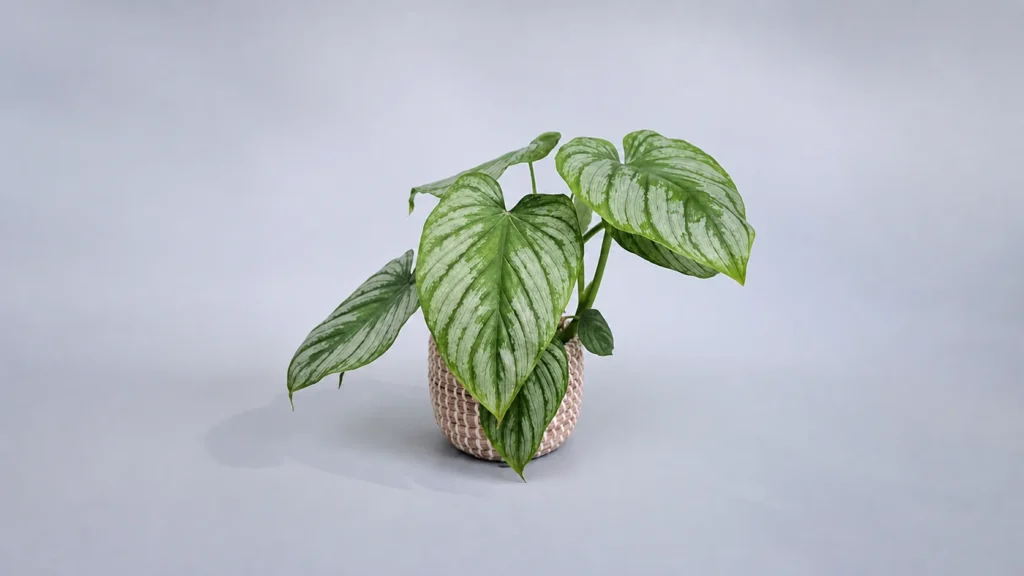
Mamei Philodendron
Philodendron mamei
An Ecuadorian crawling philodendron with quilted heart-shaped leaves, silver-gray mottling, and a horizontal stem that needs room to travel across the pot.
Watering frequency
Every 7-10 days
Ideal temperature
65-80°F / 18-27°C; minimum 59°F / 15°C
Humidity
50-70%
Care difficulty
Medium
Air purifying
No/Not Known
Growth rate
Moderate
Plant size
2-4 ft wide / 0.6-1.2 m indoors
Soil type
Airy, moisture-balanced aroid mix
Fertilizer need
Every 4-6 weeks, spring-early fall.
Care summary
- Light: Bright indirect light; avoid hot direct sun on the broad leaves.
- Water: Let the upper 1-2 inches dry, then water thoroughly and drain.
- Soil: Use an airy aroid mix that holds light moisture without staying saturated.
- Growth: A horizontal crawler; use a wide rectangular or trough-style pot.
- Humidity: Stable 50-70% humidity supports clean leaf expansion.
- Safety: Not pet-safe; keep foliage and cuttings away from pets and children.
Common problems
- New leaves getting smaller: insufficient light, root stress, or the crawling stem has reached the pot edge.
- Yellow leaves while mix stays wet: overwatering or an airless substrate.
- Brown edges: severe drying, low humidity, fertilizer salts, or root damage.
- Stem rising or twisting: juvenile growth, crowding, or a pot that does not give the rhizome a horizontal route.
- Faded silver pattern or scorch: light is too weak or direct sun is too strong.
- Spider mites, thrips, scale, or mealybugs: inspect quilted leaf surfaces and petiole joints.
Plant care guide
About Mamei Philodendron
Mamei Philodendron (Philodendron mamei) is a terrestrial, crawling aroid grown for broad heart-shaped leaves patterned with irregular silver-gray clouds. Deeply impressed veins give the blades a quilted surface, while flattened or winged petioles may show fine pale streaks and reddish color near the base. It is sometimes called Blotched Philodendron or Quilted Silver-leaf Philodendron in horticultural descriptions.
This is not a conventional climbing philodendron. Kew's accepted record for Philodendron mamei places the species in southern Ecuador, and its detailed description records a repent—horizontally creeping—adult stem. Indoors, that stem should travel over the substrate with its growing tip resting near the surface. A narrow upright pot eventually forces the stem over the rim, which is one of the most common setup mistakes.
The name “Silver Cloud” is frequently attached to Mamei plants, but horticultural usage is inconsistent. Some growers treat Philodendron mamei 'Silver Cloud' as a selected, rounder, more heavily silvered form; others use the name broadly for ordinary Mamei. This page therefore does not make Silver Cloud a direct alias. A plant sold with that additional cultivar label should retain it until its identity is reviewed.
Why You'll Like It
Mamei Philodendron combines the scale of a collector foliage plant with a growth habit that remains low. Rather than occupying a tall pole, it develops a line of leaves along the surface of a broad container. Each new blade opens lighter and softer, then hardens into a dark green heart overlaid with silver mottling.
It is especially satisfying for growers who enjoy visible plant structure. The crawling stem, nodes, new roots, and emerging cataphylls can all be observed at soil level. A well-oriented plant turns a long trough into a living sequence of progressively larger leaves.
The tradeoff is space. It is not difficult because it needs exotic chemistry; it is moderately demanding because the pot must accommodate horizontal movement and the broad, relatively thin leaves respond visibly to dry roots, harsh sun, and rough handling.
What Kind of Plant Is It?
Mamei is a tropical subshrub in the Araceae family. In southern Ecuador it grows in wet tropical forest, including shaded understory and stream-bank settings. Mature leaves in habitat can become much larger than ordinary indoor foliage, but the useful care lesson is not a promised maximum size: it is that steady moisture, filtered light, warm temperatures, and root aeration support progressively larger growth.
The horizontal stem is often casually called a rhizome by growers. Botanically, it is a creeping stem with nodes. Each advancing node can root into the substrate and produce a leaf. Keep the newest growing point above the mix; burying it deeply increases rot risk. Older rooted sections can sustain the plant even as the tip advances.
Juvenile plants may initially look upright because their internodes are longer or because the nursery has positioned the stem vertically. Confirm the direction from several nodes before tying it to a pole. The adult species is a crawler, and forcing the growth point upward usually produces an awkward plant rather than converting it into a true climber.
History of Mamei Philodendron
French botanist Édouard André formally published Philodendron mamei in 1883. Kew records the name as accepted and the native range as southern Ecuador, while the linked botanical description places known collections on the eastern Andean slope in premontane wet forest.
The silver pattern is part of the species' natural leaf character, not the same mechanism as unstable white sectoral variegation. Botanical descriptions record gray to gray-green mottling between the major veins. The amount and contrast can vary between individual plants, leaf age, and growing conditions.
Modern trade names complicate the picture. “Silver Cloud,” “Mamei Silver,” and similar labels may represent selected forms or loose sales language. Because there is no consistently documented public cultivar standard connecting every such plant, House Plant Finder retains P. mamei as the species identity and treats named silver forms as comparison plants rather than automatic synonyms.
Related Crawling Philodendrons
- Philodendron mamei 'Silver Cloud': Usually sold as a broader, rounder, more heavily silvered Mamei selection. Keep the cultivar label when supplied by a reliable grower.
- Philodendron 'McDowell': A crawling P. gloriosum × P. pastazanum hybrid with large green velvet hearts and pale veins rather than silver blotches.
- Philodendron gloriosum: A velvet-leaved crawler with striking pale venation. Its surface is generally less glossy and lacks Mamei's cloudlike silver patches.
- Philodendron plowmanii: Another crawler with dramatic petiole ruffling and variable silver patterning. Examine petiole structure, mature leaf shape, and the complete plant rather than identifying from one juvenile blade.
All need horizontal root-zone space, but they do not necessarily dry at the same rate. Match watering to the actual pot, roots, and substrate.
Where It Works Best
Give Mamei Philodendron a bright position with filtered light, such as near an east window or back from stronger south- or west-facing glass. Broad leaves can scorch in hot direct sun. In medium light it may remain healthy but usually advances more slowly and produces smaller foliage.
A plant bench, wide console, or low stand works better than a narrow shelf because the container and leaves spread sideways. Leave clearance in front of the growing point. A bright bathroom can work if it also has airflow and real window light; humidity cannot replace illumination.
Mamei Philodendron Care
Light
Provide bright indirect light. Soft morning sun may be tolerated after gradual acclimation, but harsh afternoon sun can bleach the silver pattern and leave dry tan patches. Rotate the container only if doing so does not point the crawler back toward its old growth; preserving a clear path for the tip is more important than perfectly symmetrical leaf angles.
Watering
Water when the upper 1–2 inches (2–5 cm) of mix are dry and the container feels lighter, then soak the root zone and drain completely. Every 7–10 days is a practical warm-season starting point, not a weekday rule. A wide shallow pot, vigorous new roots, and warm light may shorten the interval; winter, dense mix, or a large reservoir of unused substrate will lengthen it.
Do not allow the entire root ball to remain bone-dry for long, but do not keep the crawler continuously saturated. Yellow lower leaves, a soft stem, and wilt in wet mix justify a root check. Wilt in dry mix, crisp margins, and a very light pot point toward insufficient water.
Soil and Container
Use an airy, moisture-balanced aroid blend—potting mix or coco coir combined with fine orchid bark and perlite or pumice. Mamei needs more even moisture than a succulent, but its roots still require oxygen. A mix that collapses into mud defeats the purpose of a long container.
Choose a wide rectangular pot or trough with drainage holes. Position the established stem near one short end and aim the growing tip toward the open length. Keep nodes in contact with the surface and the active tip exposed. A round pot can work temporarily, but the plant reaches its edge sooner.
Humidity
Aim for stable 50–70% humidity. Average household humidity can work if watering remains consistent, but extremely dry air may leave emerging leaves stuck or margins browned. A room humidifier is more effective than misting. Preserve air movement so a humid leaf surface does not remain wet for hours.
Temperature
Maintain 65–80°F (18–27°C) and keep the plant above 59°F (15°C). Cold roots dry slowly and are more vulnerable to damage in wet mix. Keep the container away from cold floors, exterior doors, air conditioners, and winter glass.
Fertilizer
Feed every four to six weeks from spring through early fall while new leaves and roots are advancing. Use a balanced houseplant fertilizer at a conservative label rate. Pause in winter or after root damage. Fertilizer cannot compensate for a buried growth point, exhausted light, or an airless potting mix.
Pruning and Direction
Remove only fully yellow or badly damaged leaves at the petiole base. Do not cut the active tip simply to make the plant fit a round pot; redirect into a longer container or propagate the tip. Guide the stem with loose pins if necessary, keeping pressure away from the tender newest node.
How to Propagate Mamei Philodendron
Propagate from a section of creeping stem containing at least one healthy node. The easiest time is during spring or early summer repotting, when rooted sections are visible. Cut between nodes with a sterile blade. A division that already carries roots and a leaf has the quickest transition; an unrooted node needs warmer, more humid conditions.
Lay the section horizontally on damp sphagnum, perlite, or airy aroid mix, with the growth bud facing upward. Do not bury the whole stem. Keep it around 70–80°F (21–27°C) in bright indirect light. Initial roots or bud movement often appear within four to eight weeks, but older nodes and cool-season divisions may take longer.
Repot Mamei Philodendron
Inspect the setup every 12 months and expect many actively growing plants to need a longer container every 12–24 months. Spring is the easiest time. Repot sooner when the newest node reaches the pot edge, even if the older root ball is not tightly crowded; horizontal runway is part of the container requirement.
Keep roughly the same planting depth, replace collapsed mix, and preserve firm roots. Water once after repotting, then resume the normal dryness check. Avoid heavy feeding for about four weeks while disturbed roots settle.
Toxicity and Pet Safety
Mamei Philodendron is not pet-safe. This status uses genus-level evidence: the ASPCA lists Philodendron spp. as toxic to cats and dogs because of insoluble calcium oxalates. Chewing may cause oral pain, swelling, drooling, vomiting, and difficulty swallowing.
Keep leaves, stem sections, and propagation boxes away from pets and children. If exposure occurs, contact a veterinarian, animal poison-control service, human poison-control service, or appropriate medical professional. Breathing or swallowing difficulty requires urgent professional help.
Common Problems and Practical Fixes
- Growing point reaches the rim: Move the plant into a longer pot before the tip hangs downward and loses contact with mix.
- New leaves shrink: Check light, active-root health, temperature, pests, and whether the stem can root at new nodes.
- Yellow leaf with wet soil: Allow more drying, check drainage, and inspect for soft roots or stem tissue.
- Brown margins: Compare severe drying, low humidity, fertilizer salts, and root damage rather than assuming humidity alone.
- Silver pattern looks dull: Clean dust gently and assess usable light; do not expose the leaf suddenly to direct sun.
- Leaf opens damaged: Low humidity, physical obstruction, pests, or root stress can all interfere during expansion.
- Mites, thrips, scale, or mealybugs: Inspect the recessed veins, leaf backs, cataphylls, and petiole joints; isolate and treat with a product labeled for indoor ornamentals.
Frequently Asked Questions
Is Mamei Philodendron a crawler or climber?
It is an adult crawler. Juvenile or poorly positioned plants may appear upright, but the mature stem is designed to advance horizontally over the substrate.
Is Philodendron mamei the same as Silver Cloud?
Not automatically. Silver Cloud is inconsistently used for a selected Mamei form or as broad sales language. Retain the additional label unless the plant's provenance and mature features support merging it with ordinary Mamei.
Why does Mamei need a long pot?
Each new node should contact substrate and root as the stem advances. A long pot provides that horizontal runway and delays the growing tip reaching the rim.
Can I put it on a moss pole?
A juvenile may lean against support, but a pole does not change its adult crawling identity. A wide pot generally produces a more natural, manageable plant.
Is Mamei Philodendron pet-safe?
No. It is treated as not pet-safe based on ASPCA genus-level Philodendron toxicity guidance.
Final Thought
Mamei Philodendron becomes much easier once it is treated as a crawler. Give the growing tip horizontal space, filtered light, an airy but moisture-balanced mix, and stable warmth. The reward is a low procession of quilted green hearts carrying silver cloud patterns—without forcing the plant into a climbing shape it was not built to maintain.