
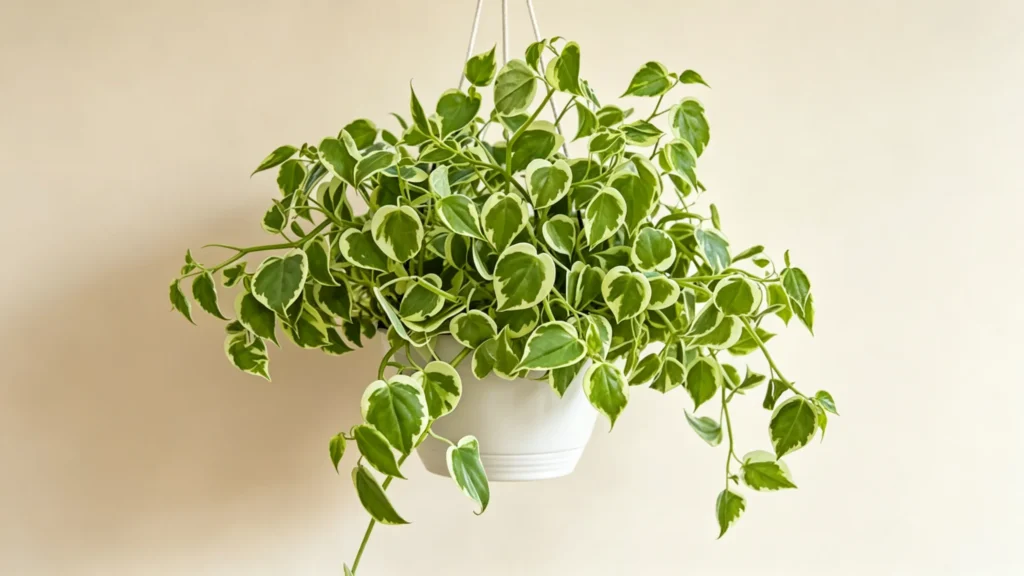
Cupid Peperomia
Peperomia nitida 'Variegata'
A trailing peperomia with fleshy, cream-edged heart-shaped leaves, covered here as Peperomia nitida 'Variegata' rather than every plant sold as scandens.
Watering frequency
Check weekly; water after the top 2-3 cm dries
Ideal temperature
65-80°F / 18-27°C; keep above 59°F / 15°C
Humidity
40-60%
Care difficulty
Easy
Air purifying
No/Not Known
Growth rate
Moderate
Plant size
Low trailing plant around 8 in / 20 cm high; allow cascading space
Soil type
Airy houseplant mix with perlite or fine bark
Fertilizer need
Every 4-6 weeks, spring-early fall.
Care summary
- Light: Bright indirect light; protect cream margins from hot sun.
- Water: Let the top 2-3 cm dry; check deeper mix is not saturated.
- Soil: Use an airy mix and a draining hanging pot.
- Humidity: Typical household humidity is usually suitable.
- Growth: Allow trailing stems room; prune selectively during spring-summer.
- Safety: Pet safe by same-genus inference, not a cultivar-specific test.
Common problems
- Wilted vines: compare soil moisture, pot weight, and root condition.
- All-green shoots: possible reversion; brighter light is not a guaranteed reversal.
- Long bare sections: review light and leaf loss before pruning.
- No new growth: check season, light, temperature, roots, and pests.
- Mealybugs: inspect nodes, leaf undersides, and the pot rim.
Plant care guide
About Cupid Peperomia
Cupid Peperomia is a trailing houseplant with fleshy, heart-shaped leaves edged in cream or pale yellow. This page specifically covers Peperomia nitida 'Variegata', the variegated horticultural plant also sold as Cupid Peperomia 'Variegata' or Variegated Cupid Peperomia. It belongs to Piperaceae, the pepper family.
The familiar name is useful, but the scientific label needs care. The RHS profile for Peperomia nitida 'Variegata' lists Peperomia scandens 'Variegata' as a synonym. That older horticultural combination still appears on plant labels. Here, 'Variegata' identifies a recorded cultivar; it is not an invented name for any plant with pale markings.
You may also encounter False Philodendron Peperomia or the very broad name Trailing Peperomia. Neither establishes an exact identity. Check the botanical label and foliage together, particularly when a listing shows a completely green vine or a different leaf shape.
Why You'll Like It
Cupid Peperomia gives a small shelf a soft, cascading outline. The pale leaf margins contrast with the green centers without requiring flowers, and the vines can be arranged around a pot rather than trained onto a large support. Place it where the upper leaves and hanging stems both receive light.
Its fleshy leaves offer some resilience when the mix dries between waterings. That does not make it a plant to ignore for long periods, but it can fit a routine built around checking pots rather than watering everything on the same day.
The main tradeoffs are delicate trailing stems, hidden wet soil in hanging containers, and occasional all-green growth. Choose it if you like monitoring a small vine and making selective trims, not if you want a permanently miniature plant that never changes shape.
What Kind of Plant Is It?
Cupid Peperomia is a low-growing, trailing perennial rather than an upright shrub. The foliage near the pot can form a mound around 8 inches (20 cm) high, with stems extending over the edge. Height and trailing length are different measurements: a low plant can still need considerable free space below its container.
Leaves have heart-shaped outlines and fleshy blades. A node is the point where a leaf joins a stem; these nodes matter when selecting cuttings. Avoid confusing a leaf stalk with a section of vine, because a useful stem cutting must include the actual stem and its nodes.
It resembles Heartleaf Philodendron or a small Golden Pothos from a distance, but those plants are aroids in Araceae. Appearance is not a reliable shortcut for either identity or pet safety. Treat an unidentified heart-leaf vine as unidentified until its name and physical features agree.
History and the Scandens Naming Confusion
Two different naming issues have become entangled. In botanical taxonomy, Kew treats Peperomia scandens as a synonym of Peperomia serpens. Separately, horticultural references use P. nitida 'Variegata' for the cream-edged Cupid plant formerly listed as P. scandens 'Variegata'.
These statements do not mean that every plant labeled scandens is automatically P. nitida, or that P. serpens is another accepted name for this cultivar. A species name and a historically used cultivar combination must be interpreted in context.
For this profile, the variegated plant is the defined subject. A green plant sold simply as P. scandens requires its own identity check. We do not assign this cultivar the collection history or native range of P. serpens, and a reliable breeder or release date for 'Variegata' has not been established here.
This distinction is practical when shopping. Save a photograph of the label and ask the seller which plant the name represents. If the description says cream-edged leaves but the photographs consistently show another form, resolve that discrepancy before using the listing as an identification reference.
Popular Varieties and Related Plants
Keep these alternatives distinct rather than treating them as different colors of the same plant:
- Green plants sold as “scandens”: A naming question, not an automatic green version of this exact cultivar. They may need assessment under P. serpens or another horticultural usage.
- Baby Rubber Plant (Peperomia obtusifolia): A more upright peperomia with rounded, thick leaves.
- Raindrop Peperomia (Peperomia polybotrya): Glossy, broad leaves and a different upright outline.
- Watermelon Peperomia (Peperomia argyreia): Silver-striped, rounded foliage rather than cream-edged vines.
- Happy Bean (Peperomia ferreyrae): Narrow bean-like foliage and a more succulent-looking habit.
- Parallel Peperomia (Peperomia tetragona): A spreading or trailing species with longitudinal stripes and whorled leaves.
For broader comparisons, the Pet-Friendly Houseplants collection offers other options. Read the evidence notes on individual profiles: a shared collection label does not mean every plant has the same level of species-specific safety evidence.
Where Cupid Peperomia Works Best
A bright shelf, small hanging basket, or window-side plant stand can show off the trailing growth. Position the pot itself in the light, not just the longest vines. A basket hung near the ceiling can be surprisingly shaded even in a sunny room.
Make sure the container is easy to take down. You need to check the root zone, empty retained water, and examine the top of the plant. A windowed bathroom is suitable only when it also supplies useful light and stable warmth.
Leave room for the stems rather than letting them rub against a door, chair, or hot appliance. Remember that vines grow back into reach of pets; hanging the plant once does not permanently solve access.
Cupid Peperomia Care
Light
Start with bright indirect light. Gentle morning sun may be suitable after acclimation, but protect pale margins from hot afternoon exposure. Move the plant gradually and judge new growth rather than repeatedly relocating it after a single discolored leaf.
Long spaces between leaves and growth reaching toward a window suggest inadequate light. A fully green shoot is a different observation and may represent reversion. Stronger light can improve growing conditions without restoring cream margins to an already green shoot.
Watering
Use a weekly reminder to check the soil, not a weekly watering appointment. Let the top 2–3 cm dry, then confirm the deeper mix is no longer saturated before watering. The RHS peperomia guide recommends allowing the top few centimeters to dry rather than keeping the compost continuously wet.
Lift the inner pot if possible. If it remains heavy and wet below the dry surface, wait and inspect the container. When water is needed, moisten the root ball evenly and let the excess drain before rehanging it.
Do not compensate for several missed checks by leaving the basket standing in water. Conversely, repeated tiny splashes may wet only one section of the pot. Drying speed changes with leaf mass, pot material, temperature, and season, so the plant may not need the same interval as an upright peperomia beside it.
Soil and Container
Use an airy houseplant mix amended with perlite or fine bark. Choose a draining pot sized to the root ball, with hanging hardware that safely supports its wet weight. Decorative baskets without drainage need a removable inner pot.
Keep foliage above the soil surface. Burying long stretches of healthy vine to disguise a sparse pot is not a substitute for proper layering or rooted cuttings. If you add rooted plants for fullness, leave enough space to inspect and water the original root system.
Humidity
Typical household humidity around 40–60% is a practical starting range. Avoid prolonged heater exposure or a strong drying draft. The plant does not need its leaves constantly wet.
Brown margins have several possible causes, including erratic watering, excessive sun, or accumulated salts. Check those conditions before buying a humidifier. If room humidity is genuinely low, improve the surrounding air rather than misting the vines repeatedly and assuming the root problem is solved.
Temperature
Aim for 65–80°F (18–27°C). Use 59°F (15°C) as a conservative minimum for indoor placement, not an experimentally determined injury threshold. Bring a summer outdoor plant inside before nights approach that boundary.
Check the temperature where the basket hangs. Glass, exterior walls, or an open window can expose the plant to conditions unlike the thermostat reading. Cool conditions also slow water use, making winter soil checks especially important.
Fertilizer
As a conservative starting routine, feed every four to six weeks from spring through early fall while the vine is making new leaves. Use a balanced houseplant fertilizer at the labeled indoor dilution; do not increase concentration to accelerate trailing length.
Pause when growth slows in winter, when roots are unhealthy, or after repotting into a mix that already contains fertilizer. Nutrients cannot replace light. If the pot stays damp and growth has stopped, address that condition before feeding again.
Pruning and Reversion
Trim overly long or bare sections during spring or summer, making cuts just above a healthy node on the portion you are keeping. Remove modest amounts at a time rather than stripping the plant back for symmetry.
If a shoot repeatedly produces entirely green leaves, you can leave it or prune back to variegated growth. Reversion is not corrected by scorching the plant in stronger sun. Where possible, preserve healthy green-and-cream sections for future growth, while recognizing that no trim guarantees every new leaf will match.
Propagating Cupid Peperomia
Spring to early summer is the easiest practical window because warmth and usable light support recovery. Choose a healthy, mixed green-and-cream shoot with several nodes. Avoid an all-white section with little green tissue or a damaged vine selected only because it is long.
- With clean scissors, cut a short piece of vine below a node.
- Remove the lowest leaf if it would sit in the rooting medium.
- Place the lower node in lightly moist, airy propagation mix, keeping remaining leaves above the surface.
- Keep the cutting warm in bright indirect light. Avoid both saturated mix and complete drying while roots form.
These are stem cuttings, not loose leaves. The RHS peperomia growing guide supports spring and summer softwood cuttings; a compulsory full day of callusing is not part of its method. Check for new roots and sustained growth over the following weeks rather than promising a fixed rooting date.
Several established cuttings can eventually make a fuller pot. Wait until each has a functioning root system; crowding unrooted pieces into a large wet basket increases the difficulty of judging moisture.
Repotting Cupid Peperomia
Spring is a useful time to inspect the root ball. Repot when roots are densely packed or the mix has deteriorated, often after a few years, rather than because one vine has become long. Long stems do not automatically indicate root crowding.
Lay the vines on a clean surface while handling the pot so their weight does not pull against the root ball. Use a container only slightly larger if healthy roots need space, maintain planting depth, and avoid breaking sound roots unnecessarily.
After an ordinary repot with intact roots, water to settle the mix and drain completely. Resume the soil-check routine rather than prescribing an automatic dry period. A temporary growth pause does not justify another immediate repot.
Toxicity and Pet Safety
Cupid Peperomia is labeled Pet safe here using same-genus inference, not a verified test of P. nitida 'Variegata'. The ASPCA's Baby Rubber Plant record lists the related P. obtusifolia as non-toxic to cats and dogs. It does not individually certify this cultivar.
Correct identification remains important because pothos and philodendron can resemble it. Keep chewing pets away from the plant and its soil, fertilizers, and treatments. If ingestion causes symptoms or you are unsure which plant was eaten, contact a veterinarian rather than relying on a common name or database tag.
Common Problems and Practical Fixes
- Wilted vines: Check pot weight and soil first. A dry pot may need water; a wet pot may have damaged roots and should not receive more automatically.
- Yellow leaves with wet soil: Inspect drainage and root condition. Do not cover the symptom with fertilizer.
- All-green shoots: Consider reversion, especially when several successive leaves lose their margins. Review light without assuming it is the only cause.
- Long bare stems: Examine where leaves were lost, whether pests are present, and how much light reaches the top of the basket.
- No new growth: Separate a normal winter slowdown from a spring or summer stall. Review light, temperature, root health, mix, pests, and crowding before intervening.
- Cottony material at nodes: Isolate the plant, inspect for mealybugs, and follow a labeled treatment suitable for indoor plants.
Frequently Asked Questions
Is Cupid Peperomia a pothos? No. The plant covered here is a peperomia in Piperaceae, not an aroid.
Should the botanical name say scandens or nitida? For this cream-edged cultivar, the profile follows P. nitida 'Variegata'. Older horticultural labels may use P. scandens 'Variegata'; a bare scandens label needs more context.
Will a green leaf become variegated again in better light? Do not expect that. Assess the next leaves on the shoot, and distinguish reversion from poor overall growing conditions.
Can I use a trellis? You can guide stems gently onto a small support, but a trailing display is simpler. It does not need the large moss-pole setup used for many climbing aroids.
Final Thought
Cupid Peperomia is a rewarding small vine when its identity and growing needs are clear. Give the cream-edged cultivar bright indirect light, a draining pot, and time to dry partially between waterings. Handle its stems gently, watch for reversion without overreacting, and keep the familiar name separate from the wider scandens naming confusion.