
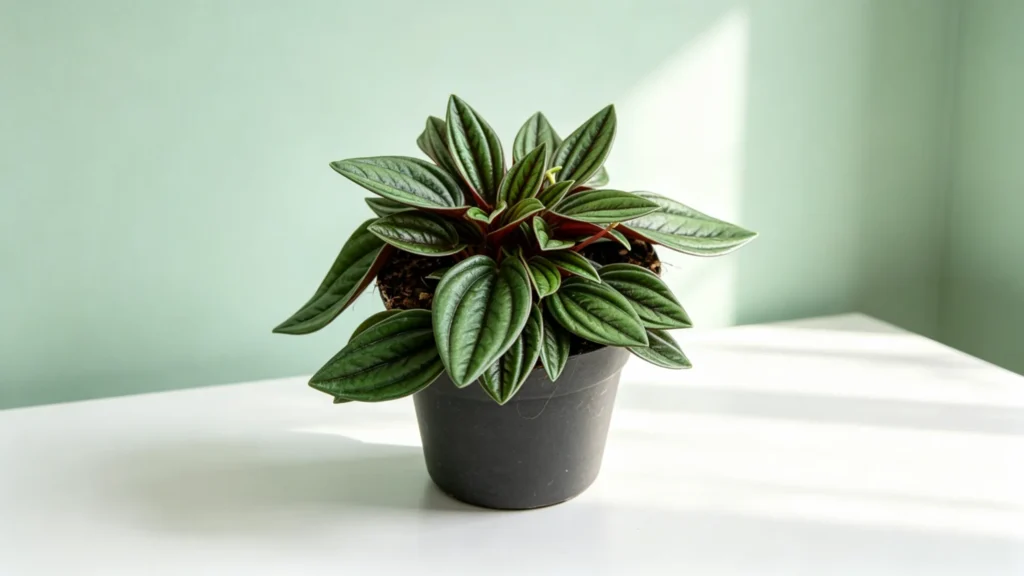
Peperomia Rosso
Peperomia 'Eden Rosso'
A compact hybrid peperomia with narrow, deeply ridged green leaves and red undersides, sold as Rosso and botanically named 'Eden Rosso'.
Watering frequency
Check weekly; water after the top 2-3 cm dries
Ideal temperature
65-80°F / 18-27°C; keep above 59°F / 15°C
Humidity
40-60%
Care difficulty
Easy
Air purifying
No/Not Known
Growth rate
Slow
Plant size
Low mound around 6-8 in / 15-20 cm tall; spread varies
Soil type
Airy houseplant mix with perlite or fine bark
Fertilizer need
Every 4-6 weeks, spring-early fall.
Care summary
- Light: Bright indirect light; avoid hot afternoon sun.
- Water: Let the top 2-3 cm dry; check deeper mix is not saturated.
- Soil: Use an airy mix and a pot with drainage.
- Humidity: Typical household humidity is usually suitable.
- Growth: Slow, compact growth; remove damaged leaves rather than topping.
- Safety: Pet safe by same-genus inference, not a cultivar-specific test.
Common problems
- Wilted leaves: check soil moisture and roots before adding water.
- Soft crown or leaf bases: inspect for rot and trapped moisture.
- Pale or stretched growth: review light, roots, and feeding history.
- No new growth: distinguish seasonal slowdown from a root or light problem.
- Mealybugs: inspect leaf undersides and crowded leaf bases.
Plant care guide
About Peperomia Rosso
Peperomia Rosso is the small, red-backed houseplant sold as Rosso Peperomia, Eden Rosso, or Ripple Peperomia 'Rosso'. Its botanical cultivar name is Peperomia 'Eden Rosso'. This guide covers that hybrid, not every red-leaved ripple peperomia that happens to share a nursery shelf.
The name matters because Rosso is often placed under Peperomia caperata in retail listings. The Canadian Food Inspection Agency's Eden Rosso record documents different parentage: Peperomia marmorata crossed with Peperomia metallica. It belongs to Piperaceae, the pepper family, but is not simply a red cultivar of Emerald Ripple Peperomia.
For a buyer, the useful combination is narrow, pointed green leaves, pronounced ridges, red undersides, and red leaf stalks. Those features are more informative than a label saying only “red peperomia.” A plant with broad, heart-shaped, purple-red leaves deserves a closer identity check.
Why You'll Like It
Rosso offers color without needing much horizontal space. From above, it looks like a small cluster of dark green spears; from the side, the leaf backs add red accents. It works especially well where you can see both surfaces rather than looking straight down onto the pot.
Its compact habit also makes everyday inspection manageable. You can lift a small nursery pot to judge its weight, turn it to examine the leaf bases, and move it temporarily for watering without untangling a long vine. It is a good choice for someone who enjoys foliage detail more than rapid size gains.
The compromise is that a dense, attractive plant can hide wet soil and damaged leaf bases. Rosso is not a desert succulent, even though its leaves store water. It benefits from a measured wet-to-partly-dry cycle, not constant dampness or repeated severe drought.
What Kind of Plant Is It?
Rosso is a compact, herbaceous hybrid with a low, rosette-like mound of foliage. Expect a small tabletop plant, roughly 6–8 inches (15–20 cm) tall in many indoor presentations, rather than a tall shrub. Pot size, age, and growing conditions affect its eventual spread; a shop specimen's dimensions are not a permanent maximum.
The leaves are elongated rather than rounded, with pointed tips and grooves that catch light differently across the surface. Red petioles—the stalks attaching individual leaves to the plant—contribute to the color underneath. A petiole is not the same structure as a branching stem, an important distinction when following propagation instructions.
Rosso can flower. Its narrow spikes look very different from petaled garden flowers and need not indicate a problem. Keep them if you enjoy the effect, or remove spent spikes with clean scissors. There is no need to buy a bloom fertilizer to keep the foliage attractive.
History of Peperomia Rosso
Rosso has a documented breeding history rather than an unknown nursery origin. Obed J. Smit made the cross in Sappemeer, the Netherlands, in June 2010, selected the resulting plant in August, and first propagated it vegetatively in September. Those dates describe development and propagation, not a verified worldwide retail launch.
The original Eden Rosso patent publication also distinguishes it from P. caperata 'Schumi Red': Rosso has more elongated foliage with green upper surfaces and red undersides. This explains why treating both plants as interchangeable “red ripple” cultivars loses useful identification information.
'Eden Rosso' is the complete cultivar denomination; 'Rosso' is the familiar shortened horticultural name. Neither the breeder's location nor the native ranges of its parents should be presented as a wild native range for the hybrid itself. It is a plant of horticultural origin.
Popular Varieties and Related Plants
These comparisons help identify Rosso and choose a genuinely different companion:
- Emerald Ripple Peperomia (Peperomia caperata): A separate species with characteristically puckered, broader leaves. Rosso is not a cultivar of this species.
- Raindrop Peperomia (Peperomia polybotrya): A more upright option with smooth, glossy leaves rather than Rosso's narrow ridged foliage.
- Watermelon Peperomia (Peperomia argyreia): Rounded, silver-striped leaves create a softer outline.
- Happy Bean (Peperomia ferreyrae): A separate, more succulent-looking species with narrow bean-shaped leaves.
- Parallel Peperomia (Peperomia tetragona): A striped species whose stems eventually spread or trail, unlike Rosso's compact presentation.
Keep the care differences in mind when grouping them. Shared genus membership does not mean every pot will dry at the same rate.
Where Peperomia Rosso Works Best
Choose a bright desk, living-room side table, or kitchen shelf close enough to a window to receive useful daylight. Keep it clear of stove heat, cold glass, and direct air-conditioning blasts. A place that looks bright to your eyes across the room may still be too dim for balanced plant growth.
An east-facing window often provides a useful starting position. At a hotter south- or west-facing window, filter the strongest sun and watch the foliage during the transition. Window orientation is only a clue: nearby buildings, trees, curtains, and the season change the actual light.
Set the pot where you can reach it easily. If lifting and inspecting it requires moving several objects, it becomes tempting to pour in a little water without checking. Easy access is more useful than a decorative position that hides both the soil and the drainage tray.
Peperomia Rosso Care
Light
Use bright indirect light as the default. Introduce any gentle direct morning sun gradually; avoid moving a shaded plant straight into hot afternoon sun. Stretching leaf stalks or new growth leaning strongly toward the window suggests reviewing placement.
Color alone is not a light meter. Leaf age, camera exposure, nutrition, and root health can all change how green or red the plant appears. If the plant looks washed out, inspect the whole growing setup instead of assuming that stronger sunlight will restore its color.
Watering
Check weekly as a reminder, but water only when the upper 2–3 cm, approximately an inch, has dried and the deeper mix is no longer saturated. This practical starting rule follows the partial dry-down approach in the RHS peperomia plant guide. Do not wait for every leaf to become limp.
Lift the pot as well as testing the surface. A light surface over a heavy, wet root ball is a reason to wait and inspect drainage. Once watering is needed, wet the mix evenly, allow excess to leave the drainage holes, and empty the outer container.
Pour around the soil rather than repeatedly filling the crowded center of the plant. Small pots in warm, bright rooms may dry much faster than larger pots in winter. The soil test always overrides an interval suggested by a calendar or calculator.
Soil and Container
Use an airy houseplant mix with perlite or fine bark, not a dense garden soil. The aim is a mix that accepts water throughout the root ball and then loses surplus moisture without remaining compacted. A drainage hole is essential.
Keep the pot close to the root system's size. A large decorative outer pot is fine if the smaller nursery pot can be removed and drained. Do not bury the plant more deeply to make it look fuller; leaves emerging at the surface need room and airflow.
Humidity
A household range around 40–60% is a reasonable starting environment, not a strict survival requirement. Rosso often manages ordinary room air, but prolonged exposure to a heater can increase drying stress.
Do not mist the crowded foliage as a substitute for correcting a dry room or unhealthy roots. If humidity is genuinely low, adjust the location or use a room humidifier with gentle air circulation. Persistent wetness between leaves is not the same as useful ambient humidity.
Temperature
Aim for roughly 65–80°F (18–27°C). For this indoor guide, use 59°F (15°C) as a conservative minimum and move the plant before a windowsill drops below it. This is a practical care boundary, not a claimed lethal temperature.
Keep the pot away from winter drafts and unheated glass. If growth slows in cooler conditions, expect the mix to dry more slowly too; maintaining summer watering while temperatures fall can create trouble even without frost.
Fertilizer
A conservative household starting routine is a diluted balanced houseplant fertilizer every four to six weeks from spring through early fall, while new leaves are developing. Follow the product's indoor-plant dilution instructions rather than increasing strength to compensate for slow growth.
Pause feeding during a winter slowdown, after root damage, or while a newly repotted plant is settling into pre-fertilized mix. If the plant remains small but healthy, that may reflect its compact habit rather than a nutrient shortage.
Pruning and Grooming
Remove dead leaves and spent flower stalks individually with clean scissors. Avoid routinely pinching out the center as though Rosso were a long branching vine. A sparse or stretched plant first needs a light and root-health assessment.
Inspect the red leaf stalks and undersides when grooming. Support the pot and root ball rather than carrying the plant by its foliage. Breaking several healthy stalks while cleaning can leave a gap that takes time to refill.
Propagating Peperomia Rosso
Spring or early summer, when the plant is growing and the room stays warm, is the most practical window. Use healthy material only. If the crown is soft or rotting, propagation is not a reason to keep cutting through damaged tissue.
For an established plant with separable rooted sections, division is a straightforward option listed in NParks' Eden Rosso profile. At repotting, gently separate a section that already has its own roots and growth point, then place it in a small draining pot. Do not tear apart a single tight crown simply because division appears on a care list.
Vegetative cuttings are documented in the breeding record, but a leaf stalk and a true stem cutting are not interchangeable instructions. For a first attempt, a naturally separable rooted section avoids that confusion. Keep newly divided plants in bright indirect light and lightly moist, airy mix while roots recover; look for sustained new growth rather than expecting success on a fixed date.
'Eden Rosso' has plant-variety protection records. Check applicable propagation rights before multiplying it, especially for sale or distribution; this care guide does not establish permission.
Repotting Peperomia Rosso
Inspect the roots in spring, usually after a couple of years in the same container, rather than automatically repotting annually. Good reasons include a densely packed root ball, deteriorated mix, or watering that no longer wets the roots evenly.
Move up only a small pot size if healthy roots need room. Preserve the existing planting depth and avoid stripping away sound roots. With an intact root ball, water the fresh mix enough to settle it and drain thoroughly; do not follow a blanket instruction to withhold water for two weeks.
Afterward, keep conditions stable and postpone feeding. A short pause is normal. Repeated repotting to “restart” growth usually adds disturbance without fixing the original cause.
Toxicity and Pet Safety
House Plant Finder labels Rosso Pet safe by cautious same-genus inference. The ASPCA Baby Rubber Plant record identifies Peperomia obtusifolia as non-toxic to cats and dogs. That is a named relative, not a Rosso-specific test or a statement proving every peperomia safe.
The label is a comparison aid, not permission for pets to eat the plant. Keep leaves, potting mix, fertilizers, and treatments out of reach. Contact a veterinarian if ingestion causes symptoms or the plant's identity is uncertain; do not assume the tag excludes every possible problem.
Common Problems and Practical Fixes
- Wilted leaves with dry, light soil: Water thoroughly and drain, then reassess. Repeated drought can damage roots, so avoid cycles of collapse and rescue.
- Wilted leaves with wet, heavy soil: Do not add water. Check for blocked drainage, a soft crown, or unhealthy roots.
- Soft leaf bases or a collapsing center: Inspect promptly for rot. Remove affected tissue and address the wet, poorly aerated conditions rather than merely waiting for leaves to recover.
- Stretched growth: Review usable light and the plant's recent move history before pruning.
- No new growth: A slow winter period can be normal. During spring or summer, examine light, temperature, roots, mix condition, pests, and crowding before adding fertilizer or choosing a bigger pot.
- Cottony deposits: Isolate the plant and inspect for mealybugs. Use only a treatment labeled for the plant and setting, following its directions.
Frequently Asked Questions
Is Rosso the same as Emerald Ripple Peperomia? No. Rosso is the hybrid cultivar 'Eden Rosso'; Emerald Ripple is P. caperata. Similar leaf texture has contributed to confused labels.
Should I remove every leaf that is not strongly red? No. Judge the plant by healthy new growth and its overall condition. Normal variation is not a reason to strip foliage.
Can Rosso live in a dark bathroom? No. Humidity does not replace light. Use a bathroom only if daylight or a suitable grow light reaches the plant.
Does Pet safe mean it has been individually tested? No. Here the classification is an explicitly limited inference from a documented same-genus relative.
Final Thought
Peperomia Rosso is most rewarding when treated as a compact foliage hybrid: give it useful indirect light, an airy root zone, and a partial dry-down between thorough waterings. Keep its identity separate from broad-leaved ripple peperomias, and let healthy growth—not a rigid calendar—guide the next care decision.