
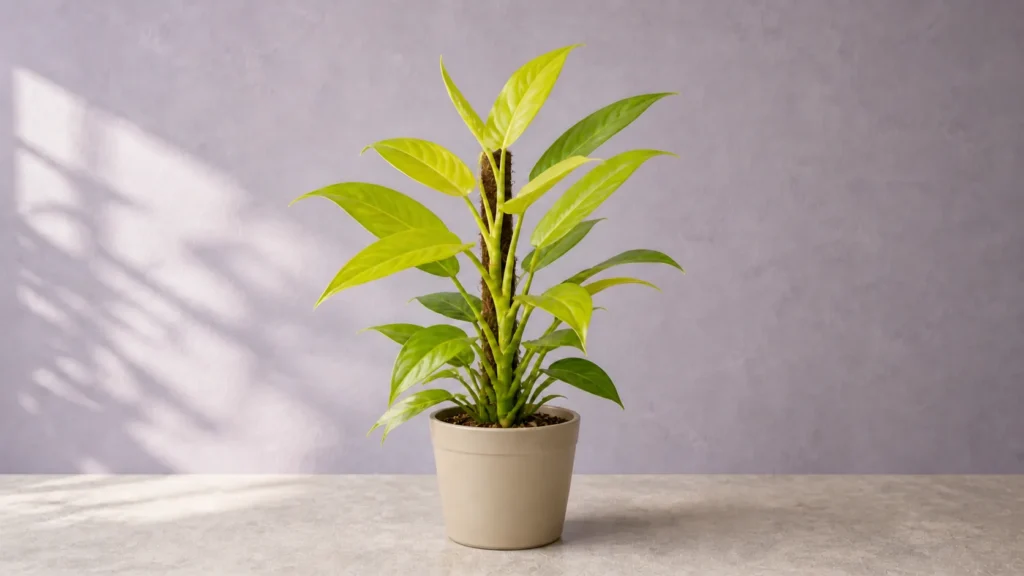
Philodendron ‘Malay Gold’
Philodendron 'Malay Gold'
A bright chartreuse climbing philodendron, often sold as Golden Goddess or Upright Lemon Lime Philodendron, with an upright young habit and longer leaves than heartleaf 'Lemon Lime'.
Watering frequency
Every 7-10 days
Ideal temperature
65-85°F / 18-29°C; minimum 59°F / 15°C
Humidity
40-70%
Care difficulty
Easy
Air purifying
No/Not Known
Growth rate
Fast
Plant size
2-6 ft climbing / 0.6-1.8 m indoors
Soil type
Loose, well-draining aroid mix
Fertilizer need
Every 4-6 weeks while actively growing.
Care summary
- Light: Bright indirect light supports strong chartreuse color; avoid harsh direct sun.
- Water: Let the top 1-2 inches of mix dry, then water thoroughly and drain.
- Soil: Use an airy aroid mix in a pot with drainage holes.
- Growth: Fast; upright and bushy when young, then lengthening and climbing with aerial roots.
- Support: Add a pole, board, or trellis as the main stem extends.
- Safety: Not pet-safe; keep away from pets and children who may chew it.
Common problems
- Older leaves turning greener: often normal maturation, but weak light can reduce the brightest color in new growth.
- Long internodes and small leaves: insufficient light, no climbing support, or both.
- Yellow leaves while soil stays wet: overwatering, compacted mix, or poor drainage.
- Pale tan patches: direct-sun scorch on chartreuse foliage.
- Brown tips: irregular watering, dry air, or fertilizer-salt buildup.
- Thrips, spider mites, scale, or mealybugs: inspect new growth, leaf undersides, and stem joints.
Plant care guide
About Philodendron 'Malay Gold'
Philodendron 'Malay Gold' is a cultivated golden-leaved philodendron with chartreuse to yellow-green foliage and a stem that becomes increasingly vine-like as it matures. It is commonly sold under the market names Golden Goddess, Philodendron Golden Goddess, and Upright Lemon Lime Philodendron. Those names are useful shopping and search aliases, so they are included in this page's Plant Aliases. They are not being presented as separate botanical species or as formal scientific synonyms.
The naming needs an important qualification. Retailers sometimes shorten Upright Lemon Lime Philodendron to simply “Lemon Lime Philodendron.” House Plant Finder does not use that ambiguous shortened name as a Malay Gold alias because this database already has a separate Philodendron 'Lemon Lime' page for the heartleaf cultivar Philodendron hederaceum 'Lemon Lime'. The two plants can share bright lime color and overlapping retail labels, but they differ in leaf shape, growth form, and documented identity.
Taipei Collectible Botanical Garden records the cultivated plant as Philodendron 'Malay Gold', lists Philodendron Golden Goddess and Philodendron Lemon Lime among its English market names, and describes its parentage as unknown. Its account also describes oval leaves, easy branching, upright young stems, and later drooping or climbing growth. That combination is a more useful basis for identifying this page's plant than color or a nursery tag reading “Lemon Lime” alone.
Why You'll Like It
Malay Gold supplies the brightness of a neon foliage plant without a mottled pattern. New leaves open vivid yellow-green, then commonly settle into golden lime or greener chartreuse. A young plant looks compact and upright; later stems can climb a pole or arch from a stand. Bright filtered light, drainage, and ordinary warm-room conditions also make it a reasonable beginner-friendly houseplant when kept away from pets that chew plants.
What Kind of Plant Is It?
Malay Gold is a horticultural Philodendron cultivar in the aroid family, Araceae. It is best understood as an upright-when-young climber rather than as a permanently self-heading rosette. Leaves emerge one after another along a stem. At each node—the joint where a leaf meets the stem—the plant may produce a bud and an aerial root. Those roots help a maturing vine grip a support.
The leaves are usually oval to elongated rather than deeply heart-shaped, with bright color across most or all of the blade. Older leaves may become greener as they harden; judge light quality from several new leaves, internode spacing, and overall vigor rather than from one aging leaf.
Malay Gold is a fast-growing indoor climber once established. Young nursery plants can look compact and bushy, but the main stem soon reveals the climbing habit. Check its support every two to three months from spring through early fall. A new plant or cutting may pause for four to eight weeks while acclimating or establishing roots.
Naming and Cultivar History
The origin of the name 'Malay Gold' is less firmly documented than many retail summaries imply. The botanical-garden record above treats it as a cultivar of unknown parentage. A specialist retailer likewise notes that the breeder, parentage, and place of selection for 'Malay Gold' remain undocumented, while also acknowledging that 'Malay Gold', 'Golden Goddess', and 'Lemon Lime' are often treated as interchangeable in horticultural sales.
There is also a documented U.S. plant patent for a distinct Philodendron cultivar named 'Lemon Lime'. The patent describes a 2004 tissue-culture mutation associated with Philodendron domesticum, selected by Tai Yam and characterized by bright lime-to-golden foliage, pink-toned petioles, basal shoots, and an upright young habit. These details help explain why the “Upright Lemon Lime” name appears in the market around Malay Gold-type plants.
However, the patent does not prove that every Malay Gold or Golden Goddess is genetically identical to the patented 'Lemon Lime'. This page therefore keeps Philodendron 'Malay Gold' as the stable name, records Golden Goddess and Upright Lemon Lime Philodendron as market aliases, and avoids assigning an unsupported parent species.
Philodendron 'Malay Gold' vs Philodendron 'Lemon Lime'
House Plant Finder treats these as separate plant profiles because the name “Lemon Lime” is used for two visibly different plants.
- Malay Gold / Golden Goddess / Upright Lemon Lime: Look for elongated oval or narrow golden leaves, a substantial central stem, basal branching, and a young plant that stands upright before it lengthens and climbs.
- Philodendron 'Lemon Lime': This profile covers Philodendron hederaceum 'Lemon Lime', a Heartleaf Philodendron cultivar with thinner, clearly heart-shaped leaves on slender, continuously trailing or climbing vines. NC State Extension lists 'Lemon Lime' among the cultivars of P. hederaceum.
Do not identify them by color alone. Both can be lime, yellow-green, or greener under different light. Instead, inspect mature leaf shape and stem architecture. A small specimen can be difficult to judge, so retain the nursery's full label, photograph the mother plant if possible, and avoid renaming it until later growth confirms the habit.
The distinction also affects display: heartleaf 'Lemon Lime' suits a hanging basket from an early stage, while Malay Gold starts fuller and upright, then benefits from vertical support. They should not share one database identity or slug.
Popular Golden Philodendrons and Related Plants
Several chartreuse aroids are sold nearby but are not guaranteed synonyms:
- Philodendron 'Lemon Lime': A slender heartleaf vine and the closest naming conflict.
- Philodendron 'Moonlight': A broader-leaved, self-heading plant rather than a climber.
- Heartleaf Philodendron: Deep-green P. hederaceum with heart-shaped foliage.
- Neon Pothos: A bright climbing or trailing Epipremnum, not a philodendron.
Keep the exact cultivar or trade label when buying any of them.
Where It Works Best
Place Malay Gold near an east window or back from stronger south- or west-facing glass. Gentle morning sun may work after acclimation, but hot direct sun can scorch chartreuse leaves. A living room or office lets the plant move from tabletop to supported floor display as it grows. Avoid dark bathrooms, drafts, cold glass, and heaters, and remember that an extending stem may reach pets even when the pot sits high.
Philodendron 'Malay Gold' Care
Light
Bright indirect light produces the strongest balance of color and compact growth. A little soft early sun is usually easier to tolerate than intense afternoon exposure. Increase direct light gradually after moving the plant; pale foliage can scorch before the root system and leaf tissue acclimate.
If new internodes become long and leaves stay small, move the plant closer to a usable light source or add a grow light. If new foliage is healthy but mature leaves become somewhat greener, do not react by pushing the plant into harsh sun. Normal maturation also deepens the color.
Watering
Water when the top 1–2 inches (2–5 cm) of mix are dry and the pot feels lighter. Wet the root ball thoroughly and let excess water drain. Every 7–10 days is only a starting estimate; pot size, roots, substrate, temperature, light, and season change the interval.
Do not keep the mix continuously wet to prevent an occasional droop. Persistent moisture displaces air around the roots and can lead to yellowing, soft stems, and root decline. At the other extreme, repeated severe drying can brown edges and slow new growth. The practical goal is a repeatable wet-to-partly-dry cycle.
Soil and Container
Use a loose aroid mix, such as potting mix or coco coir with perlite or pumice and fine orchid bark. Avoid an overly coarse blend that dries immediately or dense peat that stays wet in winter. Choose a draining pot only modestly larger than the roots, empty cachepot runoff, and install support during repotting before the vine becomes difficult to handle.
Humidity
Normal household humidity is workable. In very dry conditions, a room humidifier is more useful than misting; provide gentle airflow when humidity is high.
Temperature
Keep Malay Gold around 65–85°F (18–29°C), with 59°F (15°C) as the hard lower limit. The Royal Horticultural Society recommends at least 59°F / 15°C for indoor philodendrons. Move the plant before an overnight room or windowsill is expected to fall below that point; cold stress may cause stalled growth, drooping, or leaf loss. Growth slows as winter light and temperature fall, so the pot also takes longer to dry.
Fertilizer
Feed every four to six weeks while the plant is actively producing leaves, using a balanced houseplant fertilizer according to its label or at a conservative dilution. Reduce or pause feeding when growth slows in winter or after root stress. Fertilizer cannot correct weak light, compacted soil, or damaged roots; solve those conditions first.
Flush with plain water if mineral crust forms. Brown tips can also reflect inconsistent watering or dry air, so inspect the full care pattern before adding fertilizer.
Pruning and Training
Add a pole, plank, or trellis once the main stem begins to lean or lengthen. Secure the stem loosely with soft ties; do not bind the leaf stalks. Guide aerial roots toward the support, but do not force brittle roots into place.
To control height or rebuild a sparse plant, cut the stem just above a healthy node on the parent. New growth can activate below the cut. Root the removed section and return several established cuttings to the pot if you want a fuller base. Clean pruning tools before and after use because philodendron sap can irritate skin.
How to Propagate Philodendron 'Malay Gold'
Propagate Malay Gold from a stem section containing at least one viable node. A leaf and petiole without a piece of node may remain green temporarily but cannot produce a complete new vine. Choose a healthy section, cut below the node, and remove any leaf that would sit under water or substrate.
For the clearest schedule, take cuttings between March and August, when warmth and daylight normally support active growth. Root the cutting in water, damp sphagnum, perlite, or airy mix and keep it warm in bright indirect light. Check water-grown cuttings weekly. Expect the first roots in two to four weeks, then pot up at four to six weeks, when several roots are about 1–2 inches (2.5–5 cm) long. The RHS philodendron guide gives a couple of weeks as the normal initial rooting period, while a Golden Goddess propagation guide gives approximately three to four weeks before roots begin.
After moving a water-rooted cutting into soil, keep the mix lightly and evenly moist for the first one to two weeks, then begin the normal wet-to-partly-dry cycle. A cutting started directly in mix should be left undisturbed for four to six weeks before a gentle resistance check. Winter or cool-room propagation may take six to eight weeks, but a cutting that remains soft or blackening should be inspected rather than left indefinitely.
Basal shoots may sometimes be separable during repotting if they already have their own roots. Do not tear an unrooted shoot away merely because it appears beside the main stem.
Repot Philodendron 'Malay Gold'
Plan to repot Malay Gold every 12–24 months, ideally from March through May as active growth resumes. Fast young plants may need the shorter interval; established plants in larger containers often use the full two years. RHS says philodendrons can usually remain in their container for at least a couple of years and identifies spring as the best repotting time, while Golden Goddess-specific guidance recommends a one-to-two-year interval.
At the scheduled check, repot if roots densely circle the container, water rushes through collapsed mix, or the plant has become unstable. Move up 1–2 inches (2.5–5 cm) in pot diameter. Water once to settle the fresh mix, then wait until the top 1–2 inches dry before watering again. Pause fertilizer for four weeks after repotting so newly disturbed roots are not exposed immediately to additional salts.
If a wet plant wilts or smells sour, inspect roots instead of using a larger pot. Trim only dead, soft material, replace failed mix, and delay feeding until active growth resumes.
Toxicity and Pet Safety
Philodendron 'Malay Gold' is marked not pet-safe on a genus-level basis. The ASPCA does not provide a cultivar-specific Malay Gold test on the page used here, but its Philodendron toxicity record identifies insoluble calcium oxalates and lists oral burning or irritation, drooling, vomiting, swelling, and difficulty swallowing after exposure in cats and dogs. This cultivar belongs to the same genus, so the conservative database status is not pet-safe.
Keep foliage, pruned stems, and propagation containers away from pets and children who may chew them. Wear gloves if sap irritates your skin. If ingestion occurs, contact a veterinarian, animal poison-control service, human poison-control service, or appropriate medical professional. Swelling that affects breathing or swallowing needs urgent professional help.
Common Problems and Practical Fixes
- Older leaves turn greener: Some color deepening is normal. If the newest leaves are also dark and internodes stretch, increase indirect light gradually.
- Long stem with small leaves: Check both light and support. A climbing stem in dim conditions often stretches; improve light and guide it vertically before reaching for fertilizer.
- Yellow leaves while the pot stays wet: Extend the dry-down period, empty the cachepot, and assess whether the mix has compacted. Persistent wilt in wet soil calls for a root inspection.
- Tan or bleached patches: Sudden direct sun can scorch pale foliage. Move the plant out of the hot beam while preserving bright ambient light.
- Brown tips: Compare irregular watering, dry air, fertilizer salts, and root stress. One symptom does not identify one cause.
- Stalled growth: Consider season and recent acclimation first, then check usable light, root condition, temperature, pests, and crowding. A larger pot or stronger feed is not an automatic cure.
- Thrips, mites, scale, or mealybugs: Inspect new leaves, undersides, petiole joints, and stems. Isolate affected plants and use a treatment labeled for indoor ornamentals, repeating as directed.
Frequently Asked Questions
Are Golden Goddess and Philodendron 'Malay Gold' the same plant on this site?
Yes. Golden Goddess and Philodendron Golden Goddess are recorded as market aliases for this Malay Gold profile. They are not separate Plant pages in this database.
Is Upright Lemon Lime Philodendron the same as Malay Gold?
House Plant Finder treats Upright Lemon Lime Philodendron as a market alias for Malay Gold. The full word “Upright” matters because the unqualified Lemon Lime Philodendron name is also widely used for the separate heartleaf cultivar P. hederaceum 'Lemon Lime'.
Is Malay Gold the same as Philodendron 'Lemon Lime'?
Not in this database. Malay Gold has longer oval leaves and an upright-when-young stem that later climbs. The linked heartleaf Philodendron 'Lemon Lime' has clearly heart-shaped leaves on slender trailing or climbing vines.
Does Malay Gold stay upright?
Not permanently. It can be bushy and upright while young, but its stem lengthens with age and may droop or climb. Add support when that transition begins.
Why is my Malay Gold becoming greener?
Older leaves commonly deepen as they mature. If all new growth is darker and stretched, light is probably too weak; move the plant gradually toward brighter indirect light.
Final Thought
Philodendron 'Malay Gold' is easiest to understand once its market names are organized correctly. Golden Goddess and Upright Lemon Lime Philodendron belong with this upright-when-young golden climber; heartleaf Philodendron 'Lemon Lime' belongs on its own profile. After identification, the care is straightforward: give Malay Gold bright filtered light, let the upper mix partly dry, keep the roots aerated, and add support as the stem lengthens.