
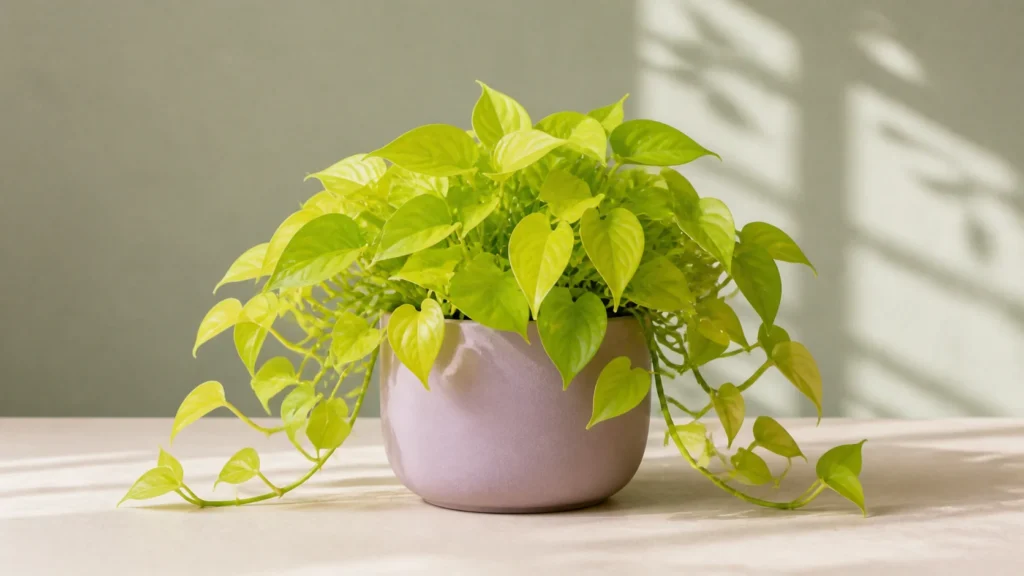
Neon Pothos
Epipremnum aureum 'Neon'
A Golden Pothos cultivar with solid chartreuse-yellow leaves whose color shifts with light — nearly as easy as the green form, with a much brighter look.
Watering frequency
Every 7-14 days
Ideal temperature
65-85°F / 18-29°C
Humidity
40-60%
Care difficulty
Easy
Air purifying
Yes
Growth rate
Fast
Plant size
2-6 ft / 0.6-1.8 m
Soil type
Well-draining potting mix
Fertilizer need
Monthly, spring-summer.
Care summary
- Light: Medium to bright indirect light keeps the neon color vivid.
- Water: Let the top 1-2 inches dry, then water thoroughly and drain.
- Soil: Use an airy, well-draining mix in a pot with drainage holes.
- Growth: Fast for a pothos; prune to keep the plant full and bushy.
- Humidity: Average household humidity is usually sufficient.
- Safety: Keep away from pets and children who may chew the leaves.
Common problems
- Leaves turning dark green: Light too dim; move the plant brighter gradually.
- Pale, washed-out leaves: Too much direct sun, or a nutrient problem in the soil.
- Yellow leaves: Usually overwatering or poor drainage.
- Leggy vines with wide gaps: Needs brighter indirect light or pruning.
- Brown leaf tips: Check watering consistency, fertilizer buildup, or dry air.
- Mealybugs or scale: Inspect leaf joints, stems, and new growth.
Plant care guide
About Neon Pothos
Neon Pothos (Epipremnum aureum 'Neon') is a cultivar of the same species as Golden Pothos, whose accepted botanical record is maintained by Kew Plants of the World Online. Instead of variegation, its leaves are a solid, luminous chartreuse — a yellow-green that looks almost backlit, especially on new growth.
The color is the cultivar's identity, and it is a living color: the plant adjusts it to its conditions. In bright indirect light, leaves hold a vivid yellow-green. In dimmer rooms, the same plant produces deeper, more muted green foliage. This color-shifting is the most interesting thing about Neon Pothos, and it makes the plant a useful "light meter" for its own care.
Because the leaves are solid green with no white tissue, Neon has none of the variegation burden that slows Marble Queen Pothos. It grows fast, tolerates a wider range of light, and is nearly as forgiving as the classic Golden Pothos — while looking completely different.
Why You'll Like It
Neon Pothos delivers a strong color pop with almost no extra effort. One plant on a shelf or in a hanging planter adds a bright accent that few houseplants match, and it stays vibrant without flowers or fuss.
It is also the most useful pothos for reading your own light levels. If the new leaves come out dark green, your spot is dimmer than ideal. If they stay bright chartreuse, you have found the right window. No other common pothos gives you that kind of direct feedback.
It grows faster than the white-variegated cultivars, so it is a better choice when you want to fill a space or train vines up a trellis. And unlike the marble forms, it does not scorch easily in bright light — its high chlorophyll content makes it tough in ways the white-leaved cultivars are not.
What Kind of Plant Is It?
Neon Pothos is a climbing and trailing aroid vine — same nodes, aerial roots, and juvenile indoor foliage as the species, as described in the NC State Extension profile of Epipremnum aureum. What makes the cultivar special is its pigment profile: the leaves carry reduced chlorophyll in a way that produces the yellow-green color but still leaves enough green tissue to grow vigorously.
That distinction matters. A solid-color cultivar like Neon does not carry the same white, non-photosynthetic tissue as a strongly variegated cultivar such as Marble Queen Pothos. There is no white tissue to scorch or variegated pattern to lose, so the plant can generally maintain faster, more even growth.
The one trait to understand is color response. The chartreuse look depends on light: bright indirect light produces the brightest color, while low light pushes the leaves greener and the vines leggier. The plant is not "broken" when it darkens — it is adapting. Move it brighter and new growth will regain the neon tone.
The pigment story is worth understanding because it explains the color shifts. Green in leaves comes from chlorophyll, but leaves also carry accessory pigments — carotenoids that read as yellow and orange. In most plants, chlorophyll is so abundant it masks the carotenoids entirely. Neon Pothos carries reduced chlorophyll, so the yellow carotenoids show through, producing the chartreuse tone. When the plant gets less light, it responds by building more chlorophyll to capture what it can — the yellow gets masked again, and the leaf looks ordinary green. In bright light, chlorophyll production stays lean, the carotenoids dominate, and the neon color returns. This is also why the newest leaves are usually the most intensely colored: young leaves have not yet accumulated the chlorophyll that older leaves build up over time. If you notice that new growth is brighter than last season's leaves, that is normal physiology, not a problem.
Neon Pothos vs. Look-Alikes
Several houseplants are sold in similar yellow-green tones, and they are easy to confuse at a glance:
- Neon Pothos — chartreuse leaves on a pothos vine with aerial roots at the nodes; leaf blades are waxy and slightly thick.
- Philodendron Lemon Lime — a heartleaf philodendron in nearly the same yellow-green, with thinner, softer leaves, smooth petioles, and a different climbing habit. Our Philodendron 'Lemon Lime' record covers the differences in detail.
- Golden Pothos — green with yellow-gold flecks rather than solid color.
- Marble Queen Pothos — cream and white marbling on a slower-growing vine.
- Satin Pothos — matte green leaves splashed with silver on a Scindapsus pictus; a common shelf-mate sold under the pothos umbrella despite being a different genus.
A reliable quick check: pothos leaves emerge from petioles with a subtle groove, while philodendron petioles are round and smooth. And pothos aerial roots are stiffer and browner. If you are still unsure, the leaf edge — pothos leaves are slightly wavy along the margin — is a useful clue.
Where It Works Best
Neon Pothos is happy in medium to bright indirect light, which gives it more placement freedom than the white-variegated cultivars. An east window is ideal; back from a south or west window also works well. The houseplant light guide is a good reference for reading light levels in any room.
It will grow in lower light, and more gracefully than most pothos — the main cost is color and pace. Leaves deepen to green and vines stretch. No plant thrives in a truly dark corner, but ZZ Plant, Snake Plant Laurentii, and Snake Plant Moonshine tolerate dimmer conditions than many common houseplants. For a room that is bright-ish but not sunny, Neon Pothos remains a strong choice.
Because the color is the point, give it a spot where the light is consistent. It brightens living rooms, offices, and bedrooms, and looks especially good against dark furniture or in a hanging planter where the trailing vines catch the light.
In interior terms, Neon Pothos behaves like a living accent color. The chartreuse sits next to most neutrals without clashing — it warms gray walls, pops against deep green or navy, and reads almost like a graphic element against white shelves. A single plant can carry a vignette that would otherwise need a colored object or a painting. And because the color responds to light, the same plant can be subtly styled: give it a bright spot and it glows; move it a step back and it settles into a softer, deeper green. That flexibility is rare among houseplants, where most choices are fixed at purchase.
How to Care for Neon Pothos
The full routine follows the species standard — the Golden Pothos care guide linked above covers watering, soil, humidity, temperature, fertilizer, and repotting in depth. The cultivar-specific notes are these:
Light: Medium to bright indirect light keeps the neon color vivid. If the leaves start coming in dark green, increase light gradually over a few days. Avoid prolonged harsh direct sun — while Neon is tougher than the white cultivars, intense afternoon sun can still bleach or scorch leaves.
Watering: When the top 1-2 inches of mix feel dry, water thoroughly and drain. Many homes land around every 7-14 days, but check the soil first — pot size, warmth, and light change the interval. The watering guide explains how to build a routine around soil moisture rather than a calendar.
Soil and container: The same airy, well-draining mix with drainage holes as the species. Nothing special needed.
Fertilizer: Balanced fertilizer at half strength monthly in spring and summer, paused in winter. Overfeeding does not substitute for light — it just builds salts.
Pruning and training: Prune long or bare vines just above a node to keep the plant full. Train vines upward on a moss pole or trellis for larger leaves, or let them trail.
How to Propagate
Propagation is identical to the species: take a cutting with at least one node, remove the lowest leaf, and root it in water or moist mix in bright indirect light. A cutting with two or three leaves is the easiest size to start.
Neon propagates easily because there is no variegation to worry about — every cutting grows true to the cultivar's color. Water-rooted cuttings can be moved to a small pot of moist mix once the roots are several inches long, then treated like the parent plant.
When to Repot
Repot when roots circle the pot or grow through the drainage holes, or when the mix dries out almost immediately after watering — typically every 1-2 years. Move up only 1-2 inches in pot size and use fresh mix. Full steps are in the houseplant repotting guide.
Toxicity and Pet Safety
Like every Epipremnum aureum cultivar, Neon Pothos is not pet-safe. The ASPCA lists the species as toxic to cats, dogs, and horses, with insoluble calcium oxalates as the toxic principle and oral pain or swelling, drooling, vomiting, and difficulty swallowing among the clinical signs. Breathing or swallowing difficulty requires urgent professional help.
If a pet chews the plant, remove it from reach and contact your veterinarian or an animal poison-control service promptly. Remember that trailing vines grow back into reach even from a high shelf. For pet-owning households, Hoya Carnosa offers a similar trailing habit and is not listed as toxic for pets.
Common Problems and Practical Fixes
- Leaves turning dark green: Light too dim. Move the plant to brighter indirect light gradually; new growth will regain the neon color.
- Pale, washed-out leaves: Too much direct sun or a soil problem. Check light first, then watering and feeding.
- Yellow leaves: Usually overwatering or poor drainage. Let the mix dry appropriately and inspect roots if symptoms continue. The yellow leaves guide helps compare causes.
- Leggy vines: Wide gaps between leaves indicate insufficient light. Brighten the spot and prune to rebuild fullness.
- Brown leaf tips: Check watering consistency, fertilizer buildup, and dry drafts. Flush the soil occasionally if salts collect.
- Mealybugs or scale: Inspect leaf joints and stems, isolate the plant, and treat weekly until clear.
Frequently Asked Questions
Why is my Neon Pothos turning dark green?
It is responding to light levels. Dimmer conditions push the plant to produce more chlorophyll, which darkens the leaves. Move it to brighter indirect light and new growth will return to chartreuse.
Is Neon Pothos the same as Philodendron Lemon Lime?
No. They look similar — both are yellow-green trailing aroids — but they are different genera. Neon Pothos has waxy, slightly grooved petioles and stiffer aerial roots; Philodendron Lemon Lime has softer leaves and smooth round petioles. The Philodendron 'Lemon Lime' record linked above covers the comparison in more detail.
Does Neon Pothos need more light than Golden Pothos?
Roughly the same, and less than the white-variegated cultivars like Marble Queen. Neon has plenty of chlorophyll, so it grows well in medium light; it only needs brighter light to keep its signature color vivid.
Is Neon Pothos toxic to cats and dogs?
Yes. It contains the same insoluble calcium oxalates as all pothos cultivars, and the ASPCA lists the species as toxic to cats, dogs, and horses. Keep it out of reach of pets and children.
Why are the new leaves lighter than the old ones?
That is normal. New leaves start with less chlorophyll, so the carotenoid yellow shows through more strongly — the newest growth looks the most neon. As a leaf ages, it accumulates more chlorophyll and settles into a deeper chartreuse. Only worry if the entire plant, including new growth, turns dark green, which means the light is too dim.
Why is the stem turning brown and woody at the base?
That is normal aging, not disease. As pothos vines mature, the lower stem develops a brown, bark-like coating and the plant looks less like a young cutting and more like a small vine. Healthy older stems stay firm and keep growing from the tip. Only worry if the browning is soft or mushy, which points to overwatering and rot rather than normal maturity.
Final Thought
Neon Pothos is the easiest way to add a bold color statement to a room without learning anything new. It asks for the standard pothos routine — dry the top inch of soil, water thoroughly, give it decent indirect light — and returns fast growth plus a living chartreuse color that tells you exactly how happy it is. If your spot is bright, this is the pothos that will reward you most visibly.