
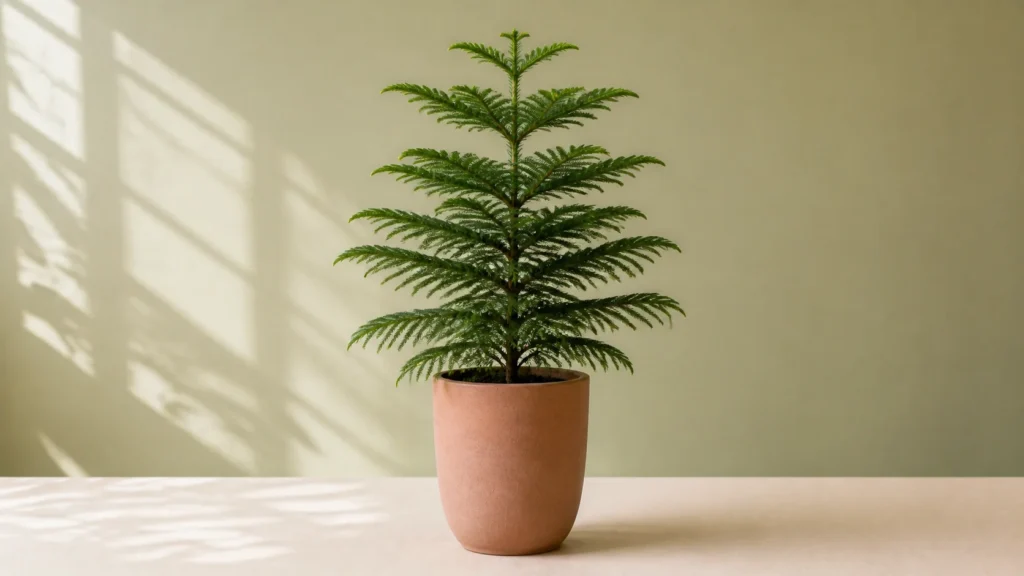
Norfolk Island Pine
Araucaria heterophylla
A graceful, tiered conifer that doubles as a living Christmas tree — easy to love, harder to keep happy past its first holiday season.
Watering frequency
Every 7-14 days
Ideal temperature
55-70°F / 13-21°C
Humidity
40-60%
Care difficulty
Medium
Air purifying
No/Not Known
Growth rate
Moderate
Plant size
3-6 ft / 0.9-1.8 m
Soil type
Well-draining, sandy, slightly acidic potting mix
Fertilizer need
Monthly, spring-fall.
Care summary
- Light: Bright light, even some direct sun, for compact growth.
- Water: Keep the soil lightly moist in spring-summer; drier in winter.
- Soil: Well-draining, sandy, slightly acidic mix.
- Temperature: Cool to comfortable rooms; avoid hot, dry vents.
- Grooming: Wipe needles and rotate weekly for even growth.
- Safety: ASPCA lists as non-toxic, but prickly needles carry physical risks.
Common problems
- Drooping lower branches: underwatering or sudden temperature swings.
- Yellowing needles: overwatering or underwatering.
- Leggy, one-sided growth: not enough light.
- Brown, crispy needle tips: dry air or salt buildup.
- Scale: small brown bumps on stems and needle undersides.
Plant care guide
About Norfolk Island Pine
The Norfolk Island Pine (Araucaria heterophylla) is not actually a pine — it belongs to Araucariaceae, an ancient conifer family that predates the true pines and dates back to the age of the dinosaurs. It is endemic to Norfolk Island, a tiny speck of land in the Pacific Ocean between Australia and New Caledonia, where wild specimens tower 200 feet above the island's cliffs. What you buy as a houseplant is a young version of that giant: a perfectly symmetrical, pyramidal tree with branches arranged in tidy horizontal tiers, usually five per whorl, covered in soft dark-green needles that curl inward in a herringbone pattern.
Its natural symmetry is the reason it has become a seasonal icon. Norfolk Island Pine is the classic "living Christmas tree" — a real, growing tree that families decorate, enjoy through the holidays, and (with care) keep growing afterward. The plant has been a houseplant for over a century, and its popularity spikes every December as retailers stock them for the holiday season.
Two things make it more demanding than it looks. First, it wants bright light — far more than most people assume for a tree sold as a holiday decoration. Second, it is sensitive to extremes: both overwatering and underwatering, hot dry air, and sudden temperature swings all show up quickly in its needles. The plant is not difficult if you meet those basic needs, but it punishes neglect faster than most conifers you'll bring home.
Why You'll Like It
The Norfolk Island Pine gives you something no other houseplant can: a living, growing tree with architectural symmetry, usable as an actual Christmas tree that never sheds its needles all over the floor. Unlike a cut tree, it stays green year-round, grows a little taller each year, and becomes a permanent part of the room instead of a piece of seasonal trash.
It is also a genuinely beautiful plant outside the holidays. The tiered, windmill-like silhouette is sculptural and calm, and it pairs surprisingly well with modern and minimalist interiors — a potted Norfolk Island Pine reads as deliberate design, not leftover decoration. It grows slowly enough to stay manageable indoors (expect 3-6 feet over several years in a typical living room) and tolerates ordinary household air better than most tropical plants.
And it asks for surprisingly little in return: no pruning, no fussing over flowers, just consistent light, steady-but-not-soggy watering, and a spot away from heat vents. For plant owners who want a tree — not a vine, not a bushy mound — the Norfolk Island Pine is the obvious choice.
What Kind of Plant Is It?
Three facts explain how this plant behaves.
- It is a true conifer, not a pine. Despite the common name, it is a member of the Araucariaceae family — an ancient lineage of cone-bearing evergreens from the southern hemisphere. Its relatives include the monkey puzzle tree and the kauri. Indoors it never produces cones or seeds; it simply grows as a compact evergreen.
- Its shape is a growth habit, not a style. The symmetrical tiers come from the tree's natural growth pattern — each whorl of five branches is one year's growth. If the growing tip (the "crown") is damaged, the symmetry breaks permanently and the tree grows crooked. That is why you must never top or cut the crown of a Norfolk Island Pine.
- It is a slow, deliberate grower with a long memory. It tolerates low light for years — the NC State Extension notes it can survive in very low light for two to three years — but eventually the weak light shows up as dropping lower branches and a thin, leggy crown. The plant forgives slowly, then makes you pay all at once.
Where It Works Best
The Norfolk Island Pine needs the brightest spot you can give it. NC State recommends full sun for compact, symmetrical growth, with light afternoon shade if you worry about foliage bleaching. Indoors, that translates to a spot right beside a south- or west-facing window, or in a bright room with several hours of direct sun. A tree a few feet from a window in ordinary room light will survive for a season or two, then gradually stretch and drop branches.
It also prefers cool air. NC State describes the ideal indoor environment as "a bright, cool room" at 55-65°F — cooler than most plants want. That makes a cool bedroom, an unheated hallway, or a living room away from the furnace genuinely better for it than a hot, sunny sunroom. Keep it well away from heat vents, radiators, and fireplace surrounds, which dry out the needles and cause browning in weeks.
For placement, think of it as a floor plant or a large table centerpiece. A living room corner beside a bright window, an entryway with daylight, or a home office near a south window all work. During the holidays it earns a spot wherever the tree goes — just remember it needs light, so a permanently dark corner decorated for Christmas is where the decline begins.
How to Care for Norfolk Island Pine
Watering: During spring and summer, water when the top inch of soil feels dry — typically every 7-14 days in a bright room — and water thoroughly so the soil is evenly moist but never soggy. In winter, cut back: the tree rests, and cooler rooms mean the soil stays wet longer. Water sparingly, letting the mix dry further between waterings. The watering guide explains how to read the soil by touch; the most common Norfolk Island Pine death is a pot that stays wet for weeks.
Light: Bright light, including direct sun, drives compact growth and keeps the tiers tight. A south or west window is ideal; if the needles yellow or bleach, pull it back slightly or add sheer shade. If new growth comes in stretched and the crown thins, the plant is telling you it needs more light — move it before the lower branches start dropping. The light guide helps you gauge what your window actually delivers.
Soil: Use a well-draining, sandy, slightly acidic potting mix — a standard houseplant mix with added perlite and a little coarse sand works well. The roots need air; a mix that stays dense and waterlogged is the fastest route to root rot.
Temperature: Cool-to-comfortable rooms of 55-70°F (13-21°C) suit it best. It tolerates typical household warmth but dislikes both hot, dry air and cold drafts. If your home runs warm and dry in winter, compensate by watering slightly less and misting the needles occasionally — NC State specifically recommends misting in heated rooms.
Humidity: Ordinary household humidity is acceptable, but dry heating-season air browns the needle tips. A pebble tray, a nearby humidifier, or a monthly misting of the needles helps; the humidity guide covers the practical options.
Fertilizer: Feed monthly from spring through fall with a diluted balanced liquid fertilizer (half-strength is plenty). Stop feeding in winter. This keeps the green dense without pushing soft, floppy growth.
Grooming and rotation: Wipe the needles occasionally with a damp cloth to keep them dust-free and photosynthesizing at full strength. Rotate the pot a quarter-turn weekly so every side gets light and the tree stays straight — a tree parked against one window will lean hard toward it within a year.
How to Propagate
Propagation is the one thing this plant genuinely can't do like other houseplants. Norfolk Island Pine grows from seed, and the seed cones mature for 18 months on mature trees before releasing edible, nut-like seeds — you will not see this happen on a houseplant. Seed-starting kits are occasionally available from specialty nurseries, and germination is slow and unreliable, so most growers simply buy a young tree.
A common mistake is trying to root a cutting from the crown. Cuttings do not produce a healthy plant: they rarely root well, and if they do, the cutting loses the tree's natural pyramidal symmetry and grows as a low, shrubby oddity. Worse, cutting the crown off the mother plant permanently ruins its shape — remember, damage to the growing tip breaks the tiers for good. If your tree outgrows its space, the honest options are to move it to a larger pot and a brighter room, or pass it to someone with more ceiling.
When to Repot
Repot every two to three years in spring, when the tree is actively growing and recovers fastest. Norfolk Island Pines prefer being slightly snug — a pot too large holds water too long and invites root rot. Move up only one pot size, and use fresh, well-draining, slightly acidic mix. Handle the roots gently; they are fine and resent disturbance. If the tree is large and the root ball intact, many growers simply refresh the top few inches of soil and leave the root ball alone — the repotting guide walks through the standard technique.
Toxicity and Pet Safety
Good news for pet owners: the ASPCA lists Norfolk Island Pine as non-toxic to dogs, cats, and horses. That means the chemical composition is not the hazard many holiday-tree owners assume it is — the plant is not like true pine sap or poinsettia-adjacent irritants.
The caveat is physical. The needles are soft but pointed, and a pet that chews and swallows a large amount of needle material can still get an upset stomach from the sheer bulk and fiber, even without chemical toxicity. Keep the tree where curious pets can't nibble it, and sweep up dropped needles promptly — a needle stuck in a paw or throat is unpleasant for everyone. For a rundown of genuinely pet-safe houseplant options, the pet-safe plants guide is a useful comparison.
Common Problems and Practical Fixes
- Drooping or dying lower branches: The classic Norfolk Island Pine failure, and almost always one of two causes: the soil stayed too wet (root rot) or the plant sat in too little light too long. Check the roots; if they're dark and mushy, repot into fresh dry mix and water far less. If the roots are fine, move the tree to the brightest spot you have.
- Yellowing needles: Overwatering is the usual culprit, but underwatering and hot dry air both show up as yellow. Rule out soggy soil first — this plant tolerates being slightly dry far better than being wet.
- Leggy, one-sided growth: The tree is reaching for light. Move it to a brighter window and rotate the pot weekly.
- Brown, crispy needle tips: Dry air, salt buildup from hard water, or fertilizer burn. Raise humidity, use filtered water, and check your feeding strength.
- Scale: Small brown bumps on stems and needles — a common pest on indoor conifers. Wipe with rubbing alcohol on a cotton swab and treat with horticultural oil; the pest guide covers the routine.
- Crown damage: If the top breaks or is cut, the tree will not regrow its symmetrical tiers — it branches awkwardly below the wound. Protect the crown when moving the plant, and never cut it.
Frequently Asked Questions
How tall does a Norfolk Island Pine grow indoors?
Slowly and controllably — expect 3-6 feet over several years in a typical living room, with the ceiling as the eventual limit. In its native habitat it reaches 200 feet; as a potted houseplant it simply grows one tier per year until it runs out of room.
Can I use it as a real Christmas tree?
Yes — that's its most popular role. Decorate it with lightweight ornaments, and remember it's a living plant: keep it in bright light, away from heat vents, and water it normally through the holidays. After the season, take the ornaments off and let it keep growing as an everyday houseplant.
Why is my Norfolk Island Pine turning brown and dropping branches?
Almost always too little light or too much water. It survives low light for a season or two, then the lower branches yellow and drop as the tree sacrifices old growth. Move it to the brightest window, let the soil dry out between waterings, and the decline usually stops.
Does it need to be misted?
Misting helps in heated winter rooms, where dry air browns the needle tips. It's a short-term fix rather than a humidity solution — a pebble tray or humidifier does more — but a weekly misting of the needles is genuinely useful for this plant.
How often should I water a Norfolk Island Pine?
Every 7-14 days in spring and summer, when the top inch of soil dries; much less in winter, especially in cool rooms. Always check the soil first — this is a plant that dies far more often from overwatering than underwatering.
Why is my tree growing sideways?
It's reaching for the window. Rotate the pot a quarter-turn every week and the tree will straighten itself with new growth. If the lean is already extreme, move it closer to the light source.
Is Norfolk Island Pine safe for pets?
The ASPCA lists it as non-toxic to cats and dogs — no chemical toxicity. The practical risk is physical: sharp needle tips can irritate a pet's mouth or stomach if chewed in quantity. Keep it out of easy reach and clean up dropped needles.
How do I keep it from getting too tall?
You can't prune it like other plants — cutting the crown permanently ruins its shape. The honest management tools are a small pot (which slows growth), bright light for compact tiers, and eventually moving the tree to a taller space or a new home with higher ceilings.
Final Thought
The Norfolk Island Pine is the houseplant equivalent of a slow-burning relationship: modest demands, patient growth, and one dramatic annual moment. Give it the brightest window you own, water it the way it wants instead of the way a calendar suggests, keep it cool and away from vents, and the tree will reward you with perfect symmetry every year — and, each December, the rare pleasure of decorating a tree you've actually grown. It is not the easiest plant in the house, but it is the only one that doubles as a living Christmas tree.