
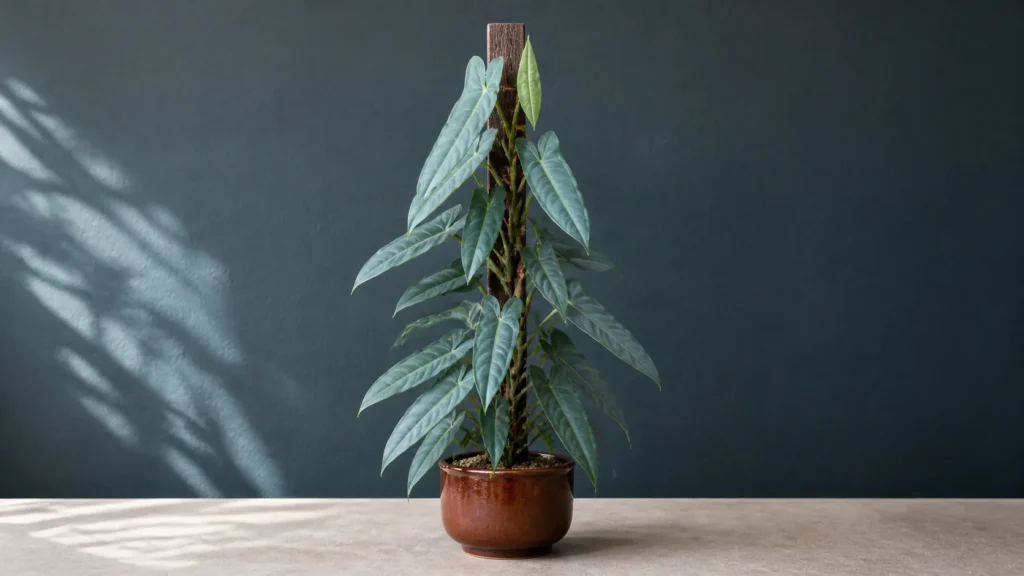
Silver Sword Philodendron
Philodendron hastatum
A fast-climbing Brazilian philodendron with blue-green to metallic silver, arrow-shaped leaves that lengthen and broaden as the vine matures on support.
Watering frequency
Every 7-10 days
Ideal temperature
65-80°F / 18-27°C; minimum 59°F / 15°C
Humidity
40-70%
Care difficulty
Easy
Air purifying
No/Not Known
Growth rate
Fast
Plant size
4-8 ft / 1.2-2.4 m climbing indoors
Soil type
Airy, moisture-balanced aroid mix
Fertilizer need
Every 4-6 weeks, spring-early fall.
Care summary
- Light: Bright indirect light supports compact growth and metallic-looking foliage.
- Water: Let the upper 1-2 inches dry, then water thoroughly and drain.
- Soil: Use a chunky, airy aroid mix in a pot with drainage.
- Support: Train the vine upward on a moss pole, plank, or trellis.
- Humidity: Stable 40-70% humidity is suitable for most indoor plants.
- Safety: Not pet-safe; keep foliage and cuttings away from pets and children.
Common problems
- Small rounded leaves and long internodes: insufficient light or lack of vertical support.
- Dull green foliage: juvenile growth, weak light, dust, or normal variation rather than a guaranteed loss of identity.
- Yellow leaves while mix stays wet: overwatering, dense soil, cold roots, or root damage.
- Brown tips and margins: severe drying, fertilizer salts, low humidity, or injured roots.
- Leaning or falling vine: aerial roots have not attached to a stable support.
- Spider mites, thrips, scale, or mealybugs: inspect leaf backs, new growth, and petiole joints.
Plant care guide
About Silver Sword Philodendron
Silver Sword Philodendron is the consumer-friendly name for Philodendron hastatum, a climbing Brazilian species valued for blue-green to metallic silver foliage. Young plants often carry compact oval or arrowlike leaves; with bright filtered light and a vertical support, later leaves lengthen into a more pronounced spear or sword shape.
The silver effect is structural leaf color, not white sectoral variegation. A healthy blade contains chlorophyll across its surface and can look blue, gray, green, or bright silver depending on age, viewing angle, and illumination. This makes Silver Sword more vigorous and predictable than many highly variegated collector philodendrons.
Kew's Plants of the World Online accepts Philodendron hastatum as a species native to southeastern Brazil and records it as a climbing plant of the wet tropical biome. The Royal Horticultural Society also uses Silver Sword Philodendron as its common name, making that the clearest title for a general houseplant audience.
Why You'll Like It
Silver Sword gives a room pale, cool-toned foliage without the growth penalty associated with large white sectors. An established vine can grow quickly in the warm season, and its leaf silhouette changes visibly as it climbs. The color works especially well against dark walls, terracotta, or green-leaved plant collections.
It is also relatively straightforward for a collector species. The plant wants the usual philodendron fundamentals—filtered light, an aerated root zone, warmth, and something vertical to climb. Its main frustration comes when it is left trailing: unsupported stems often produce smaller, rounder leaves and wider gaps between nodes.
Botanical Identity and History
The species name hastatum refers to a spear-shaped or halberd-like form, describing the increasingly elongated mature blade. German botanist Karl Koch published the accepted name in 1855. Botanical descriptions record variation in leaf proportions, which helps explain why juvenile and mature plants can look surprisingly different.
Silver Sword is a true species, not a named hybrid and not merely a color form of another common philodendron. It is hemiepiphytic in habit: a vine capable of rooting and climbing through humid forest structure. Indoors, a moss pole or plank substitutes for a tree trunk and gives aerial roots a stable upward route.
Trade identification can still be messy. Very young silver philodendrons may be confused with other glaucous species or hybrids. Confirm the accepted name, observe several leaves, and look for a consistent climbing stem and increasingly hastate foliage rather than trusting a single juvenile cutting.
Silver Sword Growth Stages
Juvenile foliage is often narrower, simpler, and less dramatically lobed than online photographs of mature plants. Tissue may appear greener immediately after unfurling before hardening to a more metallic tone.
Transition foliage begins to lengthen as the plant receives stronger filtered light and climbs. The basal lobes become more apparent, and aerial roots seek the support.
Mature foliage is longer, more spear-shaped, and visually substantial. Indoor leaves seldom match the largest habitat specimens, but reliable support and uninterrupted care can produce a clear progression. Cutting the vine resets the new shoot toward a smaller growth stage until it establishes again.
Related Philodendrons
- Philodendron 'Florida Beauty': A lobed, variegated climber with cream-to-yellow chimeric sectors; slower and less predictable than Silver Sword.
- Philodendron 'Malay Gold': An upright-climbing hybrid with chartreuse foliage rather than metallic blue-silver leaves.
- Philodendron billietiae: A climbing species with long leaves and conspicuous orange petioles.
- Philodendron domesticum: Sometimes encountered in comparisons because of elongated leaves, but normally greener and different in mature shape and texture.
- Cebu Blue Pothos: A different genus, Epipremnum, often sold for blue-green leaves; it is not a philodendron despite a superficially similar color palette.
Choosing a Healthy Silver Sword
Choose a plant with a firm stem, an intact growing point, and roots appropriate to its pot. A juvenile does not need long sword-shaped leaves to be genuine, but multiple leaves should show a coherent blue-green or silvery character rather than random bleached injury. Check leaf backs and unfurling growth for thrips, and inspect petiole joints for scale or mealybugs.
Do not pay a premium for ordinary glare described as rare variegation. Silver Sword's normal metallic color can look dramatically pale under flash photography, while sun scorch appears as damaged tan tissue. Likewise, a green juvenile is not automatically mislabeled; leaf color and shape become more characteristic with maturity, filtered light, and vertical growth.
If possible, buy a rooted plant rather than a single fresh node. Confirm that the node is present—a detached leaf cannot regenerate a vine—and ask whether the cutting was taken from mature climbing growth. A mature top cutting may size up sooner, but it still needs time to rebuild roots.
Where It Works Best
Use a bright position near an east window or back from stronger south- or west-facing glass. The metallic surface can reflect light, but that does not mean the leaf tolerates harsh sun. Filter intense rays with a sheer curtain and introduce any direct morning exposure gradually.
Give the vine height. A narrow moss pole, cork slab, coir pole, wooden plank, or trellis can work. Position the support when the plant is young, with the aerial-root side of the stem facing it. A hanging basket keeps the plant alive but usually sacrifices the largest sword-shaped foliage.
Silver Sword Philodendron Care
Light
Provide bright indirect light for compact, mature growth. Medium light is tolerated, but the spaces between leaves may lengthen and the blades may remain smaller. Pale foliage is not an excuse for full afternoon sun; scorch appears as bleached tan patches that do not recover.
Under a grow light, follow the maker's intensity and distance guidance and increase exposure over several days. Rotate only enough for balanced access without repeatedly pulling the aerial-root side away from its support.
Watering
Water when the top 1–2 inches (2–5 cm) are dry and the pot feels lighter. Saturate the entire root ball and let excess water drain. Every 7–10 days is a practical warm-season starting point, but root density, pot material, airflow, light, and season decide the actual interval.
Silver Sword does not want to remain swampy or become completely desiccated for long. Yellow leaves and wilt in wet mix suggest oxygen-starved roots; crisp margins and limp foliage in a very light pot suggest delayed watering. Check the substrate before responding to either symptom.
Soil and Pot
Use a chunky, moisture-balanced aroid mix—potting mix or coco coir combined with fine bark and perlite or pumice. It should drain promptly while retaining a small moisture reserve. A pot with unobstructed drainage is mandatory.
Choose a container only slightly larger than the root system and install the climbing support firmly. If the pole goes inside the pot, position it at repotting rather than stabbing blindly through established roots later.
Humidity
Stable 40–70% relative humidity is suitable. Silver Sword can adapt to normal household humidity, but warmer air and moderate humidity help emerging leaves open cleanly. Brown edges should trigger checks of root moisture, salts, and heat as well as humidity. Use a humidifier rather than relying on misting.
Temperature
Maintain 65–80°F (18–27°C) and keep the plant above a hard indoor minimum of 59°F (15°C). Cold drafts and wet winter mix are a poor combination. Keep foliage away from cold glass and from the drying blast of heaters or air conditioners.
Fertilizer
Feed every four to six weeks from spring through early fall during active growth. Use a balanced houseplant fertilizer at a conservative label rate on moist soil. Pause during winter slowdown or after root stress. If white crust builds on the mix or pot, flush with clean water and reduce the concentration.
Training and Pruning
Fasten the main stem loosely to the support with soft ties, leaving petioles free to turn toward light. Guide aerial roots against damp moss or toward the potting mix, but do not keep the whole stem continuously wet. Remove yellow leaves at the base and trim an overlong vine just above a healthy node.
Pruning produces a new growth point but temporarily reduces leaf size. If mature foliage is the goal, continuous climbing is more effective than frequent chopping.
Seasonal Care Rhythm
During late spring and summer, inspect ties and aerial roots every two weeks because a fast vine can outgrow its support quickly. Water by the dryness test and feed every four to six weeks while leaves are actively forming. Autumn is the time to reduce fertilizer as growth slows. In winter, maintain the 59°F (15°C) minimum, maximize available filtered light, and allow a longer drying interval when necessary. Do not keep the pot wet simply because the summer schedule said it was watering day.
In early spring, review the pole, pot stability, and root density together. Repot or extend the support before rapid growth begins; this prevents emergency work around soft new leaves later in the season.
Propagation
Take stem cuttings in late spring or early summer. Each cutting must contain at least one node; a leaf and petiole alone cannot produce a new vine. A top cutting with two or three leaves and an aerial root usually transitions faster than an old bare node.
Root in water, damp sphagnum, perlite, or a very airy aroid medium under bright indirect light at 70–80°F (21–27°C). Keep the node moist but not submerged in stagnant organic mix. Roots or bud movement often begin within three to six weeks, although cooler conditions can extend the process.
Move a water-rooted cutting to a small pot after it has several branching roots. Keep the mix lightly moist for the first two weeks, then transition to the normal dryness check. Attach the new vine to support early so it can begin sizing up again.
Repotting
Inspect roots every spring and repot every 12–24 months, or earlier if the plant dries unusually fast, roots circle densely, or the support has become unstable. Increase one practical pot size, replace compressed mix, and keep the stem base at its previous level.
Secure the pole before filling around the roots. Water thoroughly after repotting and allow drainage. Resume fertilizer after about four weeks, once new root or leaf activity shows that the plant has settled.
Toxicity and Pet Safety
Silver Sword Philodendron is not pet-safe. This status is based on genus-level evidence: the ASPCA lists Philodendron spp. as toxic to cats and dogs because their tissue contains insoluble calcium oxalates. Chewing may cause oral pain, swelling, drooling, vomiting, and difficulty swallowing.
Keep the vine, fallen leaves, and propagation cuttings out of reach. If ingestion is suspected, contact a veterinarian or poison-control professional. Breathing or swallowing difficulty requires urgent care.
Common Problems
- Leaves stay small and rounded: Increase usable indirect light and let the vine climb continuously.
- Long bare spaces on the stem: Improve light, check roots, and secure the growing tip to its support.
- Color looks dull: Clean dust gently and assess leaf age and illumination; natural color shifts with angle and maturity.
- Yellow leaves in wet mix: Allow more drying, improve aeration, and inspect roots if wilt continues.
- Brown tips: Check severe drought, fertilizer concentration, mineral buildup, humidity swings, and root damage.
- Pole becomes unstable: Repot and anchor it rather than tightening ties around the vine.
- Thrips, mites, scale, or mealybugs: Inspect leaf backs, cataphylls, nodes, and petiole joints; isolate and treat with a product labeled for indoor plants.
Frequently Asked Questions
Is Silver Sword the same as Philodendron hastatum?
Yes. Silver Sword Philodendron is the established common name used here for the accepted species Philodendron hastatum.
Why is my Silver Sword green instead of silver?
New leaf age, weak light, dust, viewing angle, and natural individual variation can affect the appearance. Improve bright filtered light gradually; do not use harsh sun to bleach the plant.
Does Silver Sword need a moss pole?
It needs a stable vertical support to produce its best mature form. The support can be a moss pole, plank, cork slab, or trellis.
How fast does it grow?
An established vine often grows quickly during warm, bright months. Growth slows after propagation, in winter, under low light, or when roots remain cold and wet.
Is Silver Sword Philodendron pet-safe?
No. It is classified as not pet-safe using established genus-level Philodendron toxicity guidance.
Final Thought
Silver Sword Philodendron delivers metallic-looking foliage without unstable white variegation. Give the vine a firm upward path, bright filtered light, warm temperatures, and an airy root zone that dries slightly between waterings. Continuous climbing turns modest juvenile leaves into the long spear-shaped foliage behind its memorable common name.